
Table 1
Patients baseline characteristics
| Patients baseline characteristics | Number (%) |
|---|---|
| Gender | |
| female | 233 (36.6) |
| male | 404 (63.4) |
| WHO clasiffication: | |
| 0 | 241 (37.8) |
| 1 | 300 (47.1) |
| 2 | 72 (11.3) |
| Tumor location: | |
| colon | 387 (60.8) |
| rectum | 250 (39.2) |
| Clinical signs of the primary colorectal cancer present before pathological confirmation | 178 (20.9) |
| Primary metastatic | 361 (56.7) |
| Liver metastases | 218 (34.3) |
Table 2
Disease characteristics
| Disease characteristics | Number (%) |
|---|---|
| pT4 of primary tumor | 186 (29.2) |
| Affected regional lymph nodes (N): | |
| N0 (no affected regional lymph nodes) | 110 (17.3) |
| N1 (1 to 3 affected regional lymph nodes) | 209 (32.8) |
| N2 (more than 3 affected regional lymph nodes) | 239 (37.5) |
| Missing data* | 62 (11.3) |
| Vascular invasion | 114 (17.9) |
| Perineural invasion | 95 (27.9) |
| Lymphangiosis | 115 (18.1) |
| Grade of differentiation: | |
| G1 (well) | 19 (3) |
| G2 (medium) | 162 (25.4) |
| G3 (poorly) | 53 (8.3) |
| G4 (no differentiated) | 1 (0.2) |
| Missing data* | 402 (63.2) |
| Resection of primary tumour | |
| R0 | 63 (9.9) |
| R1 | 10 (1.6) |
| R2 | 16 (2.5) |
Table 3
The most frequent metastatic sites
| The most frequent metastatic sites | Number (%) |
|---|---|
| Total | 637 (100) |
| Liver | 218 (34.3) |
| Lungs | 70 (11.0) |
| Lymph nodes | 34 (5.3) |
| Peritoneum | 115 (18.1) |
| Bones | 4 (0.6) |
| Other* | 18 (2.8) |
| Multiple locations | 261 (41.0) |
Table 4
Treatment regimen decision for the first line treatment of the metastatic colorectal cancer (mCRC)
| Systemic therapy options | Number (%) |
|---|---|
| Fluoropirimidines/Irinotecan/Cetuximab* | 73 (11.4) |
| Fluoropirimidines/Oxaliplatin/Cetuximab* | 49 (7.7) |
| Fluoropirimidines/Irinotecan/Panitumumab* | 17 (2.7) |
| Fluoropirimidines/Oxaliplatin/Panitumumab* | 12 (1.9) |
| EGFR inhibitors other** | 46 (7.2) |
| Fluoropirimidines/Irinotecan/Bevacizumab | 126 (19.8) |
| Fluoropirimidines/Oxaliplatin/Bevacizumab | 191 (30.0) |
| VEGF inhibitor other*** | 21 (3.3) |
| Chemotherapy only | 102 (16.0) |
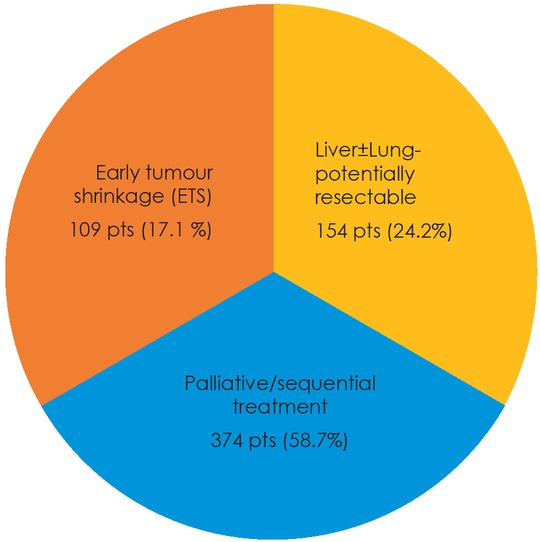
Figure 1
Treatment goal options at presentation of the metastatic colorectal cancer (mCRC) patients.
Table 5
The RAS/KRAS and BRAF status distribution
| The RAS/KRAS and BRAF status distribution | Number (%) |
|---|---|
| KRAS testing | 637 (100) |
| KRAS mutated | 311 (48.8) |
| KRAS wild type | 305 (47.9) |
| Not possible | 21 (3.3) |
| NRAS testing | 637 (100) |
| NRAS mutated | 57 (9.0) |
| NRAS wild type | 567 (89.0) |
| Not possible | 13 (2.0) |
| BRAF testing | 637 (100) |
| BRAF mutated | 84 (13.2) |
| BRAF wild type | 548 (86.1) |
| Not possible | 5 (0.7) |