
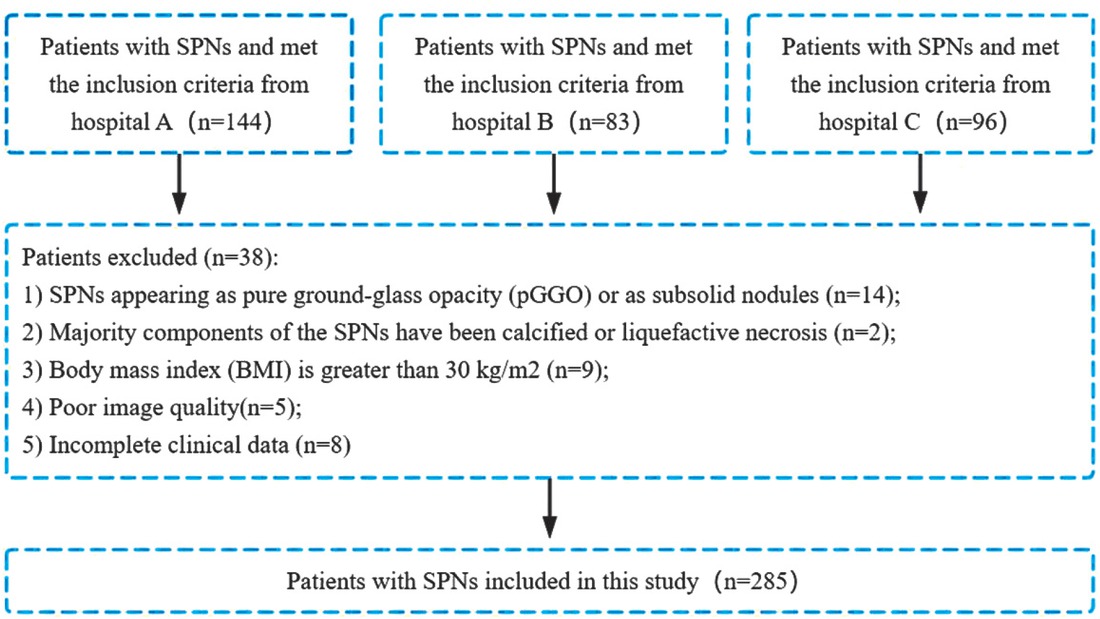
Figure 1
Flow chart of patient selection.
SPNs = solitary pulmonary nodules
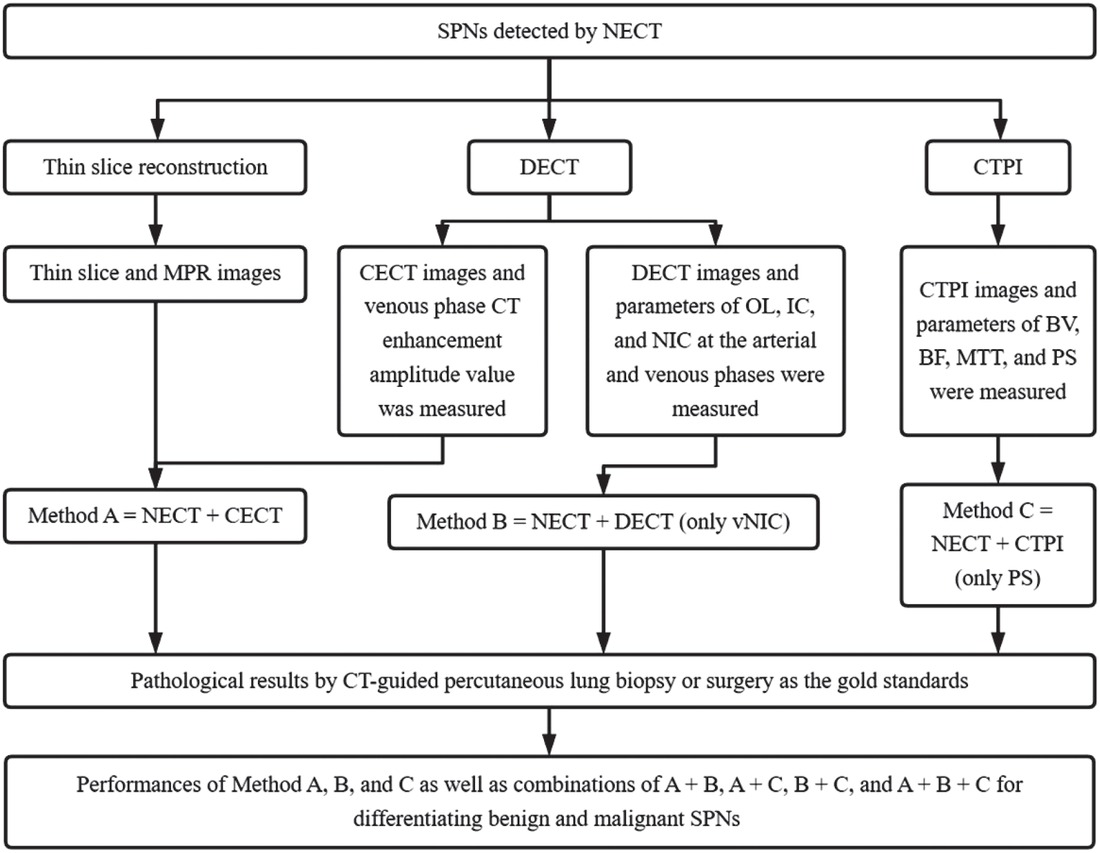
Figure 2
Technology roadmap of multimodality computed tomography (CT) imaging for evaluating solitary pulmonary nodules (SPNs).
BF = blood flow; BV = blood volume; CECT = contrast enhanced CT; CTPI = CT perfusion imaging; DECT = dual-energy CT; IC = iodine concentration; MPR = multiplanar reconstruction; NECT = non-contrast enhanced CT; MTT = mean transit time; NIC = normalized iodine concentration; OL = iodine overlay; PS = permeability surface
Table 1
Patient characteristics in 285 patients with solitary pulmonary nodules
| Benign SPNs (n = 118) | Malignant SPNs (n = 167) | ||
|---|---|---|---|
| Gender* | |||
| Male | 56 (47.46%) | 96 (57.49%) | |
| Female | 62 (52.54%) | 71 (42.51%) | 0.1170 |
| Age (years)# | 50.84 ± 19.60 | 52.93 ± 20.30 | 0.3952 |
| Smoking status* | |||
| Yes | 52 (44.07%) | 81 (48.50%) | |
| No | 66 (55.93%) | 86 (51.50%) | 0.4721 |
| Tumor history* | |||
| Yes | 17 (14.41%) | 28 (16.77%) | |
| No | 101 (85.59%) | 139 (83.23%) | 0.6245 |
| Tumor biomarkers* | |||
| Normal | 103 (87.29%) | 139 (83.23%) | 0.4026 |
| Abnormal | 15 (12.71%) | 28 (16.77%) |
[i] SPNs = solitary pulmonary nodules; *compared with the Fisher’s exact test; #compared with the two independent samples t-test
Table 2
Pathological results of the 285 solitary pulmonary nodules (SPNs) included in this study
| SPNs | Pathology | Datum (%) |
|---|---|---|
| Benign SPNs (n = 118) | ||
| Tuberculosis | 46 (29.0%) | |
| Acute and chronic inflammation | 32 (27.1%) | |
| Inflammatory pseudotumor | 14 (11.9%) | |
| Hamartoma | 9 (7.6%) | |
| Pulmonary sclerosing hemangioma | 6 (5.1%) | |
| Sequestration | 4 (3.4%) | |
| Bronchogenic cyst | 3 (2.5%) | |
| Rheumatoid arthritis | 2 (1.7%) | |
| Granulomatosis with polyangiitis | 2 (1.7%) | |
| Malignant SPNs (n = 167) | ||
| Primary pulmonary carcinoma | 116 (69.5%) | |
| Solitary metastasis | 23 (13.8%) | |
| Primary lung neuroendocrine tumor | 21 (12.6%) | |
| Primary pulmonary lymphoma | 7 (4.2%) |
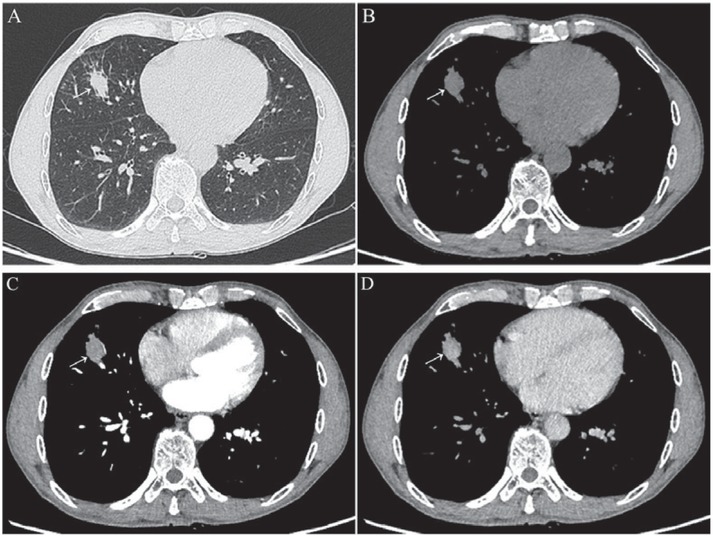
Figure 3
A solitary pulmonary nodule (SPN) with the size of 17.0 × 19.0 mm located in the middle lobe of right lung of a 59 years old male. Non-contrast enhanced CT (NECT), both upper (A) and (B) images, showed that there was sign of smooth margin, but without signs of lobulation, spiculation, vacuole, cavitation, air bronchogram, calcification, fat, pleural indentation, vessel convergence, or adjacent bronchial changes. Contrast enhanced CT (CECT) showed that there were mild and obvious enhancements in the arterial (C) and venous (D) phases, respectively. The patient was scanned with a CT-guided percutaneous lung biopsy procedure, and the pathological result showed chronic inflammatory disease. This SPN disappeared after a week of antibiotic therapy.
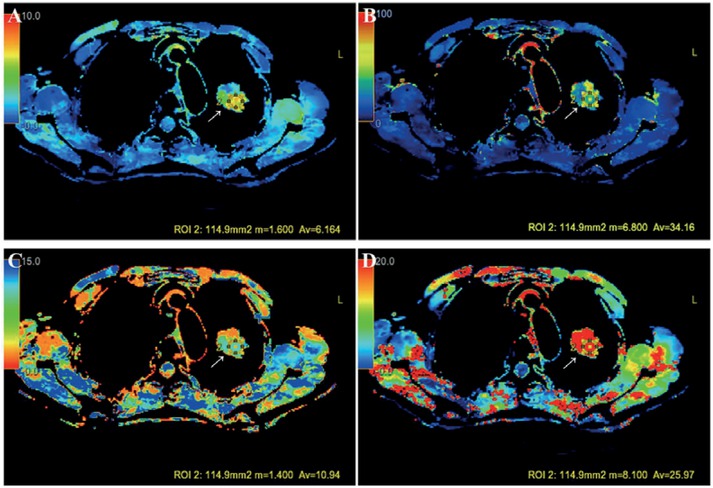
Figure 4
A solitary pulmonary nodule (SPN) with the size of 25.0 × 27.0 mm located in the superior lobe of left lung of a 61 years old female evaluated by CT perfusion imaging (CTPI). Blood volume (BV) (A), blood flow (BF) (B), mean transit time (MTT) (C), and permeability surface (PS) (D) for the SPN were 6.16 ml/100 g, 34.16 ml/100 g/min, 10.94 s, and 25.97 ml/100 g/min, respectively. Pathology of the SPN after the surgery confirmed the diagnosis of an adenocarcinoma.
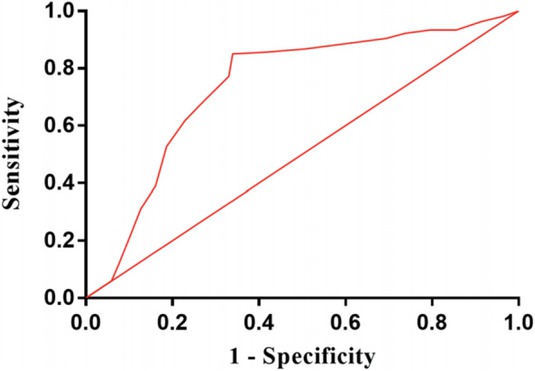
Figure 5
Receiver operating characteristic curve for distinguishing benign from malignant nodules using CT perfusion imaging parameter of permeability surface (PS).
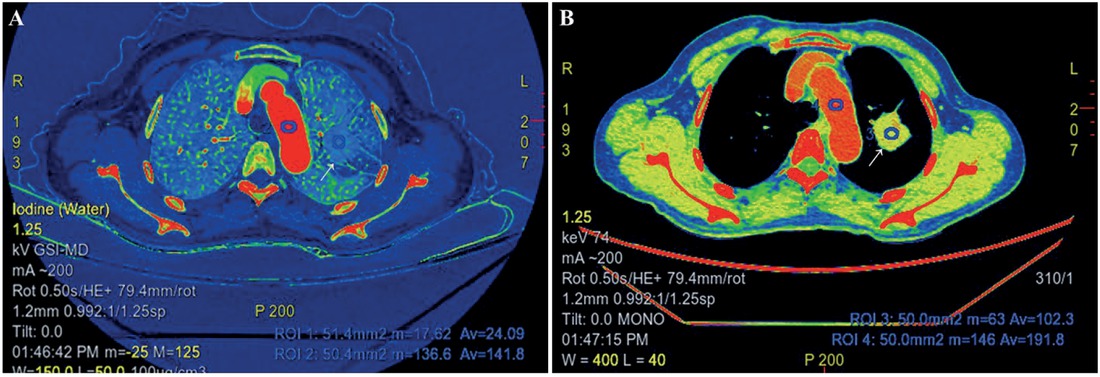
Figure 6
A solitary pulmonary nodule (SPN) with the size of 24.0 × 26.0 mm located in the superior lobe of left lung of a 57 years old female evaluated by arterial (A) and venous phases (B) of dual-energy CT (DECT). Iodine concentration at the arterial phase (aIC), Iodine concentration at the venous phase (vIC), normalized iodine concentration at the arterial phase (aNIC), and normalized iodine concentration at the venous phase (vNIC) were 2.409 mg/mL, 10.23 mg/mL, 0.17 (2.409/14.18), 0.53 (10.23/19.18) respectively. Pathology of the SPN after the surgery confirmed the diagnosis of an adenocarcinoma.
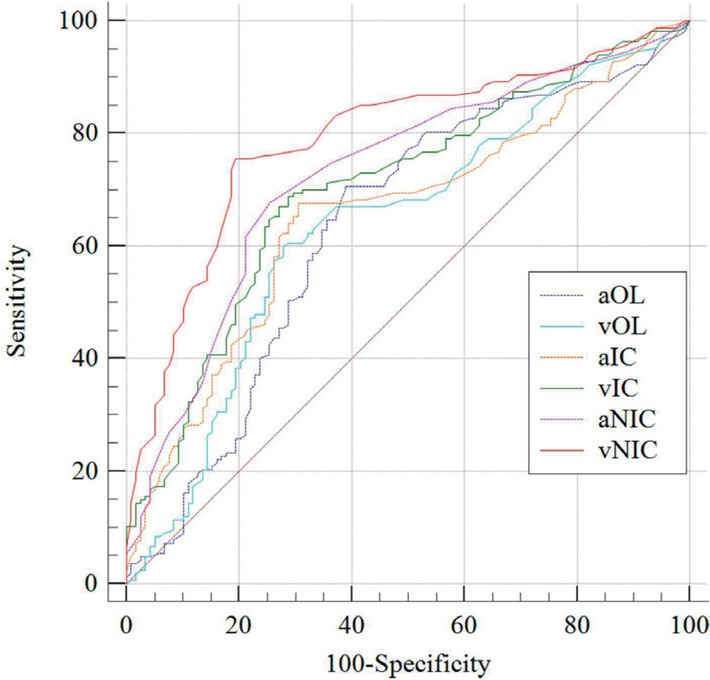
Figure 7
Receiver operating characteristic curves for distinguishing benign from malignant nodules using dual-energy CT parameters.
aOL = Iodine overlay at the arterial phase (AUC = 0.636); vOL = Iodine overlay at the venous phase (AUC = 0.638); aIC = Iodine concentration at the arterial phase (AUC = 0.657); vIC = Iodine concentration at the venous phase (area under the curve [AUC] = 0.703); aNIC = normalized iodine concentration at the arterial phase (AUC = 0.728); vNIC = normalized iodine concentration at the venous phase (AUC = 0.790); all p values < 0.05
Table 3
Solitary pulmonary nodules evaluated with non-contrast enhanced CT
| CT findings* | Benign SPNs (n = 118) | Malignant SPNs (n = 167) | P Values |
|---|---|---|---|
| Smooth margin | |||
| Yes | 84 (71.19%) | 49 (29.34%) | < 0.0001 |
| No | 34 (28.81%) | 118 (70.66%) | |
| Lobulated sign | |||
| Yes | 29 (24.58%) | 115 (68.86%) | |
| No | 89 (75.42%) | 52 (31.14%) | < 0.0001 |
| Spiculated sign | |||
| Yes | 25 (21.19%) | 108 (78.81%) | |
| No | 93 (64.67%) | 59 (35.33%) | < 0.0001 |
| Vacuole sign | |||
| Yes | 13 (11.02%) | 38 (22.75%) | 0.0120 |
| No | 105 (88.98%) | 129 (77.25%) | |
| Cavity sign | |||
| Yes | 9 (7.63%) | 16 (9.58%) | |
| No | 109 (92.37%) | 151 (90.42%) | 0.6727 |
| Air bronchogram | |||
| Yes | 33 (27.97%) | 56 (33.53%) | 0.3643 |
| No | 85 (72.03%) | 111 (66.47%) | |
| Calcification | |||
| Yes | 10 (8.47%) | 6 (3.59%) | |
| No | 108 (91.53%) | 161 (96.41%) | 0.1149 |
| Fat | |||
| Yes | 6 (5.08%) | 4 (2.40%) | 0.3277 |
| No | 112 (94.92%) | 163 (97.60%) | |
| Pleural indentation | |||
| Yes | 25 (21.19%) | 89 (53.29%) | < 0.0001 |
| No | 93 (78.81%) | 78 (46.71%) | |
| Vessel convergence | |||
| Yes | 33 (27.97%) | 84 (50.30%) | 0.0002 |
| No | 85 (72.03%) | 83 (49.70%) | |
| Adjacent bronchial changes | |||
| Yes | 26 (22.03%) | 43 (25.75%) | 0.4867 |
| No | 92 (77.97%) | 124 (74.25%) | |
| Location | |||
| Upper and middle lobes | 53 (44.92%) | 79 (47.31%) | 0.7186 |
| Inferior lobe | 65 (55.08%) | 88 (52.69%) | |
| Size (mm) | |||
| 15–20 | 29 (24.58%) | 46 (27.54%) | 0.5883 |
| 20–30 | 89 (75.42%) | 121 (72.46%) |
[i] SPNs = solitary pulmonary nodules; *compared with the Fisher’s exact test
Table 4
Non-enhanced computed tomography (NECT) in evaluating solitary pulmonary nodules (SPNs) with various categories in 285 patients
| Items | Category I | Category II | Category III | Category IV | Category V |
|---|---|---|---|---|---|
| Benign SPNs (n = 118) | 39 | 9 | 48 | 22 | 0 |
| Malignant SPNs (n = 167) | 0 | 5 | 54 | 19 | 89 |
[i] Category I = most likely benign; Category II = possibly benign; Category III = uncertain benign or malignant; Category IV = possibly malignant; Category IV = most likely malignant
Table 5
Solitary pulmonary nodules evaluated with CT perfusion imaging
| Parameters* | Benign SPNs (n = 118) | Malignant SPNs (n = 167) | P values |
|---|---|---|---|
| BF (ml/100 g/min) | 49.34 (27.78, 72.81) | 58.44 (24.91, 80.47) | 0.1022 |
| BV (ml/100 g) | 4.79 (2.87, 7.66) | 4.84 (2.90, 7.74) | 0.1829 |
| MTT (s) | 6.71 (3.05, 9.58) | 7.66 (3.83, 10.54) | 0.2034 |
| PS (ml/100 g/min) | 8.89 (4.94, 12.45) | 14.37 (11.50, 16.29) | < 0.0001 |
[i] BF = blood flow; BV = blood volume; CT = computed tomography; MTT = mean transit time; PS = permeability surface; SPNs = solitary pulmonary nodules; *compared with the Mann Whitney rank sum test
Table 6
Solitary pulmonary nodules (SPNs) evaluated with dual-energy CT
| Parameters* | Benign SPNs (n = 118) | Malignant SPNs (n = 167) | P Values |
|---|---|---|---|
| aOL (HU) | 13.24 (10.97, 21.58) | 19.58 (13.29, 26.07) | < 0.0001 |
| vOL (HU) | 11.09 (10.09, 14.86) | 14.99 (10.59, 23.98) | < 0.0001 |
| aIC (mg/ml) | 0.69 (0.47, 0.985) | 1.13 (0.70, 1.56) | < 0.0001 |
| vIC (mg/ml) | 0.55 (0.44, 1.00) | 0.97 (0.50, 1.46) | < 0.0001 |
| aNIC | 0.10 (0.06, 0.13) | 0.18 (0.11, 0.25) | < 0.0001 |
| vNIC | 0.23 (0.13, 0.32) | 0.54 (0.43, 0.65) | < 0.0001 |
[i] aIC = Iodine concentration at the arterial phase; aNIC = normalized iodine concentration at the arterial phase; aOL = Iodine overlay at the arterial phase; CT = computed tomography; HU = Hounsfield unit; SPNs = solitary pulmonary nodules; vIC = Iodine concentration at the venous phase; vNIC = normalized iodine concentration at the venous phase; vOL = Iodine overlay at the venous phase; *compared with the Mann Whitney rank sum test
Table 7
Solitary pulmonary nodules evaluated with dual-energy CT
| Parameters | AUC | Threshold | Sensitivity | Specificity | 95% CI | P values |
|---|---|---|---|---|---|---|
| aOL (HU) | 0.636 | 13.89 | 70.66 | 61.02 | 0.577–0.692 | < 0.001 |
| vOL (HU) | 0.638 | 12.79 | 59.88 | 72.03 | 0.580–0.694 | < 0.001 |
| aIC (mg/ml) | 0.657 | 0.65 | 67.66 | 69.49 | 0.599–0.712 | < 0.001 |
| vIC (mg/ml) | 0.703 | 0.85 | 68.86 | 71.19 | 0.646–0.755 | < 0.001 |
| aNIC | 0.728 | 0.12 | 67.66 | 74.58 | 0.672–0.778 | < 0.001 |
| vNIC | 0.790 | 0.35 | 75.45 | 80.51 | 0.738–0.836 | 0.0001 |
[i] aIC = Iodine concentration at the arterial phase; aNIC = normalized iodine concentration at the arterial phase; aOL = Iodine overlay at the arterial phase; AUC = area under the curve; CT = computed tomography; HU = Hounsfield unit; vIC = Iodine concentration at the venous phase; vOL = Iodine overlay at the venous phase; vNIC = normalized iodine concentration at the venous phase
95 % CI = 95 % confidence interval
Table 8
Pairwise comparison of AUC of dual energy CT parameters in 285 patients with solitary pulmonary nodules
| Parameters* | Z statistic | P value |
|---|---|---|
| aOL vs vOL | 0.0995 | 0.9207 |
| aOL vs aIC | 0.813 | 0.4162 |
| aOL vs vIC | 2.485 | 0.0129 |
| aOL vs aNIC | 3.171 | 0.0015 |
| aOL vs vNIC | 5.170 | < 0.0001 |
| vOL vs aIC | 0.702 | 0.4829 |
| vOL vs vIC | 2.567 | 0.0103 |
| vOL vs aNIC | 3.280 | 0.0010 |
| vOL vs vNIC | 5.345 | < 0.0001 |
| aIC vs vIC | 2.034 | 0.0420 |
| aIC vs aNIC | 2.755 | 0.0059 |
| aIC vs vNIC | 4.728 | < 0.0001 |
| vIC vs aNIC | 1.036 | 0.3001 |
| vIC vs vNIC | 3.227 | 0.0013 |
| aNIC vs vNIC | 2.708 | 0.0068 |
[i] aIC = Iodine concentration at the arterial phase; aOL = Iodine overlay at the arterial phase; aNIC = normalized iodine concentration at the arterial phase; AUC = area under the curve; CT = computed tomography; vIC = Iodine concentration at the venous phase; vNIC = normalized iodine concentration at the venous phase; vOL = Iodine overlay at the venous phase; *compared with the DeLong test
Table 9
Solitary pulmonary nodules evaluated with multimodality CT imaging
| Methods* | Sensitivity (%) | Specificity (%) | Accuracy (%) | PPV (%) | NPV (%) |
|---|---|---|---|---|---|
| Method A | 83.23 | 63.56 | 75.09 | 76.37 | 72.82 % |
| Method B | 85.63 | 67.80 | 78.25 | 79.01 | 76.92 % |
| Method C | 84.43 | 66.10 | 76.84 | 77.90 | 75.00 % |
| Method A+B | 94.61 | 74.58 | 86.32 | 84.04 | 90.72 % |
| Method A+C | 92.81 | 77.97 | 86.67 | 85.64 | 88.46 % |
| Method B+C | 95.81 | 81.36 | 89.82 | 87.91 | 93.20 % |
| Method A+B+C | 97.60 | 88.14 | 93.68 | 92.09 | 96.30 % |
[i] CT = computed tomography; Method A = non-contrast enhanced CT combined with contrast enhanced CT; Method B = non-contrast enhanced CT combined with dual energy CT; Method C = non-contrast enhanced CT combined with CT perfusion imaging; Method A + B = non-contrast enhanced CT combined with contrast enhanced CT and dual energy CT; Method A + C = non-contrast enhanced CT combined with contrast enhanced CT and CT perfusion imaging; Method B + C = non-contrast enhanced CT combined with dual energy CT and CT perfusion imaging; Method A + B + C = non-contrast enhanced CT combined with contrast enhanced CT, dual-energy CT, and CT perfusion imaging; NPV = Negative predictive value; PPV = Positive predictive value; *compared with the McNemar’s test
Table 10
| 1. Solid | ||
| Density | 2. Subsolid | |
| 3. Round or oval | ||
| Shape | 4. Triangular or polygonal | |
| 5. Smooth | ||
| Margins | 6. Lobulated | |
| 7. Spiculated | ||
| Non-contrast enhanced CT | 8. Fat | |
| Internal characteristics | 9. Calcification | |
| 10. Cavitation | ||
| 11. Pleural retraction | ||
| 12. Air bronchogram | ||
| Some complex findings | 13. Bubble like lucencies (pseudocavitation) | |
| 14. Cystic airspace | ||
| 15. Vascular convergence | ||
| Contrast enhanced CT | Parameter (s) | 16. Degree of enhancement |
| CT perfusion imaging | Parameter (s) | 17. Permeability surface |
| Dual-energy CT | Parameter (s) | 18. Normalized iodine concentration at the venous phase |