
Table
Morphological features useful for differentiation between neurofibromas and schwannomas5
| Peripheral nerve tumor (PNT) feature | Comment |
|---|---|
| Maximum to minimum diameter | Ratio > 3 → neurofibroma |
| Shape: round, oval, fusiform | Fusiform → neurofibroma |
| Contour: smooth, lobulated | Lobulated → neurofibroma |
| Encapsulation: absent, partial, complete | Complete → schwannoma |
| Echogenicity: hypo-, iso-, hyper- | Hypoechoic → PNT |
| Echo texture: homogenous, heterogenous | Heterogenous → schwannoma |
| Cystic changes: absent, focal, partial, | Cystic changes → |
| large | schwannoma |
| Calcifications: absent, present | Present → schwannoma |
| Target sign: absent, present | |
| Nerve entrance: not identified, identified | |
| Nerve-tumor position: central, eccentric | Central → neurofibroma |
| Nerve-tumor transition: clear, poorly defined, infiltrative | Infiltrative → neurofibroma |
| Vascularity: increased, normal, decreased | Hypovascular → neurofibroma |
Table
Demographic, anatomical, clinical, electrodiagnostic (EDx) and ultrasonographic (US) features of patients with peripheral nerve tumors (PNTs)
| # | Gender | Age | Side | Nerve | Location | Symptoms & Signs | CMAP amp. (mV) | SNAP amp. (μ V) | Tumor CSA (mm2) | Tumor diagnosis | Other |
|---|---|---|---|---|---|---|---|---|---|---|---|
| 1 | Male | 69 | R | Ulnar | Elbow | AWS | 43 | Neurofibroma | |||
| 2 | Male | 24 | L | #Radial | Upper arm | W | 0.2 | 4 | 24 | Schwannoma* | NF2 |
| 3 | Male | 66 | R | Median | Forearm | Æ | 6.9 | 5 | 49 | Schwannoma | |
| 4 | Male | 16 | L | #Median | Upper arm | WS | 61 | Neurofibroma | NF1 | ||
| 5 | Female | 26 | R | Ulnar | Forearm | AWS | 0.2 | 0 | 30 | Perineurioma | |
| 6 | Female | 18 | L | Sciatic | Thigh | AWS | 0.4 | 0 | 109 | Perineurioma | |
| 7 | Female | 18 | R | Fibular | Knee | AWS | 0 | 0 | 47 | Perineurioma | |
| 8 | Male | 47 | L | Ulnar | Elbow | M | 7.6 | 3 | 348 | Schwannoma* | |
| 9 | Female | 58 | R | Median | Forearm | P | 7.6 | 16 | 45 | Neurofibroma | |
| 10 | Female | 22 | R | Sciatic | Thigh | AWS | 0 | 0 | 97 | Perineurioma | |
| 11 | Female | 34 | R | Tibial | Ankle | PAWS | 10.6 | 7 | 1250 | Schwannoma* | |
| 12 | Male | 63 | L | Ulnar | Elbow | L | 8.2 | 5 | 368 | Schwannoma* | |
| 13 | Female | 52 | R | #Ulnar | Forearm | 6.2 | 12 | 212 | Neurofibroma | NF? | |
| 14 | Male | 24 | R | #Median | Upper arm | P | 6.3 | 33 | 26 | Neurofibroma* | NF1 |
| 15 | Female | 33 | L | Tibial | Ankle | L | 92 | Schwannoma |
[i] A = muscle atrophy; amp. = amplitude; CMAP = compound muscle action potential; CSA = cross sectional area; L = left; L = local sensitivity; M = palpable mass; NF1 = neurofibromatosis type 1; NF2 = neurofibromatosis type 2; P = pain; R = right; S = sensory loss; SNAP = sensory nerve action potential; W = weakness; # = patients had multiple tumors; * = histological diagnosis of PNT available
Table
Morphological features of peripheral nerve tumors (PNTs) found on ultrasonographic (US) examination5 of individual patients
| # | Ratio | Shape | Contour | Encapsulation | Echo texture | Nerve position | Nerve transition | Number | Tumor diagnosis |
|---|---|---|---|---|---|---|---|---|---|
| 1 | 5 | Fusiform | Lobulated | Partial | Heterogeneous | Central | Infiltrative | Single | Neurofibroma |
| 2 | ? | Lobulated | Partial | Heterogeneous | ? | ? | Several | Schwannoma* | |
| 3 | 6 | Fusiform | Smooth | Whole | Heterogeneous | Central | Poorly defined | Single | Schwannoma |
| 4 | 6 | Fusiform | Fusiform | None | Heterogeneous | Central | Infiltrative | Several | Neurofibroma |
| 5 | 8 | Fusiform | Lobulated | Partial | Heterogeneous | Central | Infiltrative | Single | Perineurioma |
| 6 | > 10 | Fusiform | Lobulated | Partial | Heterogeneous | ? | ? | Single | Perineurioma |
| 7 | 6 | Fusiform | Smooth | None | Homogenous | Central | Infiltrative | Single | Perineurioma |
| 8 | 3 | Oval | Smooth | Whole | Heterogeneous | Central | Poorly defined | Single | Schwannoma* |
| 9 | > 10 | Fusiform | Lobulated | Partial | Heterogeneous | Eccentric | Infiltrative | Single | Neurofibroma |
| 10 | 5 | Fusiform | Smooth | Whole | Heterogeneous | Central | Infiltrative | Several | Perineurioma |
| 11 | 1,5 | Oval | Smooth | Whole | Homogenous | Eccentric | ? | Single | Schwannoma* |
| 12 | 2,5 | Oval | Smooth | Whole | Heterogeneous | Central | Poorly defined | Single | Schwannoma* |
| 13 | 2,5 | Oval | Smooth | Whole | Heterogeneous | Central | Poorly defined | Several | Neurofibroma |
| 14 | 4 | Fusiform | Lobulated | Partial | Heterogeneous | Central | Infiltrative | Several | Neurofibroma* |
| 15 | 1,7 | Oval | Smooth | Whole | Heterogeneous | Eccentric | Poorly defined | Single | Schwannoma |
Figure
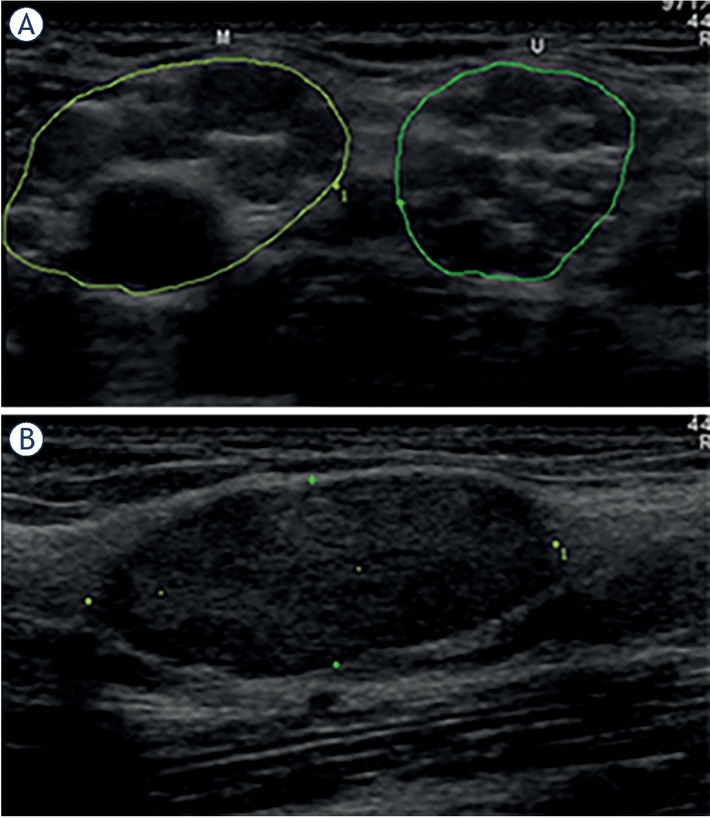
(A) Transverse ultrasonographic (US) view of the median (M) and ulnar (U) nerve in the axillary region showing numerous globular hypoechoic peripheral nerve tumours (PNTs) causing largely increased nerve cross sectional areas (CSAs, 148 mm2 and 101 mm2, respectively). (B) Longitudinal view of a single partially encapsulated, slightly lobulated and rather homogenous oval PNT (length 24 mm, thickness 9 mm) with central, but poorly defined nerve-tumour transition.5 Most probably these numerous PNTs are neurofibromas, although diagnosis in this 52-year-old woman presenting with peripheral neuropathy, primary lymphedema, and history of mitral and aortic valve surgery (patient #13, Tables 2–3), is not known yet.
Figure
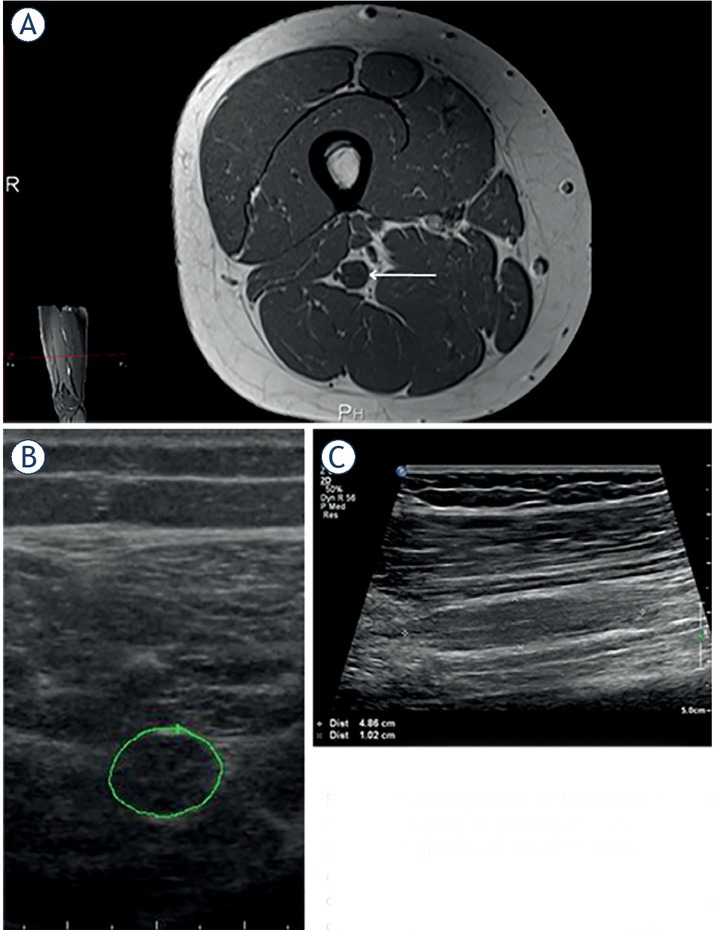
Comparison of transverse image of the sciatic peripheral nerve tumour (PNT) on (A) magnetic resonance (MR) T1 (arrow) and (B) ultrasonography (US). (C) Longitudinal US view of PNT in the middle thigh (A – small picture on the left), affecting the tibial portion of sciatic nerve. In this 22-year-old girl MR revealed at the exit of sciatic nerve from the pelvis another PNT affecting its fibular portion, and causing right foot drop of 14 years duration (patient #10, Tables 2–3). Based on clinical and imaging features in this patient diagnosis of probable perineurioma was made.
Figure
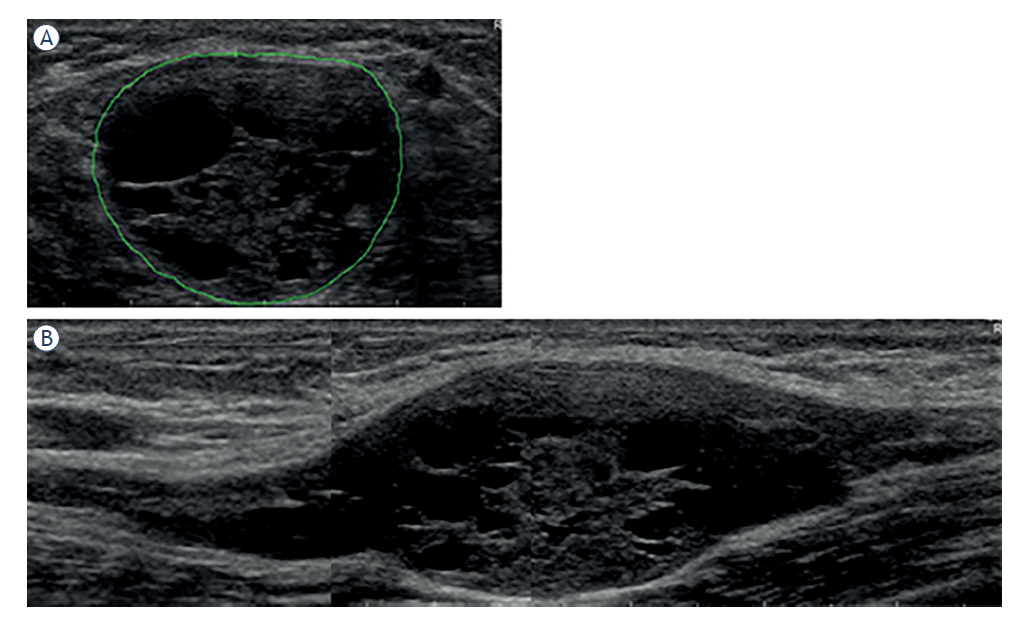
(A) Transverse and (B) longitudinal ultrasonographic (US) view of a large peripheral nerve tumour (PNT) on the left ulnar nerve just above the elbow. Three years before this 47-year-old man noted a palpable mass that in the last 6 months on touching started to elicit electrisation spreading into the last two fingers (patient #8, Tables 2–3). Well encapsulated, slightly lobulated, predominantly cystic and highly heterogenous hypoechoic oval lesion with central and poorly defined nerve-tumour transition can be seen. Histological examination confirmed a diagnosis of schwannoma.
Figure
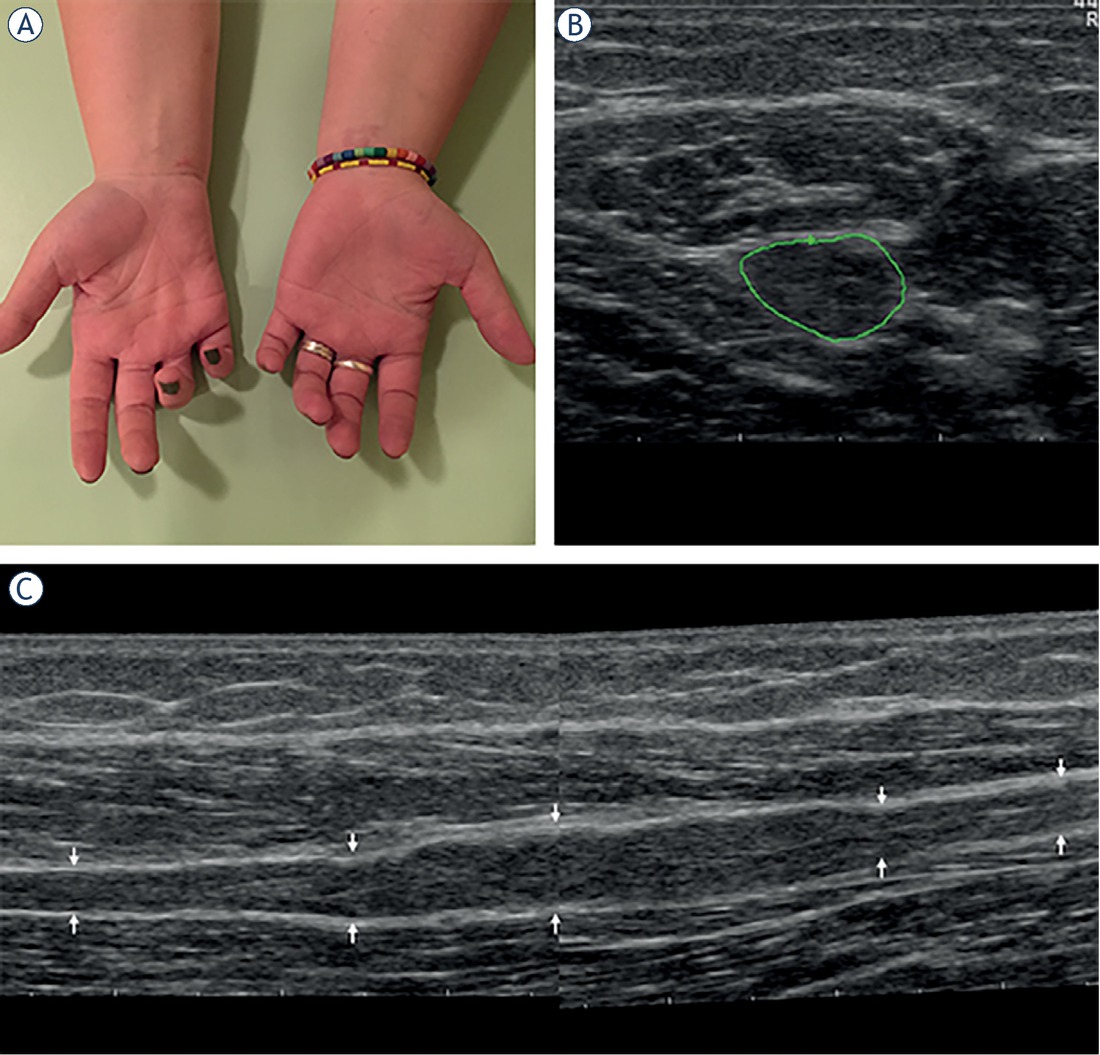
(A) Hands of a 26-year-old woman with 4-year history of muscle atrophy, weakness and numbness in the distal ulnar nerve territory (patient #5, Tables 2–3). Note intrinsic right palm muscle atrophy and clawing of the last two fingers. (B) On transverse ultrasonographic (US) view ulnar nerve cross sectional area (CSA) increased from 7 mm2 both proximally and distally to 20 mm2 in the middle of the lesion. (C) On longitudinal view a partially encapsulated, lobulated, fusiform hypoechoic right ulnar peripheral nerve tumour (PNT) of the forearm can be seen. Based on clinical and US features, we made a diagnosis of probable perineurioma.