
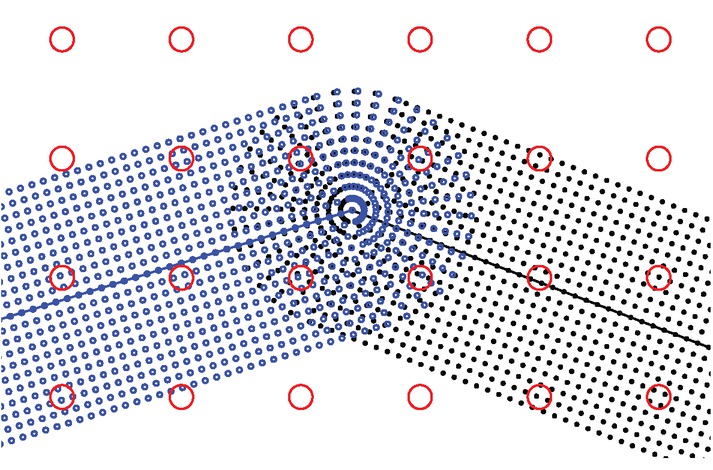
Figure 1
Points in 1m grid for two spans of a power line are shown with blue and black dots in which the program determined the values of the extremely low-frequency (ELF) magnetic fields (MF). Red circles represent the final 10 mgrid for which the final results were generated.
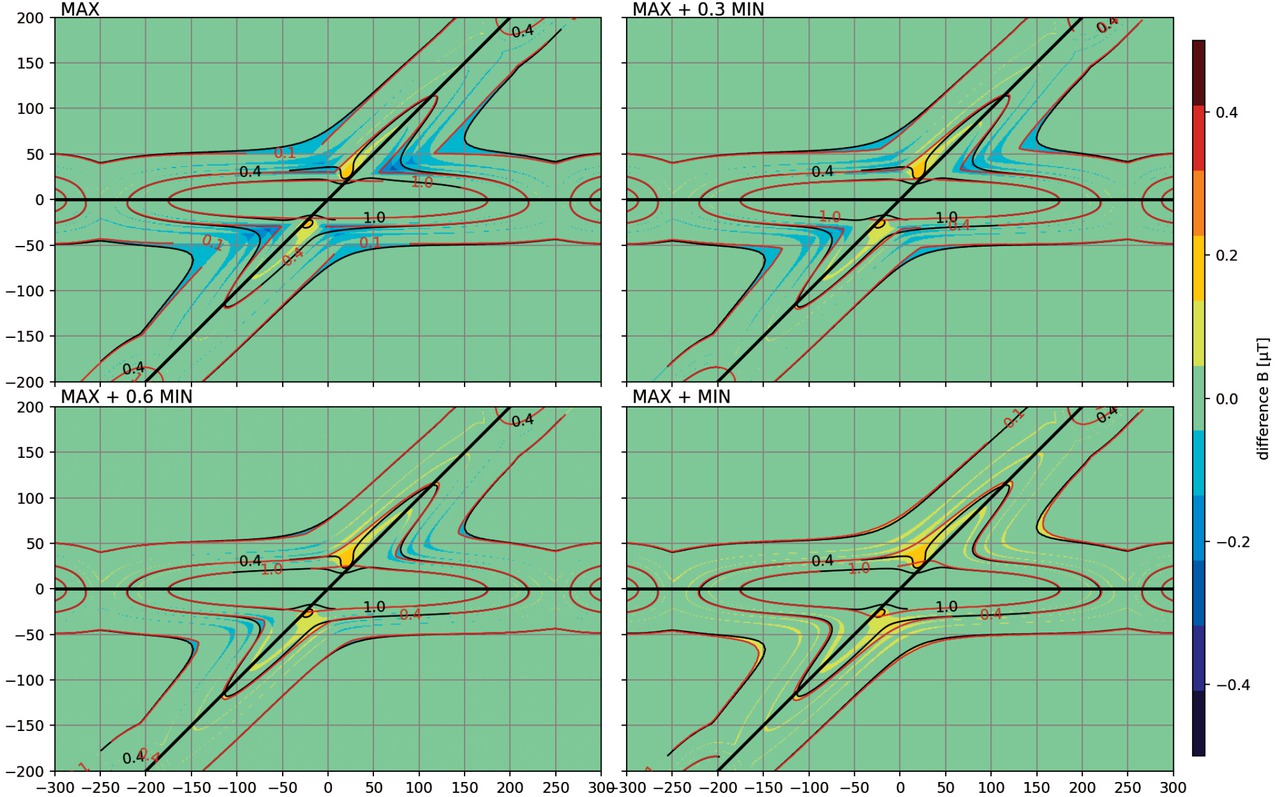
Figure 2
Comparison of results obtained by all four algorithms to determine total value of extremely low-frequency (ELF) magnetic fields (MF) for a case of crossing of two 2×110 kV power lines of type barrel under the nominal load of 650 A. The color scale shows the deviation of the estimated value of ELF MF values determined by all four new algorithms from the actual value of ELF MF determined by the usual numerical modeling procedure. The black contours represent the limits of 0.1, 0.4 and 1.0 μT for the actual values, and the red contours for the estimated values.
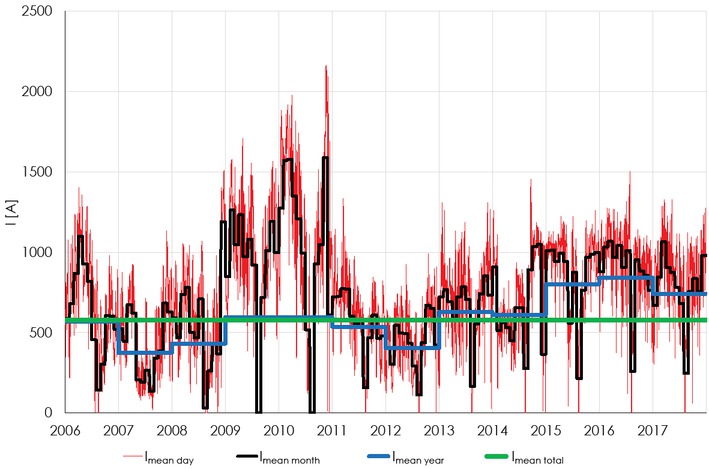
Figure 3
The daily, monthly, yearly and total (1. 1. 2006 – 31. 12. 2017) mean values of the load of a 400 kV power line with the highest mean values in Slovenia.
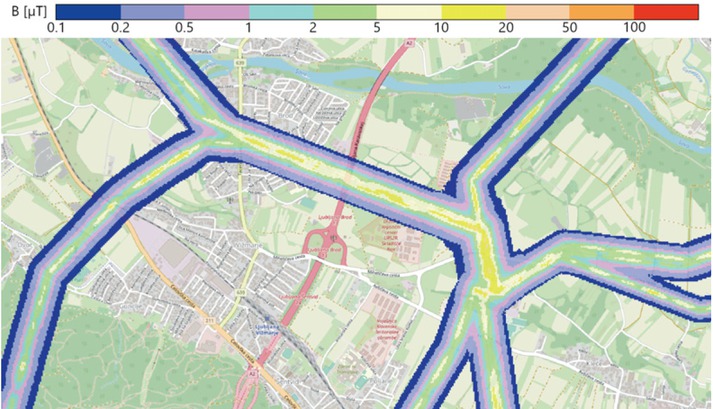
Figure 4
Example of the total value of the extremely low-frequency (ELF) magnetic fields (MF) of several high voltage power lines around distribution transformer stations for nominal load in the area of the capital city of Ljubljana (approximately 5 x 2.7 km).
Table 1
The distances from the 400 kV power line with the highest mean load, at which the value of the extremely low frequency magnetic field falls below 0.1, 0.2, 0.3 and 0.4 μT, respectively
| Distance | B = 0.1 μT | B = 0.2 μT | B = 0.3 μT | B = 0.4 μT |
|---|---|---|---|---|
| Nominal load | 340 m | 238 m | 193 m | 167 m |
| Highest daily mean load (2164 A, 23. 11. 2010) | 303 m | 212 m | 172 m | 149 m |
| Highest weekly mean load (1987A, 22. – 28.11.2010) | 290 m | 203 m | 165 m | 143 m |
| Highest monthly mean load (1588 A, 11. 2010) | 258 m | 181 m | 147 m | 127 m |
| Highest yearly mean load (842A, 2016) | 187 m | 131 m | 107 m | 92 m |
| Total mean load (742 A, 1. 1. 2006 – 31. 12. 2017) | 175 m | 123 m | 99 m | 87 m |
Table 2
Comparison of the calculated and measured value of the extremely low frequency magnetic field for 400 kV power line with the highest mean load
| Location | 1 | 2 | 3 | 4 | 5 |
|---|---|---|---|---|---|
| Calculated value [μT] | 7.4 | 3.8 | 3.0 | 9.1 | 3.4 |
| Measured value [μT] | 7.3 | 3.4 | 4.1 | 12.3 | 2.7 |
Table 3
The proportion of Slovenian population of children and adolescents in 2005–2016, observed and expected number of cancer cases, and standardized incidence ratio with 95% confidence interval for all cancers combined (age 0–14 years), leukemia (age 0–19 years) and brain tumors (age 0–29 years) are presented according to five categories of ELF MF exposure
| < 0.1 mT | 0.1–0.2 mT | 0.2–0.3 mT | 0.3–0.4 mT | ≥ 0.4 mT | |
|---|---|---|---|---|---|
| Population* (proportion) | 99.5 % | 0.2 % | 0.1 % | 0.1 % | 0.1 % |
| All cancers (age 0–14 years) | |||||
| Observed number of cases | 516 | 0 | 0 | 0 | 0 |
| Expected number of cases | 513.6 | 1.1 | 0.6 | 0.3 | 0.5 |
| Standardized (95% confidence incidence interval) ratio | 1.0 (0.9–1.1) | no cases | no cases | no cases | no cases |
| Leukemia (age 0–19 years) | |||||
| Observed number of cases | 194 | 1 | 0 | 0 | 0 |
| Expected number of cases | 194.1 | 0.4 | 0.2 | 0.1 | 0.2 |
| Standardized interval) incidence ratio (95% confidence | 1.0 (0.9–1.2) | 2.4 (0.1–13.3) | no cases | no cases | no cases |
| Brain tumors (age 0–29 years) | |||||
| Observed number of cases | 195 | 0 | 1 | 0 | 0 |
| Expected number of cases | 178.4 | 0.4 | 0.2 | 0.1 | 0.2 |
| Standardized interval) incidence ratio (95% confidence | 1.0 (0.9–1.2) | no cases | 4.6 (0.1–25.4) | no cases | no cases |