Have a personal or library account? Click to login
Real-world outcomes, treatment patterns and T790M testing rates in non-small cell lung cancer patients treated with first-line first- or second-generation epidermal growth factor receptor tyrosine kinase inhibitors from the Slovenian cohort of the REFLECT study Cover

Real-world outcomes, treatment patterns and T790M testing rates in non-small cell lung cancer patients treated with first-line first- or second-generation epidermal growth factor receptor tyrosine kinase inhibitors from the Slovenian cohort of the REFLECT study

Open Access
|Aug 2022

Figures & Tables

Figure 1

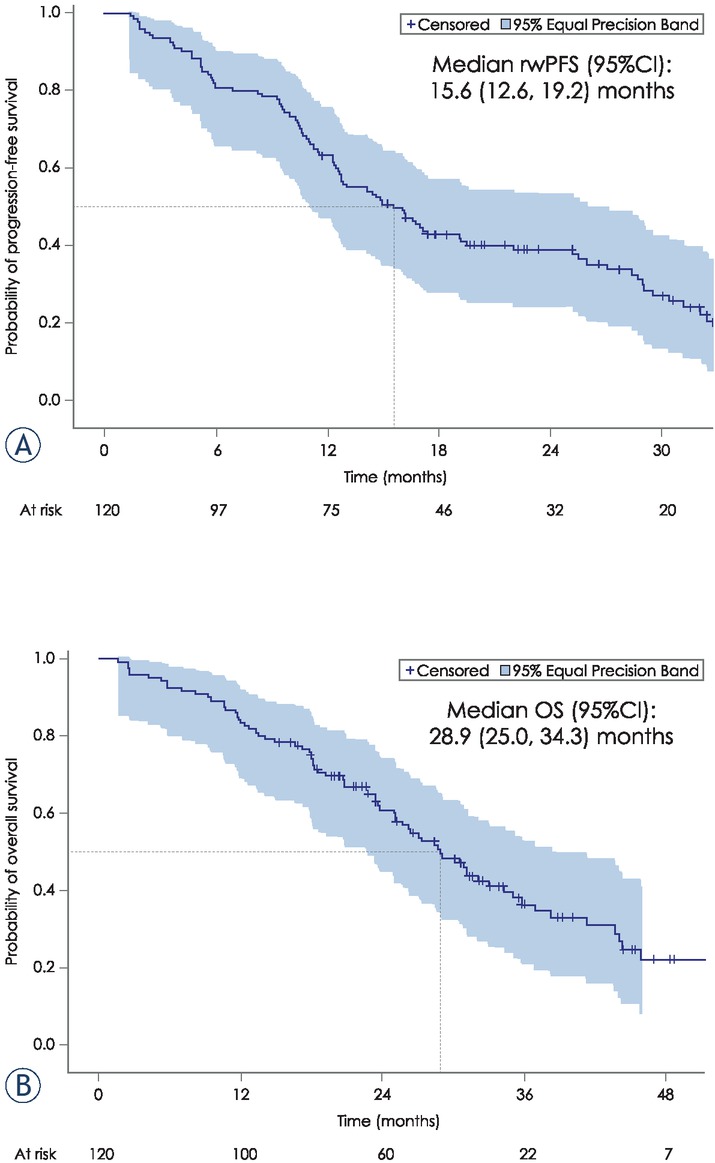
(A) Kaplan-Meier curves for median real-world progression free survival on first-line (1L) epidermal growth factor (EGFR) tyrosine kinase inhibitors (TKIs) therapy. (B) Kaplan-Meier curves for median overall survival from start of 1L EGFR TKI therapy. Censored patients are indicated with a cross.
CI = confidence interval; OS = overall survival; rwPFS = real-world progression-free survival
(A) Kaplan-Meier curves for median real-world progression free survival on first-line (1L) epidermal growth factor (EGFR) tyrosine kinase inhibitors (TKIs) therapy. (B) Kaplan-Meier curves for median overall survival from start of 1L EGFR TKI therapy. Censored patients are indicated with a cross. CI = confidence interval; OS = overall survival; rwPFS = real-world progression-free survival

Figure 2

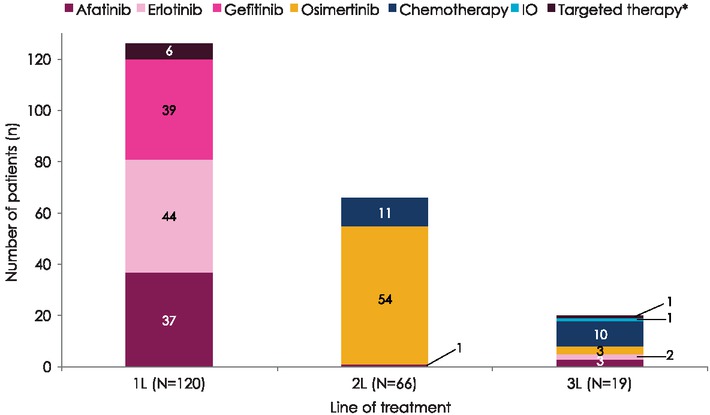
Treatment patterns patients in with locally advanced or metastatic epidermal growth factor receptor mutated (EGFRm) non-small cell lung cancer (NSCLC) treated with first-line (1L) first-/second-generation (1G/2G) EGFR tyrosine kinase inhibitors (TKIs). Note that multiple treatments could have been administered at each line of treatment.
* Targeted therapy besides afatinib, erlotinib, gefitinib and osimertinib (1L: not specified; 3L: crizotinib); 2L = second-line; 3L =third-line; IO = immuno-oncology
Treatment patterns patients in with locally advanced or metastatic epidermal growth factor receptor mutated (EGFRm) non-small cell lung cancer (NSCLC) treated with first-line (1L) first-/second-generation (1G/2G) EGFR tyrosine kinase inhibitors (TKIs). Note that multiple treatments could have been administered at each line of treatment. * Targeted therapy besides afatinib, erlotinib, gefitinib and osimertinib (1L: not specified; 3L: crizotinib); 2L = second-line; 3L =third-line; IO = immuno-oncology

Figure 3

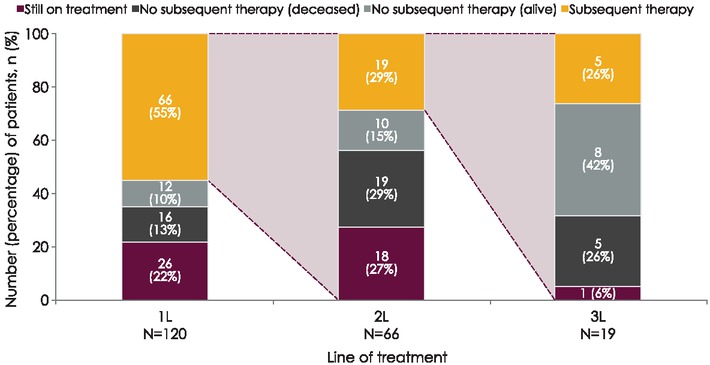
Attrition rates at first-line (1L), second-line (2L) and third-line (3L) in patients with locally advanced or metastatic epidermal growth factor receptor mutated (EGFRm) non-small cell lung cancer (NSCLC).

Clinical characteristics at the time of initial NSCLC diagnosis

CharacteristicN = 120 n (%)
Smoking history
      Current smoker7 (6)
      Former smoker33 (28)
      Never smoker76 (63)
      Unknown4 (3)
ECOG performance status
      028 (23)
      162 (52)
      222 (18)
      36 (5)
      41 (1)
      Unknown1 (1)
      Stage at initial diagnosis
      Early stage (I-II)13 (11)
      Limited regional (IIIA)4 (3)
      Locally advanced (IIIB)0
      Metastatic (IV)103 (86)
Site of distant metastases
      Adrenal12 (10)
      Bone54 (45)
      Brain33 (28)
      Liver19 (16)
      Lung60 (50)
      Lymph nodes60 (50)
      Peritoneal2 (2)
      Pleura38 (32)
      Skin/soft tissue3 (3)
      Other*10 (8)
DOI: https://doi.org/10.2478/raon-2022-0025 | Journal eISSN: 1581-3207 | Journal ISSN: 1318-2099
Language: English
Page range: 371 - 379
Submitted on: Jan 31, 2022
|
Accepted on: Apr 7, 2022
|
Published on: Aug 14, 2022
In partnership with: Paradigm Publishing Services
Publication frequency: 4 issues per year

© 2022 Nina Turnsek, Rok Devjak, Natalija Edelbaher, Ilonka Osrajnik, Mojca Unk, Dusanka Vidovic, Tina Jeric, Urska Janzic, published by Association of Radiology and Oncology
This work is licensed under the Creative Commons Attribution-NonCommercial-NoDerivatives 4.0 License.