
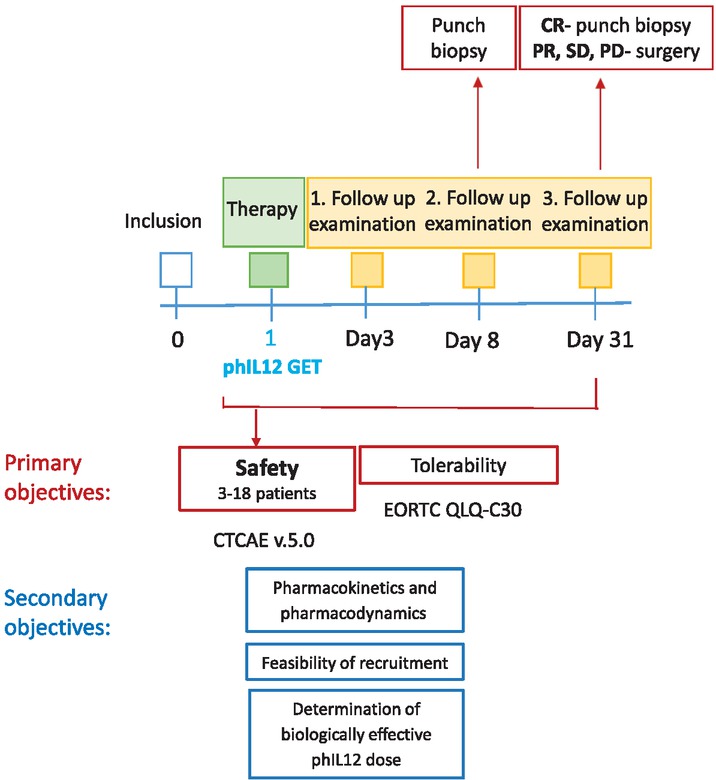
Figure 1
Clinical trial design.
CTCAE v.5 = Common Terminology Criteria for Adverse Events version 5.0; CR = complete response; EORTC QLQ-C30 = European Organization for the Research and Treatment of Cancer Quality of Life Questionnaire C30; PR = partial response; PD = progressive disease; SD = stable disease
Table 1
Primary objectives
| Primary objective | Definition of objectives | Timepoint of objectives evaluation |
|---|---|---|
| Assessment of the safety of intratumoral phIL12 GET | Assessment of adverse events in accordance with the CTCAE v5 criteria | From the beginning of therapy until the follow-up examination on day 30 after the treatment (day 1, 3, 8 and 31) |
| Assessment of the tolerability of intratumoral phIL12 GET | Assessment by the quality of patient of life questionnaire reported outcome EORTC QLQ-C30 | A follow-up examination on day 0, 8 and 31 |
Table 2
Secondary objectives
| Secondary objective | Definition of objectives | Timepoint of objectives evaluation |
|---|---|---|
| Pharmacokinetics and biodistribution. | Determination of serum levels of IL-12 cytokine. | A follow-up examination according to clinical trial protocol (day 0, 3, 8 and 31). |
| Pharmacodynamics | Determination of tumor IL-12 and IFN-γ levels in tumor biopsies. Determination of plasmid DNA in tumor biopsies. | A follow-up examination according to clinical trial protocol (day 8 and 31). |
| Feasibility of recruitment | Evaluation the treatment of the and appropriateness follow up procedures. and execution of | During recruitment, execution of the treatment and follow up. |
| Determination of recommended dose for confirmatory studies | Measurement of pharmacodynamics data and selection of the phIL12 dose that produces IL-12 expression in the tumors with best biological activity, infiltration of the immune cells and no toxicity. | Based on all measurements during follow up. |
Table 3
Inclusion and exclusion criteria
| Inclusion criteria | Exclusion criteria |
|---|---|
| Histologically basal cell carcinoma or cytologically located confirmed, in the head previously and neck untreated region cutaneous | Other malignancy at the time of inclusion |
| Solitary tumors, with largest diameter up to 3 cm, in the region where curative (R0) surgery is feasible | Lesions not suitable for treatment with GET (invasion into the bone, infiltration of large vessels) |
| Age 18-years or older | A life-threatening infection and/or severe heart failure and/or liver failure and/or other life-threatening systemic diseases |
| Life expectancy > 3 months | Significantly reduced lung function, which requires the determination of DLCO. Patients should not be treated if DLCO is abnormal |
| Physical performance in accordance with the Karnofsky scale ≥ 70 or < 2 in accordance with World Health Organization (WHO) scale | Treatment with immunosuppressive drugs, steroids and other drugs that would affect poor wound healing |
| The patient must be capable of understanding the treatment procedure and possible adverse events, which may arise during treatment | Age under 18-years |
| The patient must be capable of signing the informed consent to participate in the clinical study (voluntary and conscientious consent after education) | Major disruptions in the coagulation system (who does not respond to the standard therapy – replacement of vitamin K or freshly frozen plasma) |
| Prior multidisciplinary to inclusion in advisory the trial, team the patient meeting must be presented at a | A chronic decline in the kidney function (creatinine > 150 μmol/L) |
| Epilepsy | |
| Pregnancy and breast-feeding | |
| The patient’s incapability of comprehending the purpose or course of the trial, or not agreeing to be included in the trial | |
| Patients unwilling or unable to comply with the protocol requirements and scheduled visits |
Table 4
Trial procedures
| Day 0 | Day 1 | Day 3 | Day 8 | Day 31 | |
|---|---|---|---|---|---|
| Informed consent | X | ||||
| Concurrent treatments1 | X | ||||
| Clinical examination | X | X | X | X | |
| Complete blood count, biochemistry, serum cytokines | X2 | X | X | X | |
| Coagulation profile | X2 | ||||
| Digital imaging of the tumor and tumor measurement | X3 | X | X | X | X |
| Immune profile determination4 | X | X | X | X | |
| Saliva sample and a skin swab from the location of therapy | X | X | X | X | X |
| EORTC QLQ-C30 | X | X | X | ||
| ECOG | X | ||||
| Examination prior to anesthesia5 | X | ||||
| phIL12 GET | X | ||||
| Pain assessment in accordance with the VAS scale | X | X | X | X | |
| CTCAE v.5 | X | X | X | X | |
| Punch biopsy | X | X6 | |||
| Excision of tumor lesion | X7 |
[i] 1 A detailed description of concurrent treatments (name of the medicinal products, dosage and treatment protocol, beginning of the treatment and reason of the treatment).
2 Complete blood count, biochemistry and coagulation profile must be carried out after the inclusion examination, no more than 7 calendar days prior to therapy.
3 Temporary measurement of the size of the tumor and initial imaging must be carried out no more than 7 days prior to therapy.
4 Peripheral blood mononuclear cells will be examined with flow cytometry to determine content of different subgroups.
5 Prior to therapy, patients will be examined and assessed by anesthesiologists in accordance with the ASA scale.
6 Punch biopsy will be performed in case of complete response.
7 Tumor lesion will be excised if tumor will NOT completely respond to the treatment.
CTCAE = Common Terminology Criteria for Adverse Events; ECOG = Eastern Cooperative Oncology Group; EORTC QLQ-C30 = European Organization for the Research and Treatment of Cancer Quality of Life Questionnaire C30; GET = gene electrotransfer; VAS scale = visual analog scale scale