
Table 1
Brief presentation of patients with retrieved I71.3 ICD codes from the National Institute of Public Health and assigned code after revision
| Patient No. | Time after EVAR | Reported History | Retrieved ICD-10 Code | ICD-10 Code after Revision |
|---|---|---|---|---|
| 1 | 51 months | Rupture of AAA and unsuccessful aortobifemoral bypass | I71.3 | I71.3 |
| 2 | 2 days | Rupture of AAA after EVAR | I71.3 | I71.3 |
| 3 | 72.5 months | Rupture of AAA and unsuccessful resuscitation | I71.3 | I71.3 |
| 4 | 16.5 months | Succumbed to high fever due to prolonged and unsuccessful treatment of spondylodiscitis; graft showed imaging findings consistent with infection | I71.3 | M46.4 |
| 5 | 50.1 months | AAA rupture and placement of proximal extension cuff; 2 months after secondary procedure AAA rupture and exsanguination to peritoneal cavity | I71.3 | I71.3 |
| 6 | 1.5 months | Succumbed to nosocomial pneumonia and sepsis | I71.3 | J18.9 |
| 7 | 117.4 months | Graft extension 36.7 months after EVAR; 64.2 months after EVAR control CT scan | I71.3 | I71.3 |
| 8 | 3.4 months | 1.2 months after EVAR CTA scan and right stent graft limb lysis; additional 2.2 months later sudden severe abdominal pain and unsuccessful resuscitation | I71.3 | I71.3 |
| 9 | 18,9 months | Cardiorespiratory arrest, no history of abdominal pain. | I71.3 | I46.9 |
| 10 | 2 months | Succumbed to sepsis due to septic arthritis, CT and scintigraphy excluded stent graft infection | I71.3 | M00.8 |
| 11 | 21.9 months | 11.4 months after EVAR leak type 2 on control CT scan | I71.3 | I71.3 |
Table 2
Comorbidities in patients with abdominal aortic aneurysm
| Comorbidity | Number of patients |
|---|---|
| Hypertension | 103 (83.7%) |
| Dyslipidemia | 70 (56.9%) |
| History of smoking | 57 (46.3%) |
| PAOD | 32 (26.0%) |
| History of MI | 17 (13.8%) |
| Diabetes mellitus | 16 (13.0%) |
| Carotid disease | 11 (8.9%) |
| History of CABG | 9 (7.3%) |
| History of CVI/TIA | 6 (4.9%) |
Table 3
Secondary procedures
| Type of treatment | Number of patients treated | Time form EVAR to treatment (months) | |
|---|---|---|---|
| Stent graft extension | 14 (11.4 %) | 31.8 ± 35.7 | |
| Interventional procedure | Translumbar embolisation sac | 13 (10.6 %) | 60.2 ± 35.6 |
| Thrombolysis of iliac limb | 3 (2.4 %) | 1.9 ± 1.4 | |
| 4 aortobifemoral bypass | |||
| Surgery | 1 thrombectomy | 7 (5.7 %) | 48.5 ± 47.9 |
| 2 hemicolectomy |
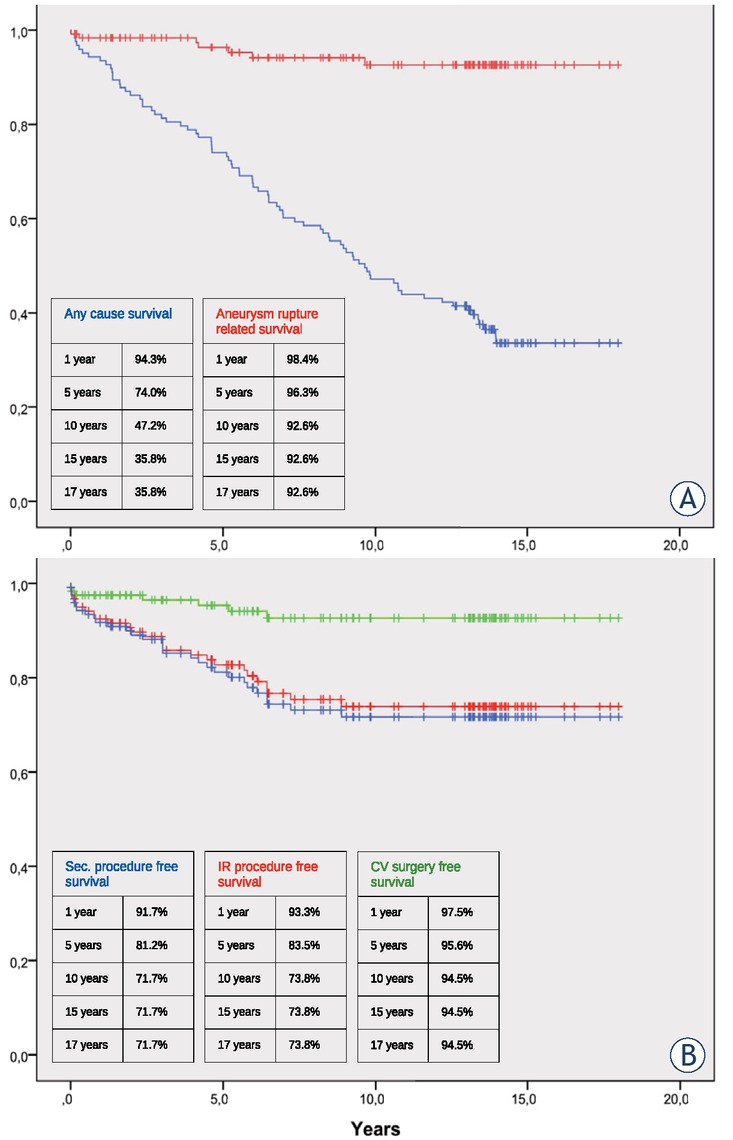
Figure 1
(A) Long-term survival; (B) survival without secondary procedure with subdivision according to the type of secondary procedure.