
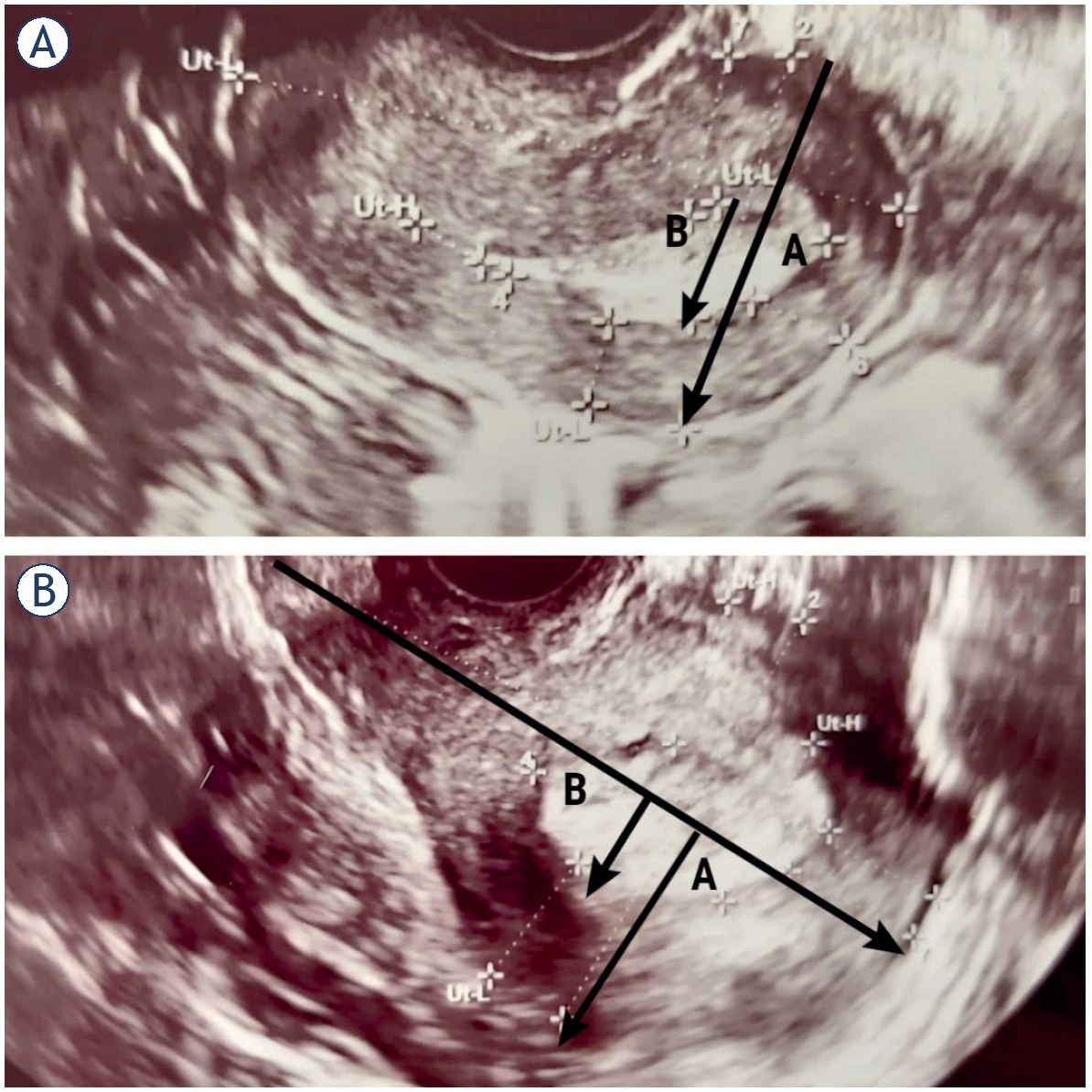
Figure 1
Assessment of myometrial invasion in patients with transvaginal ultrasonography (TVUS). Stage IA endometrial cancer in a 61-year-old postmenopausal woman, correctly diagnosed by TVUS and MRI. Karlsson’s method indicating infiltration of superficial muscle (29%) (A). Stage IA endometrial cancer in a 53-year-old postmenopausal woman. Gordon’s method indicating infiltration of superficial muscle (35%) (B).
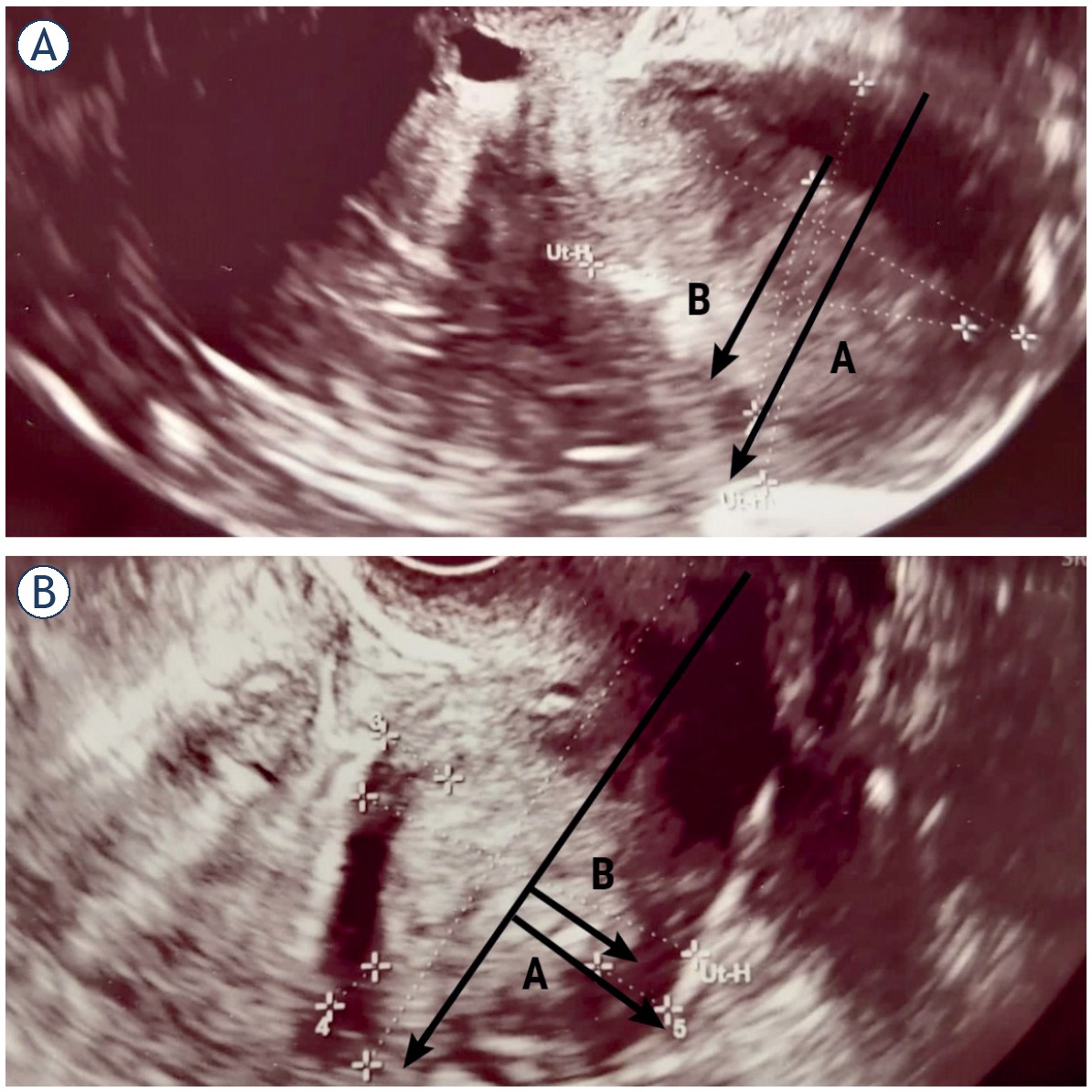
Figure 2
Assessment of myometrial invasion in patients with transvaginal ultrasonography (TVUS). Stage IB endometrial cancer in a 78-year-old postmenopausal woman, correctly diagnosed by TVUS and MRI. Karlsson’s method indicating infiltration of deep muscle (58%) (A). Stage IB endometrial cancer in an 83-year-old postmenopausal woman. Gordon’s method indicating infiltration of deep muscle (73%) (B).
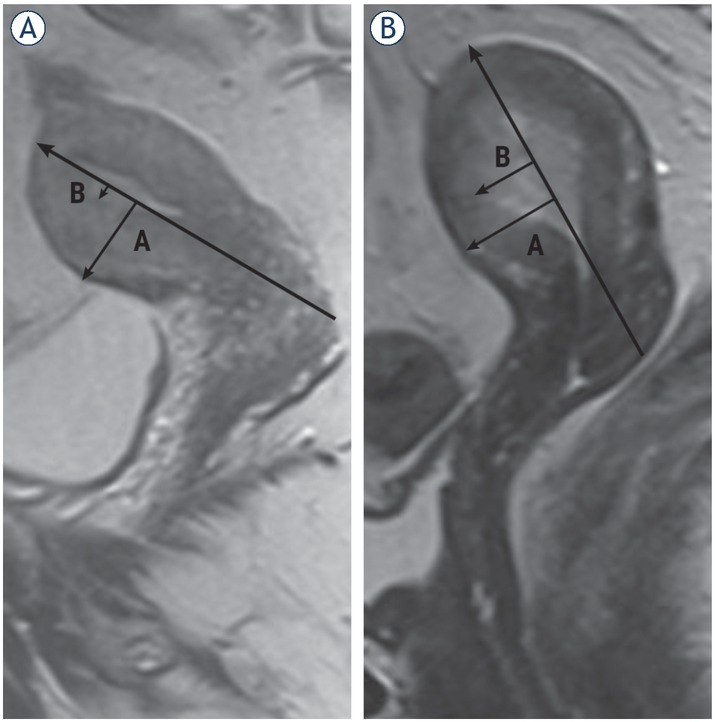
Figure 3
Assessment of myometrial invasion in patients with MRI, sagittal T2-weighted. Stage IA endometrial cancer in a 68-year-old postmenopausal woman, correctly diagnosed by TVUS and MRI. Arrow shows blurring of the junctional zone and the infiltration of superficial muscle (20%) (A). Stage IB endometrial cancer in a 58-year-old postmenopausal woman, correctly diagnosed by TVUS and MRI. Arrows refers to deep myometrial infiltration (60%) (B).
Table 1
Demographic and clinical characteristics of 60 women with histologically confirmed endometrial cancer
| Characteristics | Value (%) |
|---|---|
| Age (years) | 60 (40–83) |
| Body mass index (kg/m2) | 32.05 (21.6–49.2) |
| Postmenopausal | 45 (75) |
| Myometrial invasion | |
| Superficial (≤ 50 %) | 34 (56.7) |
| Deep (> 50%) | 26 (43.3) |
| Hystological grade | |
| Grade 1 | 18 (30) |
| Grade 2 | 35 (58) |
| Grade 3 | 7 (12) |
Table 2
Myometrial invasion in endometrial cancer according to histopathology, transvaginal ultrasonography and magnetic resonance imaging
| Histopathology | TVUS (Gordon) | TVUS (Karlsson) | MRI | Total N(%) | |||
|---|---|---|---|---|---|---|---|
| ≤ 50% N(%) | > 50% N(%) | ≤ 50% N(%) | > 50% N(%) | ≤ 50% N(%) | > 50% N(%) | ||
| ≤ 50% N (%) | 30 (88.2) | 4 (11.8) | 30 (88.2) | 4 (11.8) | 29 (85.3) | 5 (14.7) | 34 (100) |
| > 50% N(%) | 6 (23.1) | 20 (76.9) | 8 (30.8) | 18 (69.2) | 1 (3.8) | 25 (96.2) | 26 (100) |
| Total | 36 (60) | 24 (40) | 38 (63.3) | 22 (36.7) | 30 (50) | 30 (50) | 60 (100) |
Table 3
Diagnostic performance of transvaginal ultrasonography and magnetic resonance imaging in predicting myometrial invasion in endometrial cancer
| Diagnostic test measure | TVUS (Gordon) | TVUS (Karlsson) | MRI |
|---|---|---|---|
| %, (95% CI) | %, (95% CI) | %, (95% CI) | |
| Accuracy | 83 (70–92) | 80 (67–88) | 90 (78–93) |
| Sensitivity | 77 (62–87) | 69 (54–79) | 97 (83–99) |
| Specificity | 88 (77–96) | 88 (77–96) | 85 (75–88) |
| Positive predictive value | 83 (67–94) | 82 (64–93) | 83 (72–87) |
| Negative predictive value | 83 (72–90) | 79 (69–86) | 97 (85–99) |
| Likelihood Ratio of a Positive Test | 6.54 (2.65–19.00) | 5.89 (2.30–18.17) | 6.54 (3.31–8.37) |
| Likelihood Ratio of a Negative Test | 0.26 (0.14–0.50) | 0.35 (0.22–0.60) | 0,05 (0.002–0.23) |
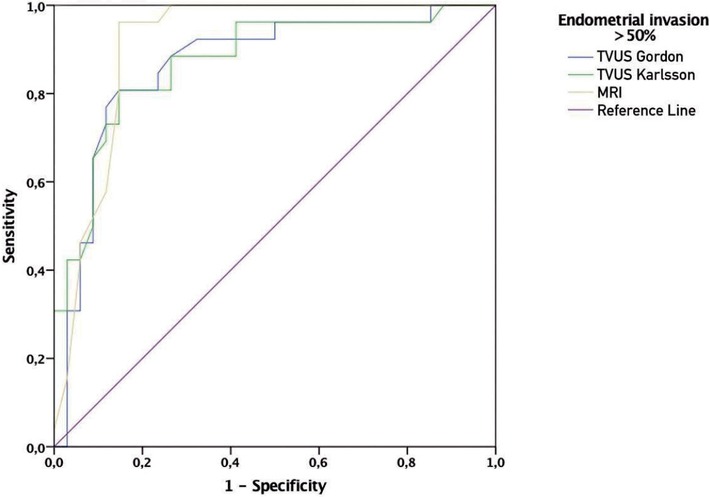
Figure 4
Receiver operating characteristics (ROC) analysis for percentage assessment of myometrial invasion (MI) with transvaginal ultrasound (TVUS) by Gordon’s and Karlsson’s, and with MRI
Table 4
Representation of the areas below the receiver operating characteristics (ROC) curve (AUC) for percentage assessment of MI with transvaginal ultrasound (TVUS) by Gordon and Karlsson, and with MRI
| Lower limit | Upper limit | |||
|---|---|---|---|---|
| TVUS (Gordon) | 0.872 | < 0.001 | 0.769 | 0.965 |
| TVUS (Karlsson) | 0.865 | < 0.001 | 0.766 | 0.964 |
| MRI | 0.911 | < 0.001 | 0.833 | 0.989 |