Have a personal or library account? Click to login
Ultrasound-guided carpal tunnel injections Cover

Ultrasound-guided carpal tunnel injections

Open Access
|Feb 2022

Figures & Tables

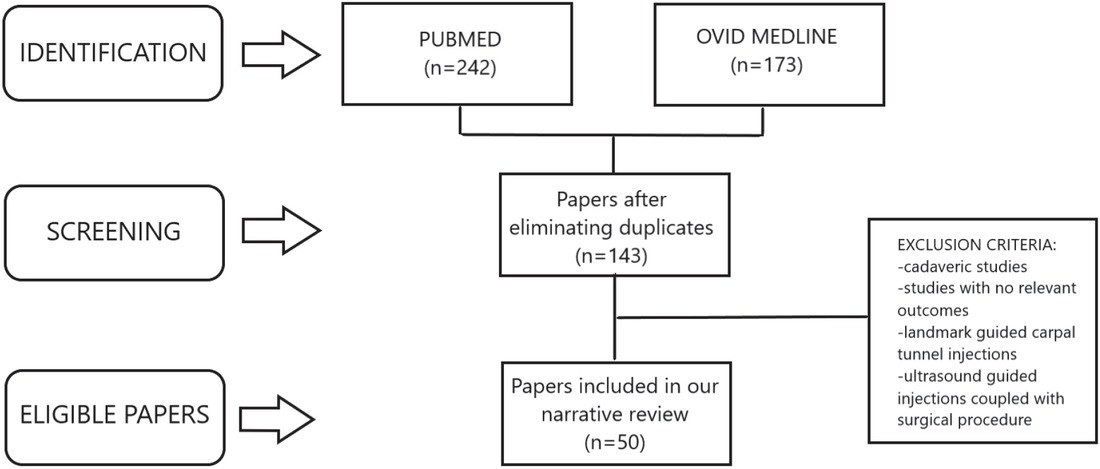
Figure 1

Depicting a flowchart of paper search and selection with exclusion criteria.
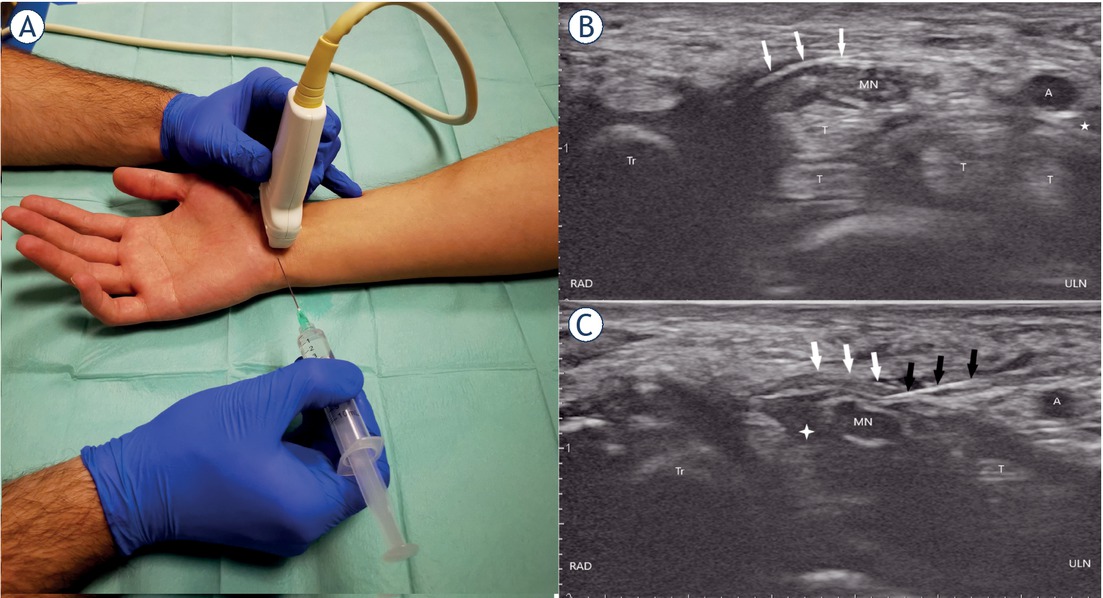

Figure 2

(A), (B), and (C) showing the ulnar approach. (A) wrist and needle positioning for carpal tunnel injection, (B) ultrasound anatomy of the carpal tunnel shown in the short axis, (C) penetrating transverse carpal ligament positioning the needle tip above the median nerve. Ultrasound of the carpal tunnel after the needle penetrates the transverse carpal ligament. Comparing B and C note the expansion of the perineural space marked with a white cross.A = ulnar artery; black arrows = needle; MN = median nerve; RAD = radial; T = flexor tendons; Tr = trapezium; ULN = ulnar; white arrows = transverse carpal ligament; white cross = perineural injectate; white star = ulnar nerve
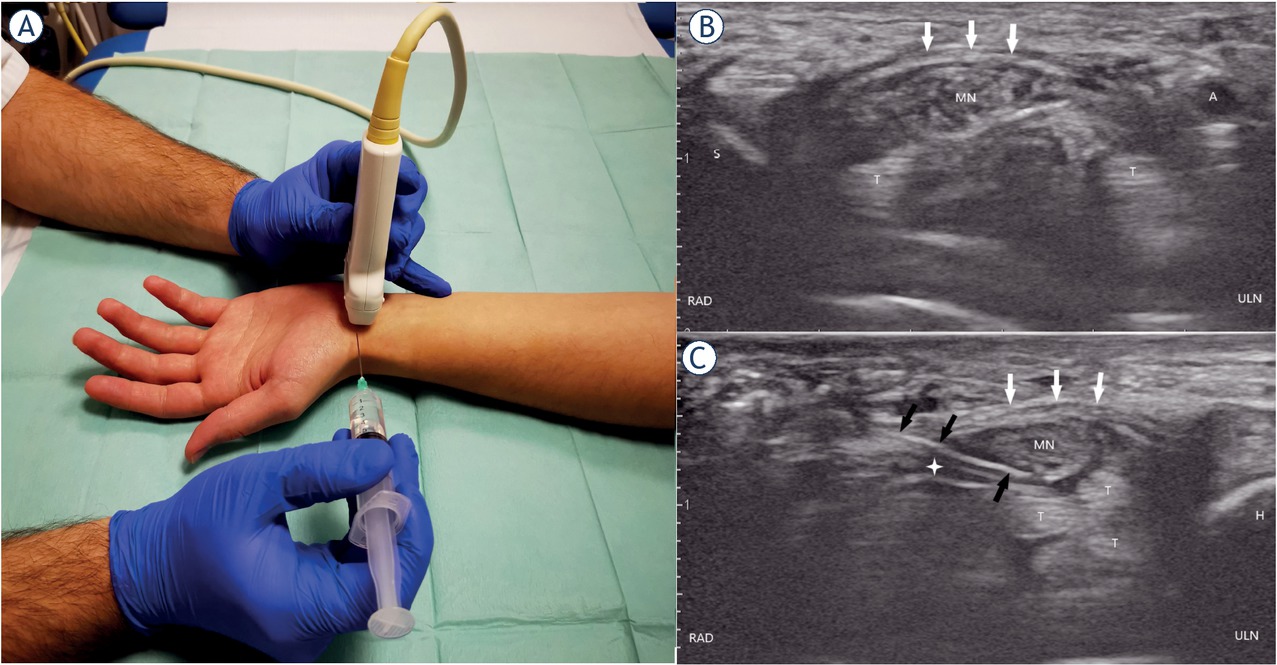

Figure 3

(A), (B), and (C) showing the radial approach. (A) wrist and needle positioning for carpal tunnel injection, (B) ultrasound anatomy of the carpal tunnel shown in the short axis, (C) penetrating transverse carpal ligament positioning the needle tip below the median nerve. Ultrasound of the carpal tunnel after the needle penetrates the transverse carpal ligament. Comparing figures B and C note the expansion of the perineural space marked with a white cross.A = ulnar artery; black arrows = needle; H = hamate; RAD = radial; S = scaphoid; MN = median nerve; T = flexor tendons; ULN = ulnar; white arrows = transverse carpal ligament; white cross = perineural injectate
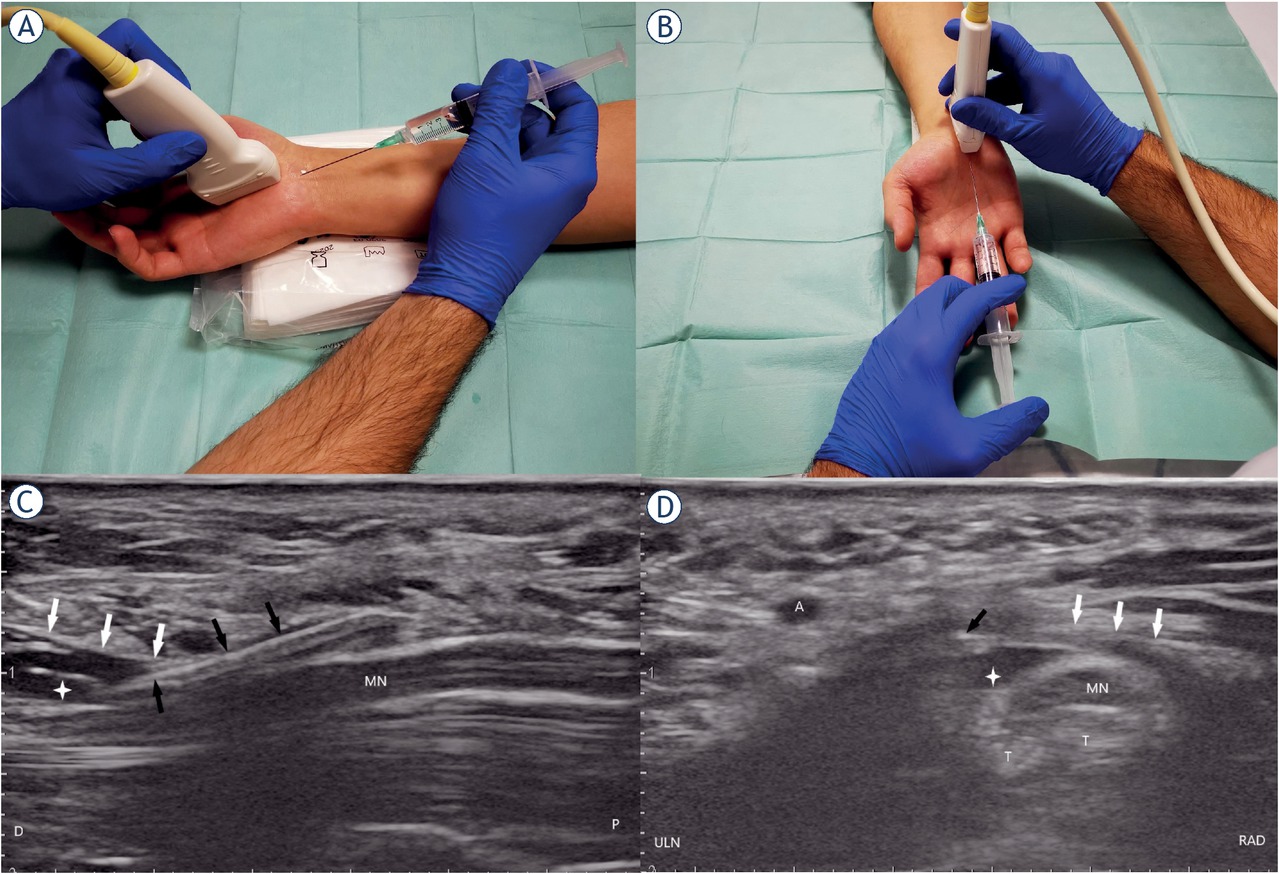
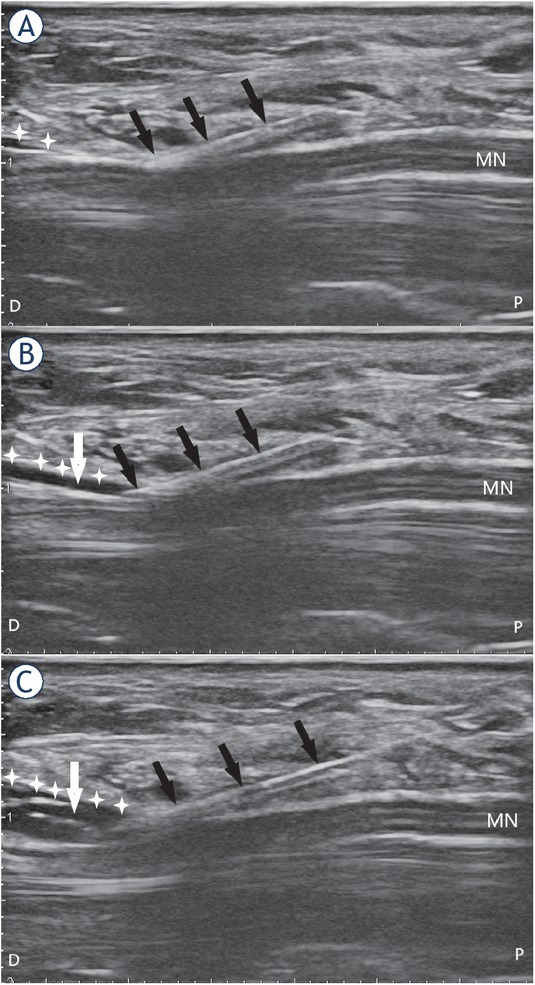
Figure 4

(A), (B), (C), and (D) showing the longitudinal approach. (A) Wrist and needle positioning for carpal tunnel injection for the proximal to distal approach, (B) Wrist and needle positioning for carpal tunnel injection for the distal to proximal approach, (C) Ultrasound of the carpal tunnel shown in the long axis after the needle penetrates the transverse carpal ligament and positioning the needle tip parallel to the median nerve, (D) ultrasound of the carpal tunnel shown in the short axis after the needle penetrates the transverse carpal ligament positioning the needle tip parallel to the median nerve. Note in C and D the expanded perineural space marked with a white cross.A = ulnar artery; black arrows = needle; D = distal; MN = median nerve; P = proximal; RAD = radial; T = flexor tendons; ULN = ulnar; white arrows = transverse carpal ligament; white cross = perineural injectate

Figure 5

(A), (B), and (C) showing the carpal tunnel in the long axis. The effect of injectate volume on perineural space expansion and subsequent hydrodissection. Note the expansion of the perineural space (white arrow) around the median nerve before (A), during (B) and after injecting 6 ml of the injectate and subsequent hydrodissection (C).black arrows = needle; D = distal; MN = median nerve; P = proximal; white cross = transverse carpal ligament
DOI: https://doi.org/10.2478/raon-2022-0004 | Journal eISSN: 1581-3207 | Journal ISSN: 1318-2099
Language: English
Page range: 14 - 22
Submitted on: Aug 10, 2021
|
Accepted on: Dec 15, 2021
|
Published on: Feb 11, 2022
In partnership with: Paradigm Publishing Services
Publication frequency: 4 issues per year

© 2022 Tilen Tumpaj, Vesna Potocnik Tumpaj, Domenico Albano, Ziga Snoj, published by Association of Radiology and Oncology
This work is licensed under the Creative Commons Attribution-NonCommercial-NoDerivatives 4.0 License.