
Table 1
Demographic
| N | % | |
|---|---|---|
| PATIENTS | 18 | |
| GENDER | ||
| M | 8 | 44.4% |
| F | 10 | 55.6% |
| DIAGNOSIS | ||
| Colorectal cancer | 38.9% | |
| Breast cancer | 22.2% | |
| Hepatocellular cancer | 11.1% | |
| Ovarian cancer | 11.1% | |
| Anal cancer | 5.6% | |
| Cancer of unknown primary origin (CUP) | 5.6% | |
| Non-small cell lung cancer (NSCLC) | 5.6% | |
| TUMOURS TREATED | 21 | |
| LIVER METASTASES | ||
| Synchronous | 44.4% | |
| Metachronous | 44.4% | |
| No | 2 | 11.2% |
| METASTASES LOCATION | ||
| Liver only | 7 | 43.7% |
| Liver + lung | 21.5% | |
| Liver + bone | 6.2% | |
| Liver + kidney | 6.2% | |
| Liver + lung + bone + brain | 6.2% | |
| Liver + bone + peritoneum | 6.2% | |
| Liver + pleural + bone | 6.2% | |
| Liver + retroperitoneal | 6.2% | |
| PREVIOUS TREATMENTS | ||
| Systemic therapy | 16 | 88.8% |
| Liver surgery | 4 | 22.2% |
| TACE | 44.4% | |
| TACE + RFA | 5.6% | |
| TACE + CP | 5.6% | |
| CRYOTH | 5.6% | |
| NO | 38.9% | |
| COMORBIDITIES* | ||
| Cardiac diseases | 33.3% | |
| Pulmonary diseases | 16.7% | |
| Liver diseases | 50.0% |
[i] * Cardiac diseases were cardiomyopathies, status post coronary bypass, status post aortocoronary venous bypass operation, valvular disease, pericardial effusion; pulmonary diseases were chronic obstructive pulmonary diseases; liver diseases were hematomas, ascites, cholestasis, hemochromatosis
CP = chemoperfusion; CRYOTH = cryotherapy; F = female; M = male; N = number; RFA = radiofrequency ablation; TACE = hepatic artery chemoembolization
Table 2
Lesions and treatment description
| N | % | |
|---|---|---|
| LESIONS | 21 | 100% |
| PLANNING MRI | 21 | 100% |
| TYPE | ||
| Hypervascular | 2 | 9.5% |
| Intermediate | 14 | 71.4% |
| Hypovascular | 5 | 19.0% |
| CHALLENGING LOCATION* | ||
| Yes | 19 | 90.5% |
| No | 2 | 9.5% |
| VESSELS OR BILE DUCTS SURROUNDING THE METASTASES | ||
| Distant (> 10 mm) | 19.0% | |
| Close (1 mm to 10 mm) | 28.6% | |
| Adjacent (< 1 mm) | 11 | 52.4% |
| PREVIOUS LOCAL TREATMENT ON THE LESION | ||
| Local ablative therapy (LAT) | 0% | |
| Transarterial chemoembolization (TACE) | 28.6% | |
| Chemoperfusion (CP) | 4.8% | |
| Treatment-naive | 14 | 66.7% |
| TECHNICAL SUCCESS | ||
| Yes | 20 | 95.2% |
| No | 1 | 4.8% |
| # ELECTRODES PER TREATMENT | ||
| 2 | 4.8% | |
| 3 | 9.5% | |
| 4 | 4.8% | |
| 6 | 16 | 76.2% |
| 8 | 1 | 4.8% |
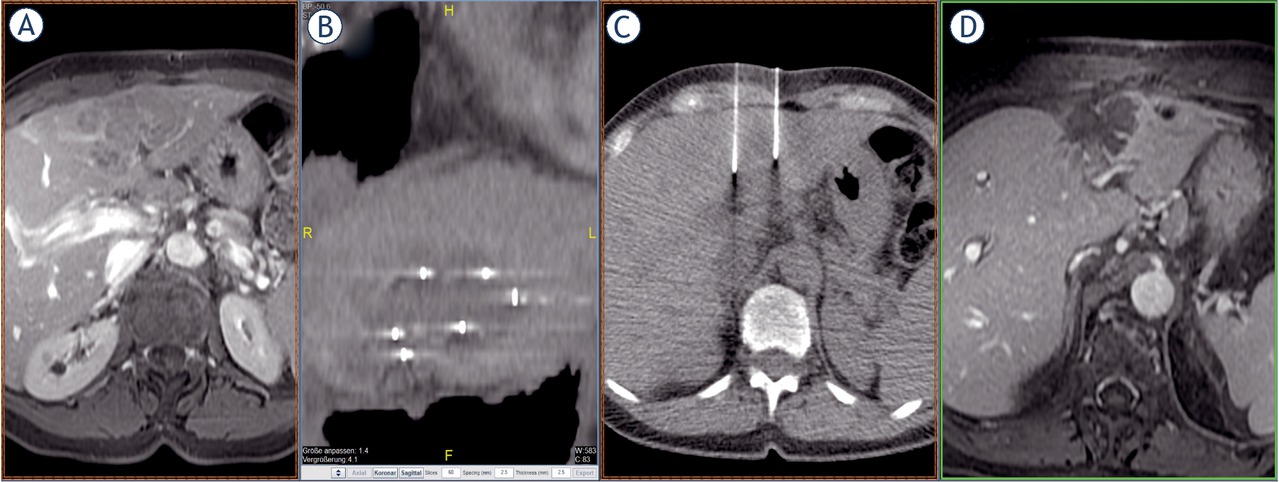
Figure 1
(A) Solitary liver metastasis from a breast carcinoma in a challenging location between the left and right lobes of the liver, not amenable to surgical resection and progressive under various lines of systemic chemotherapy. The dimensions of the metastasis in segment IVa/b adjacent to segment VIII were 4 x 7 x 5 cm (volume 70 cc). (B) Position of the electrodes in the coronary reconstruction. The aim is to achieve the most uniform coverage of the target lesion by the electrodes. (C) Position of the electrodes in axial cross-sectional imaging. This image shows another essential requirement for the therapeutic success of ECT – the parallelism of the electrodes. (D) The most recent imaging control, complete two years after the ECT procedure, shows complete chemoablation of the entire metastasis, thus formally complete remission of the target lesion without residual or marginal recurrence.
Table 3
Response of target lesions evaluated between 1 and 3 months
| RESPONSE | N | % |
|---|---|---|
| Complete response (CR) | 13 | 61.9% |
| Partial response (PR) | 5 | 23.8% |
| Stable disease (SD) | 1 | 4.8% |
| Progressive disease (PD) | 0 | 0% |
| Lost to follow-up | 2 | 9.5% |
Table 4
Response to treatment, progression-free survival and overall survival according to different subgroups of analysis
| CR | PR | SD | PD | NE | PFS (mo) | OS (mo) | |
|---|---|---|---|---|---|---|---|
| N (%) | N (%) | N (%) | N (%) | N (%) | Mean ± s.d. | Mean ± s.d. | |
| SIZE | |||||||
| < 6 cm | 9 (90.0%) | 0 | 0 | 0 | 1 (10.0%) | 12.0 ± 9.2 | 15.1 ± 8.0 |
| > 6 cm | 4 (36.4%) | 5 (45.4%) | 1 (9.1%) | 0 | 1 (9.1%) | 4.7 ± 5.4 | 7.9 ± 7.9 |
| P value | 0.0483 | 0.0209 | 0.0322 | ||||
| HISTOLOGY | |||||||
| Colorectal cancer | 4 (50.0%) | 2 (25.0%) | 0 | 0 | 2 (25.0%) | 7.3 ± 12.1 | 12.1 ± 12.1 |
| Breast cancer | 4 (80.0%) | 1 (20.0%) | 0 | 0 | 0 | 9.8 ± 7.5 | 10.6 ± 6.9 |
| Hepatocellular cancer | 1 (33.3%) | 2 (66.7%) | 0 | 0 | 0 | 10.3±10.1 | 15.0 ± 7.2 |
| P-value | 0.3615 | 0.8781 | 0.8379 | ||||
| LOCATION | |||||||
| Distant (> 10 mm) | 2 (100%) | 0 | 0 | 0 | 0 | 6.5 ± 3.5 | 8.5 ± 0.7 |
| Close (> 1 mm) | 5 (62.5%) | 1 (12.5%) | 1 (12.5%) | 0 | 1 (12.5%) | 8.0 ± 7.4 | 10.7 ± 7.3 |
| Adjacent (< 1 mm) | 6 (54.5%) | 4 (36.3%) | 0 | 0 | 1 (9.2%) | 8.8 ± 9.8 | 10.2 ± 10.5 |
| P-value | 0.6643 | 0.9364 | 0.9539 |