
Table 1
Clinical characteristics of patients with bladder paraganglioma
| Characteristics | Number (%) of patients |
|---|---|
| Median age in years (interquartile range) | 51 (40, 63) |
| Sex | |
| Male | 7 (43.8) |
| Female | 9 (56.2) |
| Clinical manifestations | |
| Postmicturition syndrome* | 6 (37.5) |
| Hypertension | 3 (18.8) |
| Hematuria or progressive dysuria | 3 (18.7) |
| 24-h urinary VMA and CA level | |
| Not measured | 11 (68.8) |
| Normal | 4 (25.0) |
| Elevated | 1 (6.2) |
| Tumor number | |
| Single | 14 (87.5) |
| Multiple | 2 (12.5) |
| Surgical approach | |
| Partial cystectomy | 7 (43.8) |
| Local resection of bladder tumor** | 9 (56.2) |
| Imaging methods | |
| Computerized tomography | 13 (81.3) |
| Magnetic resonance imaging | 8 (50.0) |
Table 2
Location and morphological characteristics of bladder paraganglioma
| Characteristics | Number (%) of patients |
|---|---|
| Mean maximum diameter of tumour (cm)* | 2. 6 ± 1.0 |
| Location | |
| Anterior wall | 3 (18.7) |
| Posterior wall | 4 (25.0) |
| Left wall | 1 (6.3) |
| Right wall | 3 (18.7) |
| Dome | 2 (12.5) |
| Bottom | 3 (18.8) |
| Spatial relationship with the bladder wall | |
| Protruding into the bladder cavity | 11 (68.7) |
| Protruding into the pelvic cavity | 1 (6.3) |
| Protruding into the bladder and pelvic cavities | 4 (25.0) |
| Morphological characteristics | |
| Oval | 10 (62.5) |
| Lobulated | 4 (25.0) |
| Fusiform | 2 (12.5) |
| Tumor margin | |
| Well-defined | 14 (87.5) |
| Ill-defined | 2 (12.5) |
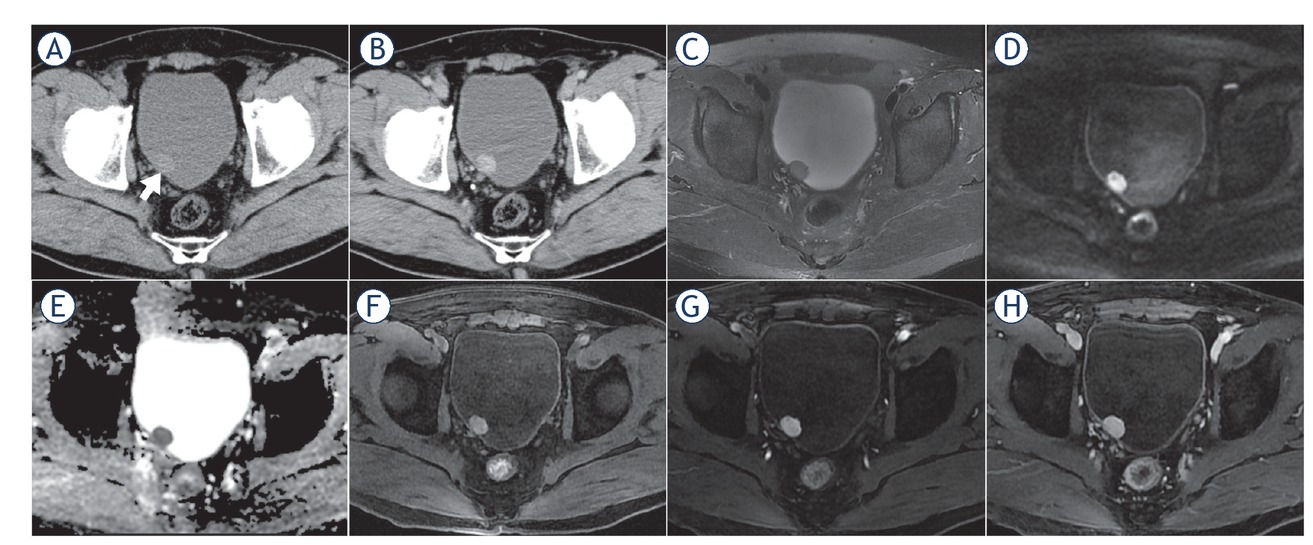
Figure 1
CT and MR images of a 61-year-old male patient with bladder paraganglioma. The tumour was located in the posterior bladder wall, oval, well-defined margin, protruding into the bladder cavity with broad-base attachment to the bladder wall (short arrow). The lesion showed slight hypodensity and obvious enhancement on axial pre- and post-contrast-enhanced CT images (A, B), homogenous slight hyperintensity on T2-weighted images (T2WI) (C), marked hyperintensity on diffusion-weighted images (DWI) (D), hypointensity on apparent diffusion coefficient (ADC) maps (mean ADC value, 0.870 × 10⁻³ mm2/s) (E), hyperintensity compared to the gluteus maximus on T1-weighted images (T1WI) (F) and “fast in and slow out” on dynamic contrast-enhanced MRI (G, H).
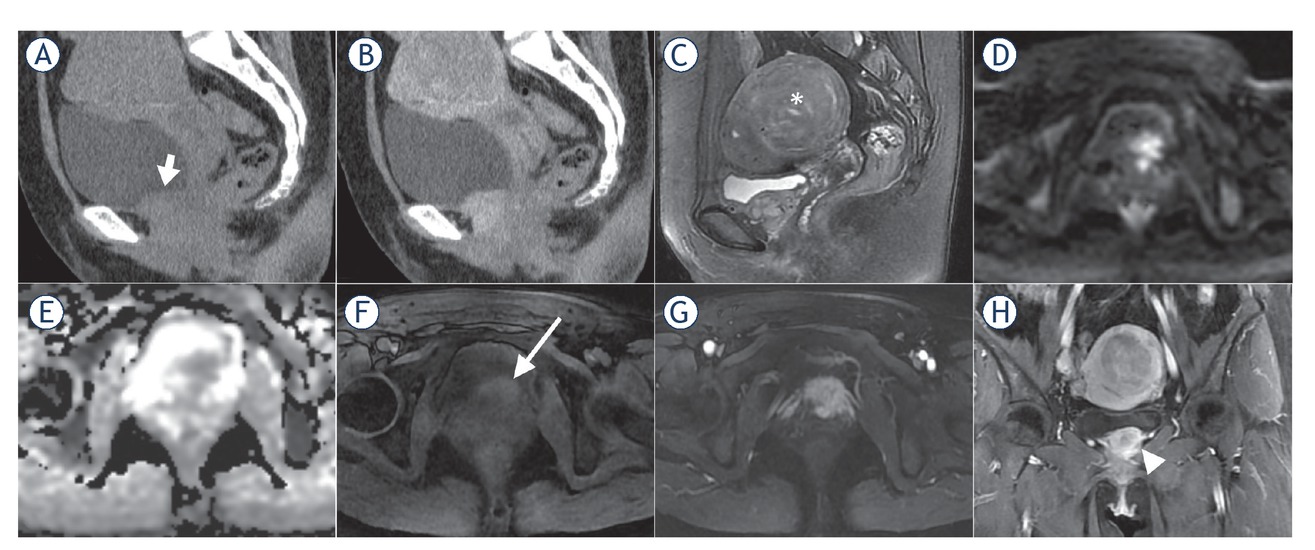
Figure 2
CT and MR images of a 47-year-old female with malignant bladder paraganglioma. The bladder tumour was located in the inferior bladder wall with an irregular shape and ill-defined margin, invading the adjacent tissues (short arrow). The tumour showed iso-density and moderate enhancement on sagittal pre- and post-contrast enhanced CT images (A, B), inhomogenous hyperintensity on sagittal T2-weighted images (T2WI) (C), hyperintensity on diffusion-weighted images (DWI) (D), hypointensity on apparent diffusion coefficient (ADC) maps (mean ADC value, 0.852 × 10⁻³ mm2/s) (E), inhomogenous slight hyperintensity compared to the gluteus maximus on T1-weighted images (T1WI) (long arrow) (F), heterogenous marked enhancement on arterial phase (G) and coronal contrast-enhanced images (arrowhead) (H). In addition, a uterine fibroid on the posterior wall of the uterus was also found (asterisk on sagittal T2WI).
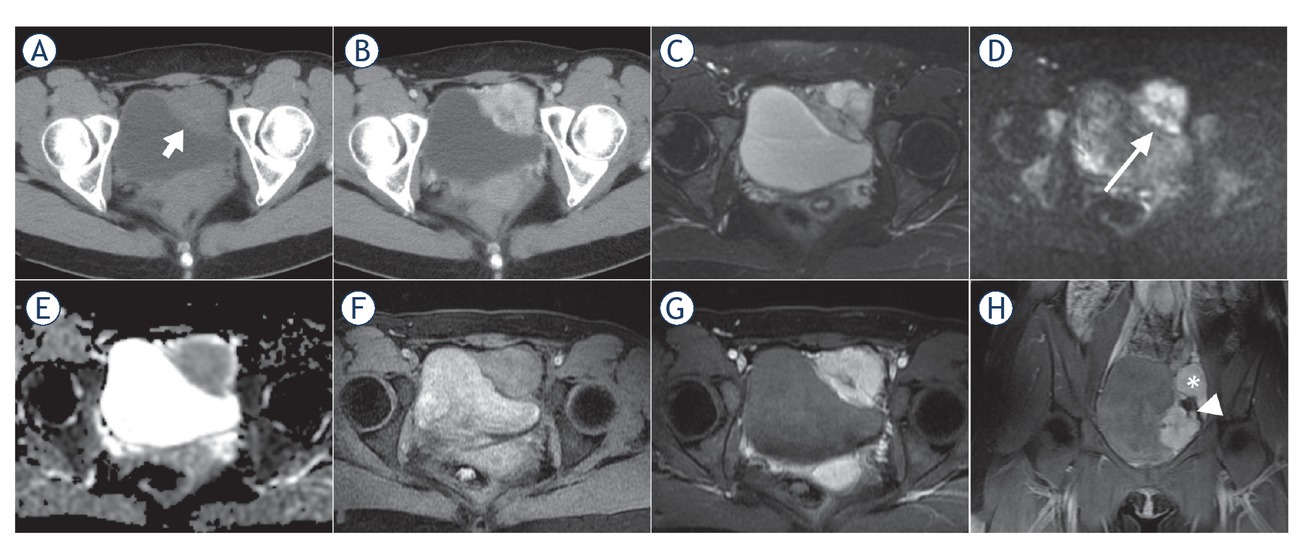
Figure 3
CT and MR images of a 25-year-old female with malignant bladder paraganglioma. The tumour was located in the left bladder wall with irregular shape, presenting heterogenous hypodensity (short arrow) and obvious enhancement on axial pre- and post-contrast enhanced CT images (A, B), heterogenous slight or marked hyperintensity on T2-weighted images (T2WI) (C), heterogenous hyperintensity on diffusion-weighted images (DWI) (long arrow) (D), hypointensity on apparent diffusion coefficient (ADC) maps (mean ADC value, 0.997×10⁻³ mm2/s) (E), slight hyperintensity compared to the gluteus maximus on T1WI (F) and early marked enhancement on arterial phase images (G). Coronal enhanced MRI showed the lesion encased the left iliac artery branch (arrowhead); a similar enhanced lesion was located next to the left iliac vessels (asterisk), suggesting multiple paraganglioma (H).
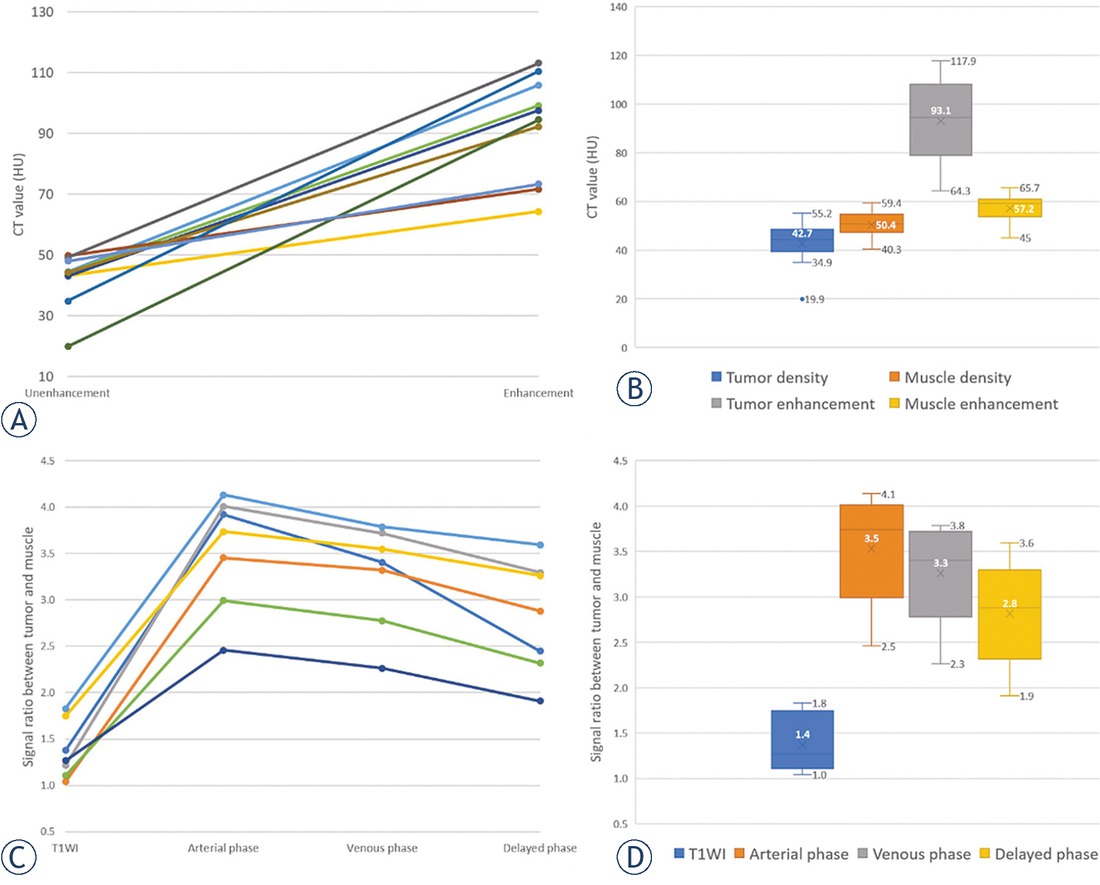
Figure 4
Enhancement trend charts of bladder paragangliomas on CT and MR images. (A) Broken line graph of enhancement trend on CT images; (B) Box plot of density distribution on pre- and post-contrast enhanced CT images (arterial phase); (C) Broken line graph of dynamic enhancement trend on MR images; (D) Box plot of signal distribution on unenhanced and dynamic contrast-enhanced MR images.
Table 3
CT and MR image characteristics*
| Computerized tomography (n = 13) | |
|---|---|
| Density | Moderate or slightly lower density |
| Enhancement characteristics | Moderate to marked enhancement |
| Calcification | None |
| Cystic degeneration or necrosis | Rare (n = 2) |
| Haemorrhage | None |
| Magnetic resonance imaging (n = 8) | |
| T2-weighted imaging | Slight hyperintensity |
| Diffusion-weighted imaging | Hyperintensity |
| Apparent diffusion coefficient (ADC) map | Hypointensity (ADC value, 0.883±0.126×10⁻³ mm2/s)** |
| T1-weighted imaging | Slight hyperintensity |
| Enhancement characteristics | “Fast in and slow out” pattern |
| Cystic degeneration or necrosis | Rare (n = 2) |
| Haemorrhage | None |
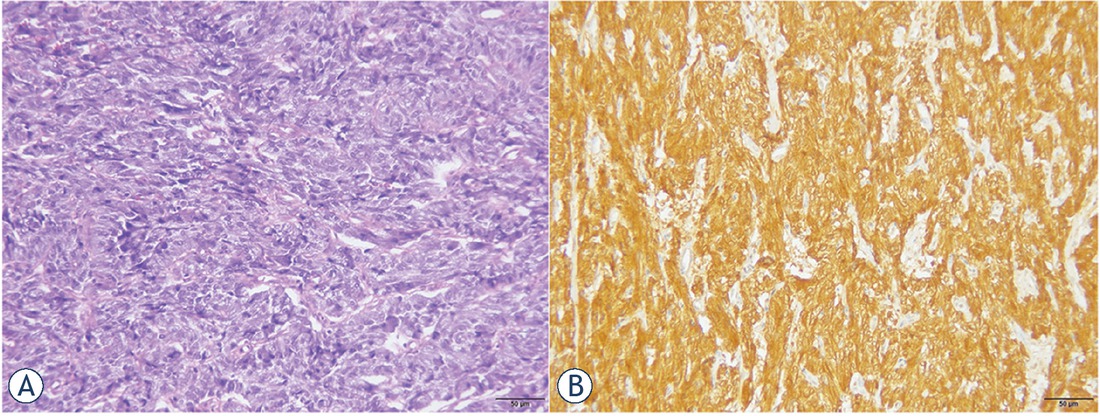
Figure 5
Microscopic examination of paraganglioma. (A) Polygonal or oval tumour cells were rich in basophil granular cytoplasm and arranged in a sheet or organoid arrangement. (Hema toxylin and eosin staining, × 400). (B) Immunohistochemical staining of tumours cells was positive for chromogranin A (CgA) (EnVision × 200).