
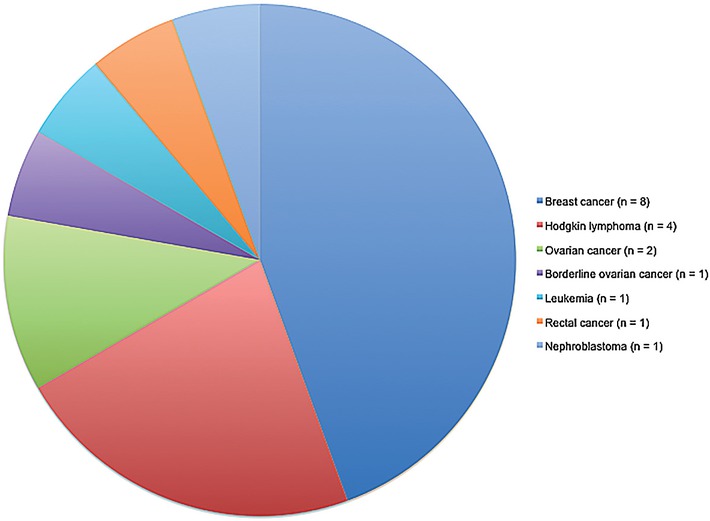
Figure 1
Types of disease in cancer patients included in this study. Breast cancer patients predominated.
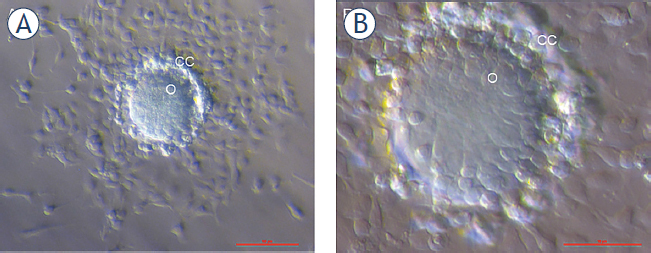
Figure 2
In vitro maturation of the oocyte in the maturation medium and in coculture with the cumulus cells of mature oocytes in the same patient at magnification 40 X (A) and magnification 100 X (B).
CC = cumulus (granulosa) cells; O = oocyte; Red bar = A) 100 μm in B) 50 μm
Table 1
Differences in the number, quality and immaturity of oocytes after controlled hormonal stimulation of the ovaries in cancer patients compared to patients with fertility problems
| Cancer patients (n = 18) | Patients with fertility problems (n = 21) | |
|---|---|---|
| Age (years) | 30.3 ± 6.3 | 33.4 ± 5.0 |
| Number of retrieved oocytes | 198 | 259 |
| Oocytes per patient | 11.0 ± 9.0 | 12.3 ± 9.2 |
| Number of degenerated oocytes | 17 (8.6%) | 17 (6.5%) |
| Number of immature (MI + GV) oocytes | 59 (30.0%)* | 113 (43.6%) * |
| Number of immature GV oocytes | 45 (23.0%) | 74 (28.6%) |
Table 2
Numbers and percentages of oocytes that matured in vitro in patients with different cancers compared to patients with fertility problems
| Number of oocytes that underwent in vitro maturation | Number of oocytes that matured in vitro | |
|---|---|---|
| All cancer patients (n = 18) | 38 / 45 | 25 (1.39 ± 1.04 per patient)* (66.0%) |
| Patients with breast cancer (n = 8) | 22 | 12 (54.5%) |
| Patients with other cancers (n = 10) | 16 | 13 (81.2%) |
| Patients with fertility problems (n = 21) | 65 / 74 | 52 (2.48 ± 1.83 per patient)* (80.0%) |
Table 3
Non-significant differences in fertilized oocytes, non-cleaved zygotes, and cleavage embryos obtained by intracytoplasmic sperm injection (ICSI) on in vitro matured and in vivo matured oocytes of patients with fertility problems (in the same cycles)
| ICSI cycles (n = 17) | In vitro matured oocytes | In vivo matured oocytes* | |
|---|---|---|---|
| Number of microinjected oocytes | 49 | 121 | |
| Fertilized oocytes | (55.127 %) | (57.069 %) | |
| Non-cleaved zygotes | (15.04 %) | (11.68 %) | |
| Cleavage embryos | (85.223 %) | (88.461 %) |
Table 4
Non-significant differences in results of intracytoplasmic sperm injection (ICSI) cycles (fertilized oocytes, non-cleaved zygotes, cleavage embryos) on in vitro matured oocytes of patients with fertility problems regarding the number of immature (germinal vesicle [GV]) oocytes
| ICSI cycles (n = 17) | ≤ 30% GV oocytes | ≥ 31% GV oocytes |
|---|---|---|
| Female age (years) | 34.4 ± 3.0 | 34.3 ± 5.6 |
| Number of microinjected oocytes | 16 | 33 |
| Fertilized oocytes | 11 (69.0%) | 16 (48.5%) |
| Non-cleaved zygotes | 0 (0%) | 4 (25.0%) |
| Cleavage embryos | 11 (100%) | 12 (75%) |