
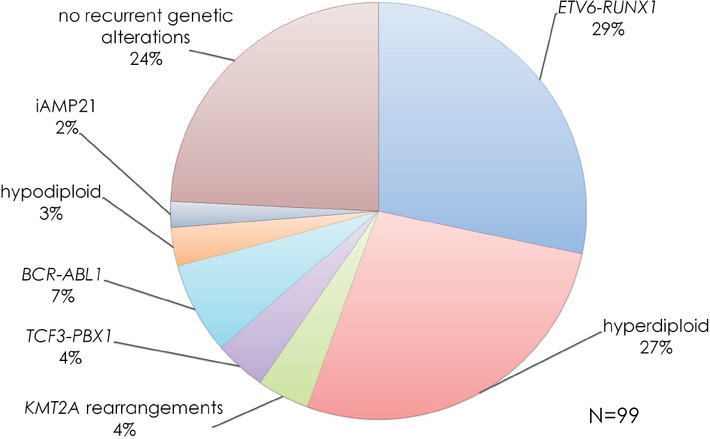
Figure 1
Prevalence of ALL subtypes in the Slovenian pediatric B-ALL cohort.
Table 1
The demographic and clinical characteristics of Slovenian B-ALL patients included in the study
| Characteristic | |
|---|---|
| Nr. of patients | 99 |
| Sex | |
| Male | 54 (54.5%) |
| Female | 45 (45.5%) |
| Primary genetic abnormalities | |
| ETV6-RUNX1 | 28 (28.3%) |
| BCR-ABL1 | 7 (7.1%) |
| KMTrearrangements 2A | 4 (4.0%) |
| TCF3-PBX1 | 4 (4.0%) |
| Hyperdiploidy | 27 (27.3%) |
| Hypodiploidy | 3 (3.0%) |
| iAMP21 | 2 (2.0%) |
| No abnormalities recurrent Age at diagnosis | 24 (24.2%) |
| < 1 | 3 (3.0%) |
| 1–5 | 57 (57.6%) |
| ≥ 6 Risk group | 39 (39.4%) |
| Standard risk | 17 (17.2%) |
| Intermediate risk | 59 (59.6%) |
| High risk | 23 (23.2%) |
| FC- minimal residual disease | |
| Day 15 | |
| < 0.1% | 35 (35.4%) |
| 0.1–10% | 48 (48.5%) |
| > 10% | 13 (13.1%) |
| Unknown | 3 (3.0%) |
| Day 33 | |
| < 0.01% | 73 (73.7%) |
| 0.01–1% | 20 (20.2%) |
| > 1% | 3 (3.0%) |
| Unknown | 3 (3.0%) |
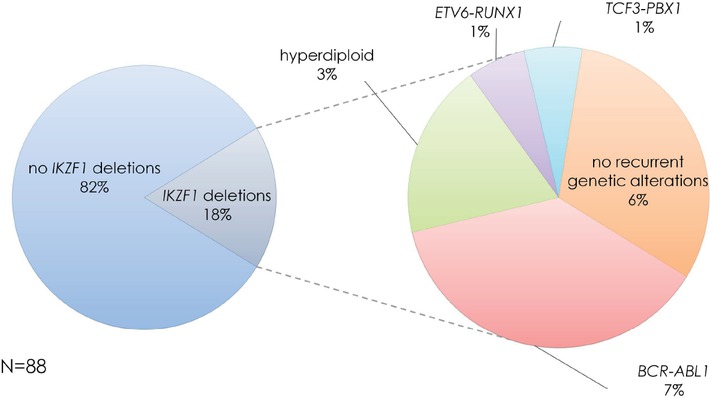
Figure 2
Primary genetic alterations in patients with IKZF1 deletions.
Table 2
Patients’ characteristics and response to treatment according to IKZF1 deletion status in 91 Slovenian pediatric B-ALL patients
| No IKZF1 deletion | IKZF1 deletion only | IKZF1plus | |
|---|---|---|---|
| Nr. of patients | 72 | 5 | 11 |
| Sex | |||
| Male | 34 (47.2%) | 5 (100%) | 9 (81.8%) |
| Female | 38 (52.8%) | 0 (0.0%) | 2 (18.2%) |
| Primary genetic abnormalities | |||
| ETV6-RUNX1 | 24 (33.3%) | 0 (0.0%) | 1 (9.1%) |
| BCR-ABL1 | 1 (1.4%) | 2 (40.0%) | 4 (36.4%) |
| KMT2A rearrangements | 4 (5.6%) | 0 (0.0%) | 0 (0.0%) |
| TCF3-PBX1 | 3 (4.2%) | 0 (0.0%) | 1 (9.1%) |
| Hyperdiploidy | 20 (27.8%) | 2 (40.0%) | 1 (9.1%) |
| Hypodiploidy | 2 (2.8%) | 0 (0.0%) | 1 (9.1%) |
| iAMP21 | 1 (1.4%) | 0 (0.0%) | 0 (0.0%) |
| No recurrent abnormalities | 18 (25.0%) | 1 (20.0%) | 3 (27.3%) |
| Age at diagnosis | |||
| < 1 | 3 (4.2%) | 0 (0.0%) | 0 (0.0%) |
| 1–5 | 41 (56.9%) | 2 (40.0%) | 5 (45.5%) |
| ≥ 6 | 28 (38.9%) | 3 (60.0%) | 6 (54.5%) |
| Risk group | |||
| Standard risk | 13 (18.1%) | 0 (0.0%) | 0 (0.0%) |
| Intermediate risk | 46 (63.9%) | 2 (40.0%) | 4 (36.4%) |
| High risk | 13 (18.1%) | 3 (60.0%) | 7 (63.6%) |
| FC- minimal residual disease | |||
| Day 15 | |||
| < 0.1% | 30 (41.7%) | 0 (0.0%) | 1 (9.1%) |
| 0.1–10% | 33 (45.8%) | 2 (40.0%) | 6 (54.5%) |
| > 10% | 6 (8.3%) | 3 (60.0%) | 4 (36.4%) |
| Unknown | 3 (4.2%) | 0 (0.0%) | 0 (0.0%) |
| Day 33 | |||
| < 0.01% | 56 (77.8%) | 0 (0.0%) | 8 (72.7%) |
| 0.01–1% | 13 (18.1%) | 3 (60.0%) | 2 (18.2%) |
| > 1% | 2 (2.8%) | 1 (20.0%) | 0 (0.0%) |
| Unknown | 1 (1.4%) | 1 (20.0%) | 1 (9.1%) |
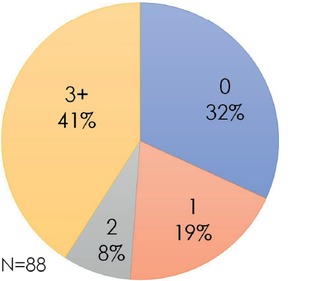
Figure 3
The number of CNVs present in Slovenian B-ALL samples.
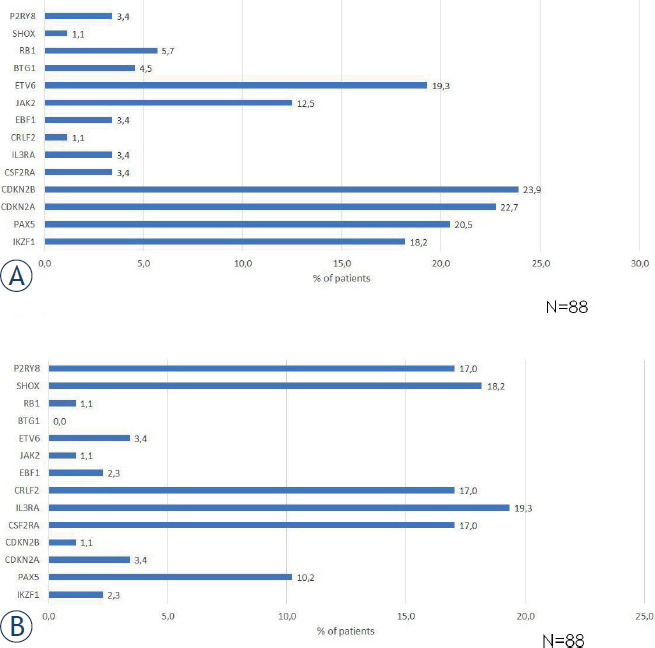
Figure 4
Frequency of copy number variations: (A) Gene deletions in the cohort. (B) Gene amplifications in the cohort.
BTG1 = BTG anti-proliferation factor 1; CDKN2A/2B = cyclin dependent kinase inhibitor 2A/2B; CRLF2 = cytokine receptor-like factor 2; CSF2RA = colony-stimulating factor 2 receptor α subunit; EBF1 = early B-cell factor 1; ETV6 = ETS variant 6; IKZF1 = IKAROS family zinc finger 1; IL3RA = interleukin 3 receptor subunit α; JAK2 = Janus kinase 2; PAX5 = paired box 5; P2RY8 = purinergic receptor P2Y8; SHOX = short-stature homeobox gene; RB1 = RB transcriptional corepressor 1
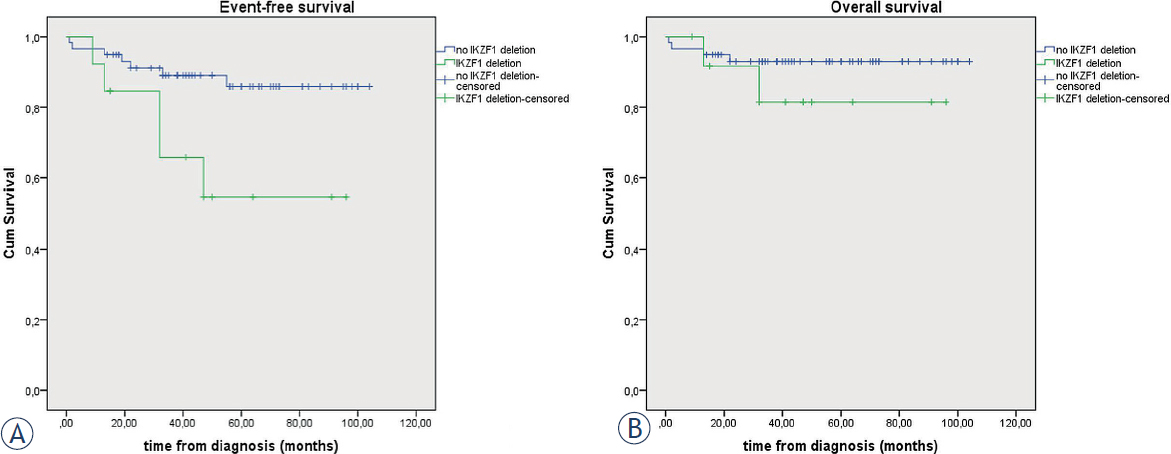
Figure 5
(A) Event-free survival in patients with or without IKZF1 deletions (5-year event-free survival [EFS] 54.8% vs. 85.9%, p = 0.016). (B) Overall survival in patients with or without IKZF1 deletions (5-year overall survival [OS] 81.5% vs. 93.0%, p = 0.295).
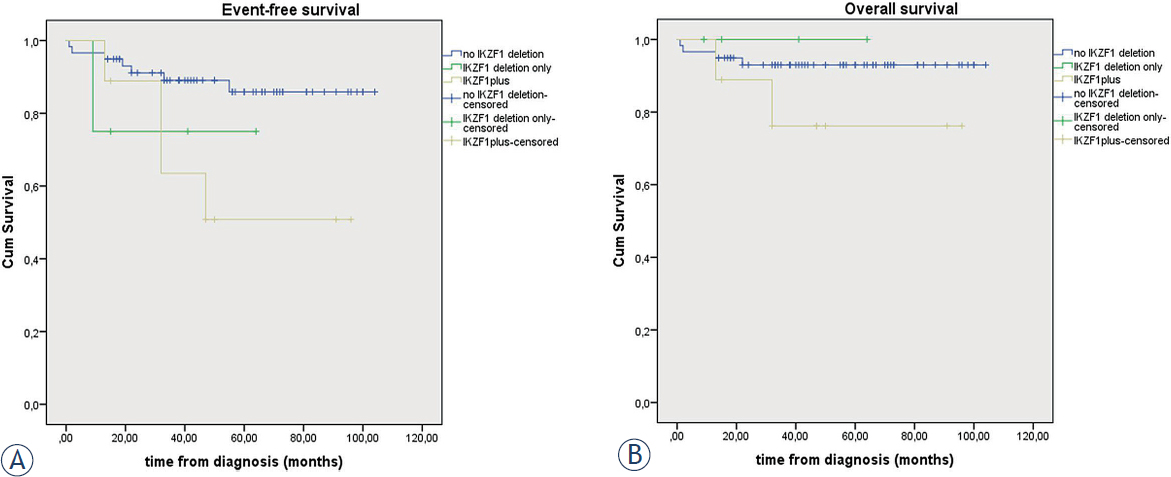
Figure 6
(A) Event-free survival in patients without IKZF1 deletions, with IKZF1 deletions only, and those with the IKZF1plus profile (5-year EFS 85.9% vs. 75.0% vs. 50.8%, p = 0.049). (B) Overall survival in patients without IKZF1 deletions, with IKZF1 deletions only and those with the IKZF1plus profile (5-year OS 93.0% vs. 100% vs. 76.2%, p = 0.290).