
Figure 1
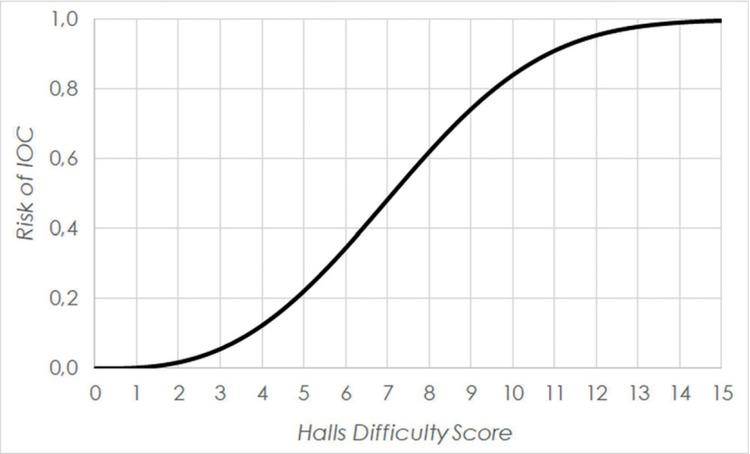
The continuous mean risk curve of intraoperative complication (IOC) as a function of the Halls difficulty score: the theoretical probability of intraoperative complication.11
Table 1
Baseline characteristics of 171 patients who underwent laparoscopic liver resection
| Baseline characteristics | Na,b |
|---|---|
| Male sexa | 104 (60.8%) |
| Age (years)b | 64 (20-86, 15) |
| BMI (kg/m2)b | 27 (18-50, 4.8) |
| 1 44 (25.7%) | |
| ASA scorea | 2 73 (42.7%) |
| 3 51 (29.8%) | |
| 4 3 (1.8%) | |
| Liver cirrhosis Child-Pugh (22)a | A 33 (19.3%) |
| B 4 (2.3%) | |
| Previous abdominal surgerya | 41 (24.0%) |
| Previous liver resectiona | 8 (4.6%) |
| Malignant tumoura | 128 (74.9%) |
| Neoadjuvant chemotherapya | 25 (14.6%) |
| Max. diameter (mm)b | 38 (2-160, 33) |
| Number of tumoursa | 1 (1-10, 0). |
| Deep location within livera | 50 (29.2%) |
| Posterosuperior liver segmentsa | 49 (28.7%) |
Table 2
Perioperative outcomes of 171 patients who underwent laparoscopic liver resection
| Intraoperative details and postoperative course | Na,b |
|---|---|
| Anatomic resection (23) a | 101 (59.1%) |
| Anatomically major resection (23) a | 27 (15.8%) |
| Technically major resection (24)a | 29 (17.0%) |
| Operation time (min)b | 160 (25-450, 90) |
| Blood loss (mL)b | 150 (0-2200, 180) |
| Intraoperative complication (10)c | 34 (19.9%) |
| Conversion to open approacha | 24 (14.0%) |
| Blood loss > 775 mLa | 12 (7.0%) |
| Unintentional damage to the surrounding structuresa | 2 (1.2%) |
| Hepatic pedicle clampinga | 45 (26.3%) |
| Total hepatic pedicle clamping time (min)b | 8 (0-75, 10) |
| Transfusion requireda | 20 (11.7%) |
| Pathohistological diagnosis | |
| Colorectal liver metastases | 53 (31%) |
| Hepatocellular carcinoma | 46 (29.6%) |
| Intrahepatic cholangiocarcinoma | 14 (8.2%) |
| Other metastases | 11 (6.4%) |
| Hepatic cysts | 10 (5.8%) |
| Hepatic adenoma | 6 (4.7%) |
| Focal nodular hyperplasia | 8 (4.7%) |
| Haemangioma | 6 (3.5%) |
| Other pathology | 15 (8.8%) |
| R0 resection | 163 (95.3%) |
| Major morbidity CD 3a–4b (25)a | 21 (12.3%) |
| Hospital stay (days)b | 6 (2-79, 4) |
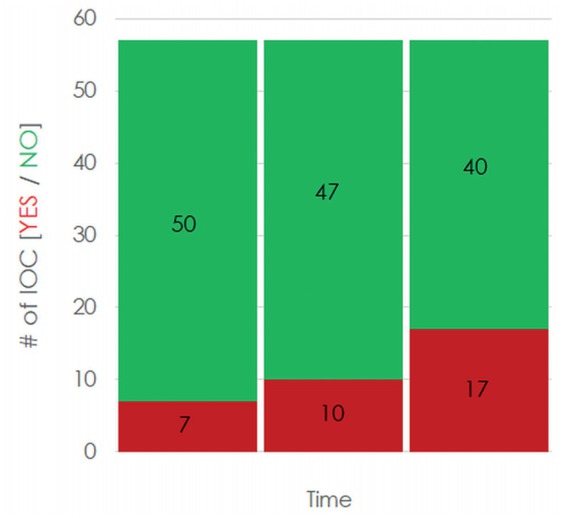
Figure 2
Histogramic time classes dependency of intraoperative complication (IOC) (yes/no) on the observed cohort.
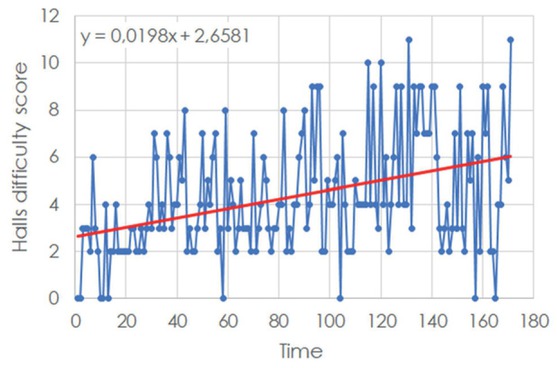
Figure 3
Time dependency of the Halls difficulty score on the observed cohort (blue points) and its regression (trend) line (red line).
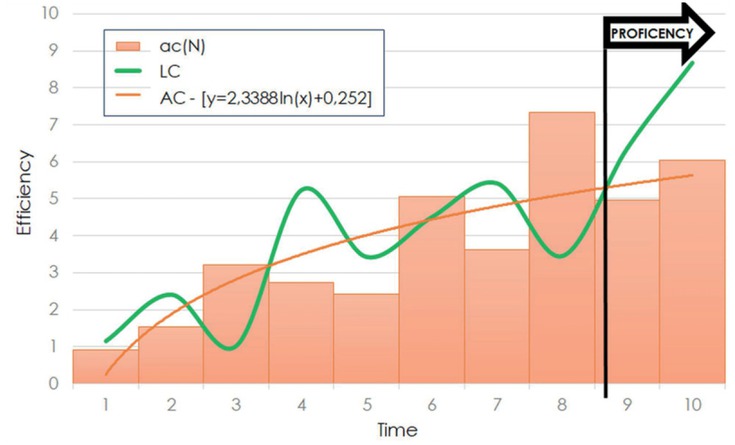
Figure 4
Two types of learning curves for observed cohort and the surgeon under consideration. The orange line (AC) represents the logarithmic regression curve based on absolute complexity. The green line (LC) represents the sum of the orange curve and the quintic regression line of relative complexity. This line represents our learning curve.
AC = absolute complexity; ac (N) = absolute complexity expressed by the number of intraoperative complications; LC = learning curve