
Table 1
MRI classification of cerebral cavernomas according to Zabramski et al.: type I, type II and an additionally proposed new type V are associated with higher prospective hemorrhage rates, as published by Nikoubashman et al. in connection with non-radiation induced cavernomas13,14
| Lesion type | MRI signal characteristics | Pathological characteristics |
|---|---|---|
| Type I | T1: hyperintense core T2: hyper- or hypointense core with surrounding hypointense rim | Subacute hemorrhage, surrounded by a rim of hemosiderinstained macrophages and gliotic brain |
| Type II | T1: reticulated mixed-signal core hypointense rim | Loculated areas of hemorrhage and thrombosis of varying ages, surrounded by gliotic, hemosiderin-stained brain; in large lesions, areas of calcification may be seen |
| T2: reticulated mixed-signal core with surrounding | ||
| Type III | T1: iso- or hypointense core | Chronic resolved hemorrhage, with hemosiderin staining within and around the lesion |
| T2: hypointense with a hypointense rim that magnifies the size of the lesion | ||
| GE: hypointense with greater magnification than T2 | ||
| Type IV | T1: poorly seen or not visualized at all T2: poorly seen or not visualized at all GE: punctate hypointense lesions | Two lesions in the category were pathologically documented as telangiectasias |
| Type V | T1 and T2: visible parts in the center of the actual cavernoma; the cavernoma is not fully distinguishable from hemorrhage |
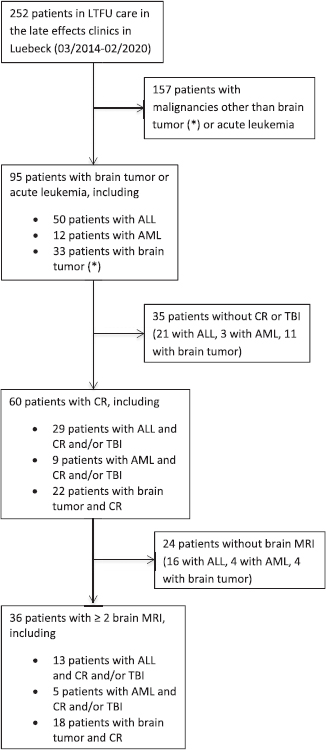
Figure 1
Flowchart of the patient selection process.
* = craniopharyngeoma, ependymoma, germinoma, medulloblastoma; ALL = acute lymphoblastic leukemia; AML = acute myeloid leukemia; CR = cranial radiotherapy; LTFU = long-term follow-u; MRI = magnetic resonance imaging; TBI = total body irradiation
Table 2
Cranial radiotherapy according to treatment protocols
| Tumor entity | Dose/day | Number of fractions |
|---|---|---|
| ALL | 1.5 Gy | 8, 12, 16, 20 or 26 |
| AML | 1.5 Gy | 8 or 10 |
| Pilocytic Astrocytoma | 1.8 Gy | 28 or 30 |
| Germinoma | 1.6 Gy | 15 or 25 |
| 1.8 Gy | 30 or 34 | |
| Medulloblastoma | 2 x 1.0 Gy (hyperfractionated) | 30 or 34 |
Table 3
Patient characteristics, therapy data, findings of radiation-induced cavernomas and other comorbidities
| No. | Gender (F=female; M=male) | Initial tumor diagnosis | Age at diagnosis (years) | Cumulative radiation dose to the brain (Gy) | Total number of brain MRI | Detection of RIC | Latency between CR and RIC (years) | Zabramski classification | RIC localization (1=supratentorial; 2=infratentorial; 3=both) | RIC dynamic | Other benign tumors in follow-up brain MRI | Leukoencephalopathy (mild; moderate; extensive) | Brain atrophy (mild; mode-rate; severe) | Other comorbidities in the long term | Period of follow-up (years) |
|---|---|---|---|---|---|---|---|---|---|---|---|---|---|---|---|
| 1 | F | ALL | 17 | 24 | 9 | Meningioma | moderate | - | COPD, hyperparathyroidism, hypercholesterolemia, migraine | 44 | |||||
| 2 | F | ALL | 1 | 12 | 2 | mild | - | Lipedema, fibroepithelioma | 26 | ||||||
| 3 | F | ALL | 3 | 12 | 2 | - | - | Class I obesity | 22 | ||||||
| 4 | F | ALL | 7 | 8 | 2 | mild | - | CRF, class II obesity, hypercholesterolemia, hypopituitarism, thyroid nodules | 37 | ||||||
| 5 | F | ALL | 3 | 24 | 4 | + | 40 | II | 3 | + | Meningioma | extensive | mild | Hypercholesterolemia, class I obesity, thyroid nodules, scoliosis, myoma uteri | 44 |
| 6 | F | ALL | 21 | 24 | 2 | + | 10 | IV | 1 | mild | - | Reduced left ventricular ejection fraction, class III obesity, multiple vein thrombosis | 13 | ||
| 7 | M | ALL | 5 | 12 | 2 | - | - | Hypercholesterolemia | 19 | ||||||
| 8 | F | ALL | 9 | 12 | 2 | mild | - | Hypercholesterolemia | 28 | ||||||
| 9 | M | ALL | 11 | 30 | 9 | mild | - | Hypogonadism, hypercholesterolemia, | 13 | ||||||
| 10 | F | ALL | 7 | 30.6 | 3 | + | 29 | IV | 1 | Meningioma | moderate | - | Basalioma, hyperparathyroidism, class II obesity, thyroid nodules | 33 | |
| 11 | F | ALL | 5 | 39 | 6 | Vestibular schwannoma, DD aneurysmal bone cyst | mild | - | Diabetes mellitus type 2, hypercholesterolemia, steatosis hepatis, congestive heart failure, restrictive lung disease, thyroid nodules, deep vein thrombosis, basalioma, CRF, vestibular schwannoma | 39 | |||||
| 12 | M | ALL | 2 | 30 | 2 | moderate | - | Thyroid Nodules, hypopituitarism, diabetes mellitus type 2, CRF, steatosis hepatis, cataract | 35 | ||||||
| 13 | F | ALL | 2 | 12 | 4 | moderate | - | Intellectual disabiliy | 17 | ||||||
| 14 | F | AML | 14 | 12 | 2 | + | 21 | IV | 1 | mild | - | Thyroid nodules, hypercholesterolemia, hypertension, spondyloarthritis | 26 | ||
| 15 | M | AML | 15 | 12 | 2 | - | - | Thyroid nodules, restrictive lung type disease, 1, hypogonadism, diabetes mellitus hypercholesterolemia | 31 | ||||||
| 16 | F | AML | 16 | 12 | 3 | + | 28 | IV | 3 | moderate | - | Thyroiditis | 18 | ||
| 17 | F | AML | 2 | 15 | 2 | + | 21 | IV | 3 | - | - | Cataract, hypercholesterolemia, depression | 24 | ||
| 18 | F | AML | 8 | 12 | 3 | - | - | CRF, class ii obesity, chronic pain, visual impairment | 14 | ||||||
| 19 | M | PA | 1 | 54 | 28 | + | 23 | IV | 3 | moderate | moderate | Hypopituitarism, stroke, epilepsia, hearing loss, hypercholesterolemia, gallstones | 29 | ||
| 20 | M | PA | 17 | 50.4 | 24 | moderate | - | Hypercholesterolemia | 11 | ||||||
| 21 | M | Germinoma | 17 | 40 | 16 | mild | - | Hypopituitarism, chronic renal failure | 5 | ||||||
| 22 | M | Germinoma | 14 | 24 | 20 | mild | - | Hypopituitarism, class I obesity, depression, hypercholesterolemia | 9 | ||||||
| 23 | M | Germinoma | 10 | 40 | 21 | + | 5 | IV | 1 | moderate | - | Depression, hypercholesterolemia, hypopituitarism | 12 | ||
| 24 | M | CP | 17 | n.a. | 15 | mild | - | Hypopituitarism, class I obesity, hypercholesterolemia, autoimmune polyendocrine syndrome type 2 with diabetes mellitus type 1, vitiligo, thyroiditis | 13 | ||||||
| 25 | F | Medulloblastoma | 7 | 55 | 3 | + | 27 | IV | 2 | Meningioma | - | mild | Hypothyroidism, thyroid nodules, hearing loss,asthma | 28 | |
| 26 | M | Medulloblastoma | 8 | 54 | 25 | + | 5 | IV | 3 | + | mild | - | Hypopituitarism, hearing loss | 14 | |
| 27 | M | Medulloblastoma | 8 | 54 | 21 | + | 2 | I | 3 | + | moderate | moderate | Hypopituitarism, hearing loss | 10 | |
| 28 | M | Medulloblastoma | 13 | 54 | 24 | + | 5 | IV | 2 | + | moderate | - | Hypopituitarism, loss, class I obesity, epilepsy, tetraparesis hearing | 10 | |
| 29 | M | Medulloblastoma | 11 | 68.6 | 24 | + | 2 | IV | 3 | + | - | mild | Spinal hygroma, hypothyrodism, growth hormone deficiency | 14 | |
| 30 | M | Medulloblastoma | 6 | 68.6 | 18 | + | 7 | IV | 3 | + | - | - | Hypopituitarism, hearing loss, intellectual disability | 19 | |
| 31 | M | Medulloblastoma | 9 | 60 | 3 | + | 29 | II | 2 | mild | - | Basalioma, hearing loss, intellectual disability | 30 | ||
| 32 | F | Medulloblastoma | 25 | 60 | 6 | + | 18 | IV | 3 | extensive | moderate | Coxarthrosis with total endoprothesis, gonarthrosis | 18 | ||
| 33 | M | Medullo- blastoma | 2 | 60 | 13 | + | 7 | IV | 3 | moderate | mild | Visual Impairment, groth hormone deficiency, hypothyroidism, intelectual disability, hearing loss, steatosis hepatis | 17 | ||
| 34 | F | Ependy-moma | 12 | 68 | 31 | + | 13 | IV | 3 | moderate | mild | Hypopituitarism, chronic renal failure | 13 | ||
| 35 | F | Ependy-moma | 6 | 72 | 28 | extensive | - | - | 13 | ||||||
| 36 | F | Ependy-moma | 7 | 68 | 10 | mild | - | Asthma bronchiale | 13 |
[i] ALL = acute lymphoblastic leukemia; AML = acute myeloid leukemia; CRF = cancer related fatigue; COPD = chronic obstructive pulmonary disease; CP = craniopharyngeoma; CR = cranial radiotherapy; DD = differential diagnosis; MRI = magnetic resonance imaging; n.a. = not available; PA = pilocytic astrocytoma; PCHT = polychemotherapy; RIC = radiation-induced cavernomas
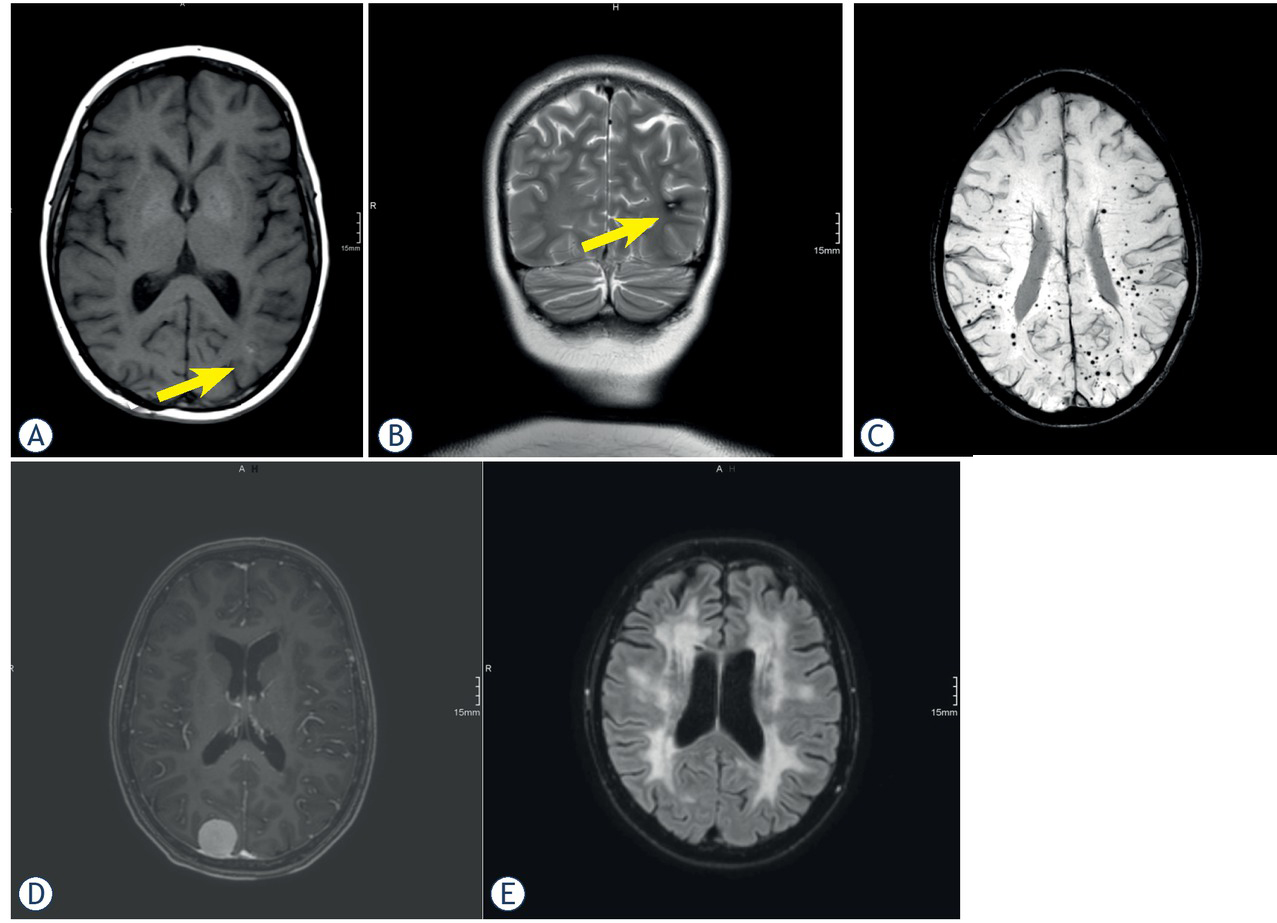
Figure 2
Examples of radiation-induced cavernomas with a type II lesion (A, B) and multiple type IV lesions (C) according to the Zabramski classification. Radiation-induced meningioma (D) and leukoencephalopathy with brain atrophy (E).