
Table 1
MRI classification of Morel-Lavallee lesions according to Mellado-Bencardino12
| Lesion type | T1W | T2W | Morphology | Other |
|---|---|---|---|---|
| Type 1 - Seroma | Homogenously hypointense seroma | Hyperintense collection | Laminar | No evidence of outer capsule formation |
| Type 2 – Subacute hematoma | Homogenously hyperintense | Homogenously hyperintense | Oval | Presence Thin capsule of methaemoglobin formation |
| Type 3 – Chronic organizing hematoma | Hypointense | Heterogeneous hypointense/ isointense | Oval | Thick capsule formation Capsular and internal enhacement on postcontrast sequences |
| Type 4-Closed laceration | Hypointense | Hyperintense | Linear | No capsule formation |
| Type pseudonodular 5-Small, rounded appearance | Variable | Variable | Round | Variable capsule formation |
| Type 6-Superimposed infection | Variable | Variable | Variable sinus tract | Thick enhancing capsule |
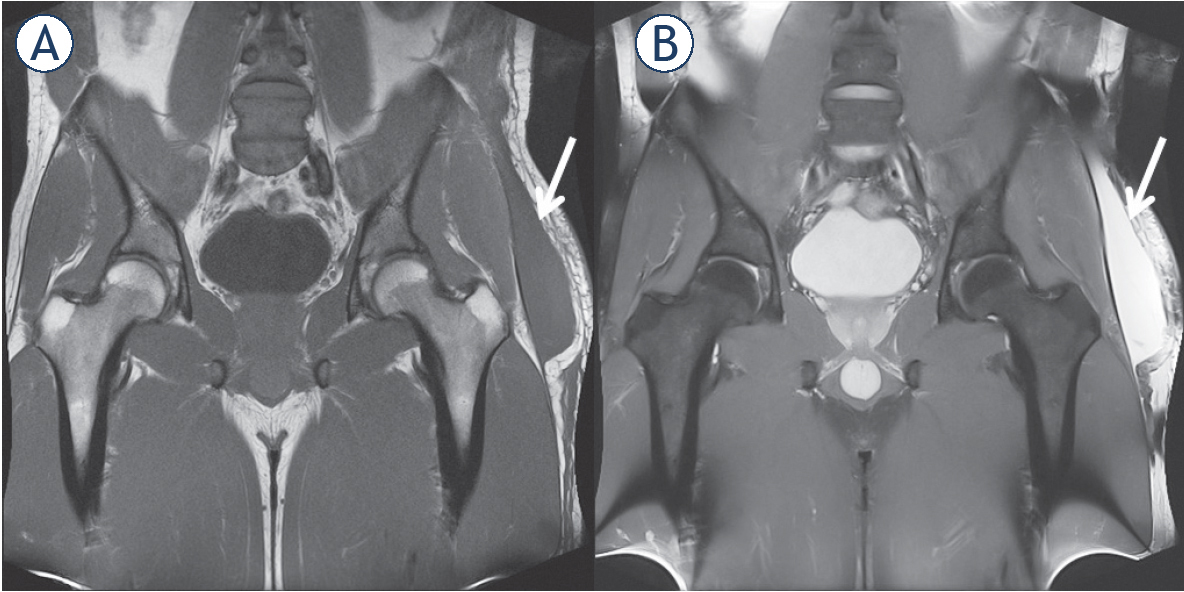
Figure 1
Morel-Lavallee lesion type 1. A 33-years-old professional skier 2 weeks after a fall. A large fusiform collection (arrows) between the subcutaneous fat and fascia lata demonstrating low signal intensity (SI) on T1 WI (A) and high SI on proton density fat-saturated image (PDFS) (B) in coronal plane indicating clear fluid i.e. seroma.
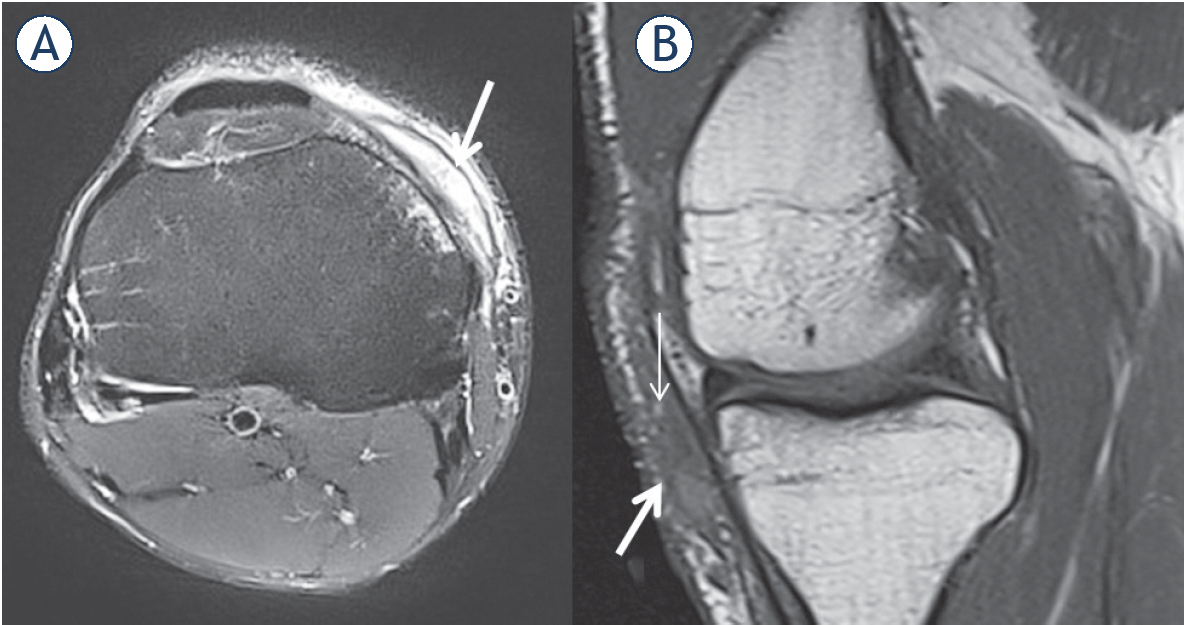
Figure 2
ML lesion type 3. A 34-year-old male after a distortion. On axial protondensity fat-suppression (PDFS) MRI (A) a fusiform fluid collection with hypointense debris is demonstrated between the deep subcutaneous fat and layers of medial patelofemoral ligament (arrows). On T1 weighted sagital image (B), in moderately hypointense collection several fat globules are visible (thin arrow).
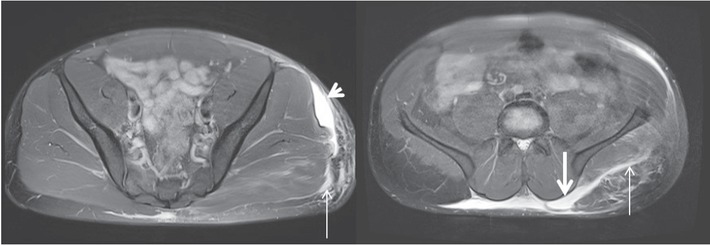
Figure 3
Extension of the Morel-Lavallée (ML) lesion. Same patient as in the Figure 1. On axial proton-density fat-suppression (PDFS) images, a thin communication (thin arrows) between gluteus maximus muscle and the deep gluteal fat connects the primary lesion (thick short arrow) and another collection posteriorly (thick arrow). Note also the mild oedema signal of the gluteus maximus muscle and gluteal fat indicating contusions.
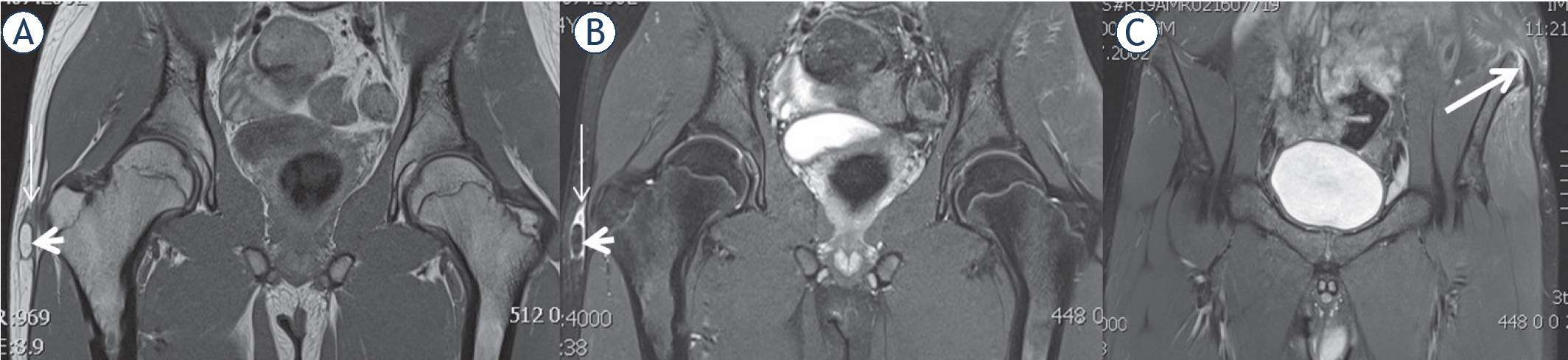
Figure 4
Fat globule and concomitant injury. In this 14-year-old boy with unknown time and mechanism of injury, a small fusiform fluid collection is visible at the right side between deep subcutaneous fat and fascia lata with low T1 (A) and high proton-density fat-suppression (PDFS) (B) SI (thin arrows) on coronal images. Note also a large fat globule in the lesion (short thick arrows). In addition, on the left side (C), an small avulsion of the sartorious tendon off the anterior superior iliac spine is visible (long thick arrow).
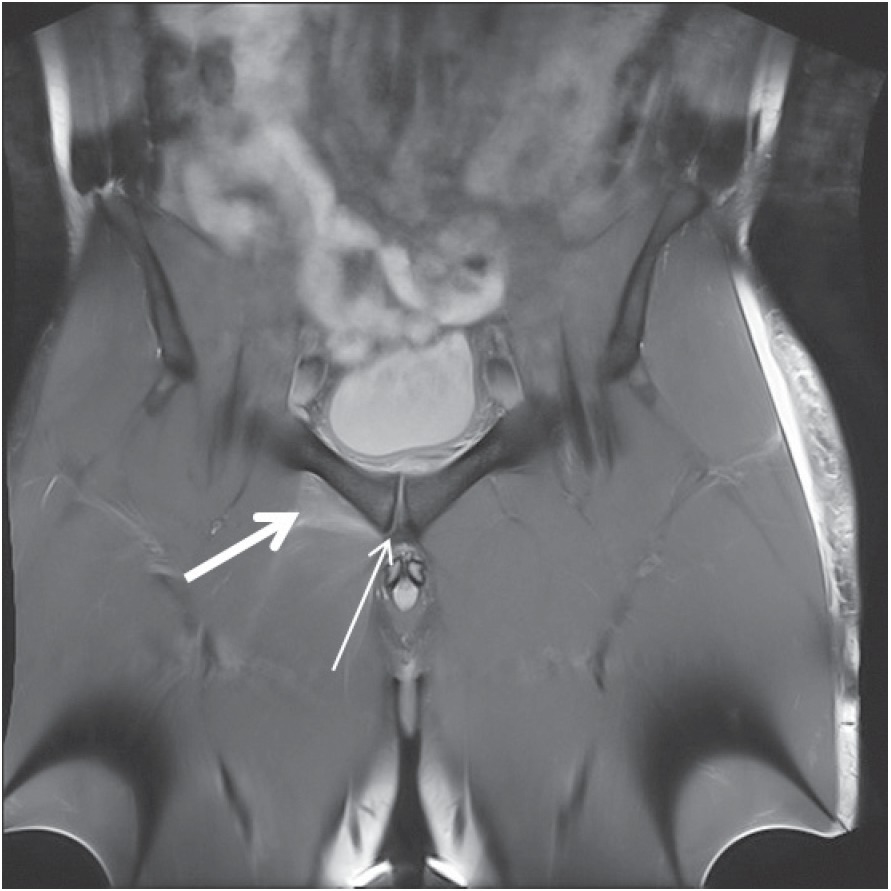
Figure 5
Concomitant injuries. Same patient as in Figure 1 and 3. In proton-density fat-suppression (PDFS) coronal image, a mild hyperintensity of adductor muscles is visible (thick arrow) indicating mild distension without fibre disruption. In addition, note secondary cleft sign (thin arrow) at the lower right edge of the pubic symphysis indicating possible injury of the rectus/adductor aponeurosis. In such case, a dedicated MRI examination might be warranted.