
Table 1
Inclusion criteria for the use of CT navigation (if three or more criteria were met)
| Non-palpable stone |
| Difficult or impossible sialendoscopic visualization of the stone |
| Far proximal stone |
| Presumably fixed stone |
| Extraluminal stone (in an abscess or deeply embedded) |
| Salvage procedure with previously failed sialendoscopy or sialendoscopy-assisted procedure |
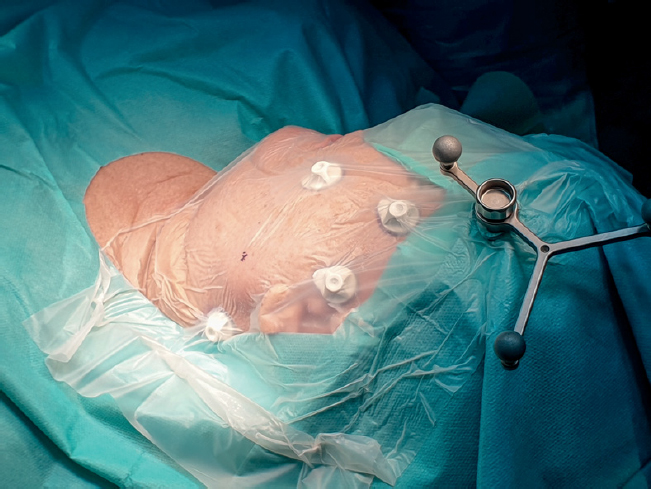
Figure 1
Patient, prepared for surgery. With fiducial markers attached to the skin and navigational star on the patient’s forehead (BrainLab, Munchen, Germany).
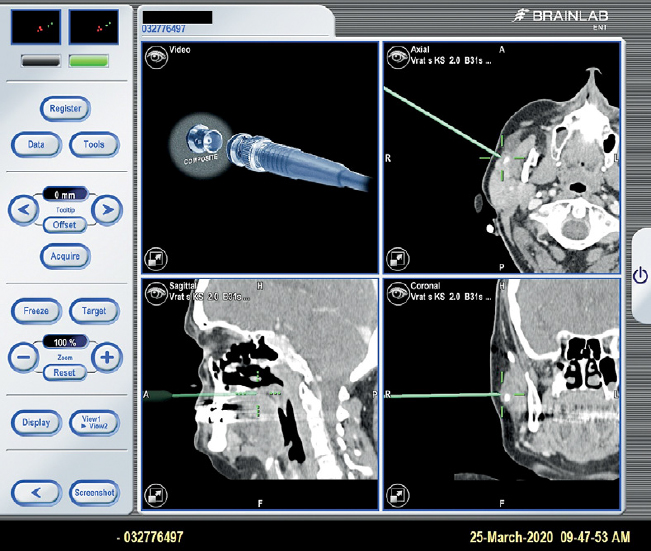
Figure 2
After identifying the skin’s reference point with the stone being visible in the three-axis, the surgical trajectory is checked by the navigation.
Table 2
Patients and sialendoscopic operations at the Department of Otorhinolaryngology and Cervicofacial Surgery, University Clinical Center Ljubljana, Slovenia, January 2012 – November 2020
| All operations | 415 (100%) | |
|---|---|---|
| Operated salivary ductal | Submandibular | 273 (66%) |
| system | Parotid | 142 (34%) |
| Local | 302 (72.8%) | |
| Anesthesia | General | 113 (27.2%) |
| All | 372 | |
| Male | 193 (51.8%) | |
| Patients | ||
| Female | 179 (48.1%) | |
| Age (average, span − in years) | 48 (4−84) | |
| Ultrasound | 372 (100%) | |
| Mandibular occlusal radiography | 17 (4.6%) | |
| Radiology diagnostics | CT | 143 (38.4%) |
| MR sialography | 8 (2.2%) | |
| X-ray sialography | 2 (0.5 %) | |
| All | 247 | |
| The type of interventional | Salivary stone extraction | 178 |
| procedure | Stricture dilatation | 69 |
| Stent insertion (after stricture dilatation or stone extraction) | 145 |
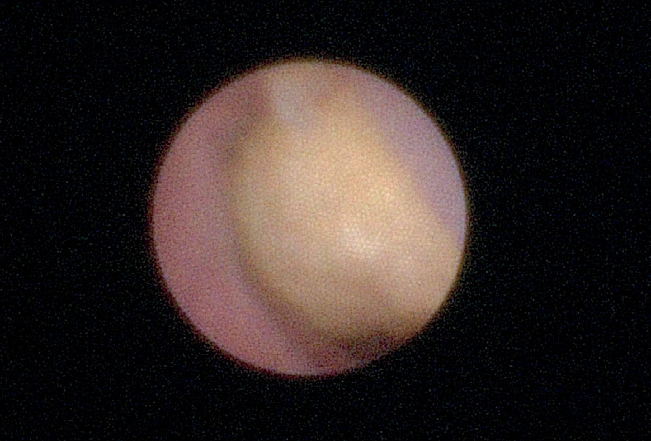
Figure 3
In case the stone is at least partially sialendoscopically visible, it can represent a backup guidance in a challenging final combined approach.
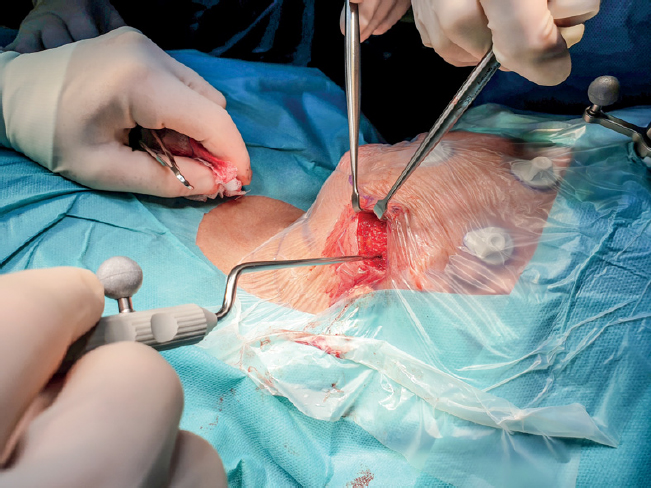
Figure 4
All stones were removed following the navigational trajectory with a transcutaneous or transoral approach.
Table 3
Sialendoscopy-assisted transcutaneous salivary stone extractions with or without the use of navigation at the Department of Otorhinolaryngology and Cervicofacial Surgery, University Medical Centre Ljubljana, Slovenia
| Gland / Stone extraction outcome | Parotid gland | Submandibular gland | Total |
|---|---|---|---|
| Successful | 4 | 6 | 10 |
| Successful (with navigation) | 2 | 3 | 5 |
| Successful last attempt wire basket retrieval (transcutaneous approach failed) | 1 | 1 | |
| Total | 6 | 10 | 16 |
Table 4
Sialendoscopy and navigation-assisted combined approach procedures at the Department of Otorhinolaryngology and Cervicofacial Surgery November 2019 – November 2020
| Patient | (years) Age | Sex | History | Site | Stone palpability | Stone location | Stone visibility | Fixation | Approach | Stone size (millimeters) | Final depth reached with sialendoscope (millimeters) | Follow-up |
|---|---|---|---|---|---|---|---|---|---|---|---|---|
| 1 | 67 | F | Acute abscess formation | Left parotid | No | Within the abscess cavity | Not visible | - | Transcutaneous sialendoscopy- assisted | 5 (SPH) | 72 | Without complaints 14 months |
| 2 | 46 | M | Advanced sialolithiasis | Right submandibular | No | 55 millimetres depth | Partially visible | Fixed | Transcutaneous sialendoscopy- assisted | 10 (SPH) | 60 | Without complaints 12 months |
| 3 | 60 | F | Persisting swelling | Right parotid | No | 45 millimetres depth | Partially visible | Fixed | Transcutaneous sialendoscopy- assisted | 7 x 4 x 3 | 65 | Without complaints 11 months |
| 4 | 70 | M | Advanced sialolithiasis | Left submandibular | No | 64 millimetres depth | Non visible | Fixed | Transcutaneous sialendoscopy- assisted | 10 (SPH) | 75 | Without complaints 11 months |
| 5 | 21 | M | Persistent swelling | Left submandibular | No | 100 millimetres depth | Not visible | Fixed | Transcutaneous sialendoscopy- assisted | 3 (intraglandular, found after gland resection) | 90 | resection After gland without complaints 7 months |
| 6 | 34 | M | Floor of the mouth phlegmona | Left submandibular | No | 28** milimetres depth | Not visible | Fixed | sialendoscopy- Transoral assisted | 6 x 4 x 3 | 62 | Without compaints 14 months |