
Table 1
| T | assessment |
|---|---|
| T1 | Tumour limited to external auditory canal without bony erosion or evidence of soft tissue involvement |
| T2 | Tumour with limited external auditory canal bone erosion (not full thickness) or limited (<0.5 cm) soft-tissue involvement |
| T3 | Tumour eroding osseous external auditory canal (full thickness) with limited (<0.5 cm) soft tissue involvement or tumour involving the middle ear and/or mastoid |
| T4 | Tumour eroding cochlea, petrous apex, medial wall of the middle ear, carotid canal, jugular foramen or dura, or with extensive soft tissue involvement (>0.5 cm) such as involvement of temporomandibular joint or styloid process, or evidence of facial paresis |
| N | assessment |
| N0 | No regional lymph node metastasis |
| N1 | Regional lymph node metastasis |
| M | assessment |
| M0 | No distant metastasis |
| M1 | Distant metastasis |
| Stage | group |
| I | T1N0M0* |
| II | T2N0M0* |
| III | T3N0M0‡, T1N1M0‡ |
| IV | T4N0M0‡, T2–4N1M0‡, T1–4N0–1M1† |
[i] The TNM assessment is based on the clinical examination and imaging findings. This staging system has been applied to assess primary external auditory canal cancer and primary middle ear cancer.1 Middle ear cancer is assessed as at least T3, therefore always locoregionally advanced.
T = tumour; N = regional lymph node metastasis; M = distant metastasis; * = localised cancer; ‡ = locoregionally advanced cancer; † = systemically advanced cancer
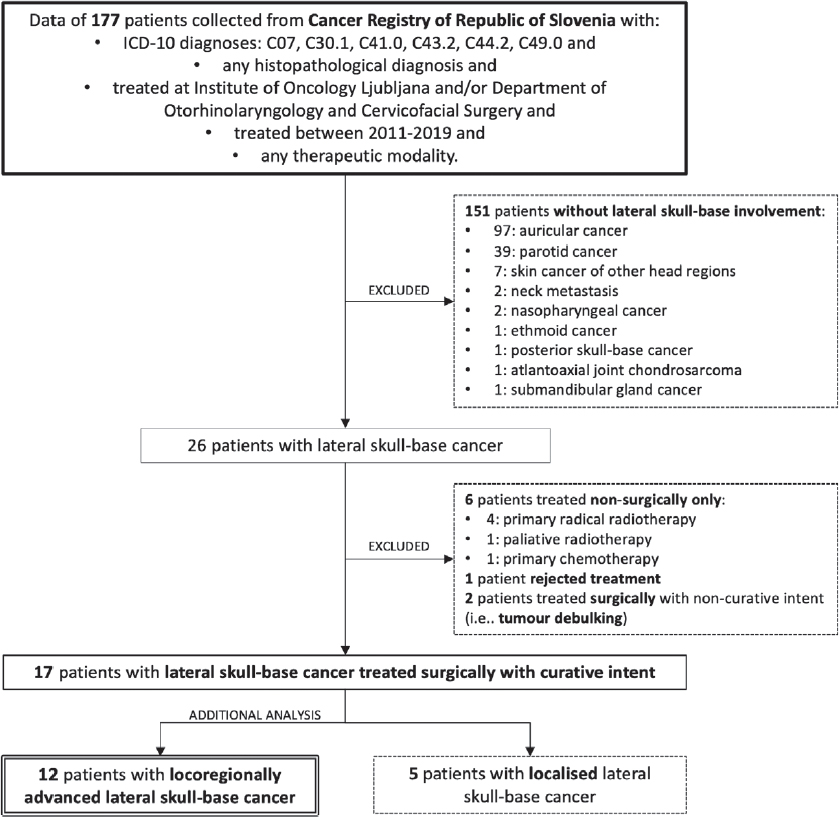
Figure 1
Data acquisition flowchart of patients with lateral skull-base cancer. Data of 177 patients were thoroughly analysed using Cancer Registry of the Republic of Slovenia and databases of Department of Otorhinolaryngology and Cervicofacial Surgery, University Medical Centre Ljubljana, Slovenia and Institute of Oncology Ljubljana, Slovenia. The majority of excluded patients suffered from auricular or parotid cancer without lateral skull-base involvement. Additional analysis was performed on the data of locoregionally advanced cancer.
ICD = International statistical classification of diseases and related Health problems 10th revision
Table 2
Dataset of patients with lateral skull-base cancer treated between 2011 and 2019
| cT | cN | cM | Grade | |||||||||||||||
|---|---|---|---|---|---|---|---|---|---|---|---|---|---|---|---|---|---|---|
| 80M | 2012 | aEECR | C44.2 | SCC | cT4* | cN1* | cM0* | IVP | CTSB, USN | yes | SURG➜RT | WLE | partial | iSND | none | PM | R1 | 8.1 |
| 79M | 2014 | EACCR | C44.2 | BCC | cT1P | cN0P | cM0P | IP | CTSB | none | SURG | WLE | none | none | yes | skin graft | R0 | 6.9 |
| 52M | 2014 | EACCL | C44.2 | SCC | cT4P | cN0P | cM0P | IVP | MRISB, CTSB, USN | yes | SURG | LTBR | partial | iSND | none | primary closure | R0 | 5.7 |
| 90F | 2015 | EACCL | C44.2 | SCC | T3P | cN0P | cM0P | IIIP | CTSB, USN | yes | SURG | LTBR | none | none | none | primary closure | R0 | 5.5 |
| 59M | 2017 | EACCL | C44.2 | ACC | cT4P | cN0P | cM0P | IVP | MRISB, CTSB, USN | yes | SURG➜RT | LTBR | partial | iSND | none | primary closure | R1 | 5.2 |
| 50M | 2017 | EACCL | C44.2 | BCC | cT P | cN0P | cM0P | IP | MRISB | none | ECT»SURG | WLE | partial | none | none | primary closure | R0 | 4.5 |
| 85F | 2017 | aEECR | C44.2 | BCC | cT2* | cN0* | cM0* | II* | USN | none | SURG | WLE | none | none | none | primary closure | R0 | (†2.9 88) |
| 75M | 2018 | aEECL | C44.2 | BCC | cT1* | cN0* | cM0* | I* | none | none | SURG | WLE | none | none | none | skin graft | R0 | (†2.8 78) |
| 79M | 2018 | MECR | C30.1 | SCC | cT3P | cN0P | cM0P | IIIP | MRISB, CTSB, MRIN | yes | SURG | LTBR | none | none | none | primary closure | R1 | (†0.4 80) |
| 67M | 2018 | aEECR | C44.2 | BCC | cT4a* | cN0* | cM0* | IVa* | MRISB, CTSB | yes | SURG | LTBR+ | partial | iSND | none | RFFF | R0 | 2.3 |
| 66F | 2019 | EACCL | C44.2 | SCC | cT1P | cN1P | cM0P | IIIP | MRISB, CTSB | yes | SURG | WLE | none | iSND | none | secondary intention | R0 | 2.0 |
| 76M | 2019 | aEECR | C44.2 | SCC | cT3* | cN0* | cM0* | III* | MRISB, CTSB | yes | RT»SURG | LTBR+ | partial | iSND | none | PM | R0 | 2.4 |
| 85M | 2012 | MECR | C30.1 | SCC | cT3P | cN0P | cM0P | IIIP | CTSB, USN | yes | SURG➜RT | LTBR | none | none | none | primary closure | R0 | (†0.5 85) |
| 73F | 2014 | aEECL | C44.2 | BCC | cT4a* | cN0* | cM0* | IVa* | MRISB, CTSB, USN | yes | RT»ECT»SURG | LTBR+ | partial | iSND | none | RFFF | R0 | 1.6 |
| 58F | 2014 | aPCR | C07 | MC | cT4a** | cN0** | cM0** | IVa** | MRISB, CTSB | yes | SURG➜RT»SURG | LTBR+ | performed previously | iSND | none | ALT | R0 | 0.6 |
| 85F | 2015 | aPCR | C07 | AC | cT4a* | cN2b* | cM0* | IVa* | CTSB | yes | SURG➜RT | MWLE | total | iMRND | none | ALT | R0 | 0.3 |
| 84M | 2017 | aEECL | C44.2 | SCC | cT2* | cN0* | cM0* | II* | USN | none | SURG➜RT | WLE | partial | iSND | none | secondary intention | R0 | 0.8 |
[i] Locoregionally advanced cancer is shown in bold. Age and survival are depicted in years
AC = adenocarcinoma; ACC = adenoid cystic carcinoma; aEEC = advanced skin cancer of external ear (including auricle, concha or periauricular skin); Age = age at the time of cancer diagnosis; ALT = anterolateral thigh free flap; aPC = advanced parotid cancer; BCC = basal cell carcinoma; CT= skull-base computed tomography; SB EACC = primary external auditory canal cancer; ECT = electrochemotherapy; ECT»SURG = ECT was performed with primary curative intent and surgery as salvage; F = female; HP = histopathological diagnosis; ICD-10 = international classification of diseases, 10th revision; iMRND = ipsilateral modified radical neck dissection; iSND = ipsilateral selective neck dissection; L = left; LTBR = lateral temporal bone resection; LTBR+ = lateral temporal bone resection with wide local excision; M = male; MWLE = mastoidectomy with wide local excision; MC = mucoepidermoid carcinoma; MEC = primary middle ear cancer; MRIN = neck magnetic resonance imaging; MRI= skull-base MRI; P = modified Pittsburgh staging SB system; PM = pectoralis major myocutaneous flap; PTA = pure tone audiometry performed prior surgery; R = right; R0 = no residual tumour; R1 = microscopic residual tumour; RFFF = radial forearm free flap; RT = radiotherapy; RTC = residual tumour classification according to the UICC staging system; SCC = squamous cell carcinoma; SURG = surgery; SURG➜RT = combined surgery and postoperative radiotherapy; TMJ = temporomandibular joint; US= neck ultrasound; WLE = wide local excision; Year = year of N cancer diagnosis; * = Union for International Cancer Control (UICC) staging system for skin carcinoma of the head and neck ** = UICC staging system for major salivary glands; † with a number = an age at death
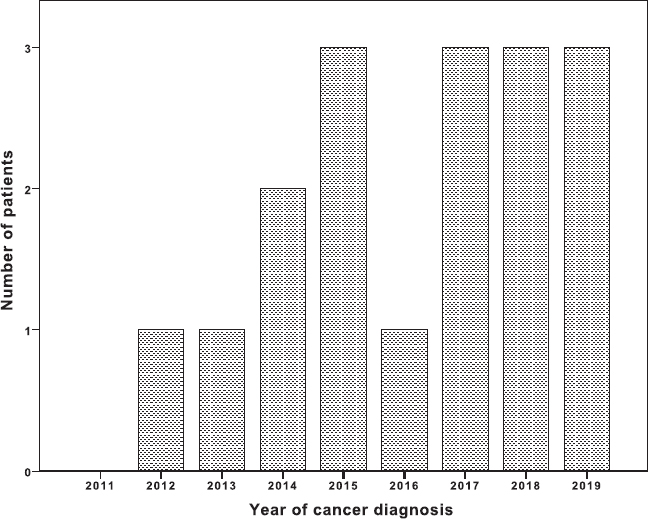
Figure 2
Barchart of seventeen patients with lateral skull-base cancer treated with curative intent between 2011 and 2019.
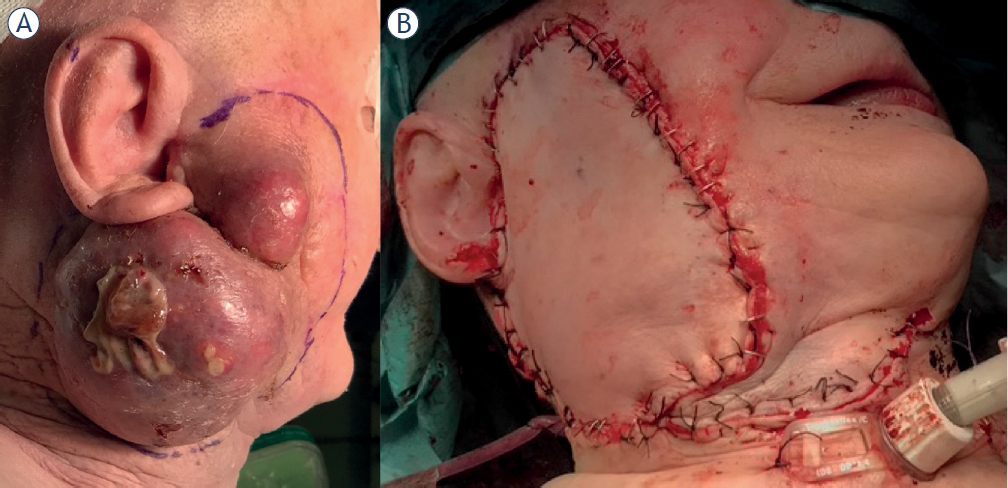
Figure 3
85-year old female with locoregionally advanced parotid adenocarcinoma (i.e., parotid metastasis after incomplete temporal skin adenocarcinoma cancer resection) extending to the right external auditory canal and lateral skull-base. The resection margin is outlined (A). Primary surgery involving mastoidectomy with wide local excision, total parotidectomy, modified radical neck dissection, temporary tracheostomy, static suspension of oral commissure with fascia lata and anterolateral thigh free flap reconstruction were performed (B).
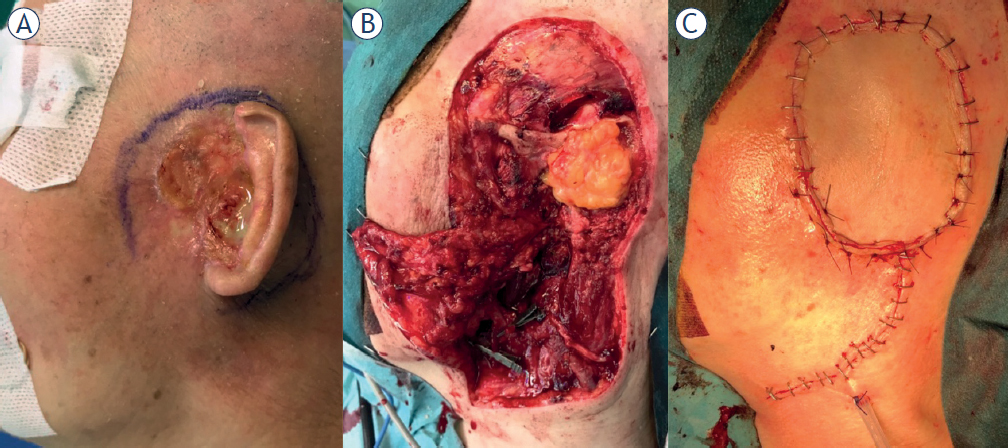
Figure 4
73-year old female with locoregionally advanced external ear basal cell carcinoma extending to the left lateral skull-base. The resection margin is outlined (A). Salvage surgery (i.e., after primary radical radiotherapy and electrochemotherapy) involving lateral temporal bone resection with fat obliteration, with wide local excision, partial parotidectomy, ipsilateral selective neck dissection (B) and radial forearm free flap reconstruction (C) were performed.
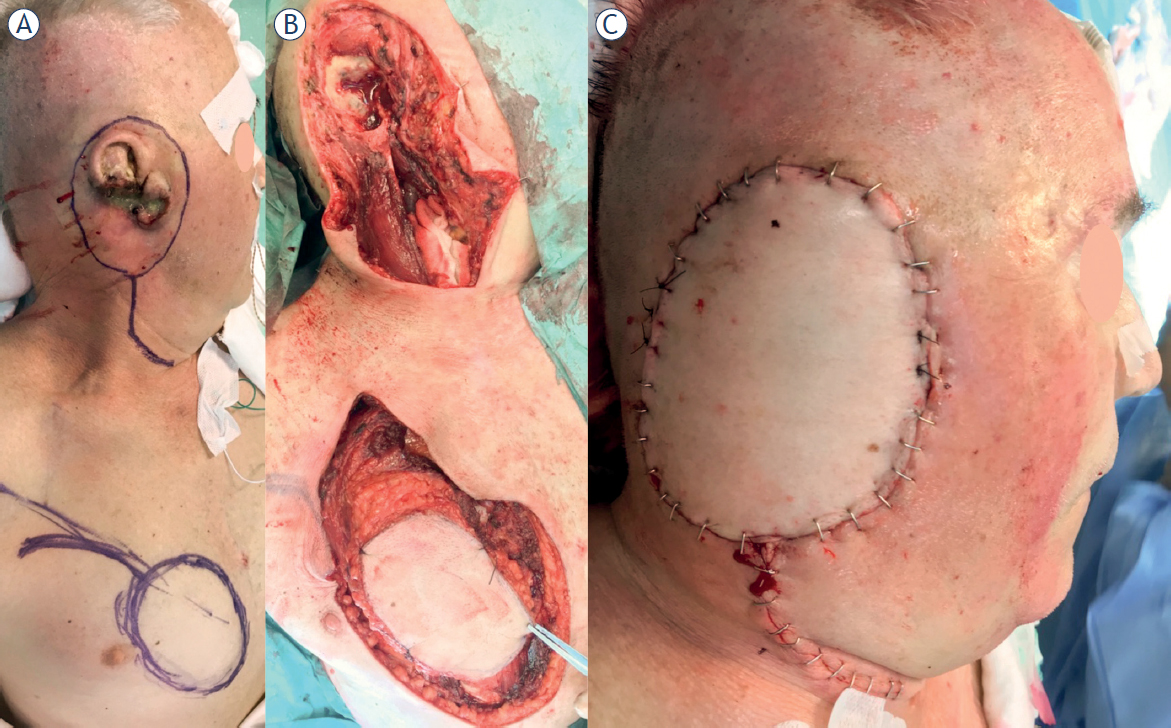
Figure 5
76-year old male with locoregionally advanced external ear squamous cell carcinoma extending to the right lateral skull-base. The resection margin is outlined (A). Salvage surgery (i.e., after primary radical radiotherapy) involving lateral temporal bone resection with wide local excision, partial parotidectomy, ipsilateral selective neck dissection and pectoralis major myocutaneous flap reconstruction (due to recipient vessel insufficiency) were performed (B, C).
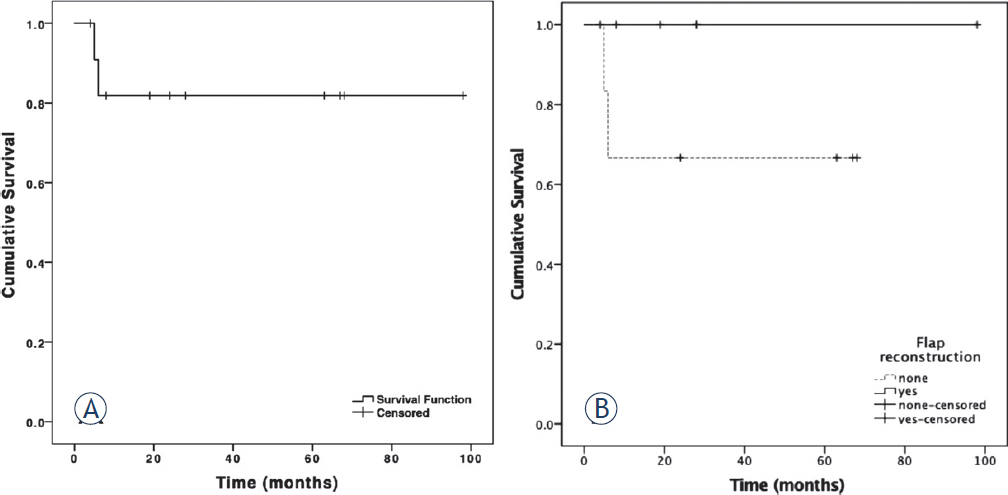
Figure 6
Kaplan-Meier analysis of overall survival of 12 patients with locoregionally advanced lateral skull-base cancer treated surgically with curative intent. (A) Kaplan-Meier analysis of 12 patients regardless of the reconstruction modality. Cumulative survival remained at 83% after six months. (B) Kaplan-Meyer analysis of 6 patients treated with flap reconstruction and six patients with other reconstruction modalities. Cumulative survival remained at 67% after six months.