
Table 1
Recommendations for first scenario – non COVID-19 cancer patient, according to Italian Society of Radiology and Interventional Radiology (SIRM) guidelines10
| Patients | Health care staff |
|---|---|
| Wear | Wear |
| • N95 mask [strong recommendation] | • N95 mask [strong recommendation] |
| • or surgical mask [weak recommendation] | • goggles or face shield [strong recommendation] |
| • gloves [strong recommendation] | |
| • surgical cap [weak recommendation] | |
| • shoe covers [weak recommendation] | |
| Stay away from other people (at least 6 feet of distance) [strong recommendation] | Clean and disinfect with 500 mg/L chlorine-containing disinfectant the radiological equipment used, clean their hands properly, and the room should be opened for appropriate ventilation [strong recommendation] |
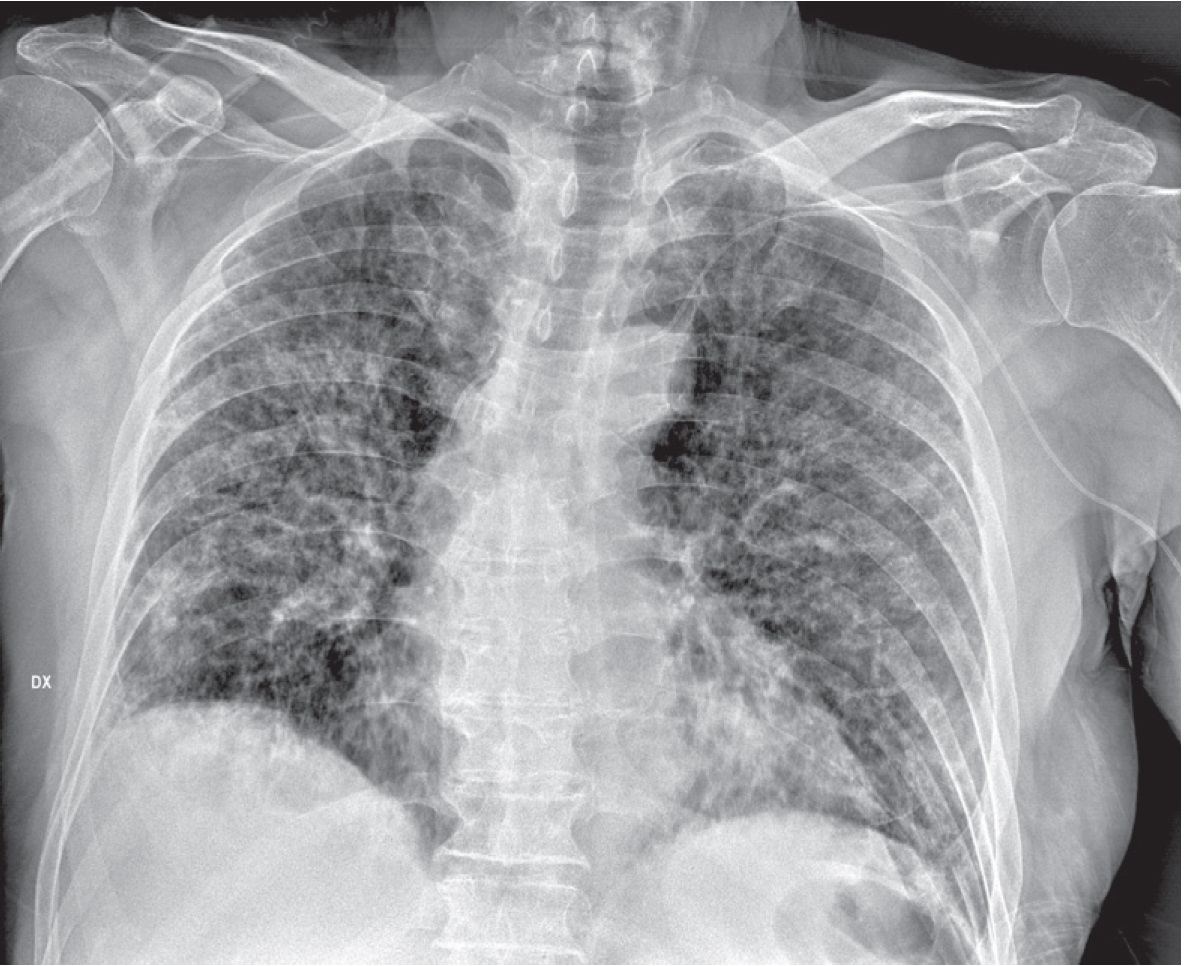
Figure 1
Man, 64 year. Chest x-ray shows patchy consolidation and strip-like opacities in a patient with confirmed COVID-19 infection by reverse transcriptase-polymerase chain reaction (RT-PCR).
Table 2
Recommendations for second scenario – suspected COVID-19 cancer patient, according to Italian Society of Radiology and Interventional Radiology (SIRM) guidelines10
| Patients | Healthcare staff |
|---|---|
| Isolated, controlled, and diagnostic confirmation should be as quick as possible | |
| Wear • N95 mask [strong recommendation] | Wear • N95 mask [strong recommendation] |
| • or surgical mask [weak recommendation] | • goggles or face shield [strong recommendation] |
| • gloves [strong recommendation] | |
| • surgical cap [weak recommendation] | |
| • shoe covers [weak recommendation] | |
| Stay away from other people (at least 6 feet of distance) [strong recommendation] | Clean and disinfect with 500 mg/L chlorine-containing disinfectant the radiological equipment used, clean their hands properly, and the room should be opened for appropriate ventilation [strong recommendation] |
| Diagnostic tool | |
| • Chest radiography (CXR; not very sensitive), with portable equipment in the isolation room [strong recommendation] | |
| • Computed tomography (CT; greater sensitivity) for early pneumonic change, disease progression, and alternative diagnoses; | |
| the administration of the intravenous contrast medium for the diagnosis of pulmonary thromboembolism |
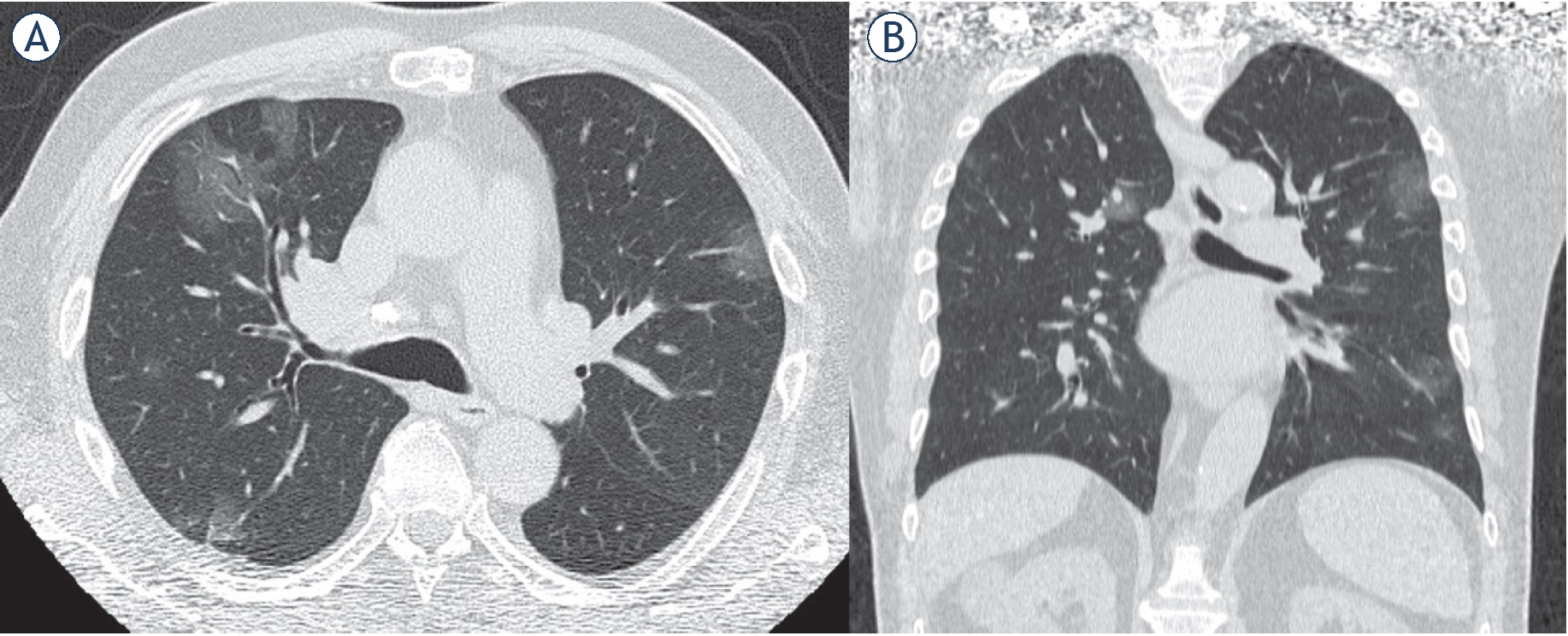
Figure 2
Man 53 y. CT shows multiple focal ground-glass opacities. (A) Axial plane, (B) multiplanar reconstruction in coronal plane.
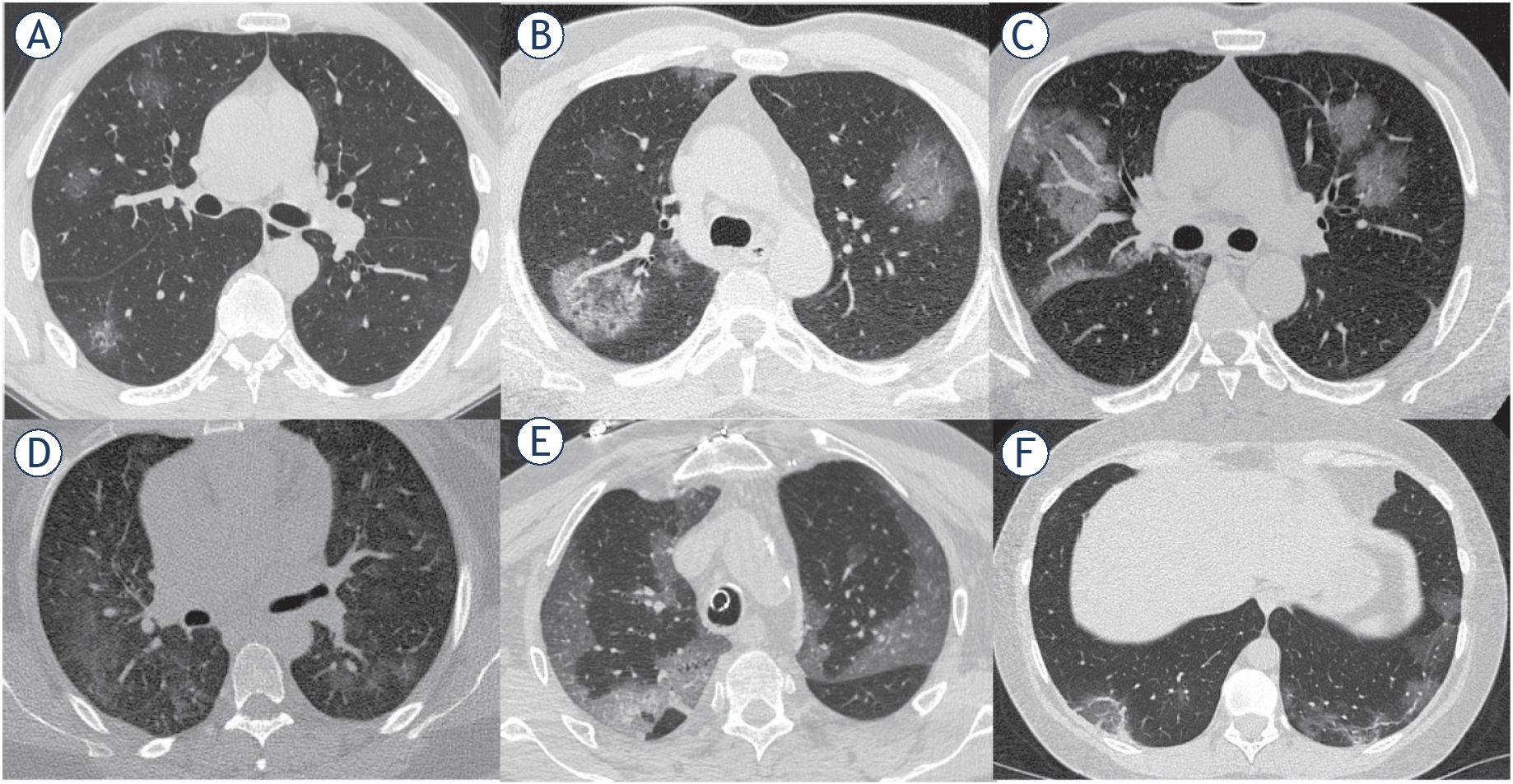
Figure 3
Man, 61 year. CT shows ground-glass opacities separated by thickened interlobular septa. (A-F) Axial planes.
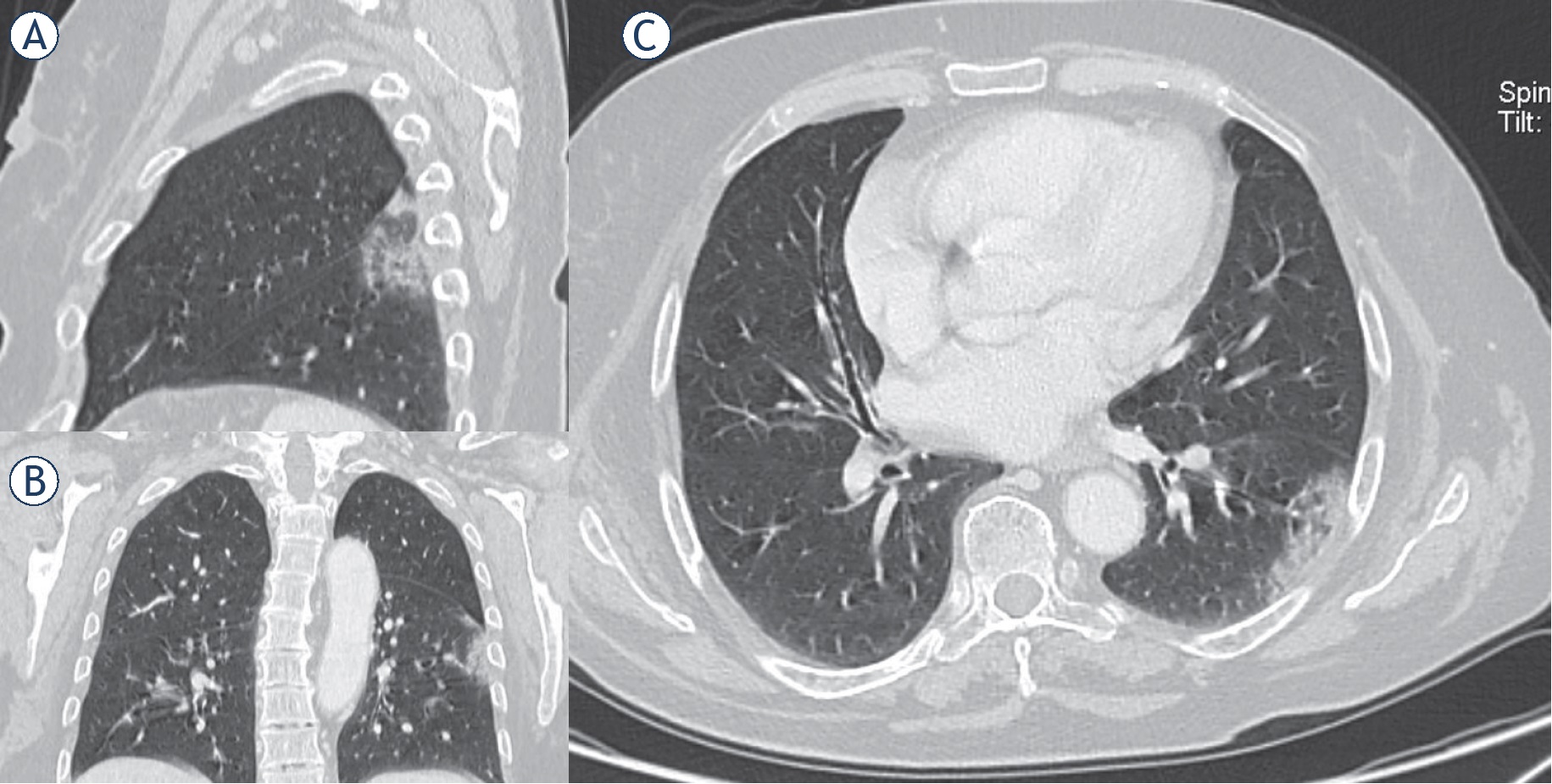
Figure 4
Woman, 54 year. CT shows patchy consolidation in apical segment of left lower lung. (A) Multiplanar reconstruction in sagittal plane; (B) multiplanar reconstruction in coronal plane; (C) axial plane.
Table 3
Recommendations for third scenario - confirmed Covid-19 cancer patient, according to Italian Society of Radiology and Interventional Radiology (SIRM) guidelines10
| Patients | Healthcare staff |
|---|---|
| Isolated and controlled | Medical personnel enter into the isolation area through |
| • treated in designated hospitals with isolation and protection conditions [strong recommendation] | designated channels (strongrecommendation] |
| Wear | |
| • N95 mask (strong recommendation] | |
| Wear | • goggles or face shield (strong recommendation] |
| • N95 mask [strong recommendation] | • gloves (strong recommendation] |
| • or surgical mask [weak recommendation] | • surgical cap (weak recommendation] |
| • shoe covers(weak recommendation] | |
| Stay away from other people (at least 6 feet of distance) [strong recommendation] | Clean and disinfect with 500 mg/L chlorine-containing disinfectant the radiological equipment used, clean their hands properly, and the room should be opened for appropriate ventilation [strong recommendation] |
| Diagnostic tool | |
| • daily chest radiographs are not indicated | |
| • CT scan is indicated for the evaluation of the stage of | |
| infection, for defining complications and for a correct | |
| differential diagnosis | |
| • The chest ultrasound (POCUS – point-of-care ultrasound) a | |
| monitoring tool to evaluate the effectiveness of the prono- | |
| supination manoeuvres |
Table 4
Fourth scenario -Cancer Patients with incidental COVID-19 diagnosis, according to Italian Society of Radiology and Interventional Radiology (SIRM) guidelines10
| Patients | Healthcare staff |
|---|---|
| Controlled | |
| • diagnostic confirmation should be as quick as possible [strong recommendation] | |
| Wear | Wear |
| • N95 mask [strong recommendation] | • N95 mask [strong recommendation] |
| • or surgical mask [weak recommendation] | • goggles or face shield [strong recommendation] |
| • gloves [strong recommendation] | |
| • surgical cap [weak recommendation] | |
| • shoe covers [weak recommendation] | |
| Stay away from other people (at least 6 feet of distance) [strong recommendation] | Clean and disinfect with 500 mg/L chlorine-containing disinfectant the radiological equipment used, clean their hands properly, and the room should be opened for appropriate ventilation [strong recommendation] |
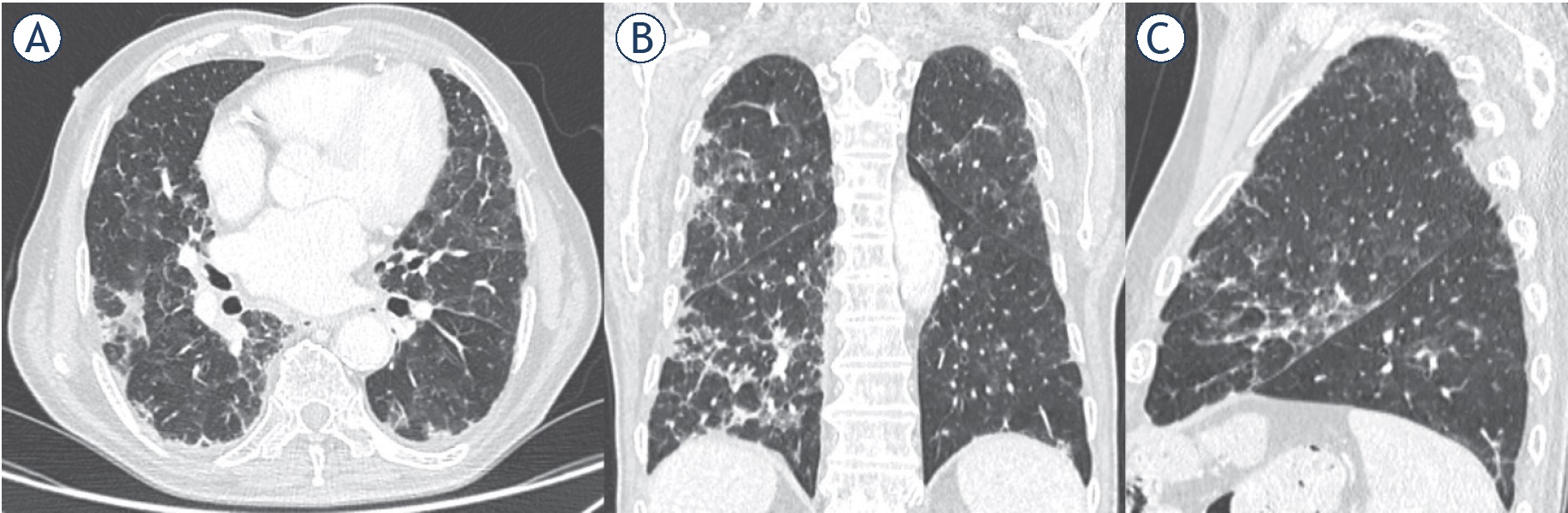
Figure 5
Man, 76 year. CT shows strip-like opacity, grid-like thickening of interlobular septa, thickening and strip-like twist of bronchial walls and patchy consolidations. (A) Axial plane; (B) multiplanar reconstruction in coronal plane; (C) multiplanar reconstruction in sagittal plane.