Have a personal or library account? Click to login
An overview of hepatocellular carcinoma with atypical enhancement pattern: spectrum of magnetic resonance imaging findings with pathologic correlation Cover

An overview of hepatocellular carcinoma with atypical enhancement pattern: spectrum of magnetic resonance imaging findings with pathologic correlation

Open Access
|Jan 2021

Figures & Tables

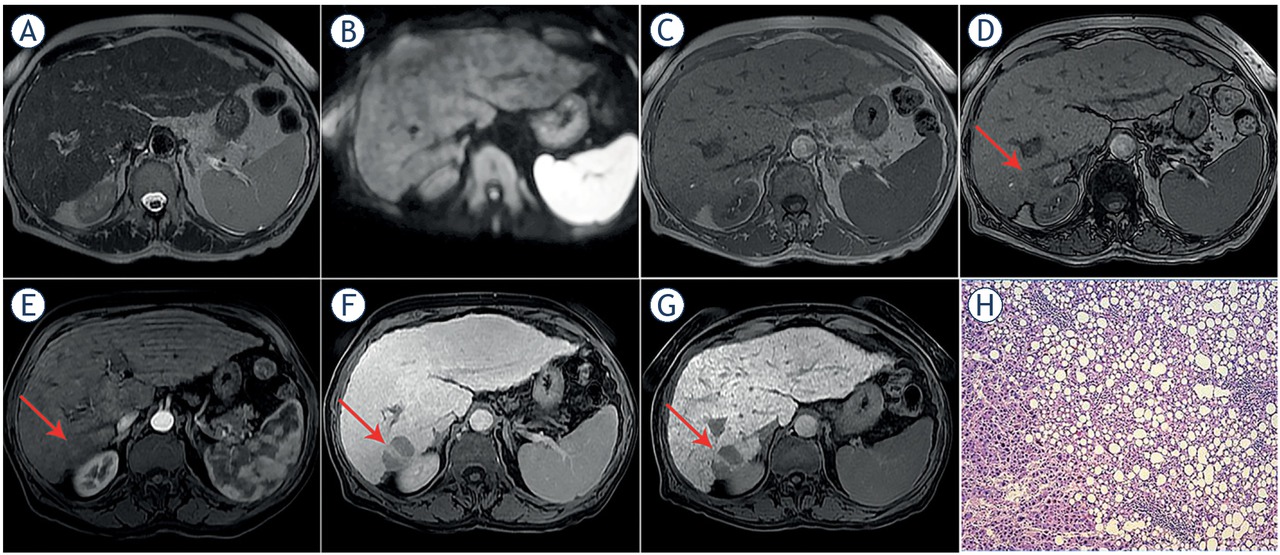
Figure 1

Hypovascular hepatocellular carcinoma (HCC) in 58-year old woman with cirrhosis. On axial T2-weighted image (A), diffusion-weighted image (B) and on in-phase image (C) tumor is isointense with surrounding liver parenchyma. On opposed-phase image there is a partial drop of signal intensity in the lesion (arrow) corresponding to the fatty component (D). The lesion (arrow) is slightly hypointense on arterial phase (E), while it is clearly hypovascular on portal-venous phase (F). On hepatobiliary phase after administration of gadoxetic acid the lesion (arrow) is hypointense (G). Hematoxylin and eosin (H&E) staining showed well-differentiated HCC with fat deposition; original magnification x 200 (H).
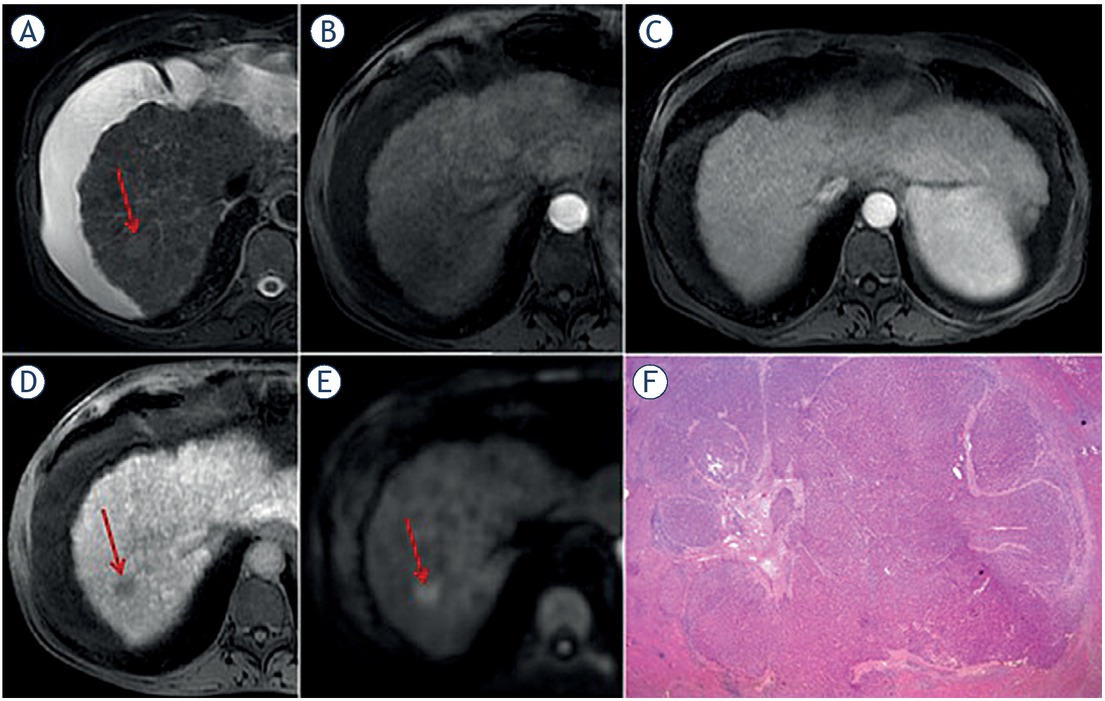

Figure 2

Isovascular hepatocellular carcinoma (HCC) in 55-year old woman with cirrhosis. On T2-weighted image slightly hyperintense nodule (arrow) is seen in liver segment VII (A). No lesion is seen on arterial (B) and portal venous phase (C). On hepatobiliary phase after administration of gadoxetic acid the lesion (arrow) is hypointense (D). Diffusion-weighted image shows diffusion restriction of the lesion (arrow) (E). Hematoxylin and eosin (H&E) staining showed well-differentiated HCC; original magnification x 200 (F).
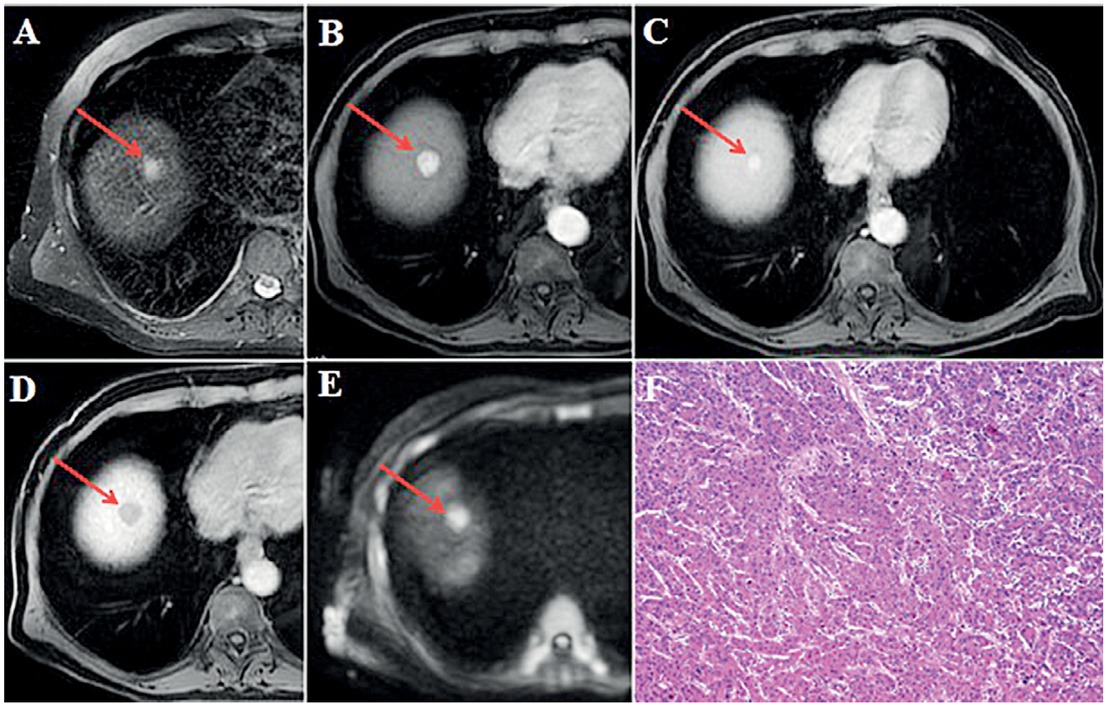

Figure 3

Hypervascular hepatocellular carcinoma (HCC) without washout in 64-year old man with cirrhosis. Axial T2-weighted fat-suppressed image shows hyperintense nodule (arrow) in liver segment VIII (A). On arterial phase the nodule (arrow) is hypervascular (B) without washout on portal-venous phase (C). On hepatobiliary phase the nodule (arrow) is hypointense (D) and on diffusion-weighted image it is hyperintense (E). Hematoxylin and eosin (H&E) staining showed moderately-differentiated HCC; original magnification x 200 (F).
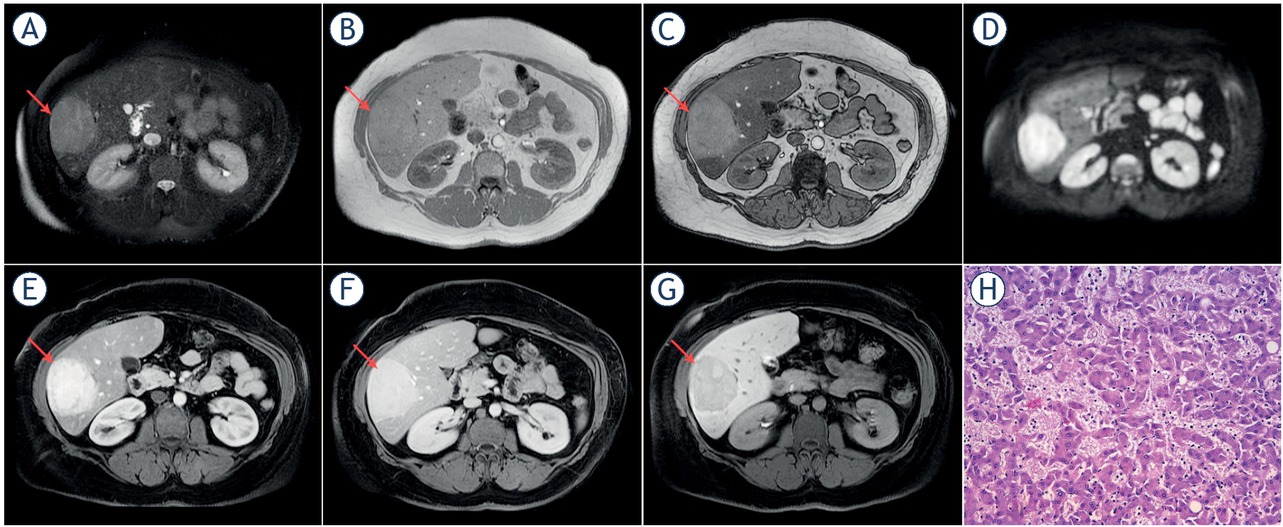

Figure 4

Hypervascular hepatocellular carcinoma (HCC) without washout in 44-year old man with non alcoholic fatty liver disease. Axial T2-weighted fat-suppressed image shows moderately hyperintense lesion (arrow) in segment VI (A). Dual-echo images show that tumor (arrows) is isointense on in-phase image (B) without signal drop on opposed-phase image, while background liver parenchyma shows diffuse signal drop as a consequence of fatty liver disease (C). The lesion (arrows) is hyperintense on diffusion-weighted image (D), hypevascular on arterial phase (E) without washout on portalvenous phase (F). On hepatobiliary phase the tumor (arrow) is hypointense (G). Hematoxylin and eosin (H&E) staining showed moderately-differentiated HCC with very dilatated sinusoidal network; original magnification x 200 (H).
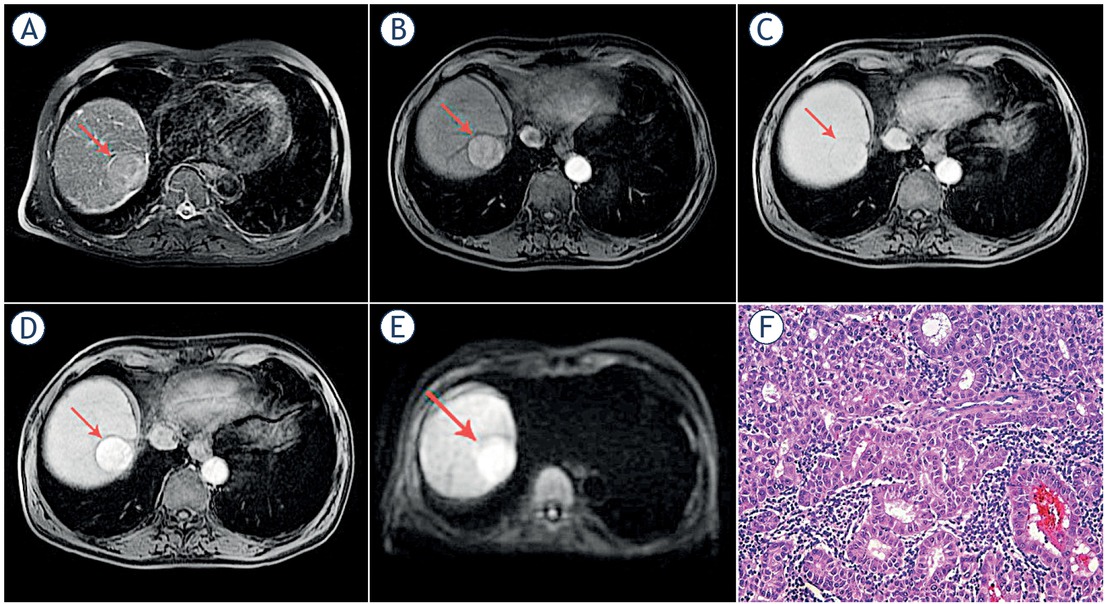

Figure 5

Hepatocellular carcinoma (HCC) in 73-year old man with alcoholic cirrhosis. Axial T2-weighted fat-suppressed image shows slightly hyperintense well-defined nodular lesion (arrow) in segment VII (A). The lesion (arrows) is hypervascular on arterial phase (B) without washout on portal-venous phase (C). On hepatobiliary phase the tumor (arrow) is strongly hyperintense (D) with hyperintensity on diffusion-weighted image (E). Hematoxylin and eosin (H&E) staining showed well-differentiated HCC; original magnification x 200 (F).
DOI: https://doi.org/10.2478/raon-2021-0004 | Journal eISSN: 1581-3207 | Journal ISSN: 1318-2099
Language: English
Page range: 130 - 143
Submitted on: Oct 9, 2020
|
Accepted on: Dec 15, 2020
|
Published on: Jan 29, 2021
In partnership with: Paradigm Publishing Services
Publication frequency: 4 issues per year

© 2021 Jelena Djokic Kovac, Aleksandar Ivanovic, Tamara Milovanovic, Marjan Micev, Francesco Alessandrino, Richard M. Gore, published by Association of Radiology and Oncology
This work is licensed under the Creative Commons Attribution-NonCommercial-NoDerivatives 3.0 License.