
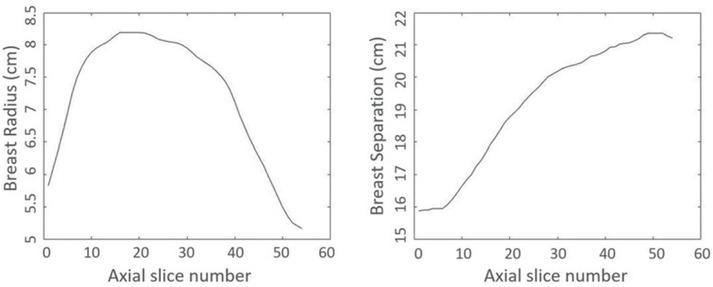
Figure 1
Left shows how the breast radius varies in the cranio-caudal direction, right shows how the breast separation varies in the cranio-caudal direction for the same collected patient breast.
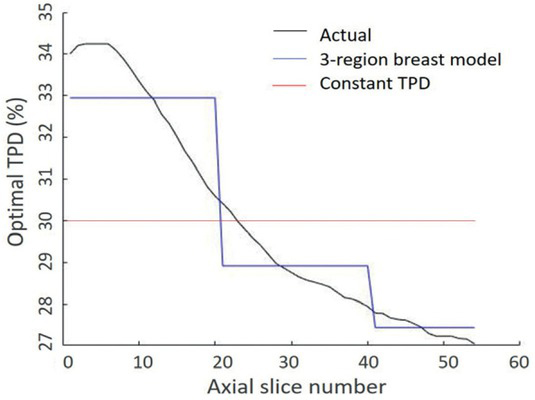
Figure 2
Variation in the optimal transmission penetration depth (TPD) over all slices in the cranio-caudal direction compared with the TPD considering a constant TPD or a TPD using the three-region breast approach.
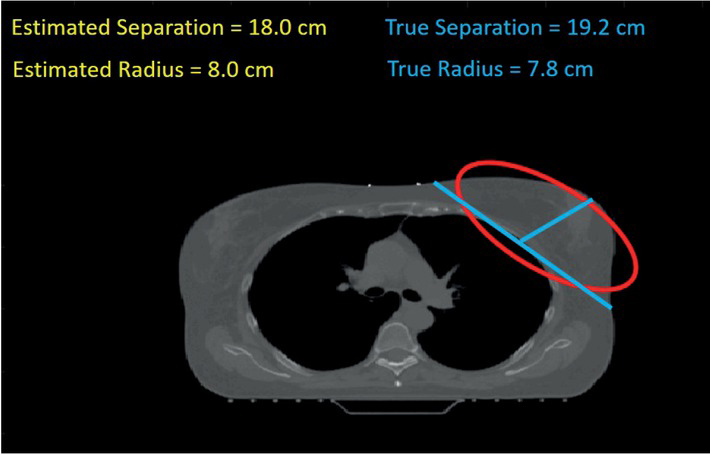
Figure 3
CT-simulation axial slice with fitted ellipse (red) and breast radius and separation estimation (yellow) and hand-measurement (blue) of left breast overlaid. Included is the location of the hand measurement for radius and separation in blue.
Table 1
Agreement between breast radius and separation hand-measurements and automatic algorithm measurement in centimeter (cm) difference and percent difference
| Radius | ||
|---|---|---|
| Number | % Difference | Difference (cm) |
| 1 | 9.6 [9.3–9.9] | 0.70 [0.68–0.72] |
| 2 | 6.2 [5.7–6.7] | 0.40 [0.39–0.41] |
| 3 | 22.0 [21.5–22.5] | 1.00 [0.98–1.02] |
| Average | 12.6 [10.4–14.8] | 0.69 [0.59–0.79] |
| Separation | ||
|---|---|---|
| Number | % Difference | Difference (cm) |
| 1 | 6.1 [5.0–7.2] | 1.13 [1.11–1.15] |
| 2 | 4.2 [4.1–4.3] | 0.71 [0.68–0.74] |
| 3 | 5.3 [5.1–5.5] | 0.91 [0.71–1.11] |
| Average | 5.2 [5.1–5.3] | 0.92 [0.79–1.05] |
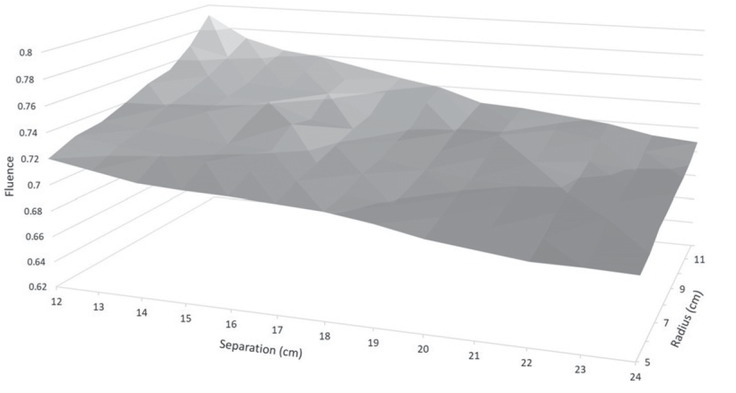
Figure 4
Correlation between breast separation and radius with the x-ray fluence needed to deliver homogenous dose distribution to the breast treatment volume using a 6 MV beam.
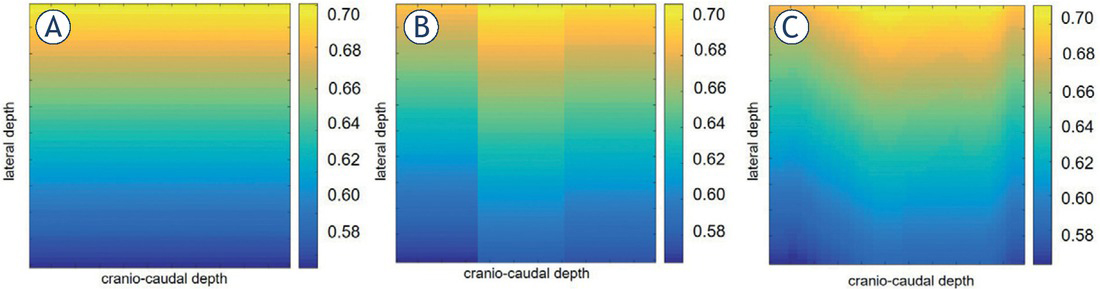
Figure 5
Optimal fluence maps from (A) assuming a single penetration depth, from (B) assuming a three-region breast model, and (C) our proposed model. Colorbar shows beam fluence.
Table 2
Summary of dose homogeneity indices (HI) for all ten collected treatment courses. Compared are the treatments generated with our proposed algorithm, plans created using the 3-region breast model proposed by Alghufaili, those plans optimized by a medical dosimetrist, and plans generated by assuming a single transmission penetration depth (TPD) within the treatment planning software
| Number | Proposed Work HI | 3-region breast model | Dosimetrist Optimized HI | Single TPD HI |
|---|---|---|---|---|
| 1 | 26.7 | 22.4 | 16.5 | 23.0 |
| 2 | 17.8 | 19.2 | 14.1 | 19.1 |
| 3 | 10.6 | 15.2 | 11.2 | 17.2 |
| 4 | 11.8 | 14.6 | 9.51 | 13.3 |
| 5 | 8.49 | 7.87 | 3.32 | 8.04 |
| 6 | 8.79 | 14.1 | 6.64 | 12.6 |
| 7 | 4.59 | 7.44 | 3.82 | 8.19 |
| 8 | 7.57 | 21.5 | 8.84 | 23.5 |
| 9 | 11.3 | 17.9 | 8.29 | 18.7 |
| 10 | 10.6 | 16.0 | 10.5 | 17.8 |
| Average | 12.6 | 15.6 | 9.87 | 17.0 |
Table 3
Summary of global dose maximum and clinical target volume (CTV) minimum values for all ten collected treatment courses. Compared are the treatments generated with our proposed algorithm, plans created using the 3-region breast model proposed by Alghufaili, those plans optimized by a medical dosimetrist, and plans generated by assuming a single transmission penetration depth (TPD) within the treatment planning software
| Global dose max (%) | CTV dose min (%) | |||||||
|---|---|---|---|---|---|---|---|---|
| Number | Proposed work | 3-region breast model | Dosimetrist optimized | Single TPD | Proposed work | 3-region breast model | Dosimetrist optimized | Single TPD |
| 1 | 107.7 | 108.5 | 109.1 | 113.3 | 96.9 | 97.3 | 104.1 | 96.0 |
| 2 | 109.7 | 111.3 | 106.5 | 111.8 | 74.4 | 75.0 | 76.9 | 74.2 |
| 3 | 107.4 | 108.1 | 107.5 | 112.7 | 95.5 | 88.7 | 95.3 | 89.1 |
| 4 | 107.5 | 110.4 | 105.9 | 109.8 | 95.5 | 95.2 | 95.0 | 96.8 |
| 5 | 107.7 | 109.7 | 104.0 | 105.0 | 95.1 | 95.9 | 98.1 | 87.8 |
| 6 | 107.5 | 108.7 | 105.5 | 111.4 | 97.9 | 96.0 | 99.3 | 97.4 |
| 7 | 108.0 | 114.2 | 105.9 | 116.3 | 95.4 | 95.4 | 95.7 | 95.4 |
| 8 | 107.6 | 112.6 | 106.6 | 114.6 | 95.3 | 92.8 | 97.8 | 94.1 |
| 9 | 107.5 | 115.5 | 106.0 | 118.1 | 95.6 | 95.6 | 95.1 | 95.0 |
| 10 | 107.5 | 108.6 | 107.8 | 114.4 | 86.1 | 81.6 | 87.8 | 87.2 |
| Average | 107.8 | 111.2 | 106.5 | 112.7 | 92.7 | 91.4 | 94.5 | 91.3 |
Table 4
Summary of mean dose to the heart and ipsilateral lung V20 Gy for all ten collected courses. Compared are the treatments generated with our proposed algorithm, plans created using the 3-region breast model proposed by Alghufaili, those plans optimized by a medical dosimetrist, and plans generated by assuming a single transmission penetration depth (TPD) within the treatment planning software
| Mean dose to the heart (cGy) | Ipsilateral lung V20 Gy (%) | |||||||
|---|---|---|---|---|---|---|---|---|
| Number | Proposed Work | 3-region breast model | Dosimetrist Optimized | Single TPD | Proposed Work | 3-region breast model | Dosimetrist Optimized | Single TPD |
| 1 | 11.0 | 15.0 | 13.7 | 13.4 | 0.42 | 2.30 | 2.41 | 2.05 |
| 2 | 298 | 296 | 294 | 327 | 18.2 | 18.3 | 16.7 | 20.3 |
| 3 | 177 | 165 | 109 | 160 | 5.12 | 4.91 | 3.56 | 4.65 |
| 4 | 271 | 267 | 149 | 250 | 9.09 | 9.03 | 8.07 | 7.93 |
| 5 | 40.8 | 44.9 | 39.7 | 42.0 | 16.6 | 16.8 | 15.8 | 16.2 |
| 6 | 113 | 112 | 108 | 111 | 8.95 | 8.84 | 8.33 | 8.59 |
| 7 | 47.0 | 52.4 | 47.7 | 51.7 | 9.56 | 11.2 | 9.9 | 10.9 |
| 8 | 26.9 | 28.9 | 26.5 | 28.7 | 11.4 | 11.2 | 11.4 | 10.9 |
| 9 | 95.9 | 128 | 89.5 | 125 | 9.18 | 10.8 | 7.8 | 10.6 |
| 10 | 406 | 402 | 159 | 397 | 18.7 | 18.5 | 12.4 | 18.2 |
| Average | 149 | 151 | 104 | 151 | 10.7 | 11.2 | 9.65 | 11.0 |
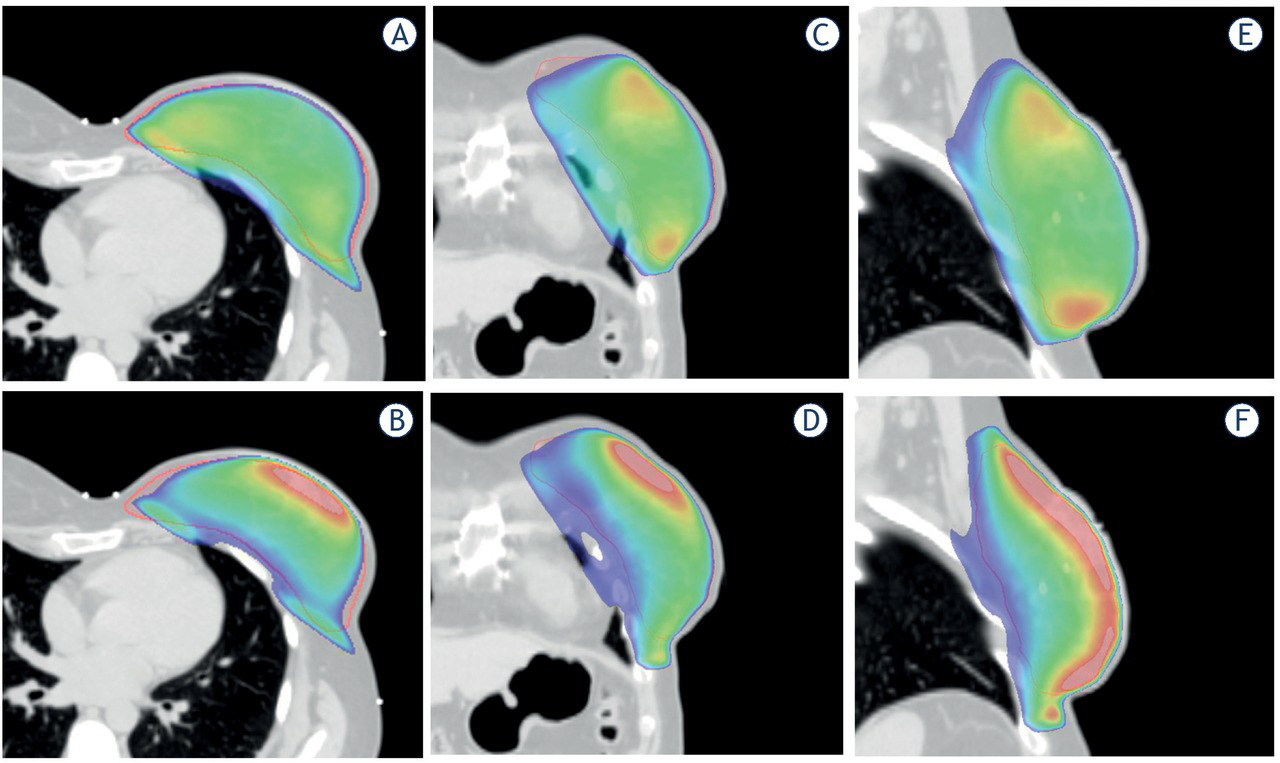
Figure 6
(A, C, E) axial, coronal, and sagittal views of the breast treatment volume showing the isodose color washes from the treatment plan generated with the proposed algorithm. (B, D, F) axial, coronal, and sagittal views of the breast treatment volume showing the isodose color washes from the treatment plan generated by assuming a constant transmission penetration depth of 30%.