
Table 1
18F-FDG PET/CT findings in medullary thyroid carcinoma patients with calcitonin levels
| Findings | Number | % | Increased calcitonin levels | Calcitonin levels above 1000 pg/ml | |
|---|---|---|---|---|---|
| TP | 35/67 | 52.2 | 35/35 (100%) | 18/35 (51%) | |
| TN | 25/67 | 37.3 | 18/25 (72%) | 0 | |
| FP | 4/67 | 6 | 2/4 (50%) | 0 | |
| FN | 3/67 | 4.5 | 2/3 (66%) | 2/3 (66%) | |
| Sensitivity | 92.11% (95% CI 78.62% to 98.34%) | ||||
| Specificity | 86.21% (95% CI 68.34% to 96.11%) | ||||
| Positive predictive value | 89.74% (95% CI 77.81% to 95.62% | ||||
| Negative predictive value | 89.29% (95% CI 73.59% to 96.14%) | ||||
| Accuracy | 89.55% (95% CI 79.65% to 95.70%) | ||||
Table 2
99mTc-DMSA scintigraphy findings in medullary thyroid carcinoma patients
| Findings | Number | % |
|---|---|---|
| TP | 4 | |
| TN | 13 | |
| FP | 3 | |
| FN | 5 | |
| Sensitivity | 44.44% (95% CI 13.70% to 78.80%) | |
| Specificity | 81.25% (95% CI 54.35% to 95.95%) | |
| Positive predictive value | 57.14% (95% CI 27.55% to 82.38%) | |
| Negative predictive value | 72.22% (95% CI 58.07% to 83.00%) | |
| Accuracy | 68.00% (95% CI 46.50% to 85.05%) |
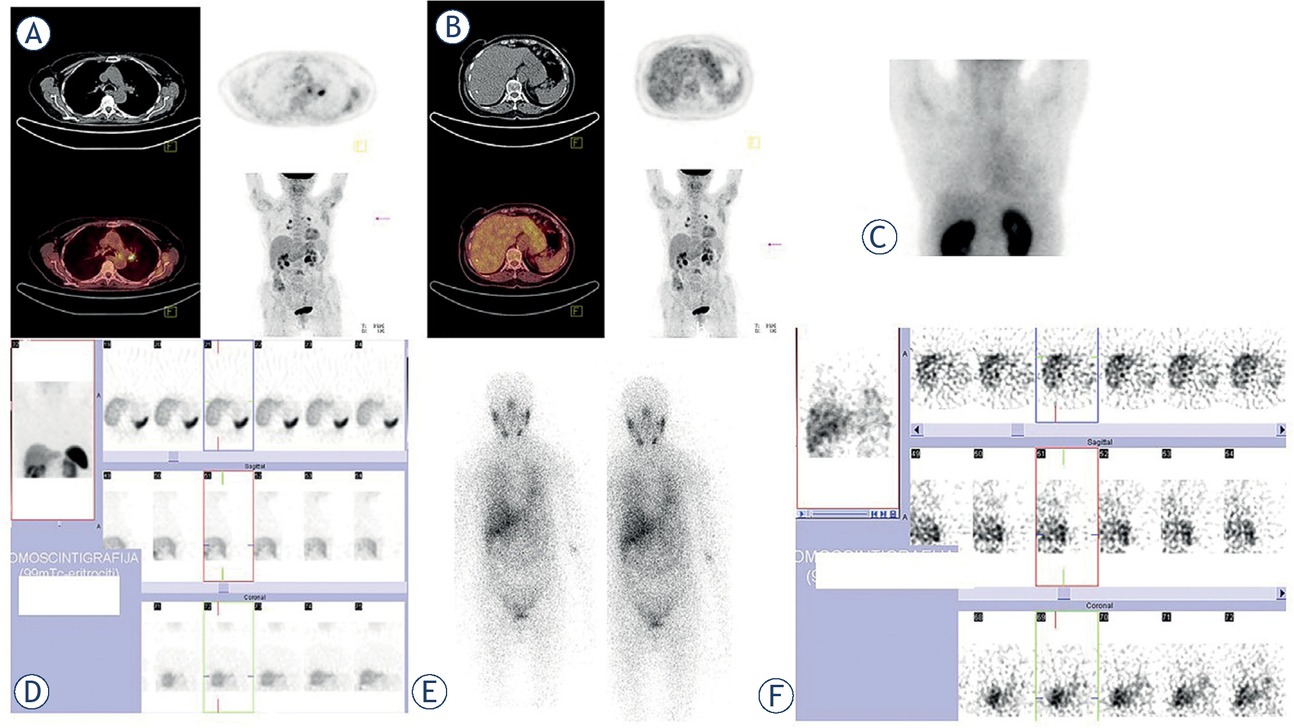
Figure 1
Patient with diagnosis of MTC after total thyroidectomy. (A, B) FDG PET/CT confirmed high uptake metastases in the mediastinal lymph nodes and uneven distribution of FDG in the liver. (C)99mTc-DMSA spot view scintigraphy finding is negative. (D)99mTc - tektrotyd SPECT finding is negative. (E)123I – MIBG WB finding showed high uptake in multiple liver metastases. (F)123I – MIBG SPECT finding showed high uptake in multiple liver metastases.
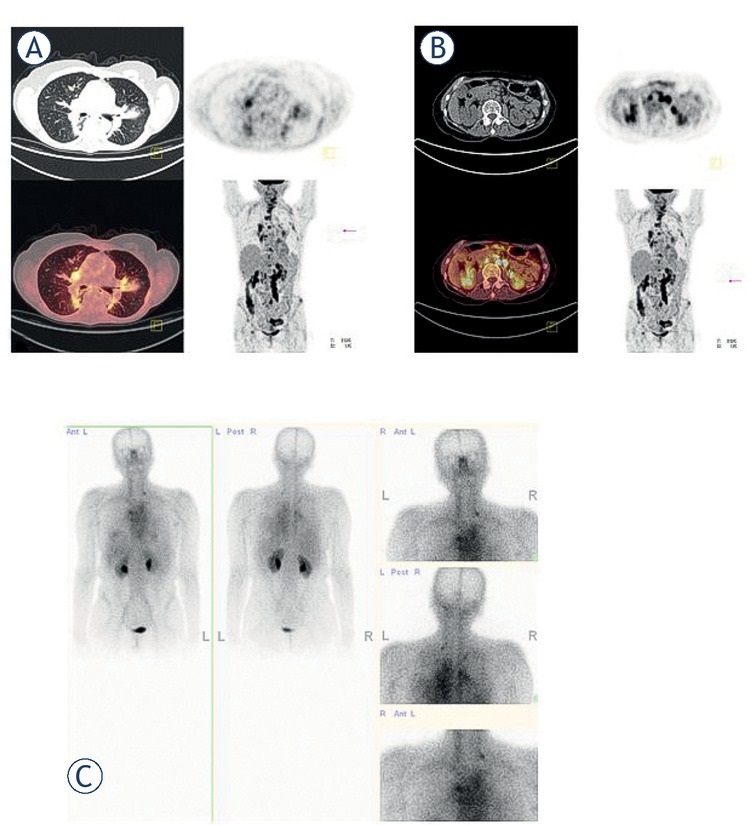
Figure 2
Patient with diagnosis of MTC after total thyroidectomy. (A, B) FDG PET/ CT confirmed high uptake metastases in the lymph nodes of the neck, mediastinum and abdomen. (C)99mTc-DMSA planar spot view scintigraphy showed uptake only in the few lymph nodes in the neck and mediastinum.
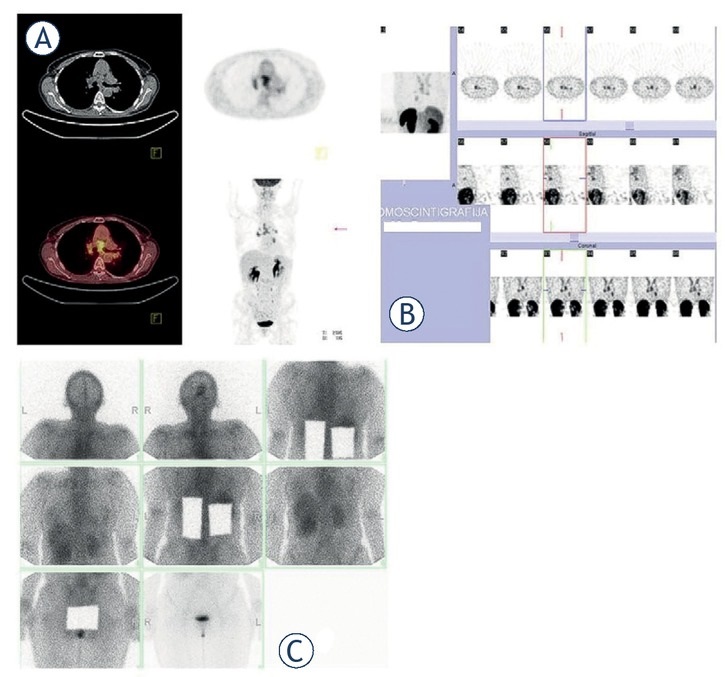
Figure 3
Patient with diagnosis of MTC after total thyroidectomy. (A) FDG PET/CT confirmed high uptake in metastases in the mediastinal lymph nodes. (B)99mTc- tektrotyd scintigraphy confirmed high uptake in metastases in the mediastinal lymph nodes. (C)99mTc-DMSA planar spot view scintigraphy finding was negative showed uptake only in the few lymph nodes in the neck and mediastinum.
Table 3
Concordance of the 18F-FDG PET/CT findings with the results of other radionuclide methods in selected number of medullary thyroid carcinoma patients
| 18F-FDG PET/CT | 99mTc(V)-DMSA | 99mTc-HYNIC-TOC | 123I-MIBG |
|---|---|---|---|
| 14 TP (100%) | 4 TP (28.6%) | 5 TP (35.7%) | 3 TP (21.4%) |
| 4 FN (28.6%) | 3 FN (21.4%) | 2 FN (14.3%) | |
| 14 TN (100%) | 11 TN (78.6%) | 1 FP (7%) | 3 TN (21.4%) |
| 2 FP (14.3%) | 1 TN (7%) | 2 FP (14.3%) | |
| 1 FP (25%) | |||
| 4 FP (100%) | 2 TN (50%) | 1 FP (7%) | |
| 1 FN (100%) | 1 FN (100%) | 1 FN (100%) |
[i] 123I-MIBG = metaiodobenzylguanidine; 18F-FDG = 18F-fluorodeoxyglucose; 99mTc(V)-DMSA = 99mTc-pentavalent dimercaptosuccinic acid; FN = false negative; FP = false positive; PET/CT = positron emission tomography with computed tomography; Tektrotyd = 99mTc-EDDA/HYNIC-Tyr3-octreotide; TN = true negative; TP = true positive
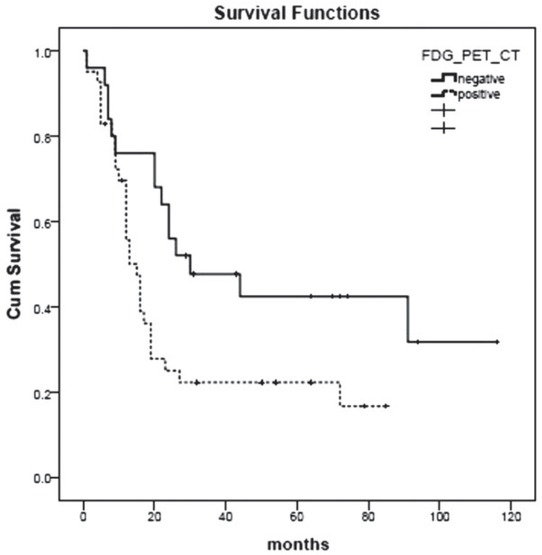
Figure 4
Kaplan Meier progression-free survival curve in positive FDG patients with median survival of 15 months (95% CI 11.14 ± 18.85 months), while median survival in disease free patients was 30 months (95% CI 1.08+58.92 months).