
Table 1
Basic characteristics of the study population
| Median (range) | |
|---|---|
| Age | 58 (32–84) |
| KPS | 80 (70–100) |
| Number of lesions (1-9) | 1 (1–9) |
| Number of patients | |
| 1 | 40 |
| 2 | 12 |
| 3 | |
| 4 | |
| 5 | |
| 6 | |
| 9 | |
| Gender (M/F) | 22/47 |
| WBRT before SRS | |
| Yes | 34 |
| No | 35 |
| Location of the primary tumour | |
| Lung | 23 |
| Breast | 20 |
| Kidney | |
| Skin (melanoma) | |
| Colon | |
| Unknown primary | |
| Uterine corpus | |
| Other* | |
| Disease status | |
| Stable/NED | 42 |
| Progressive | 27 |
| Primary tumor controlled | |
| Yes | 62 |
| No | 7 |
| Extracranial metastases | |
| Present | 39 |
| No | 30 |
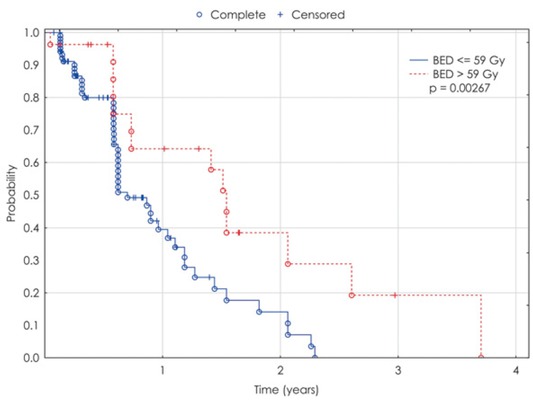
Figure 1
Local progression-free survival according to biologically effective dose (BED)10. Doses above 59 Gy10 (red, dashed line) were associated with significantly longer local progression-free survival (LPFS) (median 7.5 vs. 18.4 months).
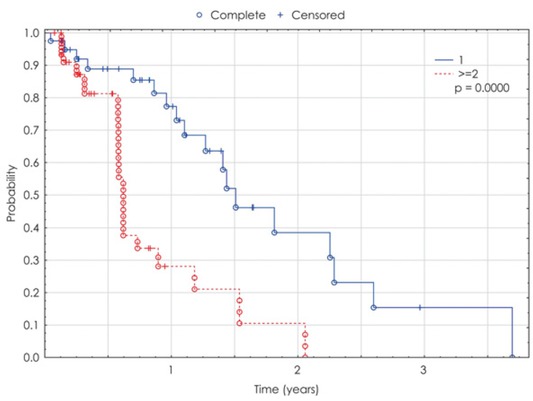
Figure 2
Local progression-free survival according to number of metastases. Presence of a single metastasis (blue, solid line) was a favorable prognostic factor.
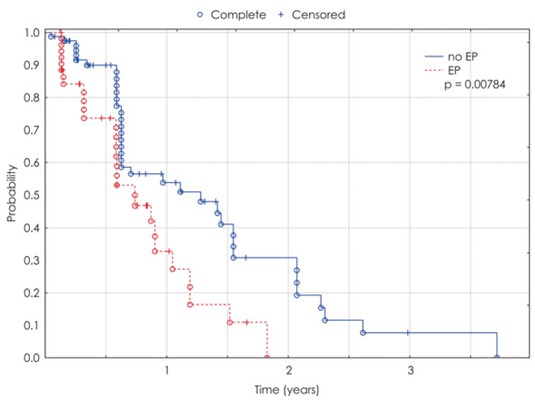
Figure 3
Local progression-free survival according to systemic disease status. Extracranial progression (red, dashed line) was an adverse prognostic factor.
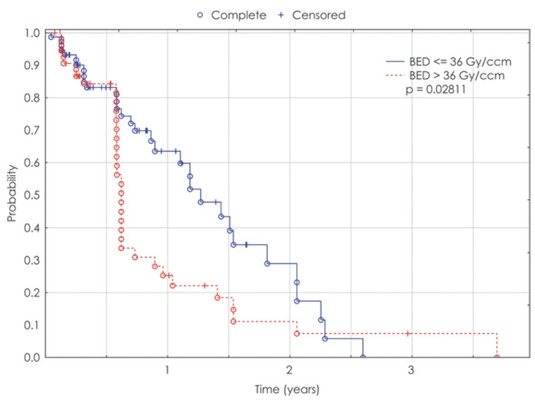
Figure 4
Local progression-free survival according to biologically effective dose (BED)10 normalized to tumor volume. Exceeding the threshold value of 36 Gy10/cm3 (red, dashed line) was associated with reduced chances of maintaining local control.
Table 2
Dosimetric and volumetric characteristics of the group
| Variable | Median (range) | p |
|---|---|---|
| Total dose in SRS | 18 Gy (5–24) | p = 0.0036* |
| Total dose in HSRT | 20 Gy (12–30) | |
| Dose per fraction in HSRT | 7.25 Gy (6–13 ) | |
| BED10 in SRS | 50.4 (7.5–81.6) | p = 0.0237* |
| BED10 in HSRT | 35.7 (19.2–60) | |
| Lesion volume | 1.74 cm3 (0.001–46.99) | |
| Single metastasis | 4.68 cm3 (0.05–39.2) | p = 0.0002* |
| Multiple metastases | 0.96 cm3 (0.001–46.99) | |
| Total tumor volume | 4.9 cm3 (0.05–63.95) | |
| Single metastasis volume | 4.68 cm3 (0.05–39.2) | p = 0.0371* |
| Multiple metastases volume | 4.90 cm3 (0.48–63.95) |
* = comparison between groups, Mann-Whitney U test; BED10 = biologically effective dose for alpha/ beta =10; HSRT = hypofractionated stereotactic radiotherapy; SRS – stereotactic radiosurgery
* = comparison between groups, Mann-Whitney U test; BED10 = biologically effective dose for alpha/ beta =10; HSRT = hypofractionated stereotactic radiotherapy; SRS – stereotactic radiosurgery
Table 3
Association of selected variables with local control
| p | ||
|---|---|---|
| Variable | univariate | Multivariate |
| Single vs. multiple lesions | 0.00001 | 0.0161 |
| Gender | 0.2508 | |
| Total dose* | 0.0011 | 0.0886 |
| BED10* | 0.7026 | |
| BED10 > 59 Gy | 0.0026 | 0.0105 |
| Fractionation (SRS vs. HSRT) | 0.1265 | |
| Tumor volume¶ | 0.1777 | |
| Total tumor volume¶ | 0.8950 | |
| Chemotherapy before SRS/HSRT | 0.3785 | |
| Chemotherapy after SRS/HSRT | 0.2174 | |
| Chemotherapy before and after SRS/HSRT | 0.2606 | |
| Time between diagnosis of primary and metastases* | 0.6551 | |
| BED10 per 1 ml tumor volume > median (24.3 Gy) | 0.3709 | |
| BED10 per 1 ml tumor volume > 36 Gy | 0.0281 | 0.3032 |
| Total dose/ml tumor volume > median (11 Gy) | 0.3882 | |
| Extracranial metastases | 0.3130 | |
| Control of primary tumor | 0.8681 | |
| Extracranial progression** | 0.0078 | 0.0011 |
| RPA class | 0.8627 | |
| WBRT use | 0.3918 | |
| BED2/cm3 > 60 | 0.0392 | 0.8638 |
** = progression of primary tumor or any of extracranial metastases; SRS = stereotactic radiosurgery; HSRT = hypofractionated stereotactic radiotherapy; BED10, BED2 = biologically effective dose for alpha/beta =10 and 2, respectively; WBRT = whole brain radiotherapy; RPA = recursive partitioning analysis