
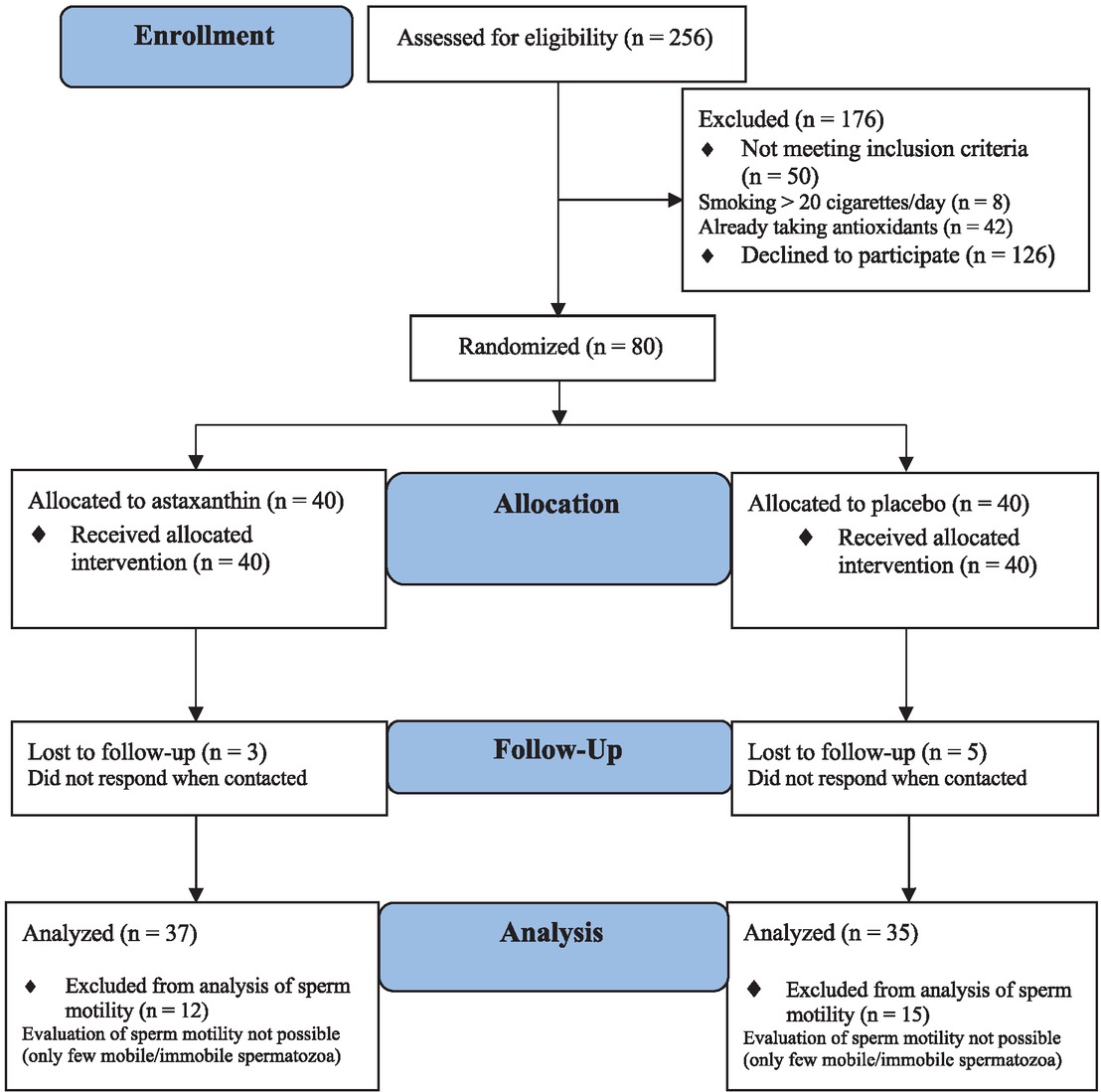
Figure 1
CONSORT flow chart of study presenting the inclusion criteria, randomization and follow-up of participants.
Table 1
Comparison of baseline characteristics of patients in astaxanthin and placebo groups
| Characteristic | Astaxanthin (n = 37) | Placebo (n = 35) | p-value |
|---|---|---|---|
| Age (years) | 35.0 ± 5.2 | 36.4 ± 5.5 | 0.276 |
| BMI (kg/m2) | 25.9 ± 3.8 | 27.1 ± 4.6 | 0.162 |
| Smoking (no. of cigarettes smoked / day) | 4.8 ± 6.8 | 3.6 ± 6.8 | 0.264 |
| Sperm concentration (million /ml)* | 6.9 ± 5.7 | 5.4 ± 5.8 | 0.297 |
| Total sperm number (million/ejaculate)* | 23.9 ± 28.4 | 15.6 ± 21.0 | 0.164 |
| Total sperm motility (%)** | 29.9 ± 14.8 | 38.2 ± 14.8 | 0.063 |
| Progressive sperm motility (%)** | 25.1 ± 14.5 | 33.3 ± 14.6 | 0.063 |
| Sperm morphology (%) | 1.8 ± 2.1 | 1.9 ± 2.0 | 0.663 |
| Sperm head defect (%) | 95.1 ± 16.2 | 97.5 ± 3.3 | 0.936 |
| Sperm neck + midpiece defect (%) | 2.9 ± 16.4 | 0.2 ± 0.8 | 0.981 |
| Sperm tail defect (%) | 0.2 ± 0.6 | 0.5 ± 1.0 | 0.424 |
| Leukocytes with peroxidase (million/ml) | 0.3 ± 0.3 | 0.5 ± 0.8 | 0.976 |
| Mitochondrial membrane potential (%)*** | 27.5 ± 18.5 | 26.9 ± 15.3 | 0.888 |
| DNA fragmentation (%) | 50.5 ± 23.9 | 45.8 ± 21.8 | 0.424 |
| FSH (IU/l) | 9.7 ± 7.8 | 9.2 ± 5.8 | 0.919 |
| Chemicals at work (% exposed) | 5.4 | 14.3 | 0.204 |
| Ultraviolet rays at work (% exposed) | 2.7 | 0 | 0.327 |
| X-ray at work (% exposed) | 0 | 11.4 | 0.051 |
| High temperature at work (% exposed) | 13.5 | 14.3 | 0.925 |
| Sedentary job (% exposed) | 45.9 | 40.0 | 0.611 |
* = the analysis for total sperm number and sperm concentration was made for 34/37 patients from the astaxanthin group and 35/35 patients from the placebo group, since the excluded patients only had a few mobile or immobile spermatozoa in the semen sample;
* = the analysis for total sperm number and sperm concentration was made for 34/37 patients from the astaxanthin group and 35/35 patients from the placebo group, since the excluded patients only had a few mobile or immobile spermatozoa in the semen sample;
** = the analysis for total and progressive sperm motility was made for 25/37 patients from the astaxanthin group and 20/35 patients from placebo group, since the excluded patients only had a few mobile or immobile spermatozoa in the semen sample;
Table 2
Comparison of basic semen parameters, sperm MMP, DNA fragmentation, serum FSH values in astaxanthin and placebo groups after three-month treatment period
| Parameter | Astaxanthin (n = 37) | Placebo (n = 35) | ||||
|---|---|---|---|---|---|---|
| Baseline | After 3 months | p-value | Baseline | After 3 months | p-value | |
| Sperm concentration (million /ml)* | 7.0 ± 5.6 | 9.2 ± 7.9 | 0.100 | 5.7 ± 5.9 | 10.2 ± 15.7 | 0.024 |
| Total sperm number (million/ejaculate)* | 24.6 ± 28.6 | 31.7 ± 33.4 | 0.186 | 16.0 ± 21.1 | 38.4 ± 69.2 | 0.002 |
| Total sperm motility (%)** | 32.3 ± 14.0 | 37.9 ± 14.7 | 0.172 | 38.0 ± 15.0 | 43.1 ± 12.8 | 0.164 |
| Progressive sperm motility (%)** | 27.3 ± 14.0 | 33.0 ± 14.7 | 0.171 | 33.1 ± 14.7 | 38.1 ± 12.8 | 0.176 |
| Sperm morphology (%) | 1.8 ± 2.1 | 1.6 ± 1.4 | 0.471 | 1.9 ± 2.0 | 2.0 ± 1.7 | 0.913 |
| Sperm head defect (%) | 95.1 ± 16.2 | 97.8 ± 2.2 | 0.785 | 97.5 ± 3.3 | 97.2 ± 2.7 | 0.836 |
| Sperm neck + midpiece defect (%) | 2.9 ± 16.4 | 0.2 ± 0.7 | 0.916 | 0.2 ± 0.8 | 0.3 ± 0.8 | 0.472 |
| Sperm tail defect (%) | 0.2 ± 0.6 | 0.4 ± 0.9 | 0.253 | 0.5 ± 1.0 | 0.5 ± 0.9 | 0.872 |
| Leukocytes with peroxidase (million/ml) | 0.3 ± 0.3 | 0.5 ± 0.7 | 0.155 | 0.5 ± 0.8 | 0.6 ± 0.9 | 0.365 |
| Mitochondrial membrane potential (%)*** | 27.5 ± 18.5 | 26.3 ± 18.5 | 0.375 | 26.9 ± 15.3 | 27.1 ± 15.9 | 0.925 |
| DNA fragmentation (%) | 50.5 ± 23.9 | 51.2 ± 17.9 | 0.958 | 45.8 ± 21.8 | 49.8 ± 16.9 | 0.116 |
| FSH IU/l) | 9.7 ± 7.8 | 10.0 ± 8.3 | 0.200 | 9.2 ± 5.8 | 9.7 ± 6.5 | 0.345 |
* = the analysis for total sperm number and sperm concentration was made for 33/37 patients from the astaxanthin group and 34/35 patients from the placebo group, since the excluded patients only had a few mobile or immobile spermatozoa in the semen sample;
* = the analysis for total sperm number and sperm concentration was made for 33/37 patients from the astaxanthin group and 34/35 patients from the placebo group, since the excluded patients only had a few mobile or immobile spermatozoa in the semen sample;
** = the analysis for total and progressive sperm motility was made for 22/37 patients from the astaxanthin group and 16/35 patients from the placebo group, since the excluded patients only had a few mobile or immobile spermatozoa in the semen sample;