
Table 1
Characteristics of the 62 selected patients
| Description | Numbers (%)/ range |
|---|---|
| Gender | Men 48 (77.4%) Women 14 (22.6%) |
| Age | 63 y; range. 38–80 y |
| Number of hepatic nodules | |
| Single nodule | 62 (100%) |
| Multiple nodules | / |
| Nodule size (mm) | median range size 10-190 46.0 mm mm; |
| Risk factor for HCC | |
| Chronic hepatitis B; HBV-related liver cirrhosis | 37 (59.7%) |
| Chronic hepatitis C; HCV-related liver cirrhosis | 23 (37.1) |
| Alcoholic liver cirrhosis | 2 (3.2%) |
| Child–Pugh Classification | |
| A | 62 (100%) |
| B |
Table 2
Imaging features in study population
| True HCC (n 51) | cHCC-CCA (n 11) | P value* | |
|---|---|---|---|
| Arterial hyperenhancement | |||
| Yes | 35 (68.6%) | 4 (36. 4%) | |
| No | 3 (5.8%) | 0 (0%) | 0.04 |
| Inhomogeneous | 13 (25.5%) | 7 (63.6%) | |
| Wash-out appearance | |||
| Yes | 37 (72.5%) | 6 (54.5%) | |
| No | 5 (17.6%) | 1 (9.1%) | 0.38 |
| Inhomogeneous | 9 (17.6%) | 4 (35.4%) | |
| Capsule appearance | |||
| Yes | 31 (60.8%) | 2 (18.2%) | |
| No | 19 (37.2%) | 9 (81.8%) | 0.03 |
| Inhomogeneous | 1 (1.9%) alo-sign | ||
| MR features | 16 | 7 | |
| T2-W hyperintensity | |||
| Yes | 15 (93.7%) | 5 (71.4%) | 0.14 |
| Inhomogeneous | 1 (6.2%) | 2 (28.6%) | |
| Diffusion restricted | |||
| Yes | 15 (100%) | 7 (100%) | - |
| No | |||
| Median ADC | 1210 x 10-3mm2/s | 880.7 x 10⁻³mm2/s | 0.03 |
| Progressive enhancement contrast | 2 (3.9%) | 7 (63.6%) | <<0.001 |
| Satellite nodules | 3 (5.9%) | 7 (63.6%) | <<0.001 |
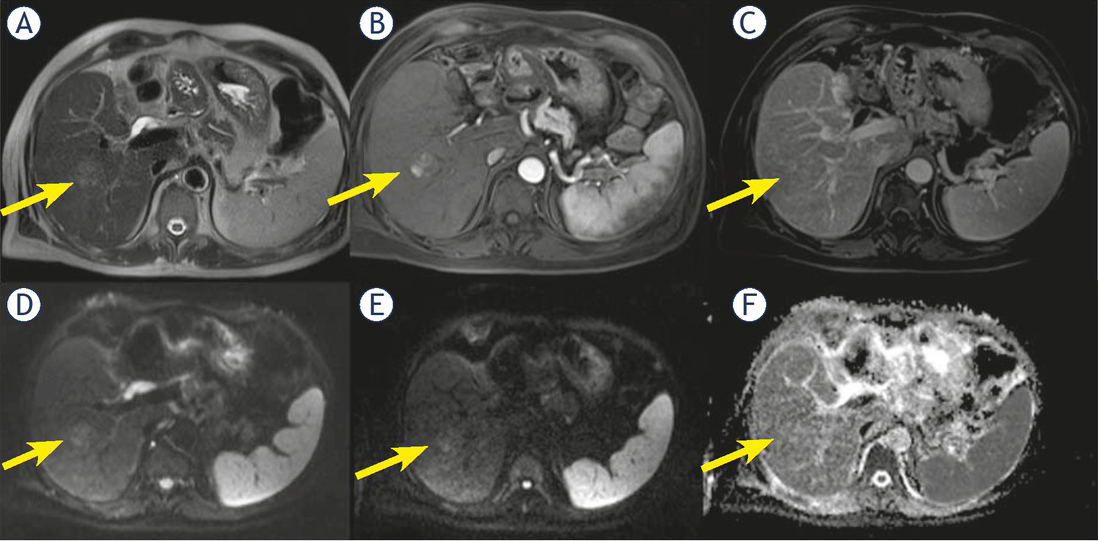
Figure 1
Man 56 y with combined hepatocellular-cholangiocarcinoma (cHCC-CCA) on VI hepatic segment. MRI study. The nodule is iso-hyperintense (arrow) in T2-W sequence (A), with inhomogeneous hypervascular appearance (arrow) during arterial phase of contrast study (B), without wash-out or capsule appearance (arrow) during portal phase of contrast study (C). The nodule shows restricted (arrow) diffusion (D, E and F) in diffusion weighted imaging (DWI) sequences.
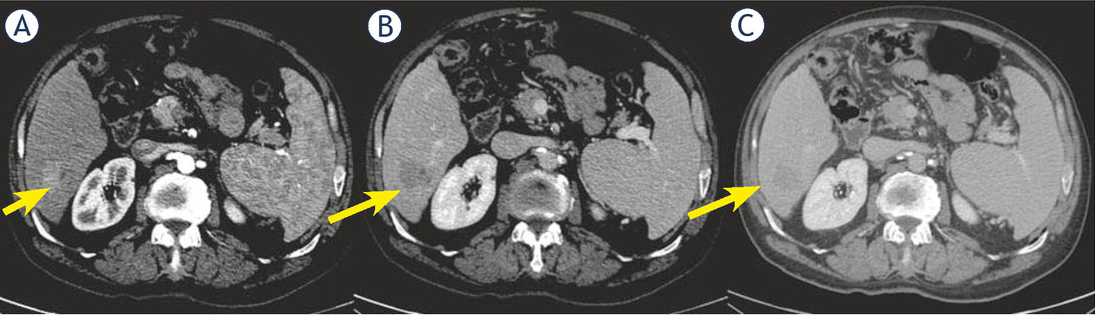
Figure 2
Woman 68 y with combined hepatocellular-cholangiocarcinoma (cHCC-CCA) on VI hepatic segment. Multidetector computed tomography (MDCT) study. The nodule shows hypervascular appearance (arrow) during arterial phase of contrast study (A), with wash-out appearance (arrow) and without capsule appearance (arrow) during portal and late phase of contrast study (B and C).
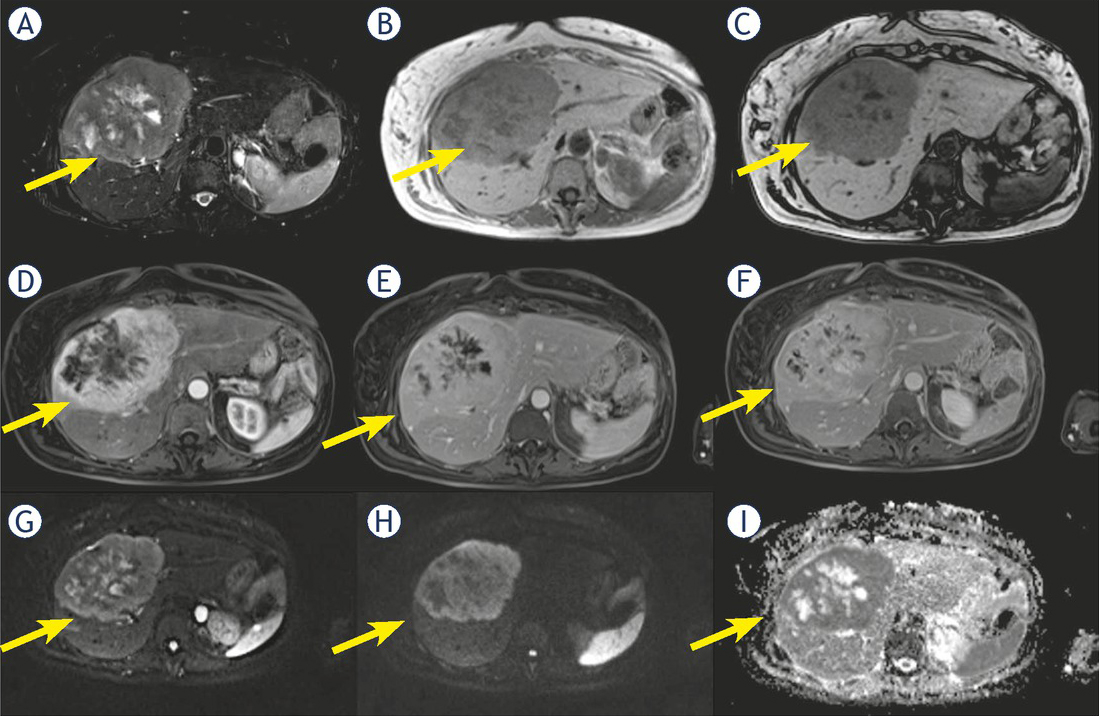
Figure 3
Woman 58 y with combined hepatocellular-cholangiocarcinoma (cHCC-CCA) on IV-V-VIII hepatic segment. MRI study. Pre surgical radiological diagnosis was cholangiocarcinoma (CCA). The lesion shows inhomogeneous hyperintense signal (arrow) in T2-W sequence (A) with central more hyperintense area. In T1-W in-out phase sequence (B and C) the lesion is inhomogeneous hypointense (arrow). During contrast study (D: arterial phase, E: portal phase; F: late phase) the lesion shows progressive contrast enhancement (arrow). In diffusion weighted imaging (DWI) (G, H and I) it shows restricted diffusion (arrow).
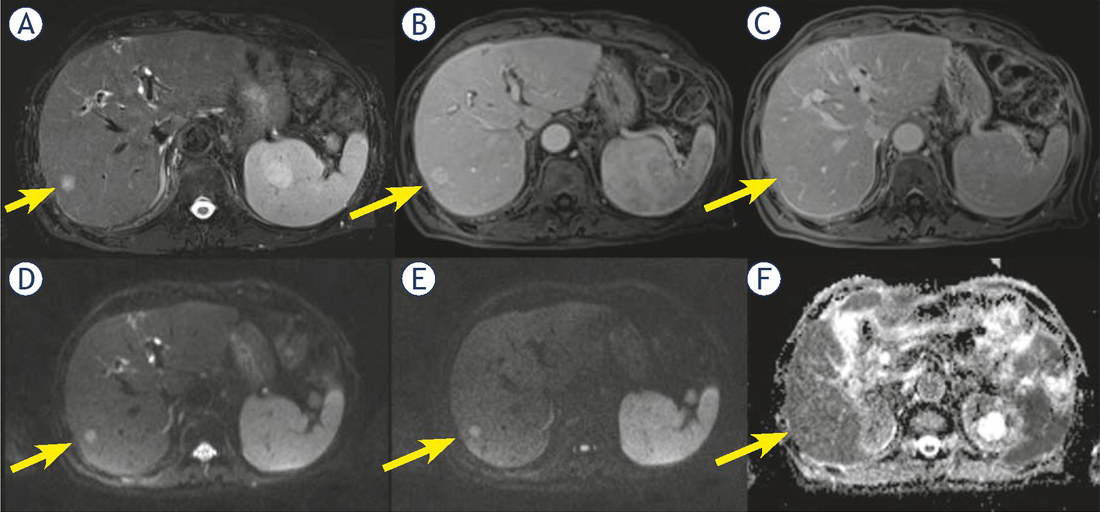
Figure 4
Man 71 y with combined hepatocellular-cholangiocarcinoma (cHCC-CCA) on VI hepatic segment. MRI study. The nodule shows hyperintense signal (arrow) in T2-W sequence (A) and target like pattern of enhancement (arrow) during arterial (B) and portal (C) phase of contrast study. Restricted diffusion (arrow) in diffusion weighted imaging (DWI) (D, E and F) sequence.
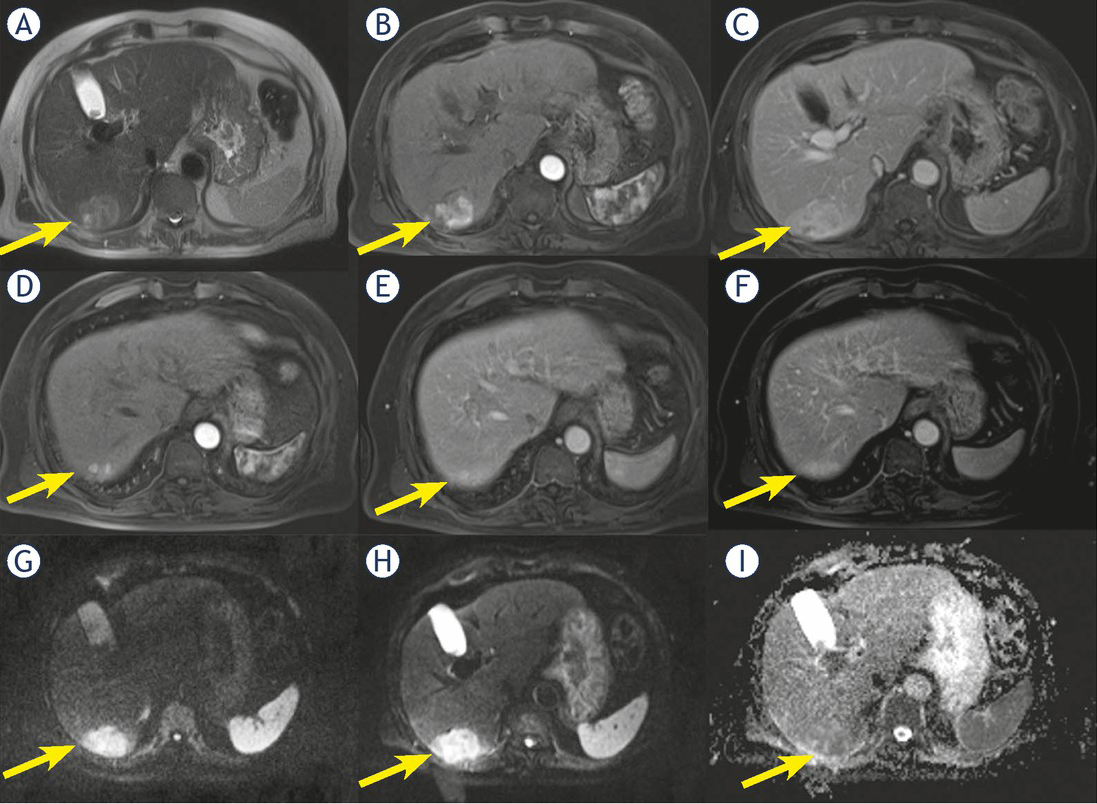
Figure 5
Man 69 y with combined hepatocellular-cholangiocarcinoma (cHCC-CCA) on VI hepatic segment. MRI study. The nodule shows inhomogeneous hyperintense signal (arrow) in T2-W sequence (A) and progressive pattern of enhancement (arrow) during arterial (B) and portal (C) phase of contrast study. In (D, E and F) arrow shows a nodule satellite. Restricted diffusion (arrow) in diffusion weighted imaging (DWI) (G, H and I) sequence.