
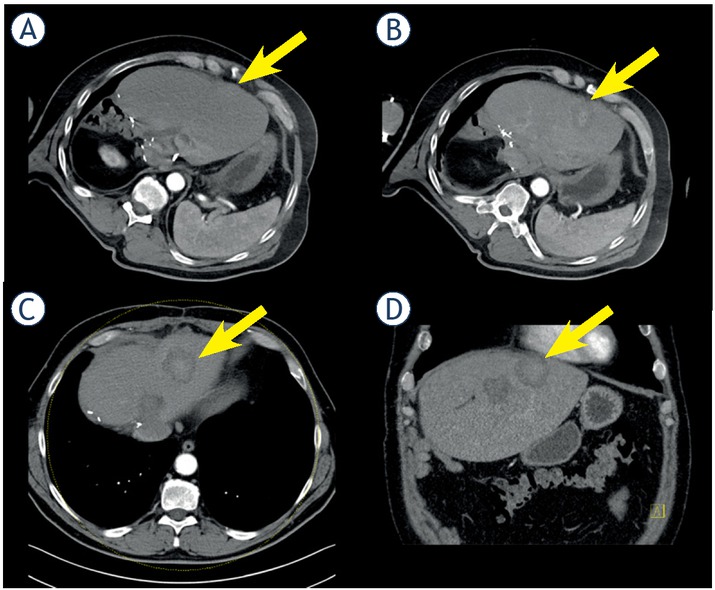
Figure 1
(A) Pre-interventional arterial phase in which the tumor is almost invisible. This not only complicates ablation but also post-interventional detection of residual tumor tissue. (B) The result immediately postinterventionally with a corresponding ablation defect. (C) Axial and (D) coronal show the situation one day postinterventionally. Due to the different breathing position, the tumor was more peripheral the day before, whereas on the following day healthy liver tissue around the ablation defect is visible. Measuring the safety distance is particularly difficult in these cases.
Table 1
Baseline characteristics
| Number of patients | N = 58 |
|---|---|
| Age | |
| mean (years) | 62.84 (10.85) |
| range (years) | 36–83 |
| Gender | |
| male (%) | 53 (91) |
| Ablation method (%) | |
| microwave ablation | 58 (100) |
| Liver segments | |
| I | 3 (5) |
| II | 4 (7) |
| III | 6 (10) |
| IVa | 7 (12) |
| IVb | 3 (5) |
| V | 7 (12) |
| VI | 4 (7) |
| VII | 12 (21) |
| VIII | 9 (16) |
| Tumor entity | |
| Hepatocellular carcinoma | 46 (79) |
| Metastasis colorectal cancer | 9 (16) |
| Metastasis pancreatic cancer | 3 (5) |
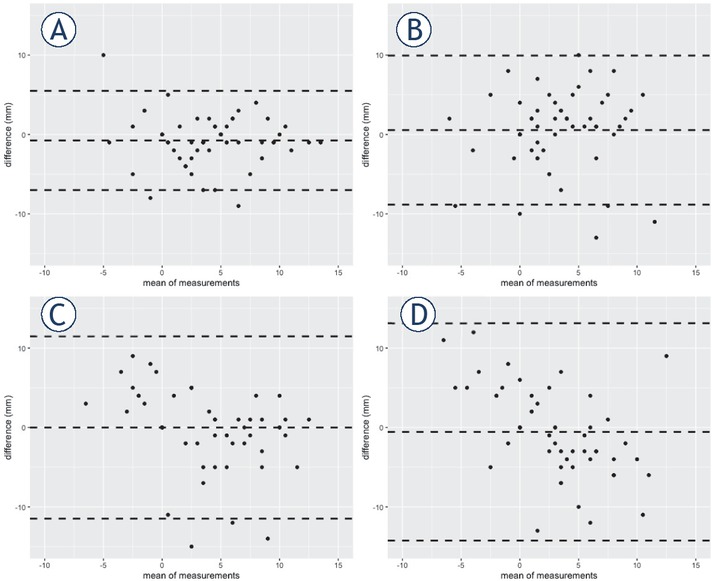
Figure 2
Bland-Altman plots: intra- (A) and inter-reader (B) = reader 1 vs. reader 2, (C) = reader 2 vs. reader 3, (D) = reader 1 vs. 3) agreement for minimum safety margin measurements. The middle line shows the mean percentage difference in measurements and the dashed lines above and below show the 95% reference range. Measurements within the 95% reference range can be considered as intrinsic measurement errors (or variations) that are associated with the given measurement tools and imaging techniques. Therefore, a narrower reference range indicates a lower measurement error/variation.
Table 2
Contingency table of all the three independent readings compared with the six weeks follow-up MRI as gold standard
| Incomplete (6 weeks MRI) | Complete (6 weeks MRI) | |
|---|---|---|
| Reader 1 | ||
| Incomplete | 2 | 3 |
| Complete | 4 | 41 |
| Reader 2 | ||
| Incomplete | 1 | 8 |
| Complete | 5 | 36 |
| Reader 3 | ||
| Incomplete | 5 | 8 |
| Complete | 1 | 36 |
Table 3
Sensitivity, specificity, positive predictive value (PPV) and negative predictive value (NPV) of the three independent readings (R 1, 2, 3)) compared with the six weeks follow-up MRI as gold standard
| R 1 | R 2 | R 3 | |
|---|---|---|---|
| Sensitivity | 93% | 82 % | 82 % |
| Specificity | 33% | 17 % | 83 % |
| PPV | 91 % | 88 % | 97 % |
| NPV | 40 % | 10 % | 39% |
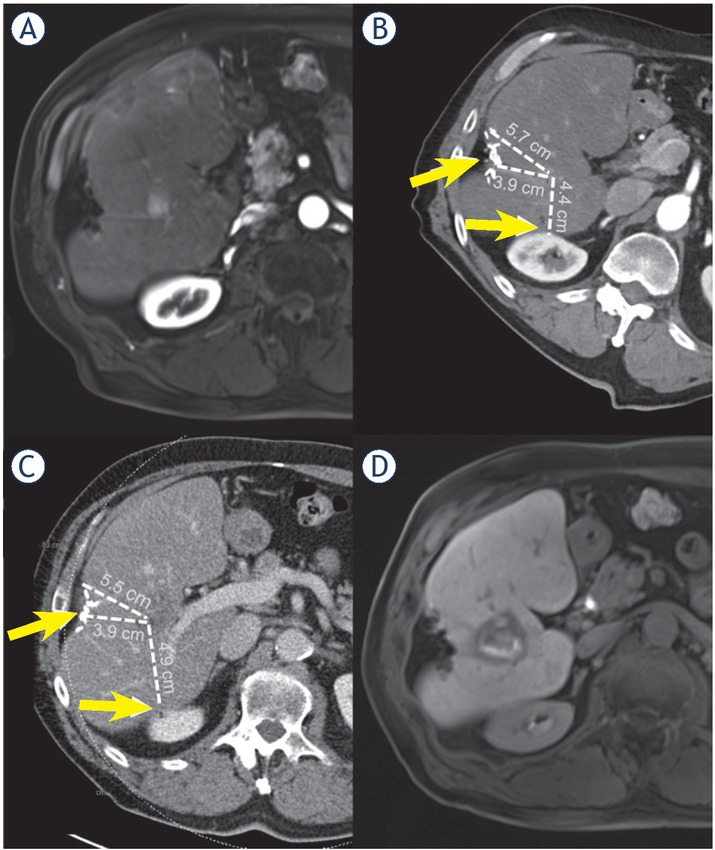
Figure 3
The HCC in segment VIII (A) was pre-interventionally localized using landmarks such as metal clips (arrow) and anatomical landmarks like the kidney (arrow) (B). Post-interventionally, the same landmarks are used and the target area is localized by distance measurements (dashed lines) from different angles (C). The MRI follow-up after 6 weeks confirmed complete ablation (D).
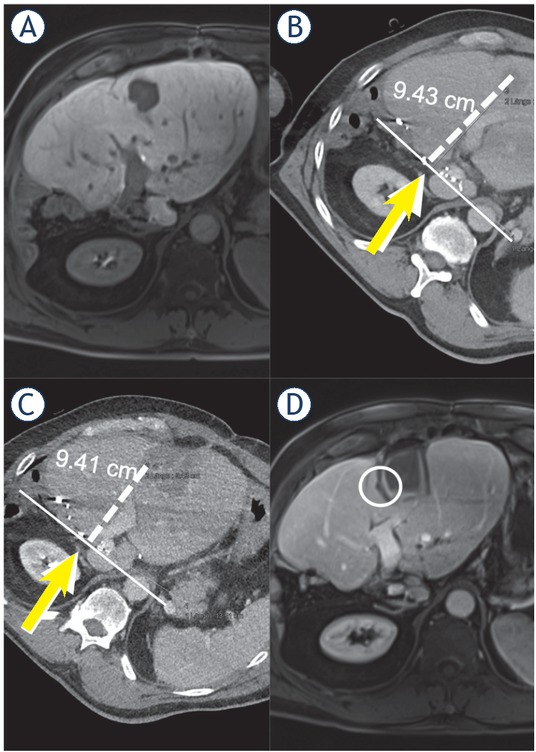
Figure 4
Metastasis was best seen in the portal venous phase (B). In this case, clips after hemihepatectomy serve as orientation. A line is drawn (solid line) and the distance (dashed line) is measured by means of a clip at an angle of 90 degrees. The same fixed points are used postinterventionally. This already shows only a small safety distance in the peripheral area. In the 6 weeks follow-up MRI residual tumor tissue (circle) was detected.