
Table 1
MRI sequence parameters
| Sequence parameter | MRI sequence | ||
|---|---|---|---|
| 3D spin-echo | 3D PGSE DWI | 3D multi-echo | |
| Field of view [mm3] | 20 x 10 x 10 | 20 x 10 x 10 | 20 x 10 x 10 |
| Imaging matrix | 128 x 64 x 64 | 128 x 64 x 16 | 128 x 64 x 16 |
| Spatial resolution [μm3] | 156 x 156 x 156 | 156 x 156 x 625 | 156 x 156 x 625 |
| Echo/inter-echo time [ms] | 5 | 34 | 16 |
| Repetition time [ms] | 100 | 1035 | 1930 |
| Signal averages | 10 | 2 | 2 |
| Number of echoes | 1 | 1 | 8 |
| b-values [s/mm2] | / | 0, 260, 620, 1250 | / |
| Scan time [h] | 1 | 4.7 | 2.3 |
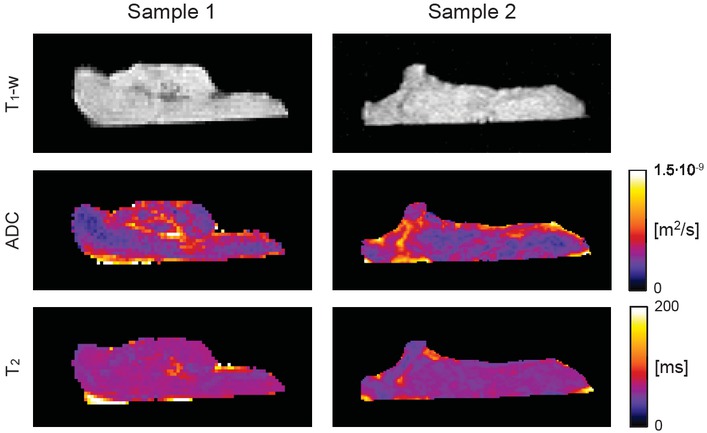
Figure 1
Two representative cerebral thrombi presented by central-slice T1- weighetd images, ADC and T2 maps. Low ADC and T2 values, shown in dark blue, correspond to regions of higher compaction while brighter regions are less compact regions that are more susceptible to thrombolytic therapy. From the images can also be seen that variability of ADC values across the thrombi is considerably higher than that of T2 values.
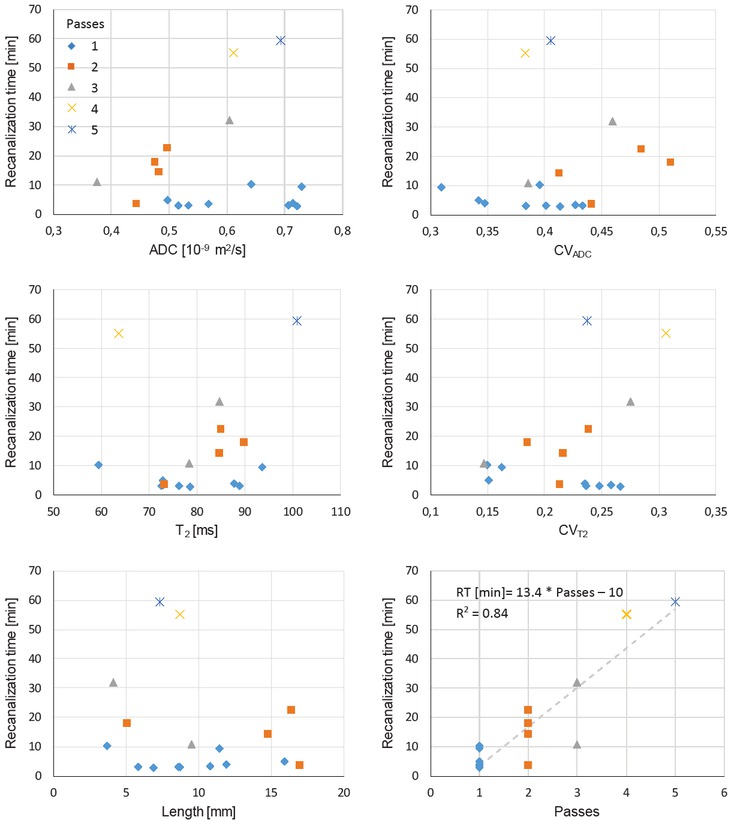
Figure 2
Graphs of correlation between the recanalization time (RT) of mechanical thrombectomy and different thrombi parameters: sample-mean apparent diffusion coefficient (ADC), within-sample coefficient of variation of apparent diffusion coefficient (CVADC), sample-mean spin-spin relaxation time (T2), within-sample coefficient of variation of spin-spin relaxation time (CVT2), thrombus length (Length), and number of thrombectomy procedure passes (Passes). Colour (symbol type) of experimental points indicates number of thrombectomy passes.
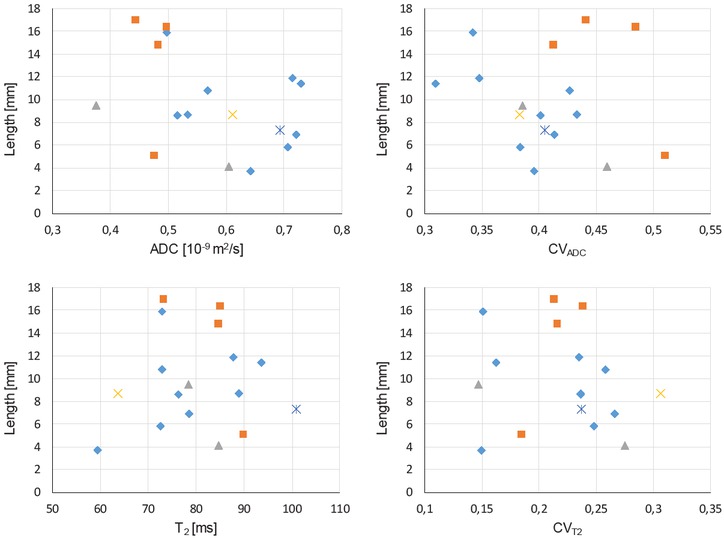
Figure 3
Graphs of correlation between the thrombus length (Length) and: sample-mean apparent diffusion coefficient (ADC), within-sample coefficient of variation of apparent diffusion coefficient (CVADC), sample-mean spin-spin relaxation time (T2), and within-sample coefficient of variation of spin-spin relaxation time (CVT2). Color (symbol type) of experimental points indicates number of thrombectomy passes as defined in Figure 2.
Table 2
Pearson correlation coefficient for different pairs of thrombi parameters. Correlation coefficients are sorted by their decreasing absolute values
| Pair | ρ | Pair | ρ | Pair | ρ |
|---|---|---|---|---|---|
| Passes-RT | 0.92 | T2-Passes | 0.24 | CVADC-Length | -0.14 |
| ADC-CVADC | -0.43 | Length-RT | -0.22 | Length-Passes | -0.13 |
| ADC-Length | -0.41 | T2-RT | 0.21 | ADC-T2 | 0.13 |
| CVT2-RT | 0.38 | CVADC-Passes | 0.19 | CVADC-T2 | 0.12 |
| ADC-CVT2 | 0.32 | CVT2-Length | -0.16 | ADC-Passes | -0.09 |
| CVADC-CVT2 | 0.28 | ADC-RT | 0.15 | T2-Length | 0.06 |
| CVT2-Passes | 0.27 | CVADC-RT | 0.14 | T2-CVT2 | -0.01 |
[i] ADC = apparent diffusion coefficient; CVADC = sample coefficient of variation CVADC; CVT2 = sample coefficient of variation CVT2; Length = thrombus length; ρ = Pearson correlation coefficient; RT = recanalization time
Table 3
Significance of differences between the single-pass (n = 9) and multi-pass (n = 8) thrombectomy groups for different parameters analysed by group-average values and by the t-test
| Thrombectomy group / t-test | ADC_g [10-9 m2/s] | CVADC_g | T2_g [ms] | CVT2_g | Length_g [mm] | RT_g [min] |
|---|---|---|---|---|---|---|
| Single-pass | 0.63 ± 0.1 | 0.38 ± 0.04 | 78 ± 10 | 0.22 ± 0.05 | 9.3 ± 3.7 | 4.8 ± 2.8 |
| Multi-pass | 0.52 ± 0.1 | 0.44 ± 0.05 | 82 ± 11 | 0.23 ± 0.05 | 10.4 ± 5.1 | 27 ± 20 |
| p-value | 0.05 | 0.03 | 0.41 | 0.64 | 0.62 | 0.006 |
[i] ADC = apparent diffusion coefficient; ADC_g = group-average of sample-mean ADC; CVADC_g = group-average of within sample coefficient of variation CVADC; CVT2_g = group-average of within sample coefficient of variation CVT2; Length_g = group-average of thrombus length; p-value = result of the t-test analysis between single- and multi-pass thrombectomy groups; RT_g = group-average of recanalization time; T2_g = group-average of sample-mean T2