
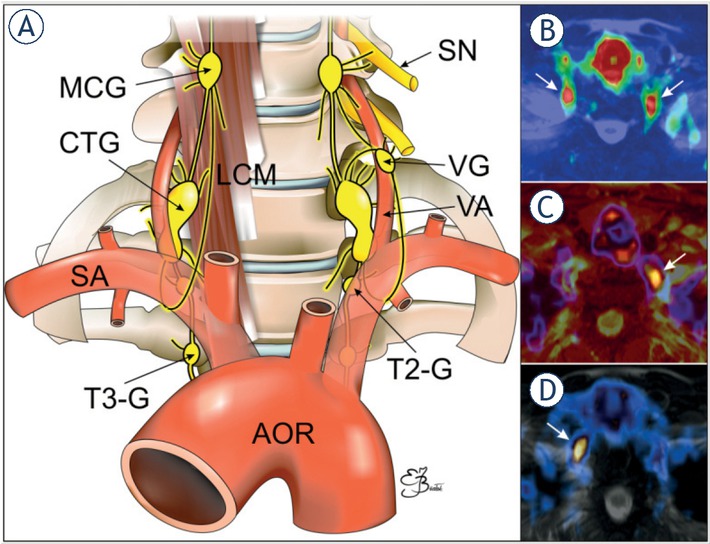
Figure 1
The scheme of the location of the sympathetic cervico-thoracic ganglia (CTG) and their surroundings (A) and examples of elevated PSMA-ligand uptake, potentially suggesting malignancy in both CTG complexes (B), in the left CTG (C) and in the right CTG (D) on fused PET/MR T2-weighted images presented with application of different colour maps.
AOR = aortic arch; LCM = longus colli muscle; MCG = middle cervical sympathetic ganglion; SA = subclavian artery; SN = spinal nerve; T2-G = 2nd thoracic sympathetic ganglion; T3-G = 3rd thoracic sympathetic ganglion; VA = vertebral artery; VG = vertebral sympathetic ganglion
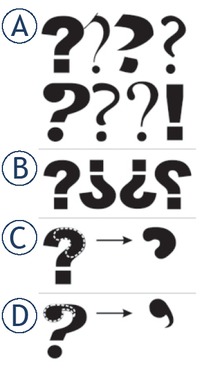
Figure 2
Schematic presentation of the discovered in current study “typical” cervico-thoracic ganglia complexes shapes resembling different forms of a question-mark or close to an exclamation-mark (A), which may be configured in various orientations, for example normal, mirror, upside-down and reversed mirror (B) or represent a part of a question-mark similar to kidney (C) or comma (D).
Table 1
Dimensions of the right and left cervico-thoracic ganglia complex (CTG-C)
| thickness (mm) | width (mm) | length (mm) | |||||||
|---|---|---|---|---|---|---|---|---|---|
| Mean ± SD* | minimal | maximal | Mean ± SD | minimal | maximal | Mean ± SD | minimal | maximal | |
| right CTG-C (n = 103) | 4.31 ± 1.17 | 1.5 | 8 | 12.50 ± 5.30 | 4 | 28 | 12.7 ± 3.88 | 5 | 25 |
| left CTG-C(n = 106) | 4.35 ± 1.24 | 2 | 8 | 14.90±4.79 | 5 | 29 | 13.50 ± 3.53 | 7 | 25 |
[i] * SD standard deviation
Table 2
68Ga-PSMA-11 uptake in the right and left cervico-thoracic ganglia complex (CTG-C)
| 68Ga-PSMA-11 uptake (SUVmax) | |||||
|---|---|---|---|---|---|
| mean | median | SD* | minimal | maximal | |
| right CTG-C | 2.54 | 2.45 | 0.82 | 1.06 | 6.23 |
| left CTG-C | 2.75 | 2.74 | 0.78 | 1.35 | 5.73 |
[i] * SD standard deviation
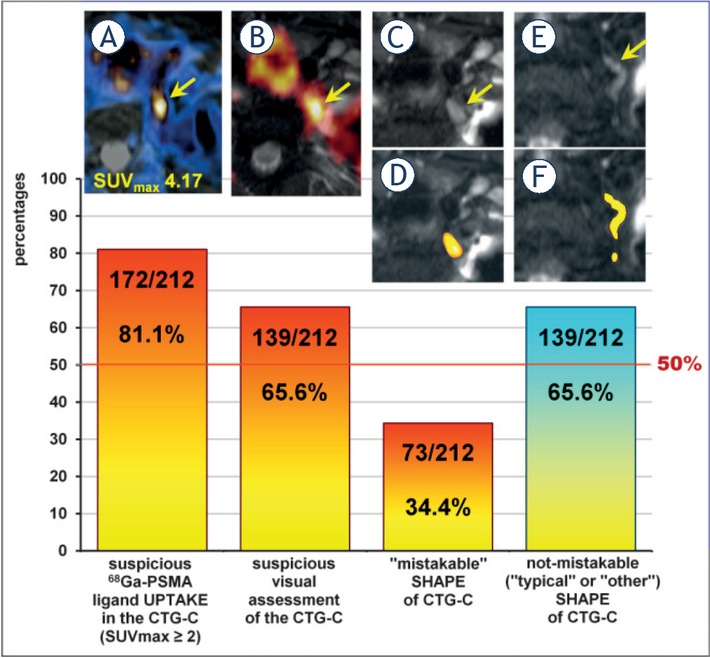
Figure 3
The chart comparing proportions of suspicious of malignancy PET presentation of cervico-thoracic ganglia complex (CTG-C) (arrow) in quantitative (SUVmax at least 2) and qualitative (visual) assessment with potentially ”mistakable” and not-mistakable with malignancy underlying shape of CTG-C on MR part of the multimodal PET/MR. (A, B) Fused PET/MR scans of the left CTG-C potentially suspicious of malignancy in different patients. MR T2-weighted scans showing the mistakable (oval) shape (C) and not-mistakable (question-mark ) shape (E) of the left CTG-C (arrow) with respective schemes (D, F).
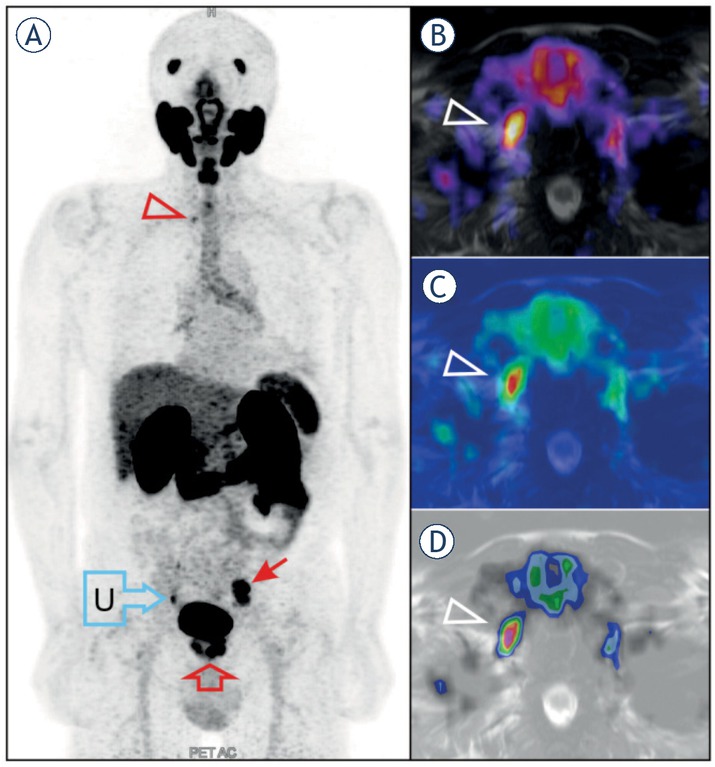
Figure 4
(A) Prostate cancer (empty block arrow) with lymph node metastases (arrow) on the maximum intensity projection (MIP) attenuation corrected (AC) PET image. Possibly suspected of metastasis asymmetric increased uptake in the right cervico-thoracic sympathetic ganglion (arrowhaed) is noticeable already on the MIP image (A) and more conspicuously on fused PET/MR T2-weighted images presented with application of different color maps (B–D).
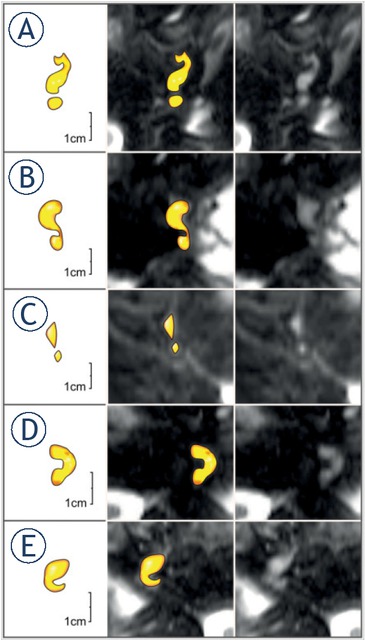
Figure 5
Schemes (two first columns) and original MR T2-weighted fat-saturated images (two last columns) depicting exemplary “typical” shapes of the cervico-thoracic ganglia complex (CTG-C): a question-mark shape (A), a mirror question-mark shape (B), an exclamation-mark shape (C), a part of a question-mark resembling kidney (D), a part of a question-mark resembling comma (E).