Have a personal or library account? Click to login
The multidisciplinary team for gastroenteropancreatic neuroendocrine tumours: the radiologist’s challenge Cover

The multidisciplinary team for gastroenteropancreatic neuroendocrine tumours: the radiologist’s challenge

Open Access
|Oct 2019

Figures & Tables

Figure 1

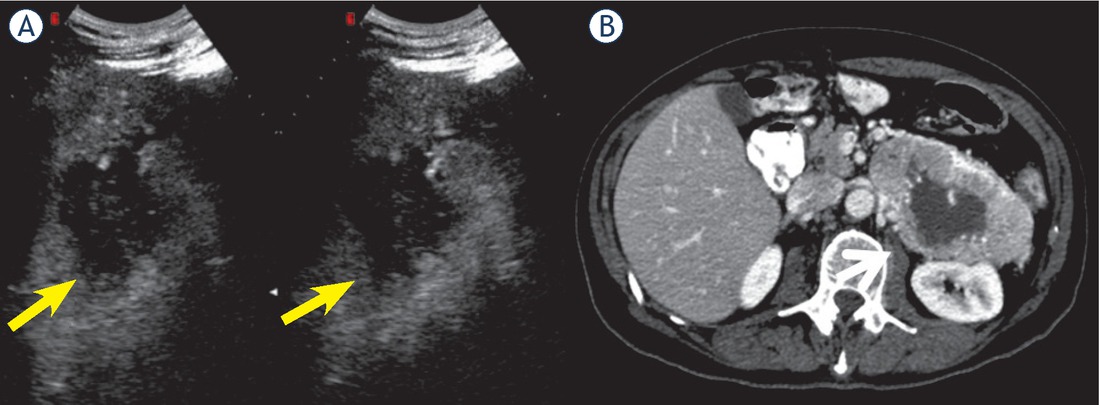
A 45 yrs old female: CEUS study of inhomogeneous pancreatic lesion (A), with necrotic central area (arrow). CT (B), during late arterial phase of contrast study shows the same vascular profile (arrow) seeing during CEUS study.
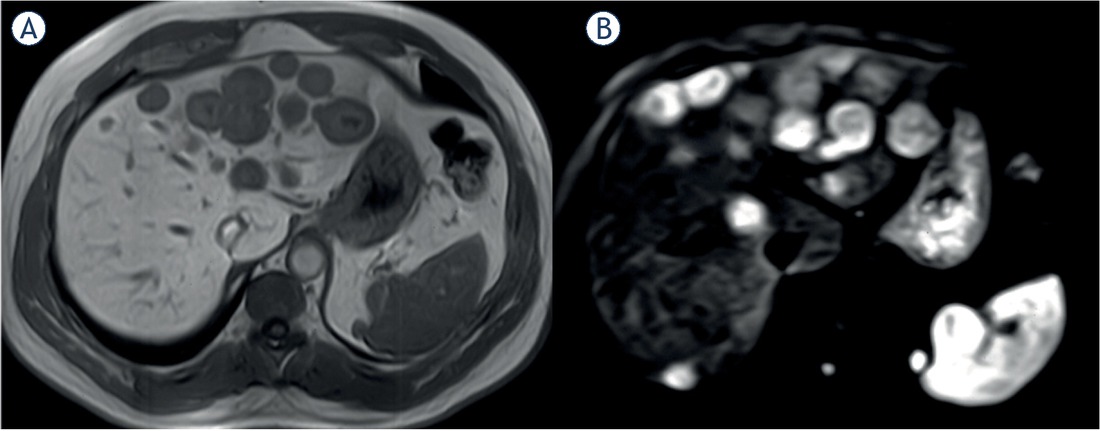

Figure 2

A 64 yrs old male with pancreatic NET. Liver metastases in IV, II and III segment, with a “target” appearance (arrow) during hepatobiliary phase of EOB-MR study (A) and restricted diffusion (arrow) on b800 s/mm2(B).
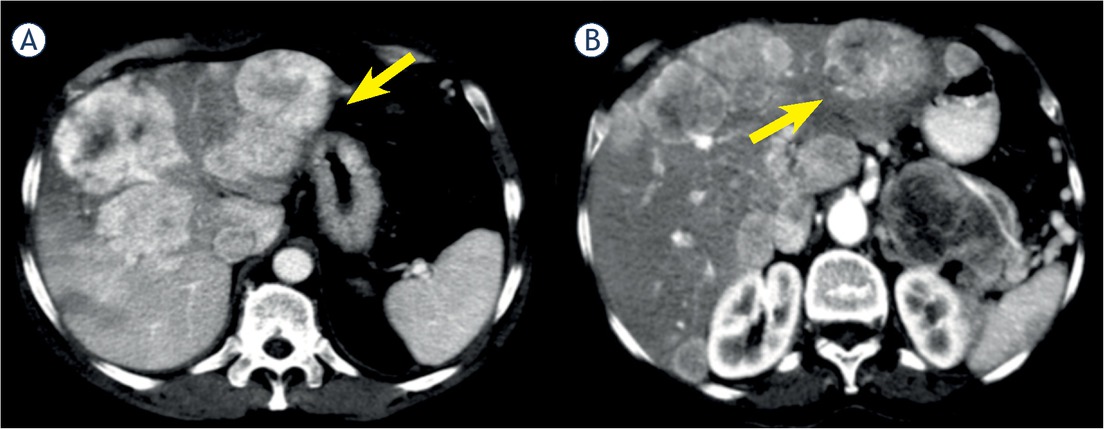

Figure 3

A 52 yrs old female with pancreatic NET. Liver metastases show hypervascular appearance (arrow) during arterial phase of contrast study on CT (A, B).
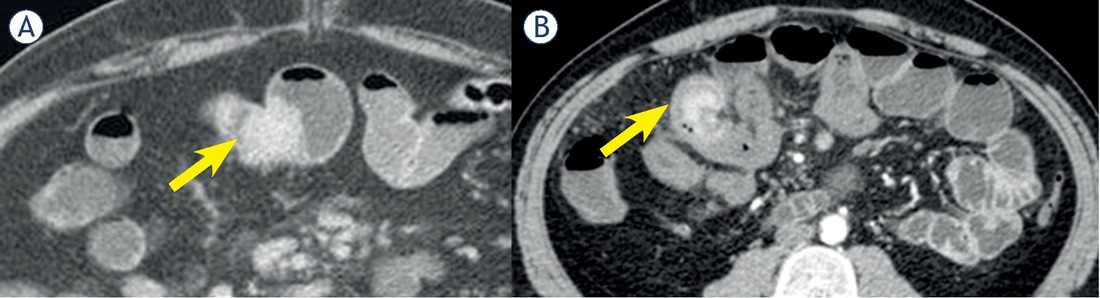

Figure 4

A 41 yrs old male. CT enteroclysis examination shows lesion, in (A), as small, hypervascular, polypoid (arrow) and, in (B), as an asymmetric bowel wall thickening (arrow).
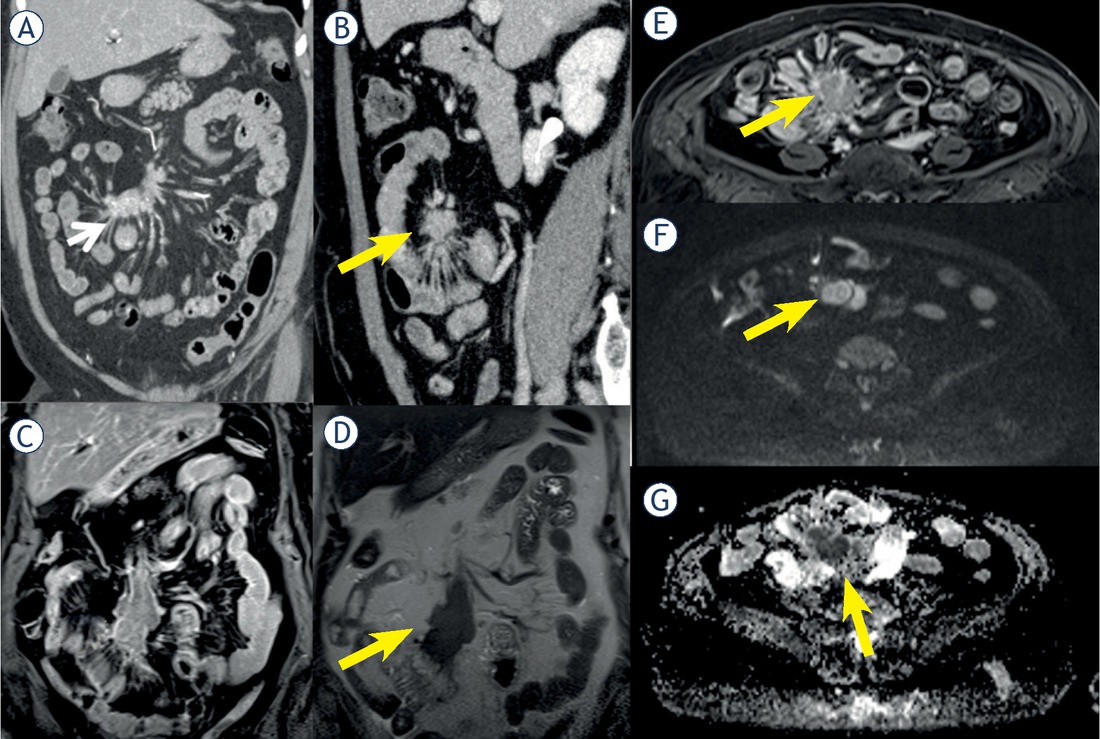

Figure 5

A 48 yrs old male with ileal net. CT during portal phase shows (A, coronal plane and B sagittal plane) desmoplastic reaction in the mesentery and lymphadenopathy (arrow); these features in T1-W post contrast study (C and E portal phase) show hypointense signal (arrow) and hypintense signal (arrow) in T2- W sequence (D) with restricted diffusion (arrow) in b800 s/mm2(F) and hypointense signal in ADC (G) map.
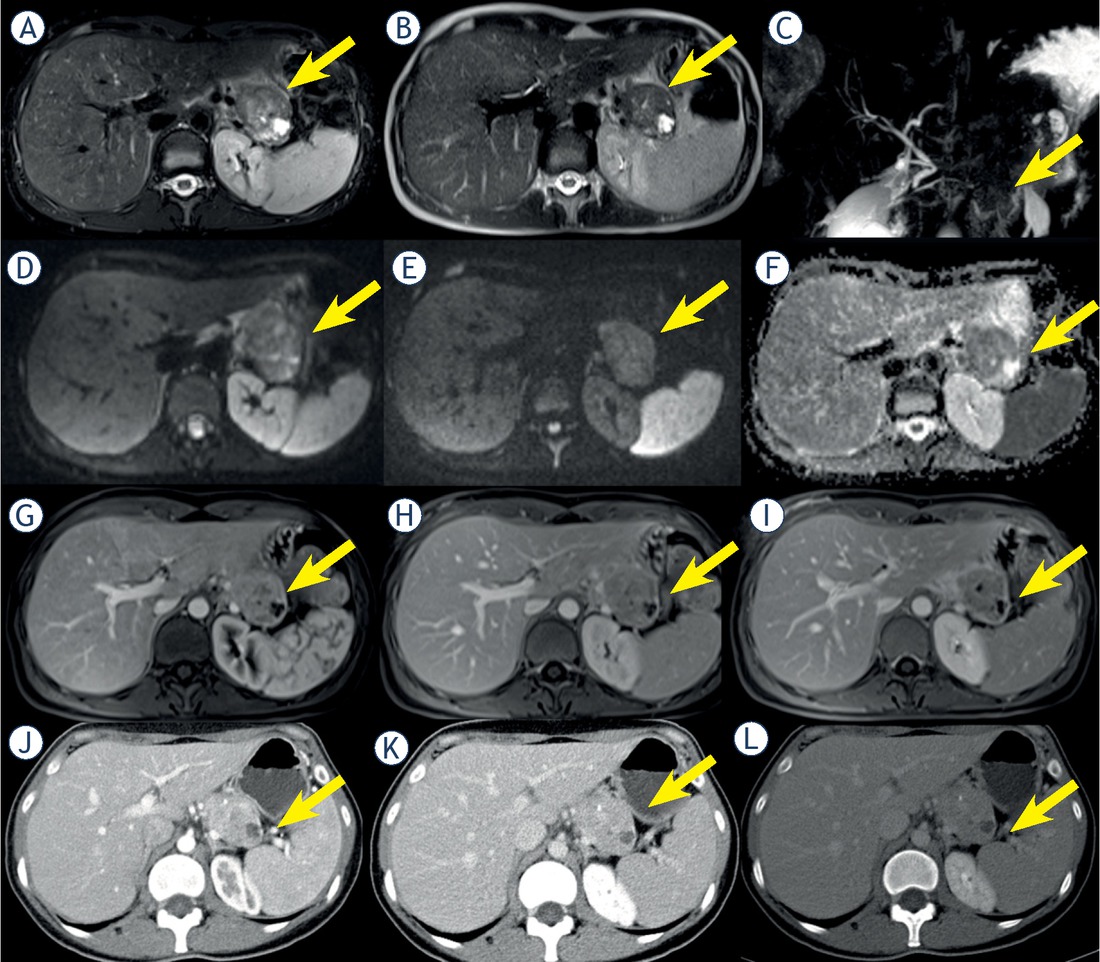

Figure 6

A 29 yrs old female with p-Net of pancreatic tail. The lesion shows inhomogeneous signal with cystic component (arrow) on T2-W sequences (A, B). MR cholangiopancreatography (C) sequence show its relation to the pancreatic duct and the main bile duct (arrow). The lesion shows restricted diffusion (D, E, F) and inhomogeneous contrast enhancement during arterial (G, J), venus (H, K) and late (I, L) phase as in MR as in CT (arrow).
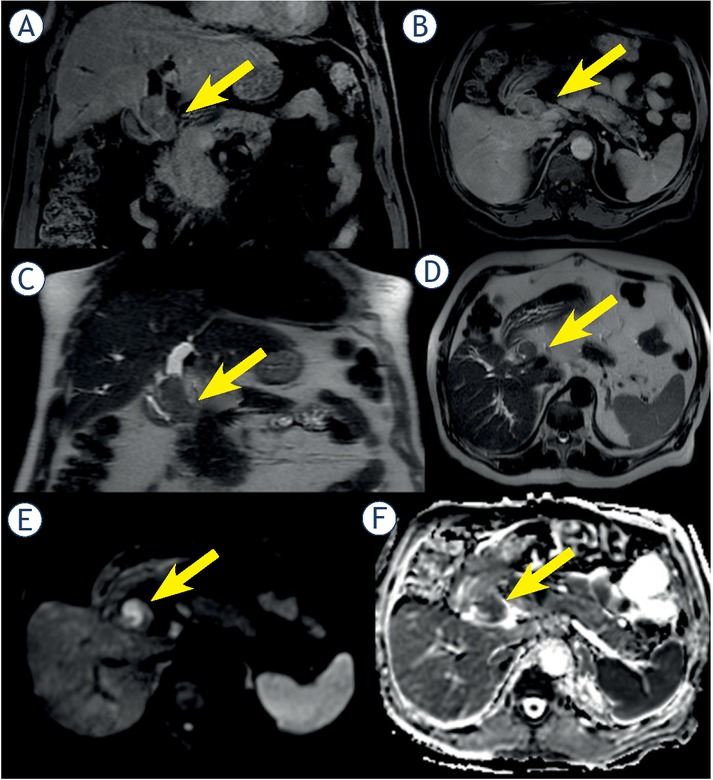

Figure 7

A 58 yrs old male wih primitive NET of biliary tree. The lesion shows hypointense signal (arrow) during portal phase of contrast study (A, B), hyperintense signal (arrow) on T2-W sequences (C, D) and restricted diffusion (arrow) on DW sequences (E, F).
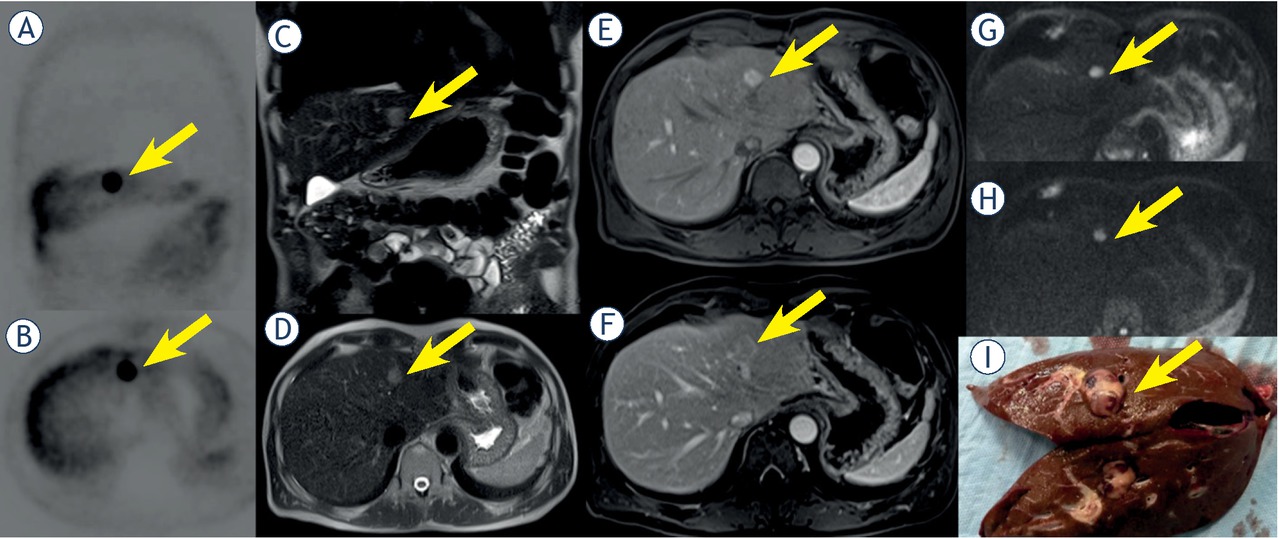

Figure 8

A 63 yrs old male with solitary liver lesion. The nodule is detected (arrow) by 68Ga-DOTATOC-PET/CT (A, B), showing hyperintense signal (arrow) in T2-W sequences (C, D). The lesion shows hypervascular appearance (arrow) during arterial phase (E) and “target” appearance (arrow) during portal phase (F) of contrast study, with restricted diffusion (G, H). In (I) it is shown speciemen.
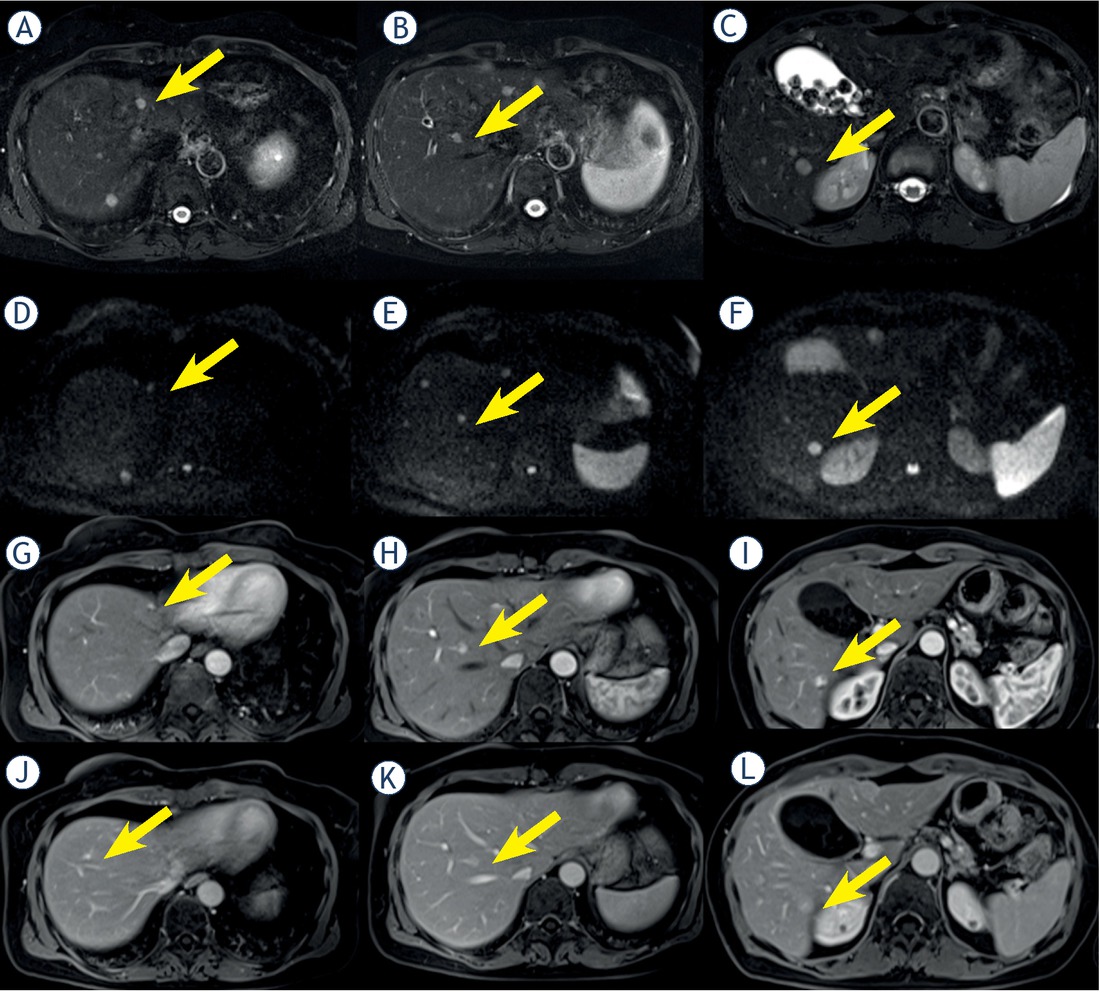

Figure 9

A 46 yrs old female with p-Net and bilobar liver metastases. The metastases show hyperintense signal (arrow) in T2-W sequences (A, B ,C), restricted diffusion (arrow) in DW sequences (D, E, F), hypervascular appearance (arrow) during arterial phase of contrast study (G, H, I) and hyperintense signal (arrow) during portal phase of contrast study (J, K, L).
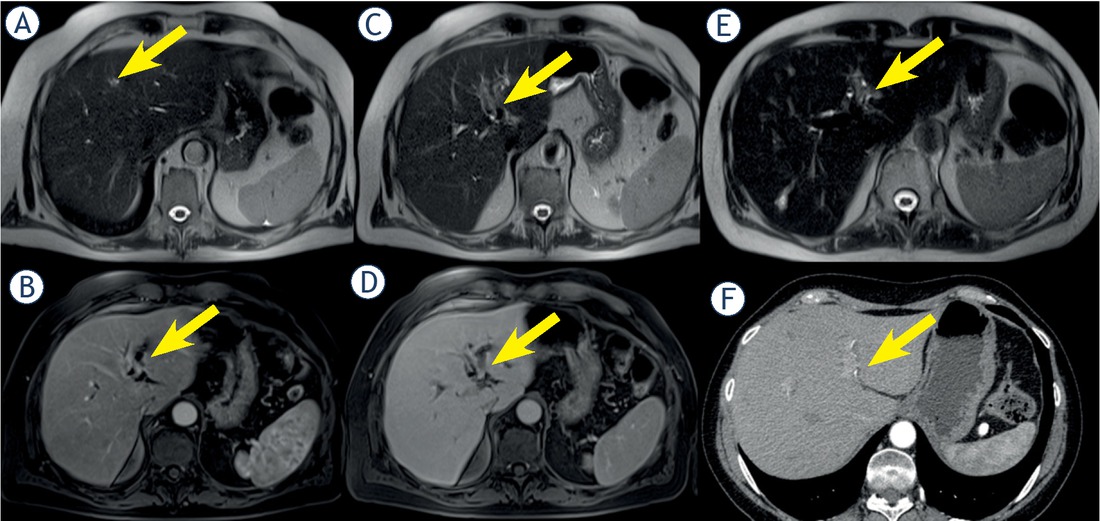

Figure 10

Man 51 y with p-Net and peribiliary metastasis. The lesion is hyperintense (arrow) in T2-W sequences (A, C, E) with progressive contrast enhancement (arrow) during contrast study (B, D, F) both in MR and in CT.
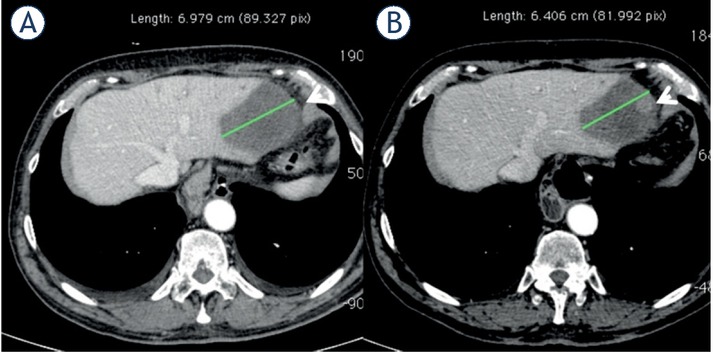

Figure 11

Nodule in nodule appearance (arrow) during follow-up of p-NET, indicating progressive disease.
DOI: https://doi.org/10.2478/raon-2019-0040 | Journal eISSN: 1581-3207 | Journal ISSN: 1318-2099
Language: English
Page range: 373 - 387
Submitted on: Mar 30, 2019
|
Accepted on: Jul 15, 2019
|
Published on: Oct 25, 2019
In partnership with: Paradigm Publishing Services
Publication frequency: 4 issues per year

© 2019 Vincenza Granata, Roberta Fusco, Sergio Venanzio Setola, Elisabetta de Lutio di Castelguidone, Luigi Camera, Salvatore Tafuto, Antonio Avallone, Andrea Belli, Paola Incollingo, Raffaele Palaia, Francesco Izzo, Antonella Petrillo, published by Association of Radiology and Oncology
This work is licensed under the Creative Commons Attribution-NonCommercial-NoDerivatives 3.0 License.