
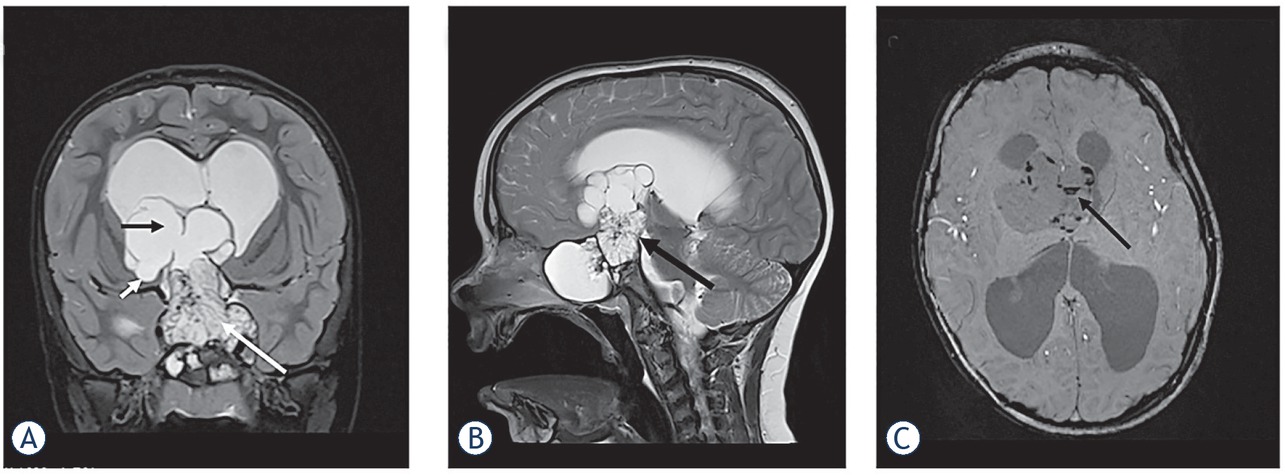
Figure 1
Large, partially solid, partially multicystic adamantinomatous craniopharyngioma in a 5-year old boy. (A) Coronal T2 sequence through sellar region; solid part of the tumor (white arrow) involves enlarged sella turcica, parasellar regions, occupies the suprasellar cistern and the third ventricle. The cystic portion of the tumor (black arrow) extends into the lateral ventricles and on the right side it infiltrates the adjacent brain parenchym (small arrow). Lateral ventricles are enlarged with a band of periventricular transependimal edema as a sign of acute hydrocephalus. (B) Sagital T2 sequence through the sellar region; Hypothalamus and mammillary bodies are not visible (arrow). (C) SWI sequence through the multicystic portion of the tumor shows multiple calcifications in the cyst walls (arrow).
Table 1
Comparison of pediatric and adult-onset craniopharyngioma characteristics
| Pediatric-onset | Adult-onset | |
|---|---|---|
| 30–50 % of all CPs | ||
| Age at presentation | Peak at 5–14 years1 | Peak at 40–44 years2 |
| Gender distribution (m/f) | Equal8,21 | Equal8,27 |
| Most frequent presentation | Headache (68–85%) | Visual impairment (40–84%) |
| Visual impairment (36– 55%) | Menstrual irregularities (57%) | |
| Growth failure (7–36%)9,35,66 | Headache (42–56%)13,26,27 | |
| Pathohistological type | Adamantinomatous 99% | 33 |
| Papillary extremely rare* | Papillary 14–50% | |
| Initial hypothalamic involvement | 42–66%8,9,35 | 42%18 |
| Endocrine deficits at diagnosis | ||
| Any | 40–87%8,13,21,35,65,66 | 41–73%8 |
| GH | 41–75%8,13,21,35,65,66 | 18–86%8,13 |
| FSH/LH | 20–56%8,13,21,35,65,66 | 29–74%8,13 |
| ACTH | 8–68%8,13,21,35,65,66 | 35–58%8,13 |
| TSH | 15–32%8,13,21,35,65,66 | 35–56%8,13 |
| ADH | 7–17%8,13,21,35,65,66 | 6–17%8,13 |
| Pituitary hormone deficiencies after treatment | ||
| Any | 64–100%8,64 | 48–97%8,64 |
| GH | 93–96%8,18,21 | 52–68%8,18 |
| FSH/LH | 59–95%8,18,21 | 70–94%8,18 |
| ACTH | 78–100%8,18,21 | 74–88%8,18 |
| TSH | 86–100%8,18,21 | 81–92%8,18 |
| ADH | 65–96%8,18,21 | 43–70%8,18 |
| Panhypopituitarism*** | 43–100%8,18,64 | 59–74%8,18,64 |
| Obesity** | 44–64%8,9,19,64 | 41–47%8,19,64 |
[i] * Only 23 identified cases since 1995.83
** Obesity was defined with BMI > 30 kg/m2 in adults and BMI >95. percentile for their age in children.
*** Panhypopituitarism was defined as present when 3 anterior pituitary deficiencies were diagnosed in one patient (growth hormone deficiency, thyroid-stimulating hormone deficiency, adrenocorticotropic hormone deficiency, and late puberty in children or hypogonadism in adults).
ACTH = adrenocorticotropic hormone; ADH = vasopressin (antidiuretic hormone); FSH/LH = follicle stimulating hormone/luteinizing hormone; GH = growth hormone; TSH = thyroid stimulating hormone