
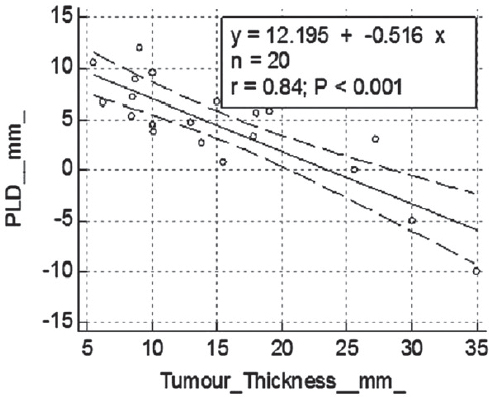
Figure 1
Scatter plot showing strong negative correlation between MR tumour thickness and para-lingual distance (p-value < 0.001 and r = 0.84).
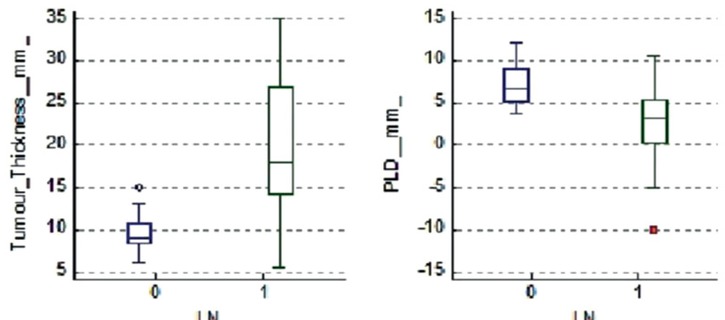
Figure 2
Comparison graphs illustrating the significant differences between tumour thickness and para-lingual distance among nodes positive (N1) and negative (N0) patients (p-values 0.008 and 0.003 respectively).
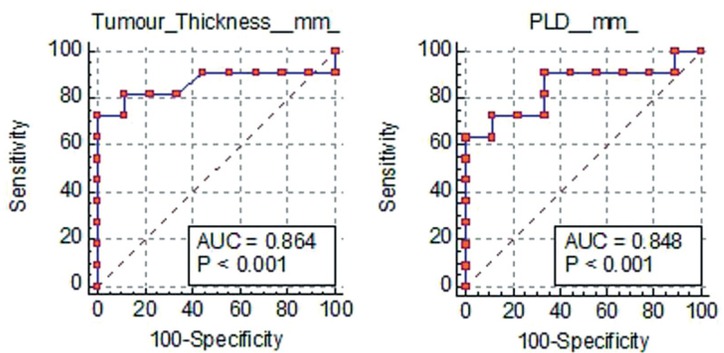
Figure 3
Receiver Operator Characteristic (ROC) curve analyses for tumour thickness and para-lingual distance predicting nodes spread (p-values < 0.001 and AUC 0.864 and 0.848 respectively).
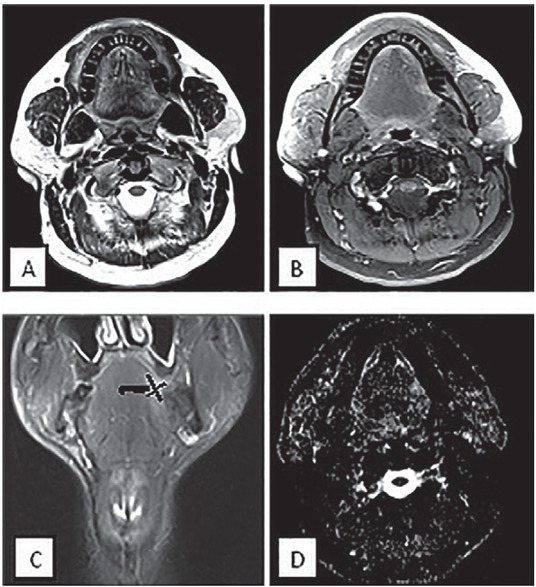
Figure 4
MRI of a male patient 65-years-old with small lesion at left hemi-tongue (T1N0) disease. (A) Axial T2 (B) Axial T1 fat suppression post contrast (C) T2 coronal (D) Axial DWI. MRI and elective dissected neck revealed no positive cervical lymph nodes spread. The vertical black line was drawn as a reference line connecting maximum tumour-mucosa junctions. Two horizontal lines were drawn perpendicular to the reference line. Tumour thickness is the sum of both of these horizontal lines and was determined as 5.5 mm. The thick black line between the tumour and the para-lingual space represented the para-lingual distance = 10.5 mm.
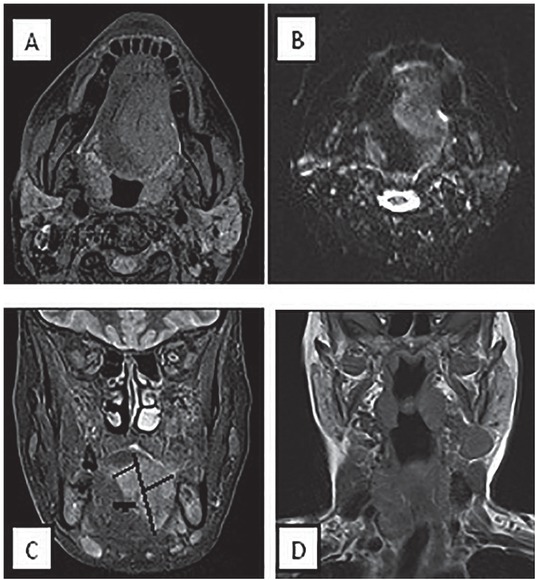
Figure 5
MRI of a 75-years-old female with sizable tongue mass crossing the midline (T4N1 disease). (A) Axial T1 post contrast fat suppression (B) Axial DWI (C) Coronal T1 post contrast fat suppression (D) Coronal T1 post contrast shows metastatic cervical lymph nodes. Tumour thickness is the sum of the two horizontal black lines drawn perpendicular to the vertical black line connecting maximum tumour junction distance and was determined as 30 mm. The thick black line representing para-lingual distance between the tumour and the para-lingual space was determined as – 10 as the tumour margin extends beyond the midline by 10 mm
Table 1
Absolute values for TT, PLD and ADC for (N0) and (N1) LN spread
| N0 | ||
|---|---|---|
| TT (mm) | PLD (mm) | ADC |
| 10 | 9.5 | 0.899 |
| 8.4 | 5.3 | 0.937 |
| 15 | 6.7 | 0.815 |
| 8.7 | 8.9 | 0.953 |
| 10.1 | 3.8 | 1.051 |
| 5.5 | 10.5 | 0.875 |
| 6.2 | 6.6 | 0.988 |
| 9 | 12 | 0.836 |
| 13 | 4.7 | 0.864 |
| 8.5 | 7.2 | 0.955 |
| 9.8 | 10 | 0.832 |
| 9 | 7.8 | 0.968 |
| 12.3 | 6.3 | 0.843 |
| 7.6 | 9.2 | 0.915 |
| 10.7 | 4.3 | 1.31 |
| 6.3 | 10.8 | 0.864 |
| 6.4 | 6.7 | 0.978 |
| 9.3 | 12.4 | 0.834 |
| 9.1 | 7.9 | 0.869 |
| 10 | 9.5 | 0.899 |
| 8.4 | 5.3 | 0.937 |
| 8.7 | 8.9 | 0.953 |
| N1 | ||
| 19 | 5.8 | 1.18 |
| 17.8 | 3.3 | 0.928 |
| 10 | 4.5 | 1.16 |
| 15.5 | 0.8 | 0.795 |
| 13.8 | 2.7 | 0.961 |
| 18 | 5.6 | 0.793 |
| 16.9 | 3.1 | 0.874 |
| 12.3 | 4.7 | 1.17 |
| 13.7 | 0.5 | 0.778 |
| 14.8 | 3.7 | 0.959 |
| 19 | 5.8 | 1.18 |
| 17.8 | 3.3 | 0.928 |
| 15 | 6.7 | 0.815 |
| 13.8 | 4.4 | 0.83 |
| 35 | -10 | 0.987 |
| 27.2 | 3.1 | 1.03 |
| 30 | -5 | 0.976 |
| 25.6 | 0 | 0.892 |
| 34 | -8 | 0.984 |
| 25 | 7 | 1.21 |
| 23.2 | 3.2 | 1.07 |
| 29.7 | -3 | 0.938 |
| 22.8 | 0 | 0.792 |
| 21.4 | 5.8 | 0.724 |
| 27.8 | -7 | 0.852 |
| 23.9 | 0 | 0.897 |
| 42.7 | -15 | 0.893 |
| 43.2 | -12 | 1.051 |
Table 2
Summary of descriptive statistics for studied population
| N | N1 | N0 | P value | |
|---|---|---|---|---|
| Age (mean+/-SD) | 61 ± 10 | 61 ± 11 | 60 ± 9 | 0.794 |
| Sex (male, no., %) | 34/50 (68%) | 20/28 (71%) | 14/22 (64%) | _ |
| Tumour Thickness (mean+/-SD) | 16.62 ± 9.45 | 19.8 ± 8.8 | 9.9 ± 2.6 | 0.008* |
| Para-lingual distance (mean+/-SD) | 3.8 ± 5.12 | 0.9 ± 5.5 | 7.2 ± 2.5 | 0.003* |
| ADC (mean+/-SD) | 0.944 ± 0.124 | 0.952 ± 0.112 | 0.928 ± 0.118 | 0.518 |
[i] * = significant p value
Table 3
Logistic regression analysis for independent variables predicting LN spread
| P value | R2 | Odds Ratio | 95% CI | |
|---|---|---|---|---|
| Age | 0.926 | 0.0005 | 1.004 | 0.917 to 1.099 |
| Tumour Thickness | <0.0001** | 0.755 | 1.756 | 1.075 to 2.866 |
| Para-lingual distance | 0.0001** | 0.697 | 0.325 | 0.107 to 0.982 |
| ADC | 0.472 | 0.023 | 1.003 | 0.995 to 1.015 |
[i] ** = highly significant p value; CI: confidence Interval