
Table 1
Comparison between ovarian cancer patients’ characteristics who underwent primary debulking surgery and those considered candidates for neoadjuvant chemotherapy (= diagnostic laparoscopy as primary event)
| Parameters | Primary event: Debulking surgery | Primary event: Diagnostic laparoscopy |
|---|---|---|
| Number of patients | 13 | 18 |
| Age (years, value ± SEM) | 57.61 ± 3.27 | 62 ± 2.45 |
| Age range (years) | 41-76 | 45-85 |
| Elevated CA125 (U/mL) | ||
| n (%) | 13 (100 %) | 18 (100 %) |
| Value (mean ± SEM) | 3936 ± 1568 | 3904 ± 1972 |
| sOPN (ng/mL) | ||
| Serum (mean ± SEM) | 70.48 ± 9.95 | 102 ± 11.53 |
| Ascites (mean ± SEM) | 2154 ± 479.7 | 4515 ± 657.3 |
| Histological type, n (%) | ||
| Serous | 10 (77 %) | 17 (94 %) |
| Endometrioid | 2 (15 %) | 1 (6 %) |
| Serous + clear cell | 1 (8 %) | 0 (0 %) |
| FIGO stage, n (%) | ||
| IIIB | 1 (8 %) | 0 (0 %) |
| IIIC | 11 (84 %) | 11 (61 %) |
| IV | 1 (8 %) | 7 (39 %) |
| Histological grade, n (%) | ||
| G1 | 0 (0 %) | 2 (11 %) |
| G2 | 5 (38 %) | 7 (39 %) |
| G3 | 8 (62 %) | 9 (50 %) |
| Ascites (mL) | ||
| Volume (mean ± SEM) | 1779 ± 728.4 | 3916 ± 614.7 |
| Resection, n (%) | * | |
| R0 | 5 (38 %) | 9 (50 %) |
| R1 | 5 (38 %) | 1 (6 %) |
| R2 | 3 (24 %) | 0 (0 %) |
| Unresectable | 0 (0 %) | 8 (44 %) |
[i] * Results of interval debulking surgery.
CA125 = cancer antigen 125; FIGO = International Federation of Gynecology and Obstetrics;.G = gradus; R0 = no macroscopic residual disease; R1 = < 1 cm residual disease; R2 = > 1 cm residual disease; SEM = standard error of the mean; sOPN = soluble osteopontin
Table 2
Characteristics of control patients
| Control group | |
|---|---|
| Number of patients | 34 |
| Age (years, value ± SEM) | 41.97 ± 1.68 |
| Age range (years) | 21-69 |
| Elevated CA125 (U/mL) | |
| n (%) | 0 |
| Value (mean ± SEM) | NA |
| sOPN (ng/mL) | |
| Serum (mean ± SEM) | 28.12 ± 2.10 |
| Peritoneal fluid (mean ± SEM) | 132.02 ± 7.85 |
| Benign diagnosis, n (%) | |
| Benign ovarian cyst | 6 (17 %) |
| Myoma of uterus | 21 (62 %) |
| Pelvic pain, sterilisation | 5 (15 %) |
| Preventive adnexectomy | 2 (6 %) |
| Peritoneal fluid (mL) | |
| Volume (mean ± SEM) | 8.04 ± 1.22 |
[i] CA125 = cancer antigen 125; SEM = standard error of the mean; sOPN - = soluble osteopontin
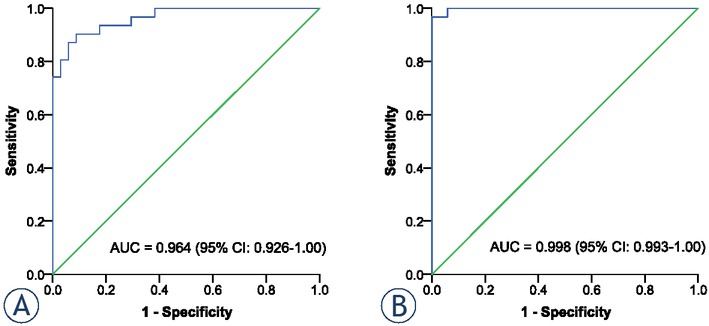
Figure 1
Receiver operating characteristic (ROC) curve for the diagnosis of ovarian cancer. The predictive performance of preoperative serum soluble osteopontin (sOPN) concentration (A) and ascites sOPN concentration (B).
AUC = area under the curve
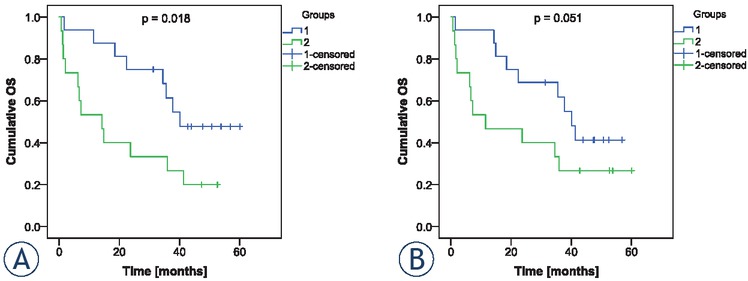
Figure 2
Kaplan-Meier survival curves. Overall survival (OS) according to preoperative soluble osteopontin (sOPN) concentrations in serum (A) and in ascites (B). Serum sOPN concentrations: group 1 ≤ 75.39 ng/ml (blue line) and group 2 > 75.39 ng/ml (green line). Ascites sOPN concentrations: group 1 ≤ 2729 ng/ml (blue line) and group 2 > 2729 ng/ml (green line).
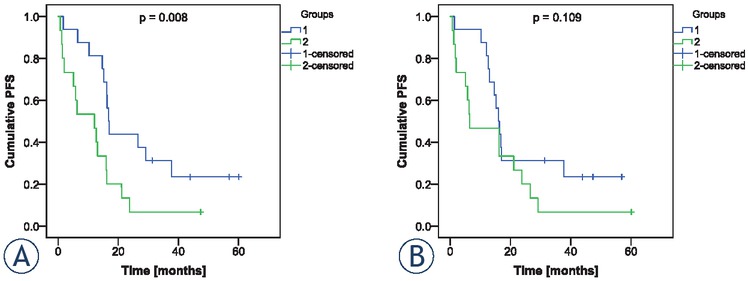
Figure 3
Progression-free survival (PFS) according to preoperative soluble osteopontin (sOPN) concentrations in serum (A) and in ascites (B). Serum sOPN concentrations: group 1 ≤ 75.39 ng/ml (blue line) and group 2 > 75.39 ng/ml (green line). Ascites sOPN concentrations: group 1 ≤ 2729 ng/ml (blue line) and group 2 > 2729 ng/ml (green line).
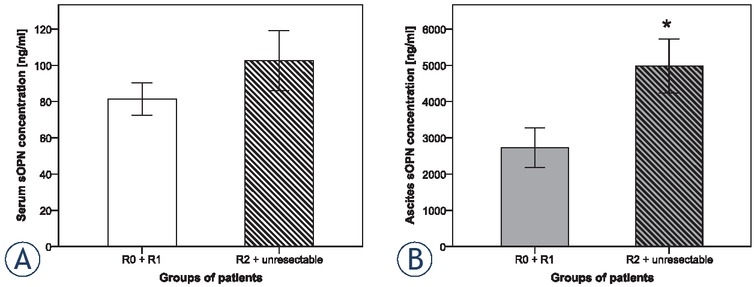
Figure 4
Association of surgical outcome and soluble osteopontin (sOPN) concentrations in serum (A) and ascites (B) at primary operation. Group 1: patients with complete (R0) and optimal (R1) cytoreduction. Group 2: patients with suboptimal (R2) cytoreduction and unresectable disease.
*p < 0.05
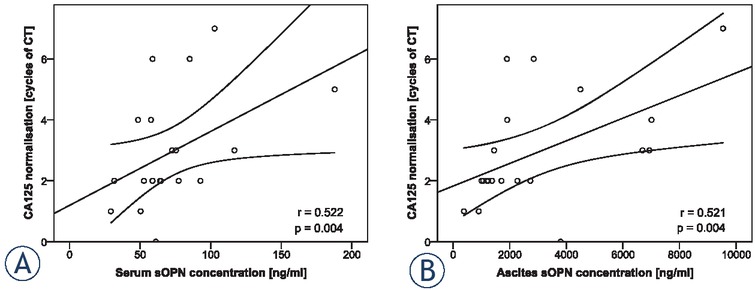
Figure 5
Correlation between serum cancer antigen 125 (CA125) normalisation after platinum-based chemotherapy and soluble osteopontin (sOPN) concentrations in preoperative serum (A) and ascites (B).
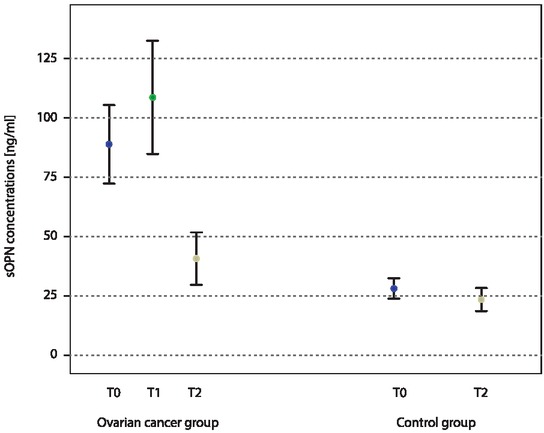
Figure 6
Comparison of soluble osteopontin (sOPN) concentrations in serum during treatment. Epithelial ovarian cancer (EOC) group - sOPN concentration: T0-preoperative, T1-after primary (debulking) surgery and T2–3 to 6 months after systemic chemotherapy. Control group (patients with benign gynaecological pathology) – sOPN concentrations: T0-preoperative and T2–3 to 6 months after surgery.
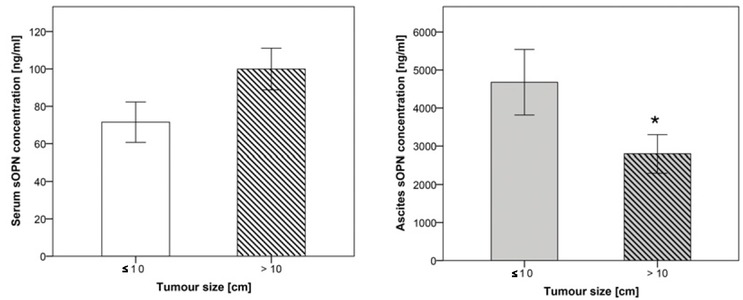
Figure 7
Association of tumour size and soluble osteopontin (sOPN) concentrations in preoperative serum (A) and ascites (B). Group 1: patients with tumour size ≤ 10 cm. Group 2: patients with tumour size > 10 cm.
*p < 0.05