
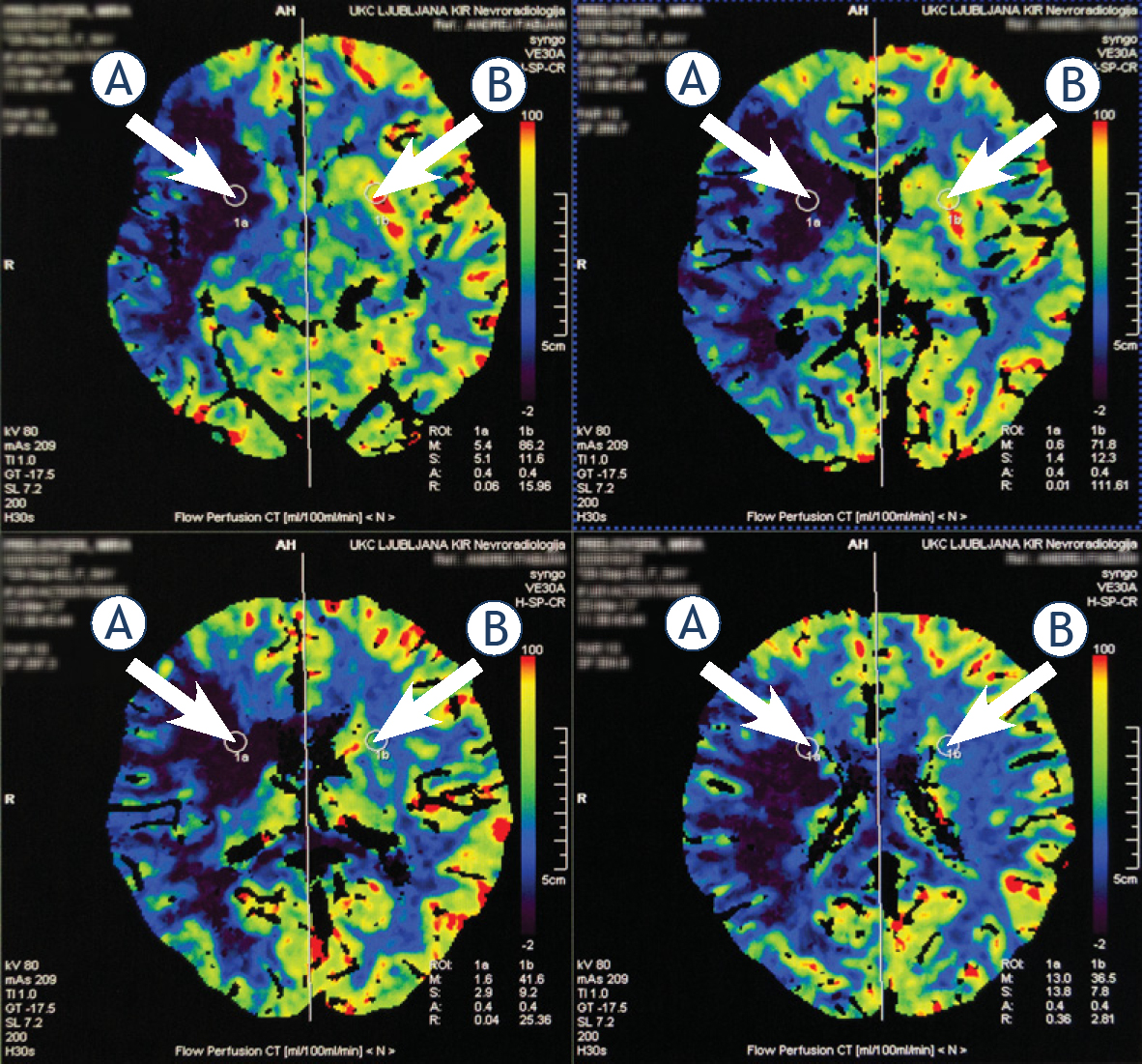
Figure 1
CT perfusion (CTP) in a 64-year old patient with acute ischemic stroke (AIS) in the territory supplied by the right middle cerebral artery (MCA). Four radiological slices correspond to different anatomical levels of image acquisition. (A) Hand-drawn region of interest (ROI) in the region of infarct core. (B) Automatically generated ROI of the asymptomatic contralateral hemisphere.
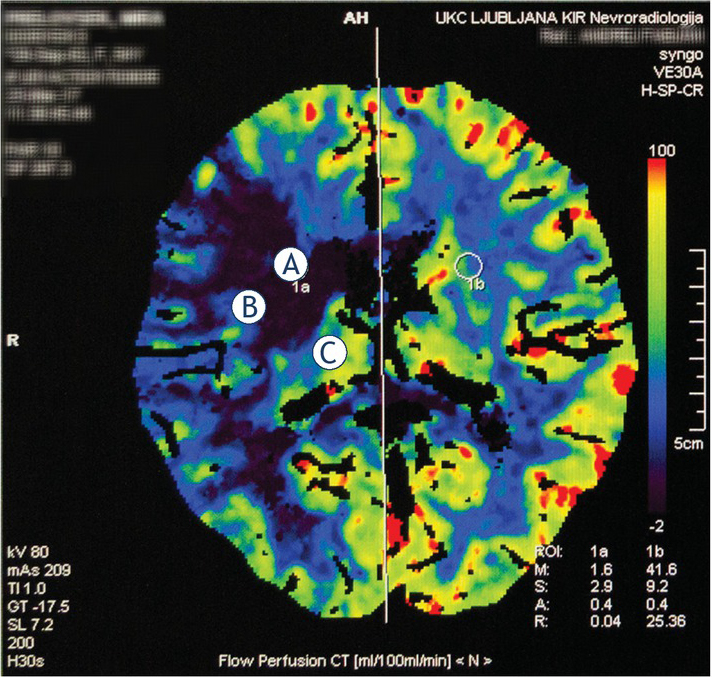
Figure 2
CT perfusion (CTP) in a 64-year old patient with acute ischemic stroke (AIS) in the territory supplied by the right middle cerebral artery (MCA). (A) Infarct core. (B) Penumbra. (C) Intact brain parenchyma.
Table 1
Characteristics of study cohort
| Parameter | Cases | Controls | p value |
|---|---|---|---|
| CBF (mean (SD)) [mL/100 g/min] | 0.38 (0.47) | 0.98 (1.37) | 0.004 |
| CBV (mean (SD)) [mL/100 g] | 1.45 (1.7) | 3.06 (2.99) | 0.009 |
| MTT (mean (SD)) [s] | 4.27 (4.00) | 4.22 (3.26) | 0.718 |
| rCBF (mean (SD)) | 0.03 (0.05) | 0.10 (0.12) | < 0.000 |
| rCBV (mean (SD)) | 0.07 (0.09) | 0.10 (0.12) | 0.001 |
| rMTT (mean (SD)) | 2.47 (2.05) | 2.36 (1.65) | 0.948 |
[i] CBF = cerebral blood flow; CBV = cerebral blood volume; MTT = mean transit time; rCBF = relative cerebral blood flow; rCBV = relative cerebral blood volume); rMTT = relative mean transit time
Table 2
Region of interest (ROI) curve analysis results
| AUC | cut-off value | sensitivity | specificity | |
|---|---|---|---|---|
| CBF [mL/100 g/min] | 0.691 | 0.35 | 62.0% | 35.0% |
| CBV [mL/100g] | 0.676 | 1.65 | 68.6% | 40.0% |
| rCBF | 0.736 | 4.5% | 71.0% | 52.5% |
| rCBV | 0.704 | 8.5% | 71.4% | 42.5% |
[i] CBF = cerebral blood flow); CBV = cerebral blood volume); rCBF = relative cerebral blood flow; rCBV = relative cerebral blood volume
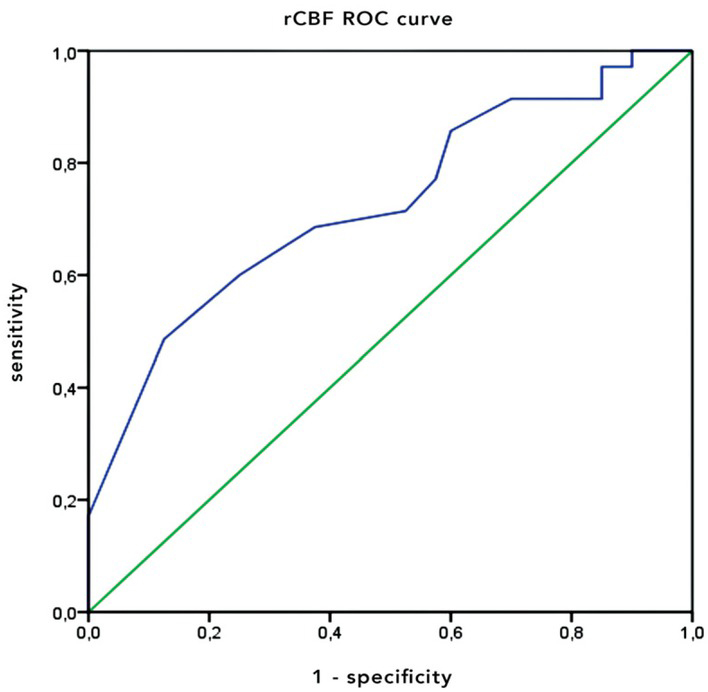
Figure 3
Region of interest (ROI) curve of relative cerebral blood flow (rCBF) in patients with and without hemorrhagic transformation (HT). rCBF represents the CBF of the infarct core region normalized to the intact contralateral side. The cut-off point marks the threshold at which relative cerebral blood volume (rCBV) can predict HT with optimal sensitivity and specificity. Diagonal segments are produced by ties.