
Table 1
Clinical data of patients and US features of Bethesda category III nodules
| Variables | ||
|---|---|---|
| Patients, n | 105 | |
| Age (y), range | 52,9 ± 12,7∗ | (24–77) |
| Gender | ||
| Male | 18 | 17.10% |
| Female | 87 | 82.90% |
| Thyroid nodules, n (total) | 112 | |
| Benign | 77 | 68.8% |
| Malignant | 35 | 31.2% |
| Nodule size (mm), range | 23,4 ± 9,4∗ | (8–60) |
| US features | ||
| Composition | ||
| Solid | 83 | 74.1% |
| Mixed | 25 | 22.3% |
| Cystic | 4 | 3.6% |
| Echogenicity | ||
| Anechoic | 3 | 2.7% |
| Hypoechoic | 56 | 50.0% |
| Isoechoic | 47 | 42.0% |
| Hyperechoic | 6 | 5.4% |
| Calcifications | ||
| No calcifications | 88 | 78.6% |
| Microcalcifications | 17 | 15.2% |
| Macrocalcifications | 7 | 6.3% |
| Vascularisation | ||
| No vascularisation | 20 | 1.,9% |
| Low | 18 | 16.1% |
| Peripheral | 16 | 14.3% |
| Central | 58 | 51.8% |
| Thyroid scan | ||
| No scan | 52 | 46.4% |
| Hypofunctioning (Cold) | 19 | 17.0% |
| Isofunctioning | 34 | 30.3% |
| Hyperfunctioning (Hot) | 7 | 6.3% |
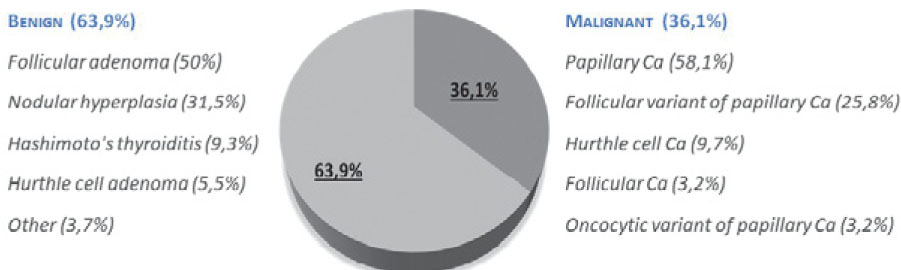
Figure 1
Histologic outcomes of Bethesda Category III nodules from patients who underwent direct surgical treatment. Malignancies were found in 36.1% of AUS/FLUS nodules who were managed with surgery without a repeat cytology. Papillary Thyroid Carcinoma and its Follicular variant were the most common types of cancer, accounting for a total of 83.9% of all malignancies. Among the benign lesions, Follicular adenomas presented in 50% of these cases, and Nodular hyperplasia was second in line with a frequency of 31.5%.
Table 2
Comparison of clinical data of benign and malignant thyroid nodules in 105 patients with Bethesda III cytology report
| Variables | Final outcome | p-value | |
|---|---|---|---|
| Benign (n = 71) | Malignant (n = 34) | ||
| Age (y), | 54.9 ± 11.7∗ | 48 ± 14.2∗ | < 0.01 (0.005) |
| range | (25–77) | (24–71) | OR 0.953 (95% CI 0.922–0.986) |
| Gender | ns (0,506) | ||
| Male | 14 (19.7%) | 4 (11.7%) | |
| Female | 57 (80.3%) | 30 (88.3%) | |
| Nodule size (mm), | 24.6 ± 9.1∗ | 20.7 ± 9.8∗ | < 0.05 (0.048) |
| range | (10–60) | (8–47) | OR 0.952 (95% CI 0.907-1.00) |
| Thyroid scan | number of nodules: | ns (0.117) | |
| Hypofunctioning (Cold) | 10 (23.8%) | 9 (50.0%) | |
| Isofunctioning | 25 (59.5%) | 9 (50.0%) | |
| Hyperfunctioning (Hot) | 7 (16.7%) | 0 (0.0%) | |
Table 3
Comparison of US features of benign and malignant thyroid nodules with Bethesda III cytology report
| Variables | Final outcome | p-value | |
|---|---|---|---|
| Benign n = 77 (68.8%) | Malignant n = 35 (31.2%) | ||
| Composition | ns (0.372) | ||
| Solid | 54 (70.1%) | 29 (82.9%) | |
| Mixed | 20 (26.0%) | 5 (14.3%) | |
| Cystic | 3 (3.9%) | 1 (2.9%) | |
| Echogenicity | |||
| Anechoic | 3 (3.9%) | 0 (0.0%) | ns (0.999) |
| Hypoechoic | 31 (40.3%) | 25 (71.4%) | < 0.01 (0.003) OR 3.710 (95% CI 1.565–8.795) |
| Isoechoic | 38 (49.4%) | 9 (25.7%) | < 0.05 (0.021) OR 0.355 (95% CI 0.147–0.856) |
| Hyperechoic | 5 (6.5%) | 1 (2.9%) | ns (0.216) |
| Calcifications | |||
| No calcifications | 68 (88.3%) | 20 (57.1%) | < 0.01 (0.000) OR 0.176 (95% CI 0.067–0.463) |
| Microcalcifications | 8 (10.4%) | 9 (25.7%) | < 0.05 (0.042) OR 2.986 (95% CI 1.041–8.564) |
| Macrocalcifications | 1 (1.3%) | 6 (17.1%) | < 0.05 (0.012) OR 15.724 (95% CI 1.814–136.318) |
| Vascularisation | |||
| No vascularisation | 10 (13.0%) | 10 (28.6%) | ns (0.051) |
| Peripheral | 15 (19.5%) | 1 (2.9%) | < 0.05 (0.046) OR 0.122 (95% CI 015–0.961) |
| Central | 41 (53.2%) | 17 (48.6%) | ns (0.646) |
| Low | 11 (14.3%) | 7 (20%) | ns (0.447) |
[i] n = number of nodules; ns = non significant; OR = odds ratio.