
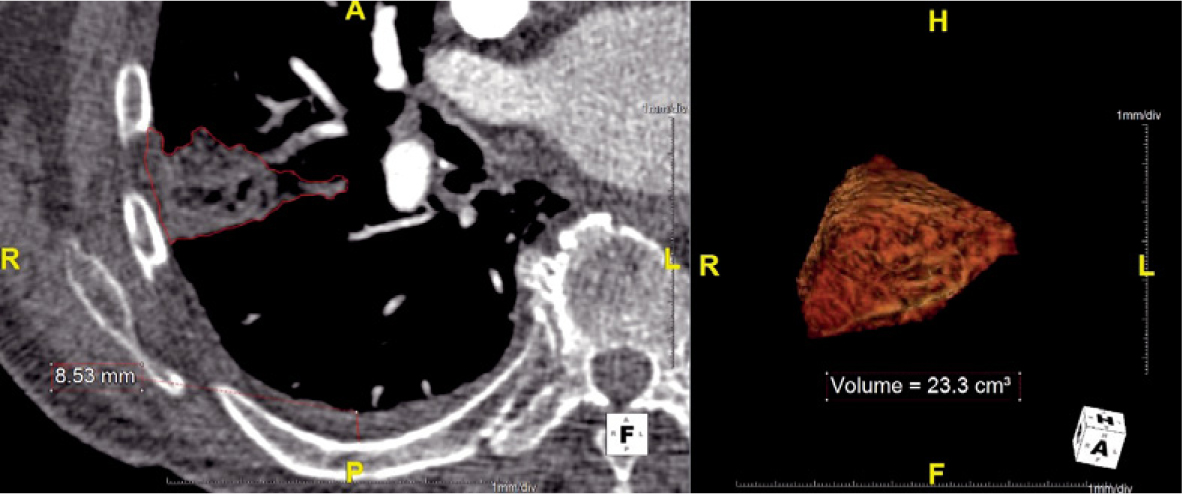
Figure 1
Measurements of pulmonary infarction volume and effusion layer size. Left: ROI around infarcted area and pleural effusion layer thickness measurement. Right: 3D visualization of the infarcted area.
Table 1
Demographic data and comorbidities. (∗) Multiple linear regression was performed to test for correlation. P-values are shown
| Gender | N | (%) | |||
| Male | 37 | (38.9 %) | |||
| Female | 58 | (61.6 %) | |||
| Age | |||||
| Mean (SD) | 61.3 | (± 19.5) | |||
| Pleural effusion | N | (%) | |||
| Present | 57 | (60 %) | |||
| Not present | 38 | (40 %) | |||
| Correlation(∗) with | |||||
| Comorbidities | N | (%) | PI size | Ef. size | Presence of ef. |
| Reduced mobility | 38 | (40 %) | 0.6 | 0.5 | 0.7 |
| Previous PE | 8 | (8.4 %) | 0.7 | 0.2 | 0.9 |
| Oral contraceptives | 7 | (7.4 %) | 0.5 | 0.4 | 0.2 |
| Known malignancy | 6 | (6.3 %) | 0.09 | 0.2 | 0.3 |
| Proven GVT | 6 | (6.3 %) | 0.9 | 0.7 | 0.1 |
| Congestive heart failure | 5 | (5.3 %) | 0.5 | 0.3 | 0.7 |
| COPD | 4 | (4.2 %) | 0.5 | 0.9 | 0.07 |
| Number of comorbidities present in a patient | N | (%) | |||
| No comorbidities | 37 | (38.9 %) | |||
| 1 | 51 | (53.7 %) | |||
| 2 | 5 | (5.3 %) | |||
| 3 | 2 | (2.1 %) | |||
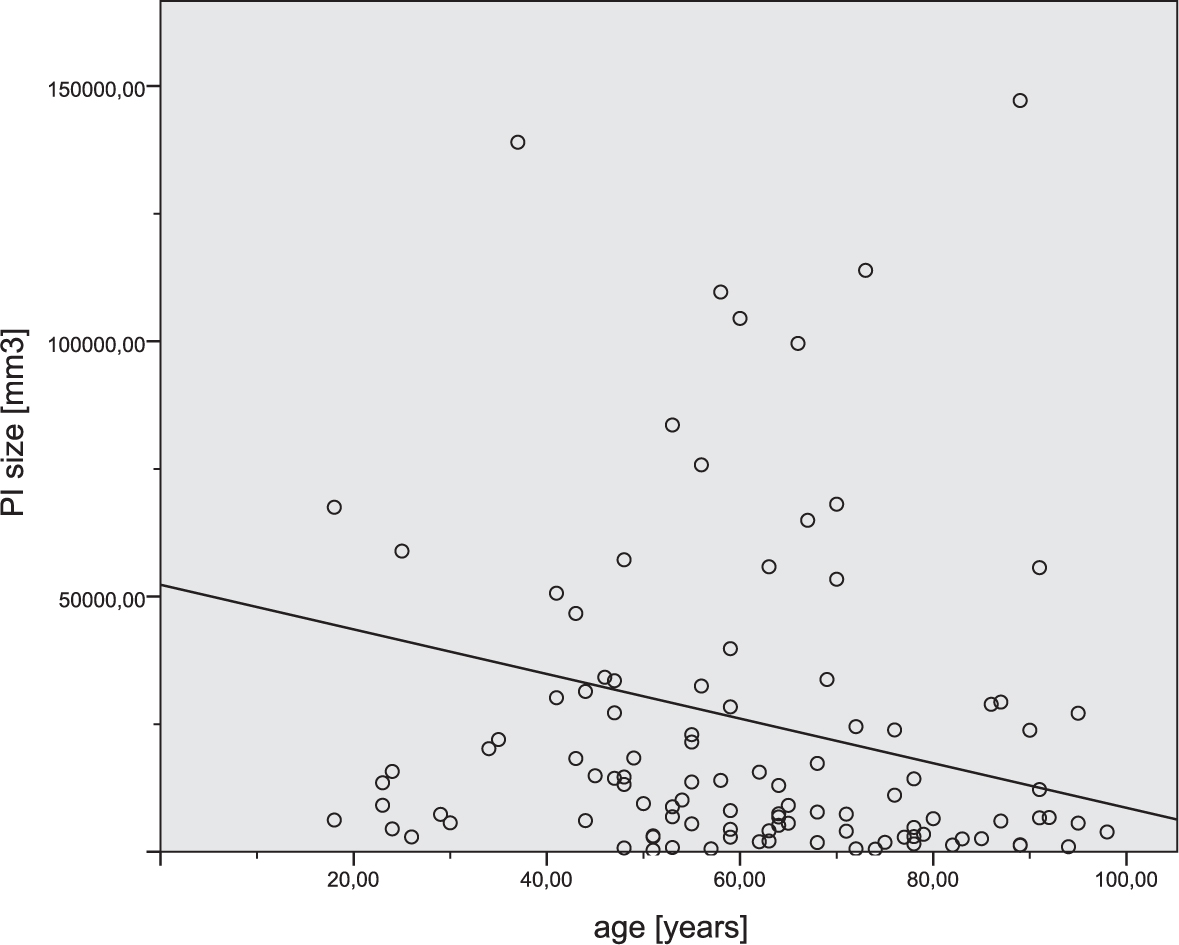
Figure 2
Size of the pulmonary infarction (in mm3) in relation to patients’ age (in years).
Table 2
Mean pulmonary infarction size in patients with and without pleural effusion
| Pleural effusion | Mean PI size |
|---|---|
| Not present | 14.3 cm3 (± 17.8 cm3) |
| Present | 34.5 cm3 (± 50.5 cm3) |
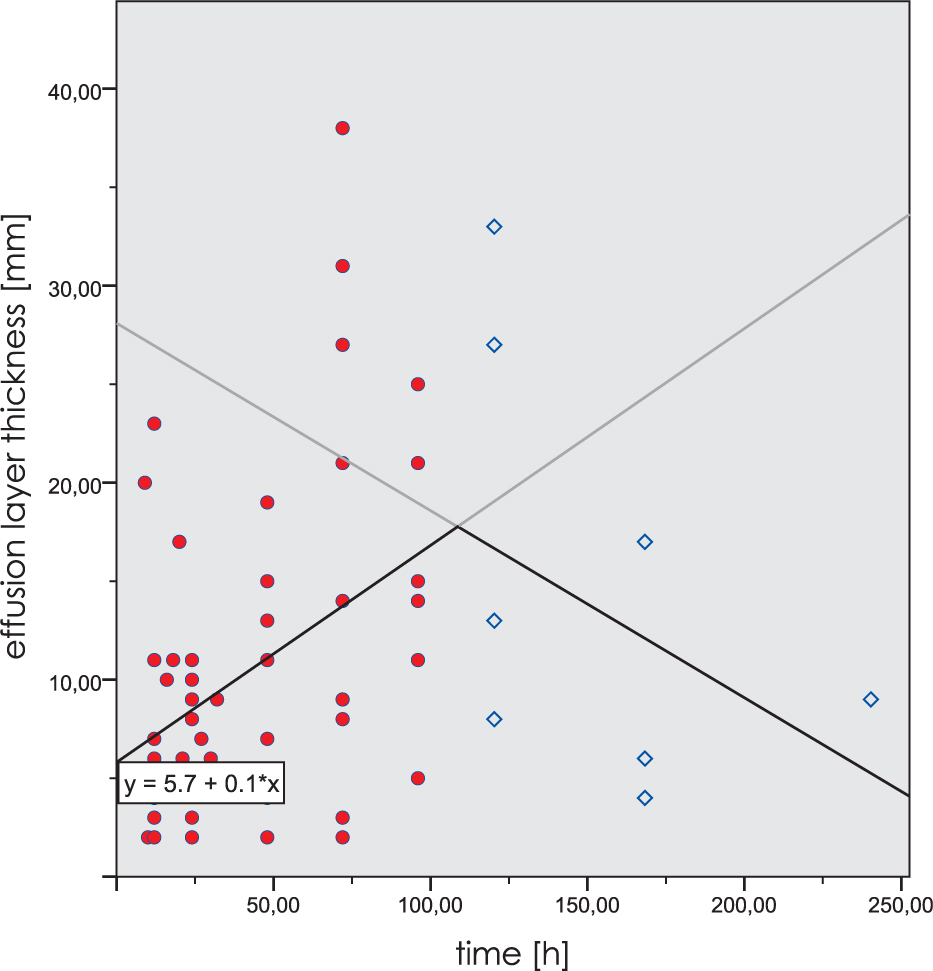
Figure 3
Thickness of the pleural effusion layer (in mm) in relation to time since the onset of symptoms (in hours).