
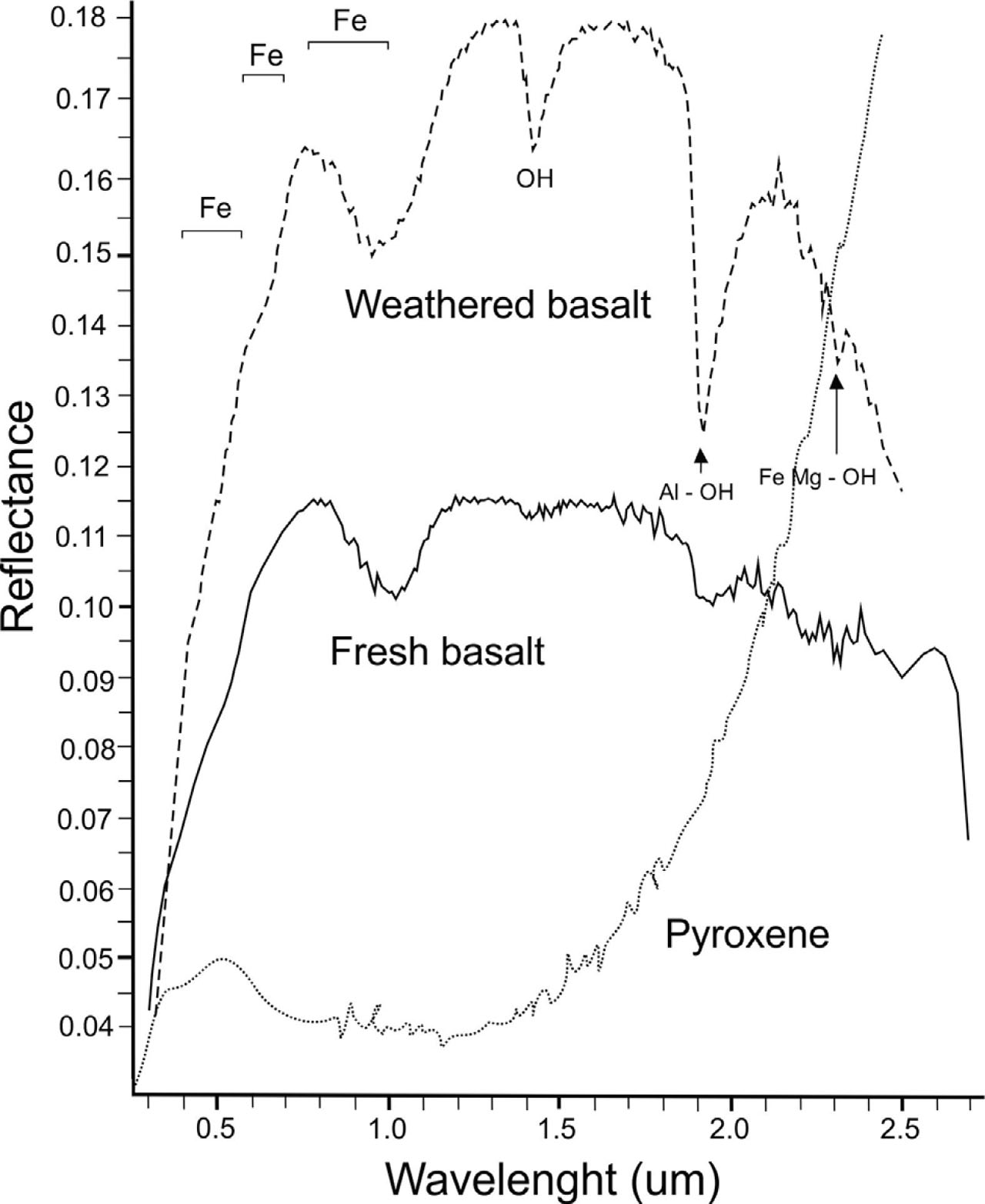
Fig. 1
Examples of spectral reflectance diagrams for fresh and weathered basaltic rocks and pyroxene (based on Kokaly et al. 2017, Zhou and Wang 2017, modified). Selected spectral features are marked acc. to Zhou and Wang (2017).
Table 1
A selection of current widely available spectral libraries (based on Xie et al. 2020, modified).
| Release year | Spectral library | Institution |
|---|---|---|
| 1978 | Infrared spectrogram database | Shanghai institute of organic chemistry, Chinese Academy of Sciences |
| 1981 | JPL spectral library | Jet propulsion laboratory JPL, California Institute of Technology |
| 1990 | ICGP-264 spectral library | United States Geological Survey USGS |
| 1990 | Ground object reflectance spectral characteristics database | Institute of optical machinery, Chinese Academy of Sciences |
| 1991 | JHU spectral library | Johns Hopkins University JHU |
| 1993 | USGS spectral library | United States Geological Survey USGS |
| 1998, 2008 | ASTER spectral library (version 1 and 2) | America's space agency, NASA |
| 2000 | ASU Thermal infrared spectrum library | Arizona State University ASU |
| 2002 | China typical feature spectrum library | Beijing Normal University |
| 2007 | National typical ground object spectrum database for e-government | Institute of Remote Sensing Earth, Chinese Academy of Sciences |
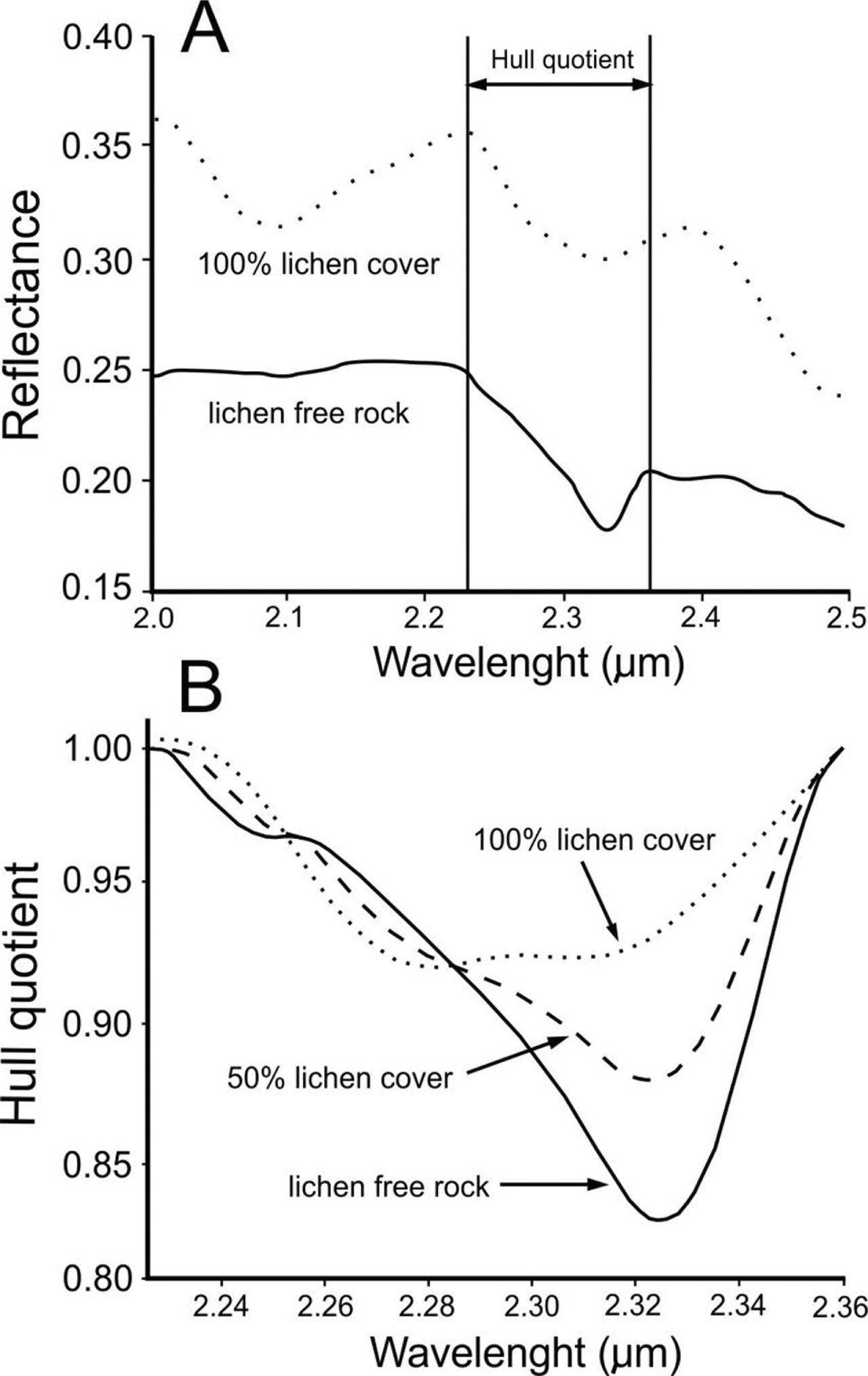
Fig. 2
A – Averaged spectra of kimberlite rock with and without crustose lichen cover, B – The corresponding hull quotient (Clark, Roush 1984) with spectra associated with the antigorite absorption feature (acc. to Salehi et al. 2017, modified).
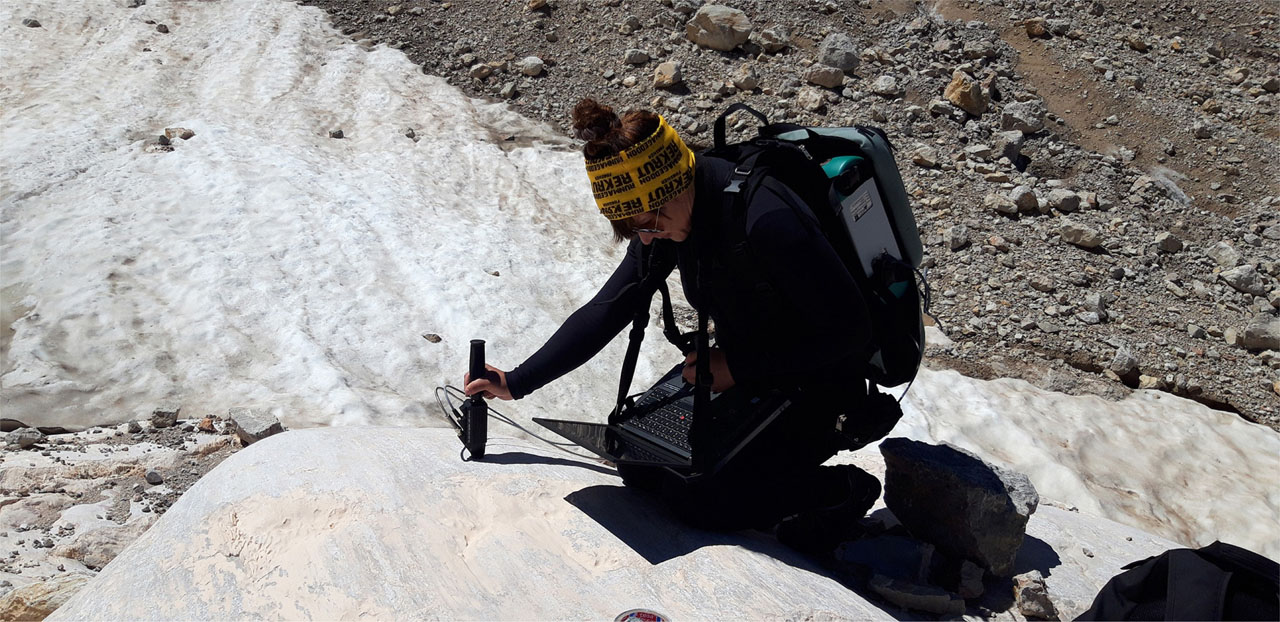
Fig. 3
The spectroradiometer ASD FieldSpec used in weathering studies in front of Hallstätter Glacier in the Alps (photo M. Dąbski).