
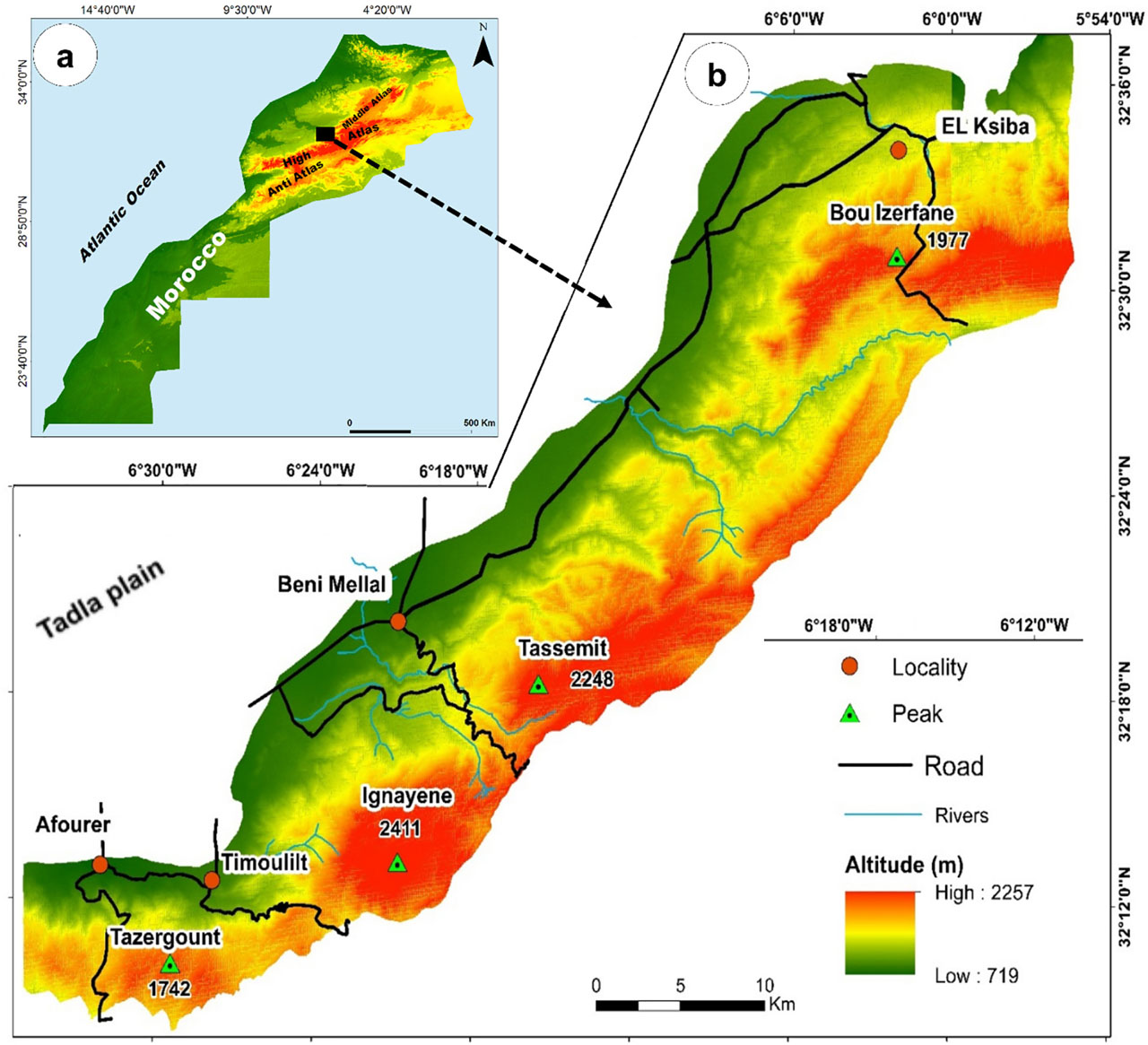
Fig. 1
Location of the study area.
a) Map of Morocco showing the geographical position of the study area, b) map of the study area.
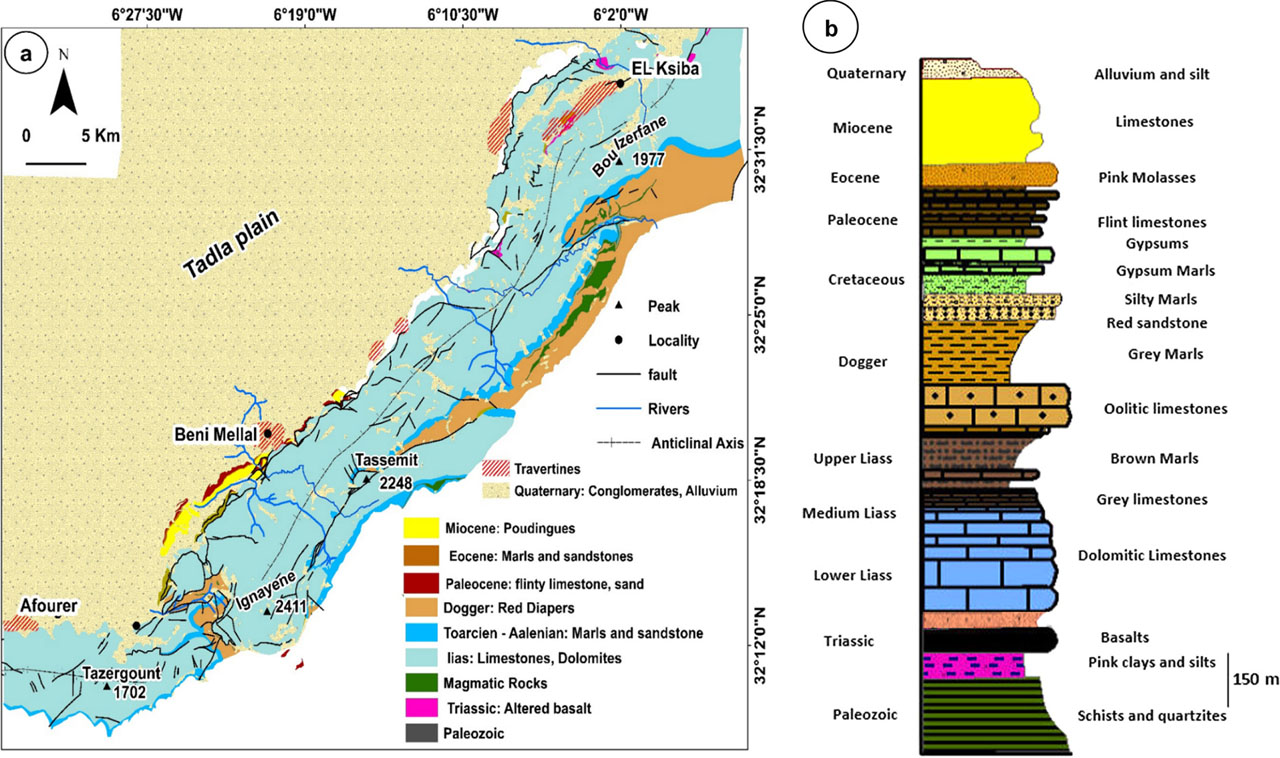
Fig. 2
a) The geological map of the study area. Extracted by the geological map of Morocco 1:100,000. Sheet of Béni Mellal, Afourer and Kasba Tadla. b) Litho-stratigraphic log of Beni Mellal Atlas.
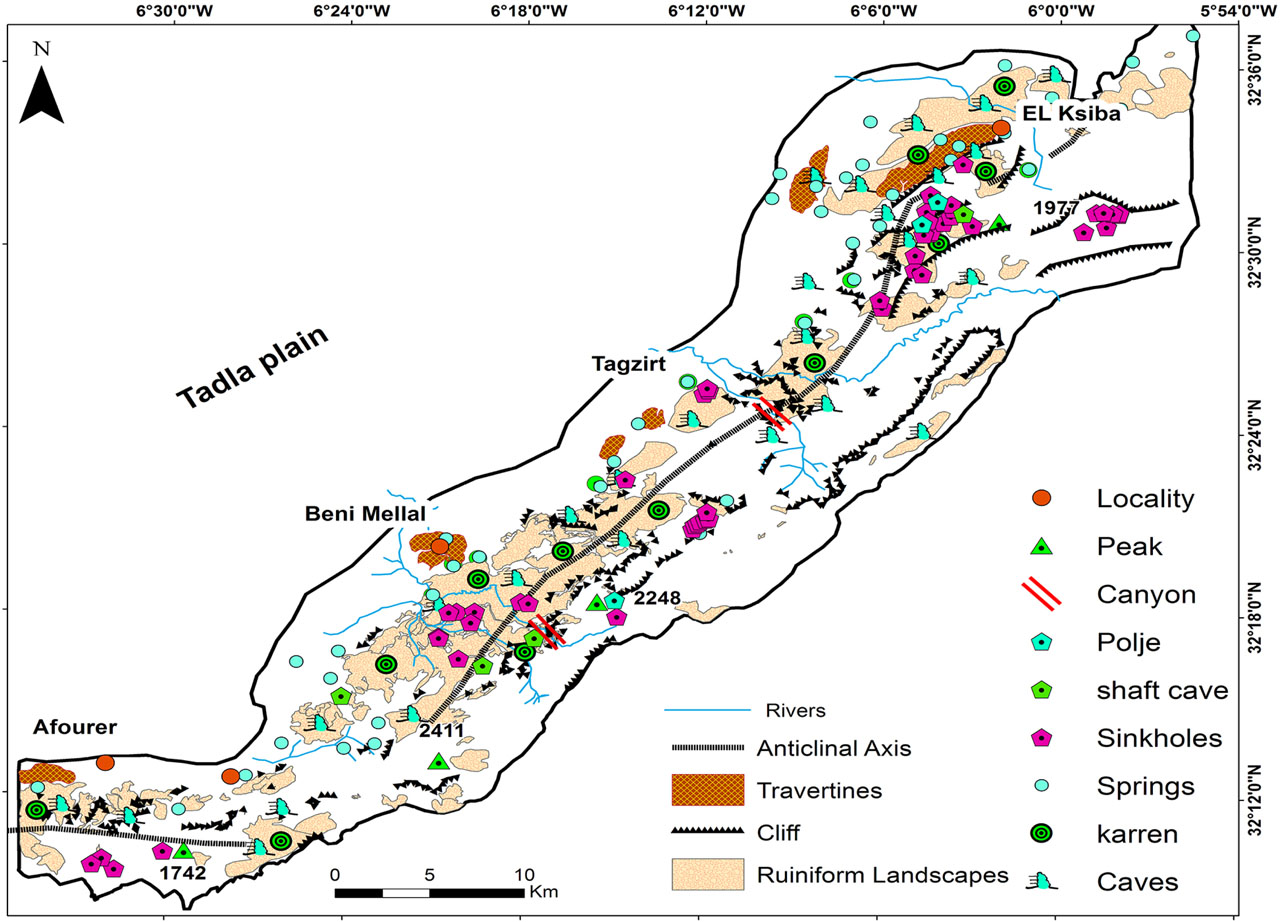
Fig. 3
Geomorphological synthesis map.
Table 1
Methodology used (based on Reynard et al. 2016).
| Geomorhosites inventory | Assessment of intrinsic value | Characteristics of use and management |
|---|---|---|
Identification of potential sites
| Scientific values
| Protection
|
Selection geomorphosites
| Additional values
| Promotion
|
Table 2
List of selected and evaluated geosites.
| No | Name | Commune | Code | Scientific value | Additional value |
|---|---|---|---|---|---|
| 1 | Spring of Ain Asserdoune | Beni Mellal | BEMhyd001 | 0.95 | 0.59 |
| 2 | Spring of Ain El Ghazi | Foum El Ancer | FOMhyd002 | 0.80 | 0.12 |
| 3 | Karren Moudj | Foum El Ancer | FOMkar003 | 0.90 | 0.34 |
| 4 | Ruiniform landscapes of Moudj | Foum El Ancer | FOMkar004 | 0.90 | 0.21 |
| 5 | Canyon of Hansala | Tagzirt | TAGkar005 | 0.90 | 0.28 |
| 6 | Canyon of Moudj | Foum El Ancer | FOMkar006 | 0.90 | 0.25 |
| 7 | Timskar Waterfalls | Foum El Ancer | FOMkar007 | 0.90 | 0.25 |
| 8 | Tazerkount Ruiniformes Landscapes | Afourer | AFOkar008 | 0.65 | 0.25 |
| 9 | Ruiniformes Landscapes of Oribaa | Beni Mellal | BEMkar009 | 0.95 | 0.40 |
| 10 | Caves of Orbiaa | Beni Mellal | BEMkar010 | 0.80 | 0.21 |
| 11 | Caves of Ain El ghazi | Foum El Ancer | FOAkar011 | 0.60 | 0.21 |
| 12 | Ain Orbiaa | Beni Mellal | BEMkar012 | 0.95 | 0.28 |
| 13 | Ruiniformes Landscapes of Tassemit | Beni Mellal | BEMkar012 | 0.55 | 0.21 |
| 14 | travertines of Timskar | Foum El Ancer | FOAhyd013 | 0.80 | 0.25 |
| 15 | Tazzerkount Tepee Structures | Afourer | AFOsed013 | 0.80 | 0.25 |
| 16 | travertines of El Ksiba | EL Ksiba | ELKhyd014 | 0,80 | 0.18 |
| 17 | Ruiniformes Landscapes of ELKsiba | EL Ksiba | ELKkar014 | 0.85 | 0.18 |
| 18 | Fossils of Moudj | Foum El Ancer | FOApal014 | 0.95 | 0.21 |
| 19 | Panoramic view of Rurate | Afourer | AFOant015 | 0.95 | 0.18 |
| 20 | Spring of Lala Kamria | Foum El Ancer | FOAhyd016 | 0.65 | 0.28 |
| 21 | Spring of Ouchrah | Tagzirt | TAGhyd017 | 0.95 | 0.59 |
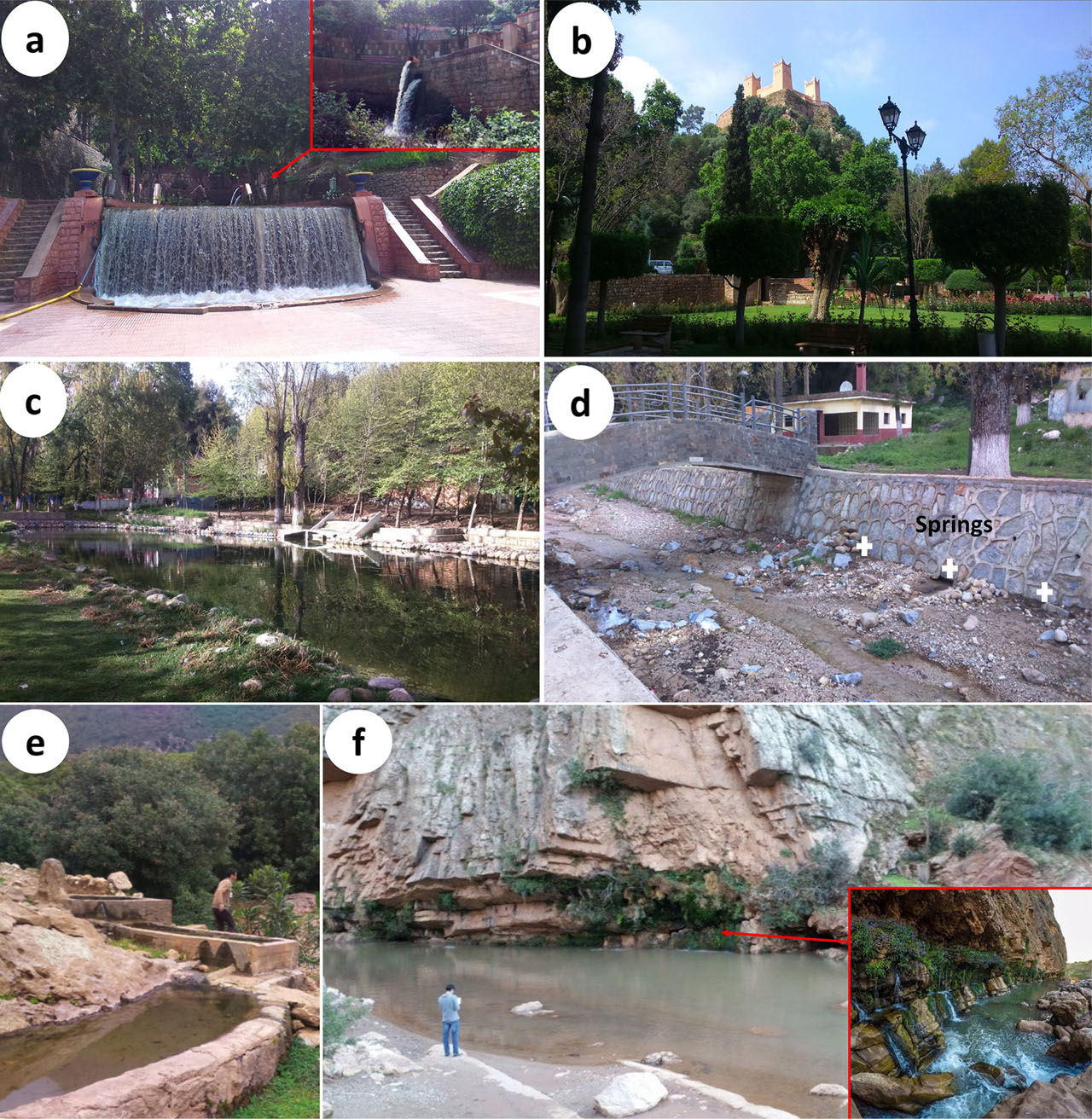
Fig. 4
The most springs visited by tourists and hikers.
(a, b) Spring of Ain Asserdoune. (c), (d) Spring of Taghbalout Ouhlima. (e) Spring of Tamoudjout. (f) Springs of Ochrah.
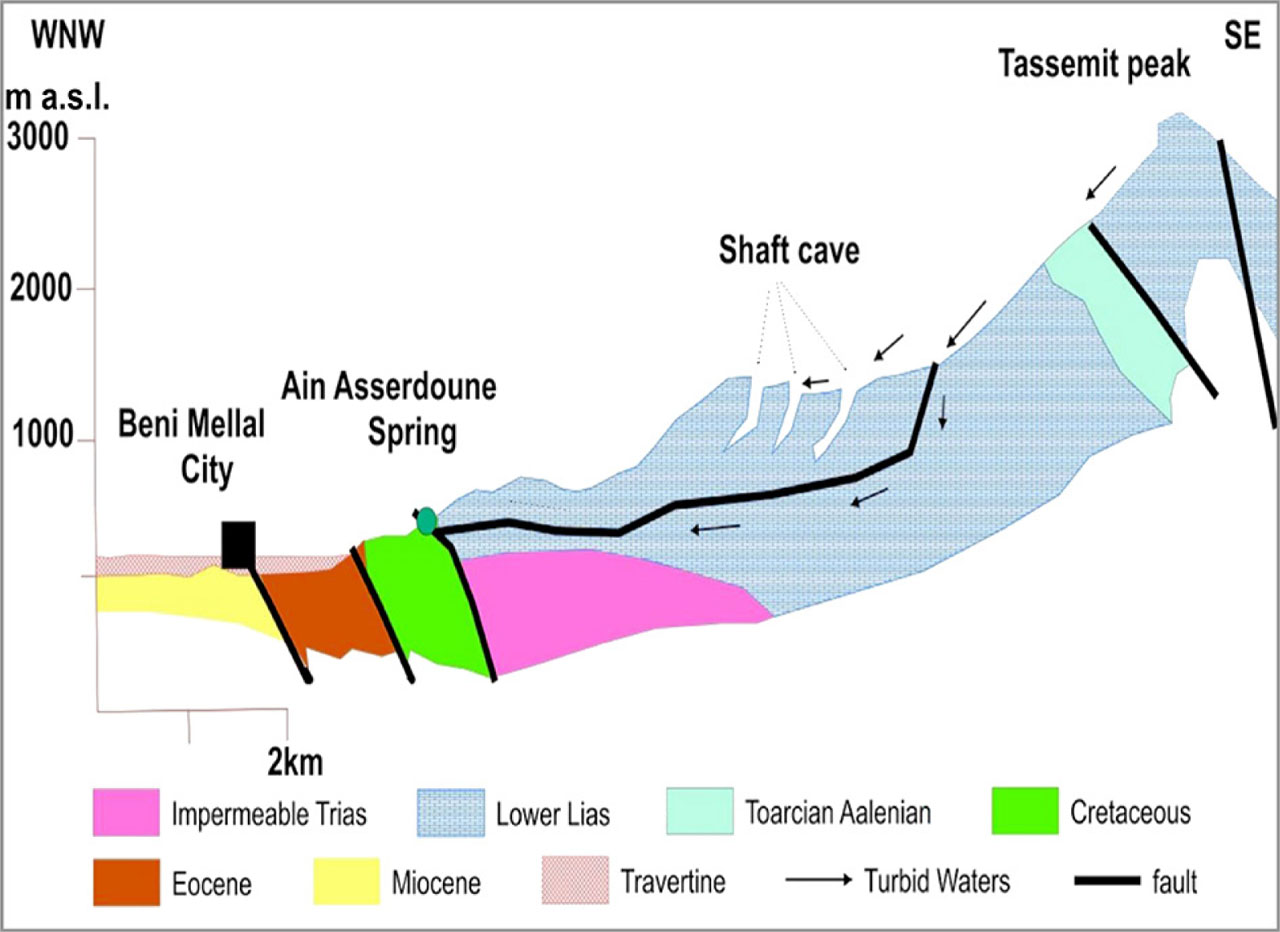
Fig. 5
Hydrogeological section showing the emergence conditions of Ain Asserdoune, Beni Mellal.
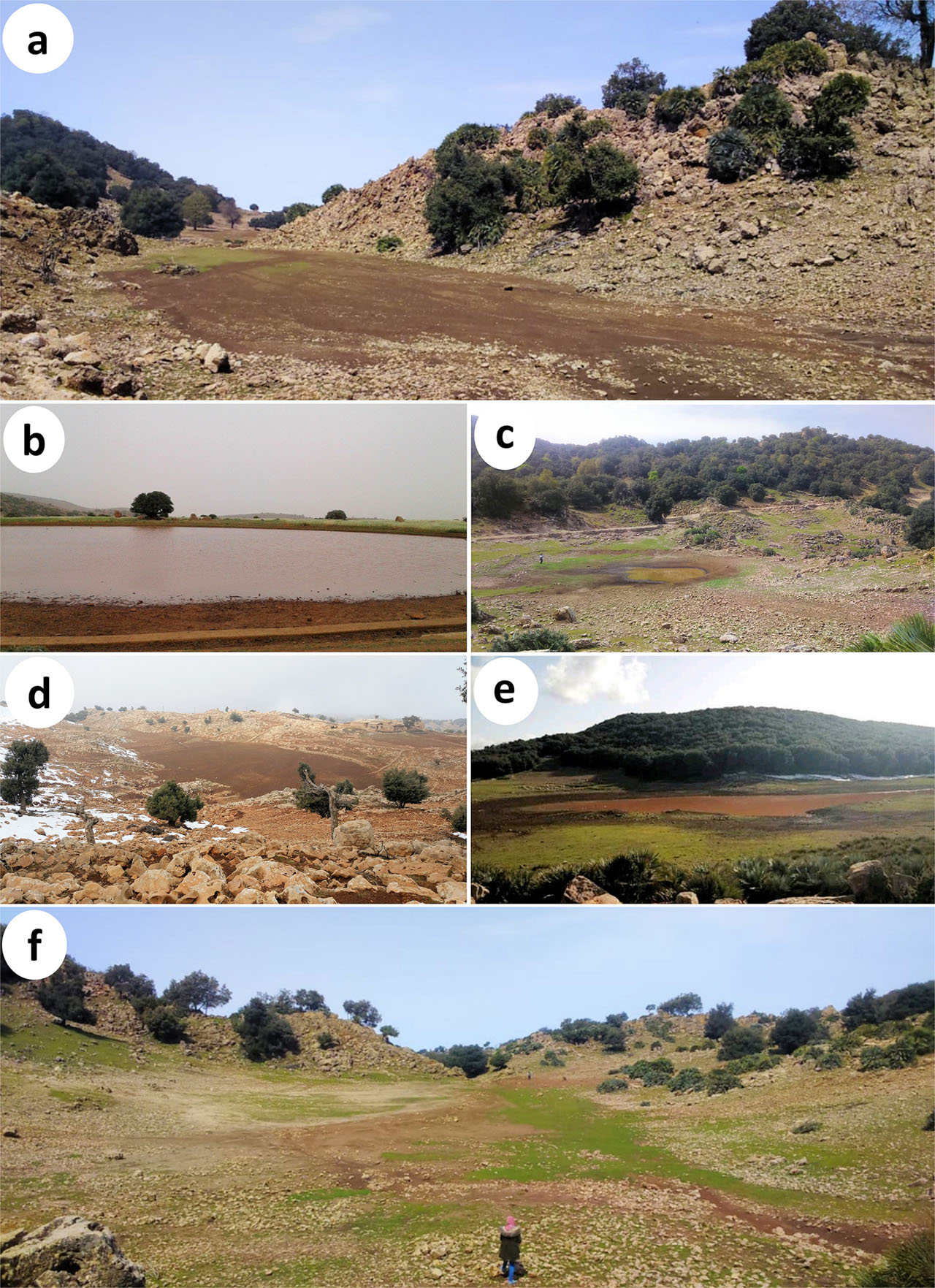
Fig. 6
The important sinkholes in the Study Area.
(a) Sinkholes River at the level of El Ksiba. (b) Sinkhole at the Orbia developed to retain water. (c) Sinkhole at the level of El Ksiba. (d) Polje at the level of Tassemit. (e) Polje at the site of Tazerkount. (f) Giant Polje at El Ksiba filled with alteration products of clays and limestones.
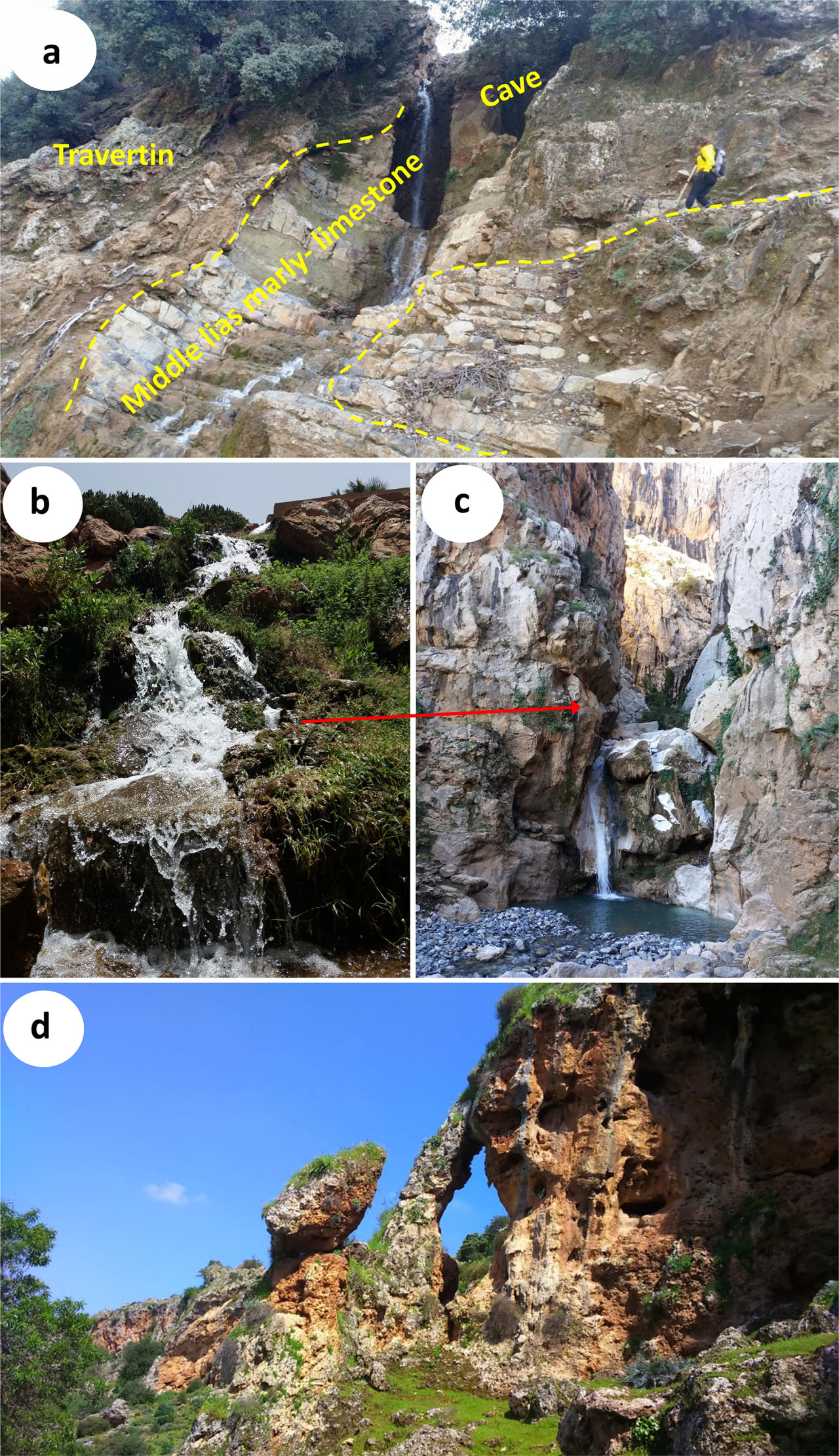
Fig. 7
The travertine, canyon and waterfalls of Moudj.
(a) waterfall of Timskar. (b) Moudj waterfall. (c) Canyon of Moudj, (d) El Ksiba travertine.
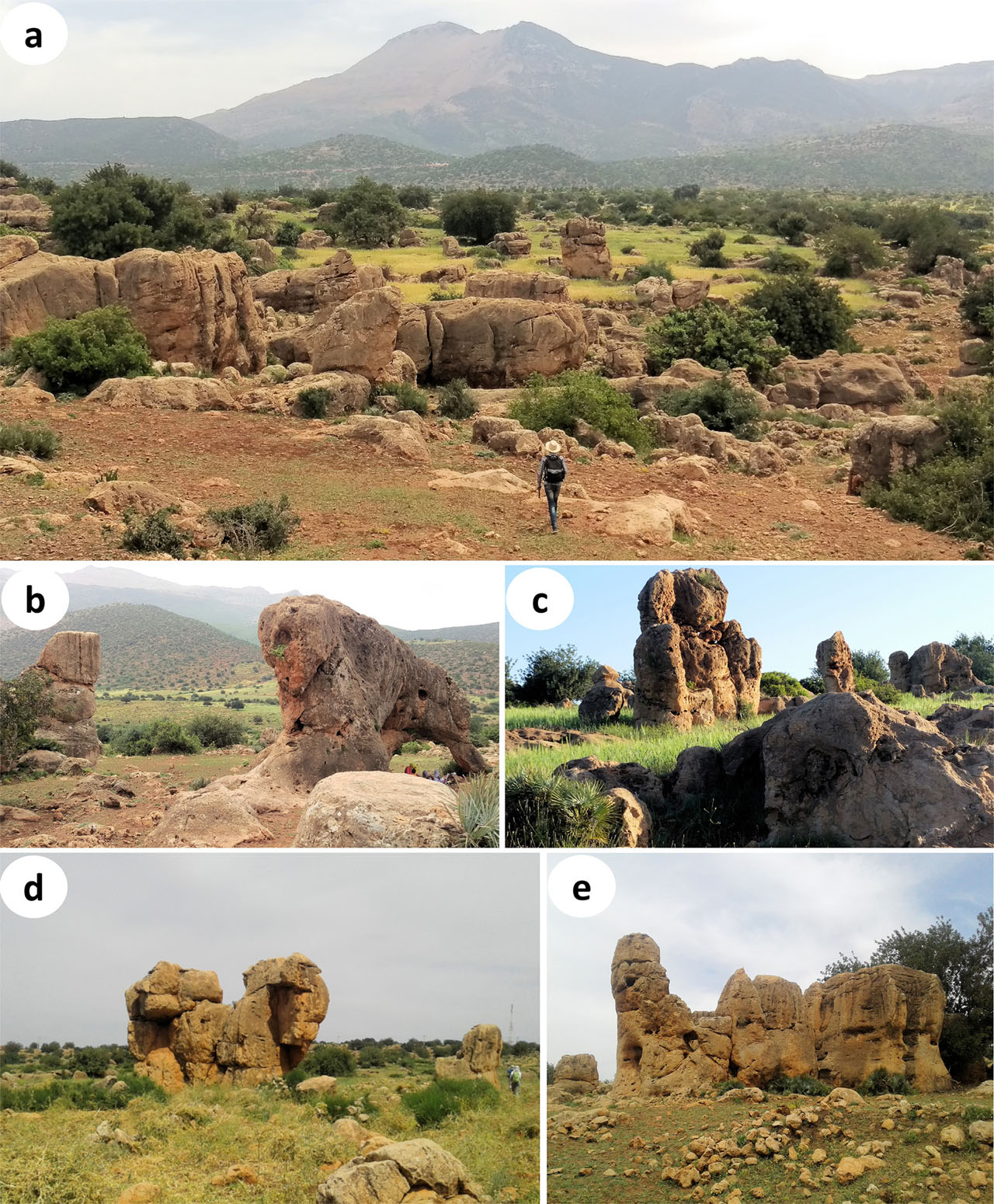
Fig. 8
The ruiniform landscapes of the Orbia site of varying shapes and sizes.
(a) Panoramic view of the Orbia site. (b), (c), (d), (e) The different shapes of the ruiniform landscapes of the Orbia site.
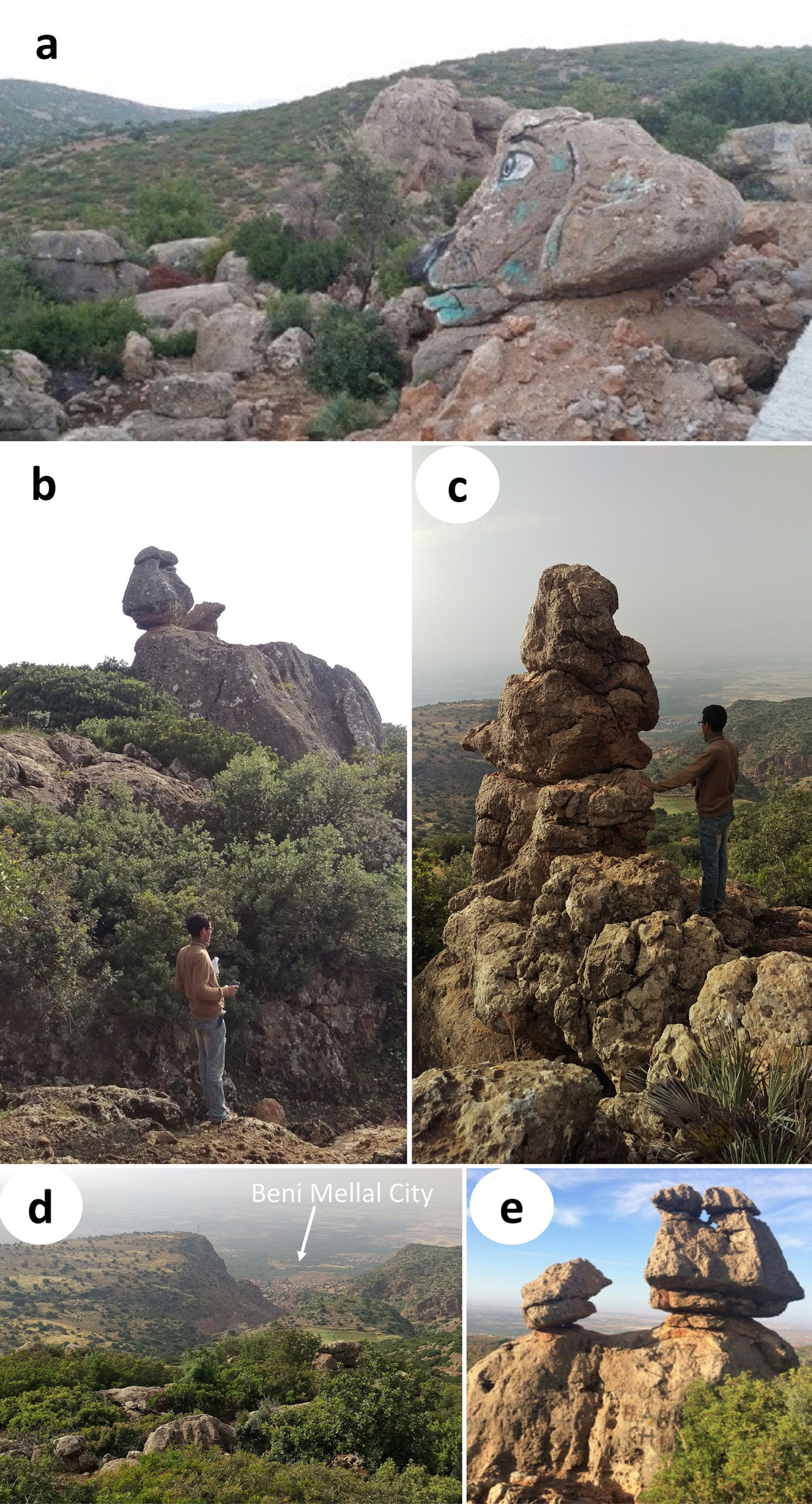
Fig. 9
The ruiniform landscapes of Ain el Ghazi site of varying shapes and sizes.
(a), (b), (d), (e) The different shapes of the ruiniform landscapes of the Ain el Ghazi site. (c) Panoramic view of the Ain el Ghazi site and city of Beni Mellal.
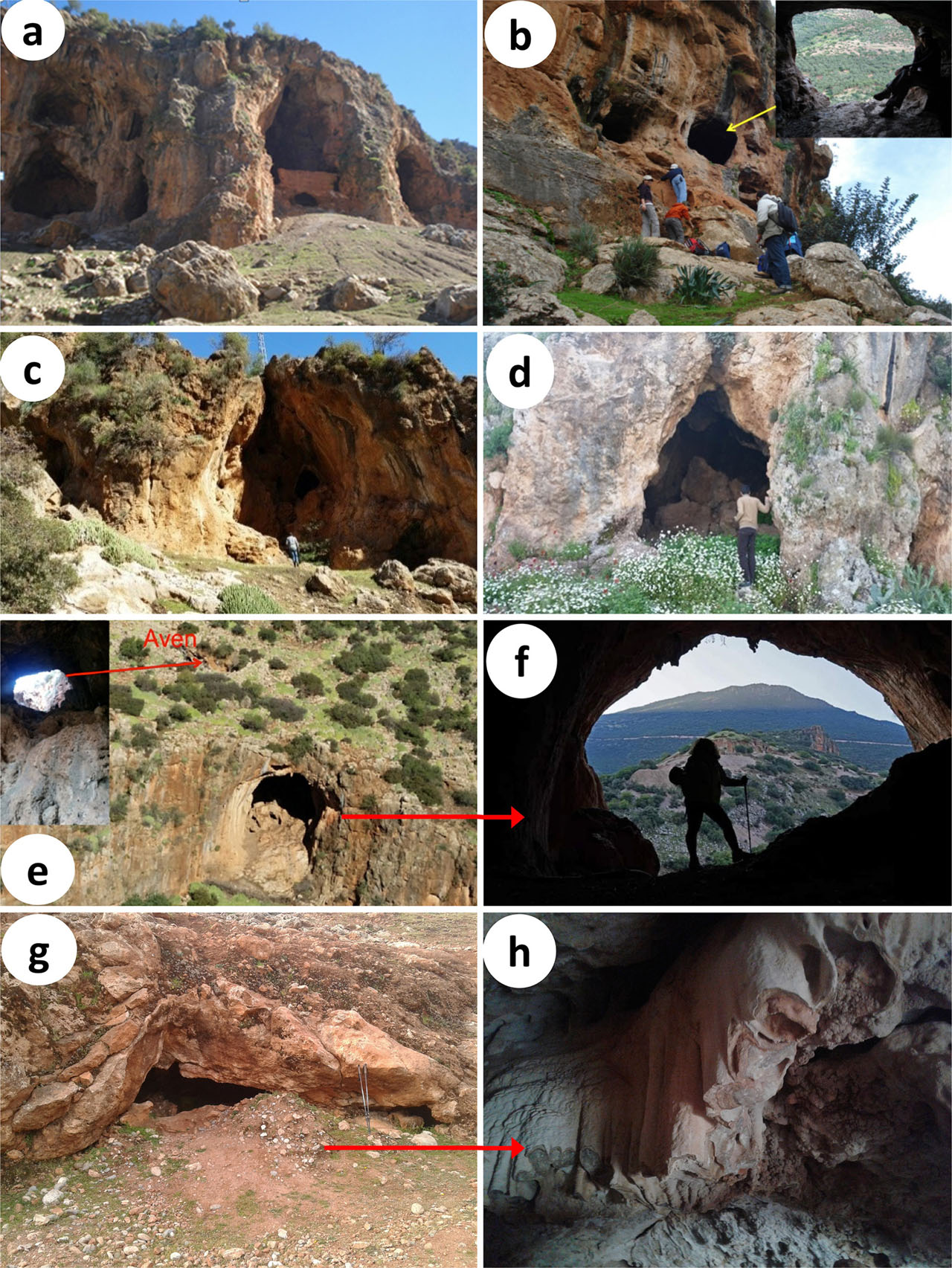
Fig. 10
The different caves encountered in the study area.
(a) Caves of the cliffs of Timoulilte. (b) Caves of the cliffs of Tit n’ziza at dir d’El Ksiba. (c) Cave of the cliffs of Tanougha. (c) Cave of Tazart n’amar at Tanougha. (e) Cave of Foum El Ancer. (f) View from inside Foum El Ancer cave. (g) Cave of Orbiaa site. (h) Stalactites inside Orbiaa cave.
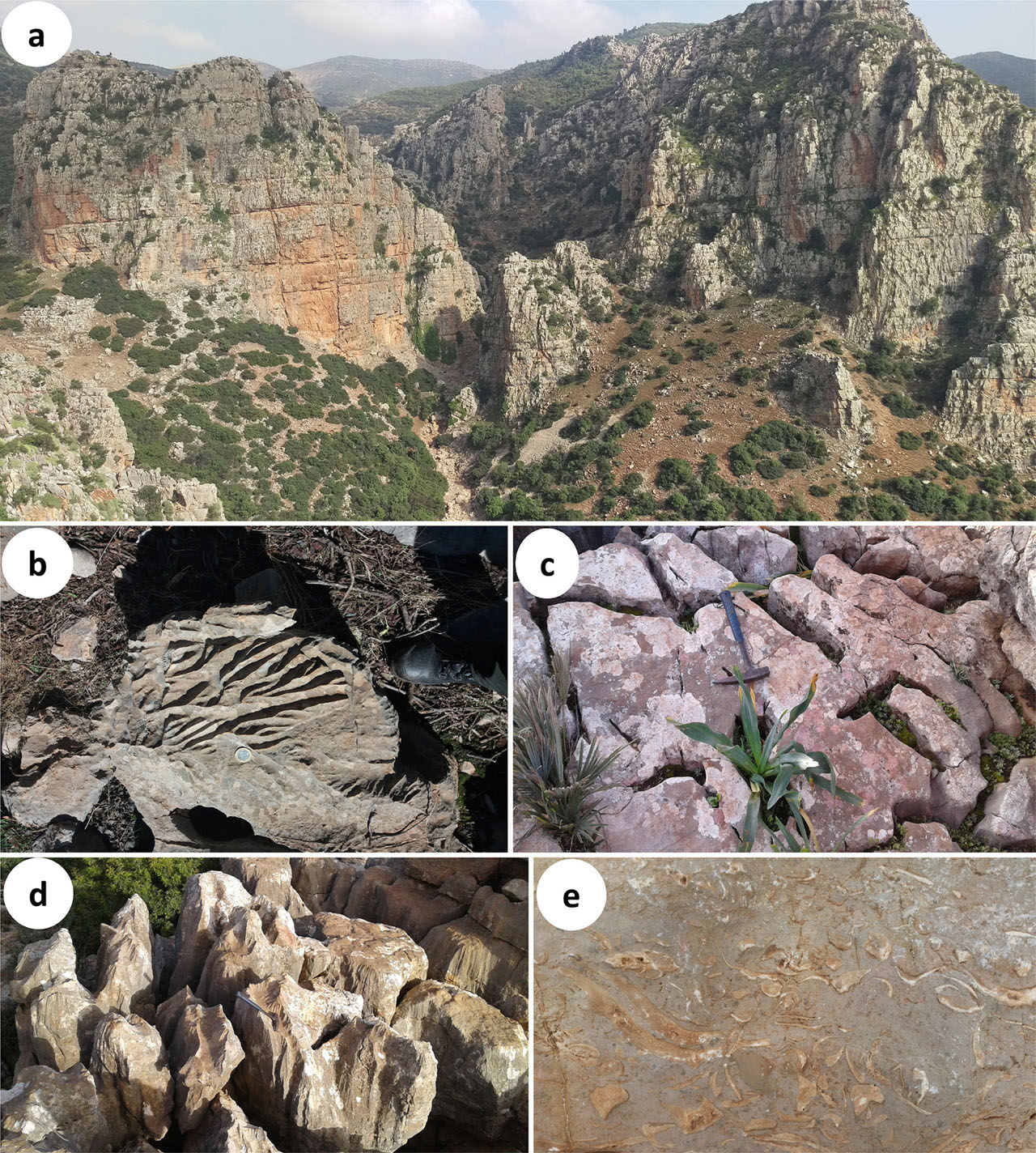
Fig. 11
Cliffs and karren of Moudj.
(a) Giant grikes. (b) Incipient karren. (c) Freeze and thaw karren. (d) Grikes. (e) Limestone of the massive carbonates of Liass lower Sineurian age fossilized from the Gastropods and Lamellibranchs.
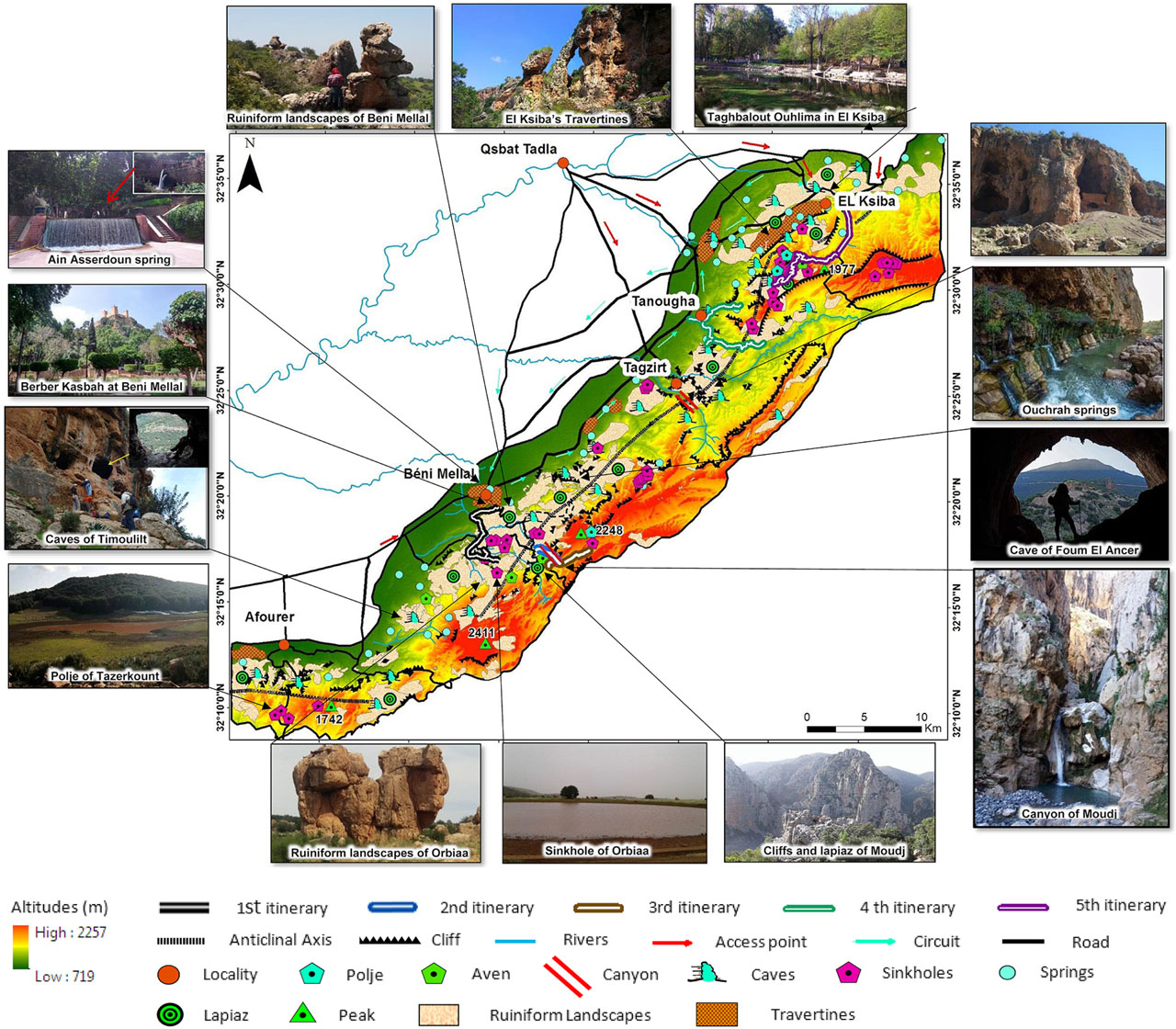
Fig. 12
Geotouristic map of the study area.
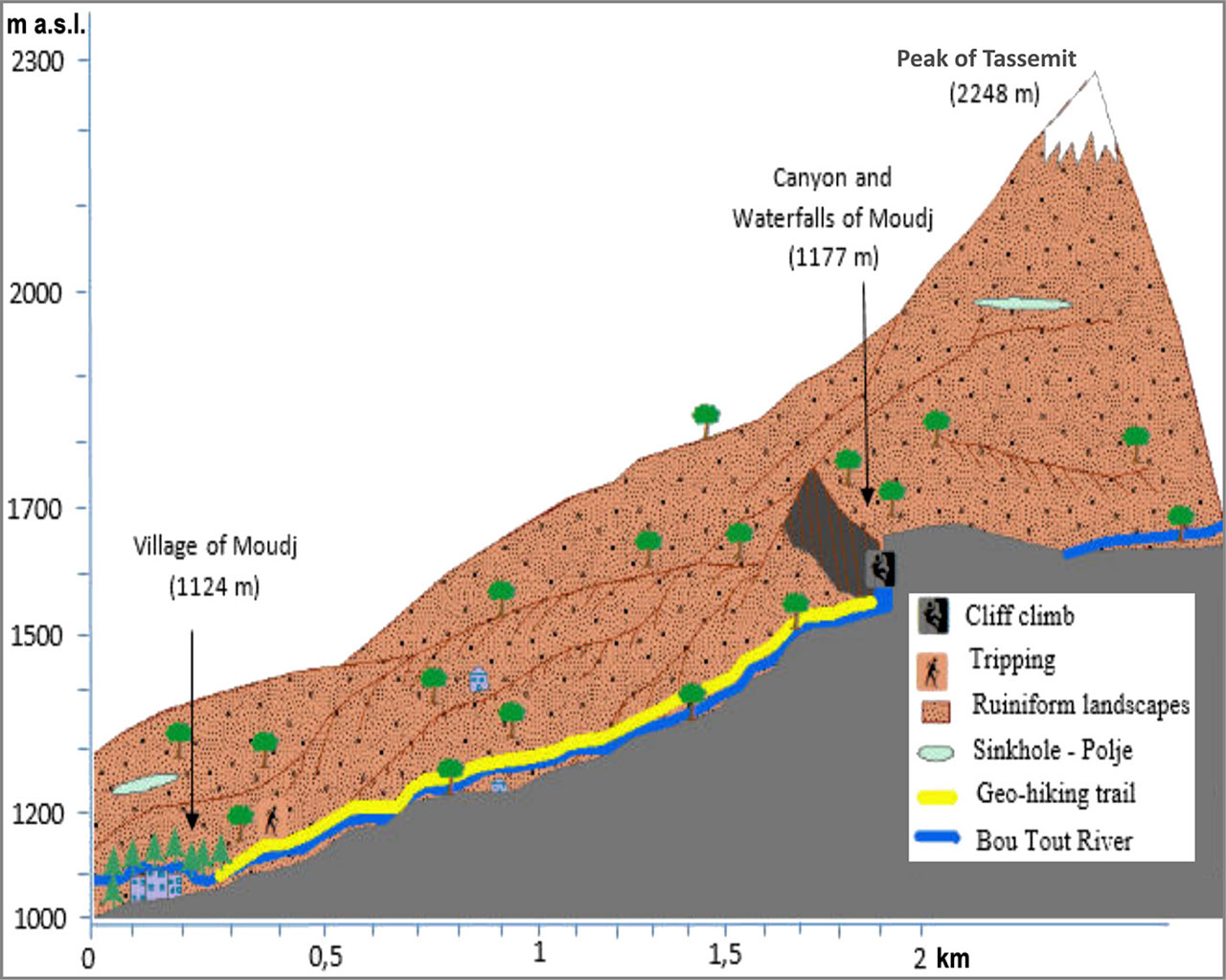
Fig. 13
Moudj canon geo-hiking trail.