
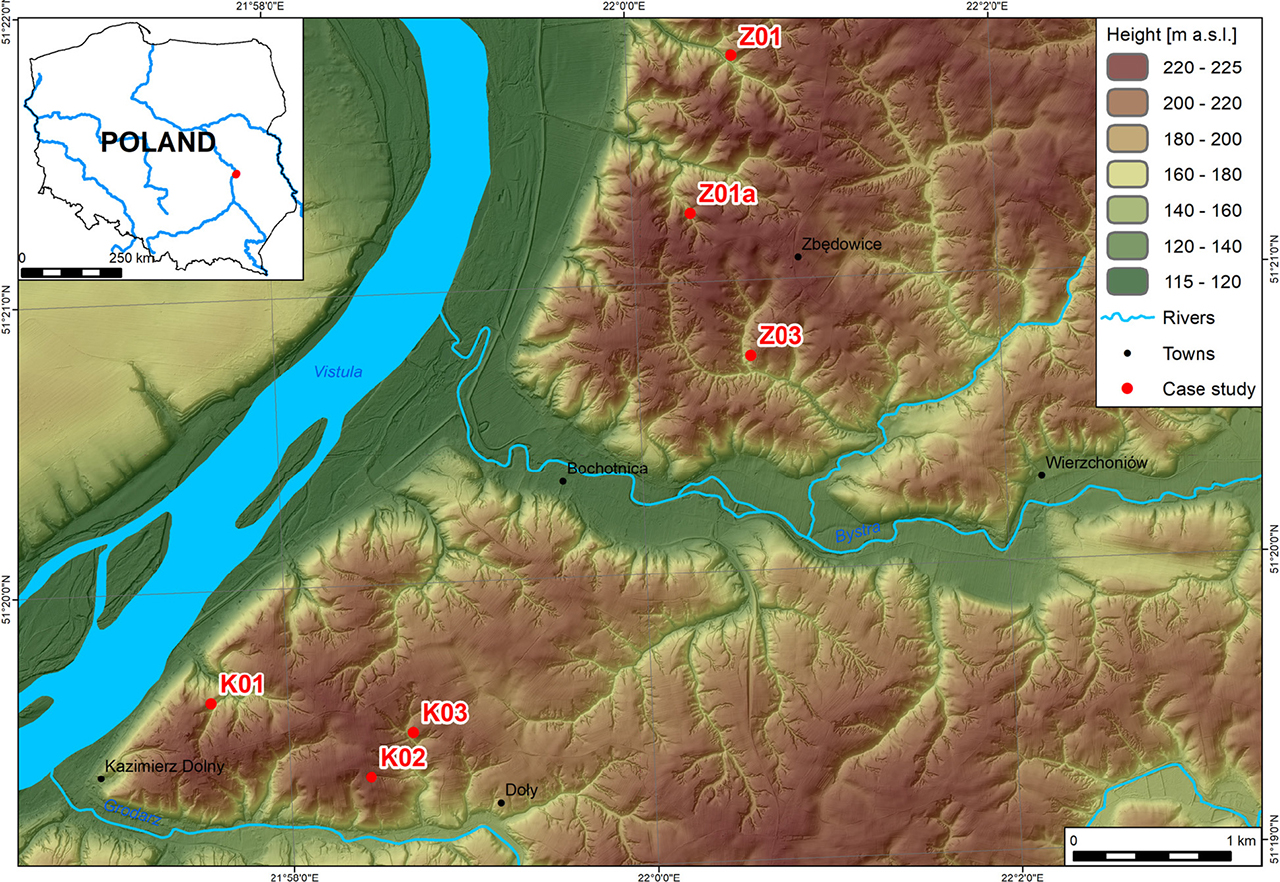
Fig. 1
Location of research sites shown against a LiDAR elevation-based shaded relief map of the western part of the Nałęczów Plateau.
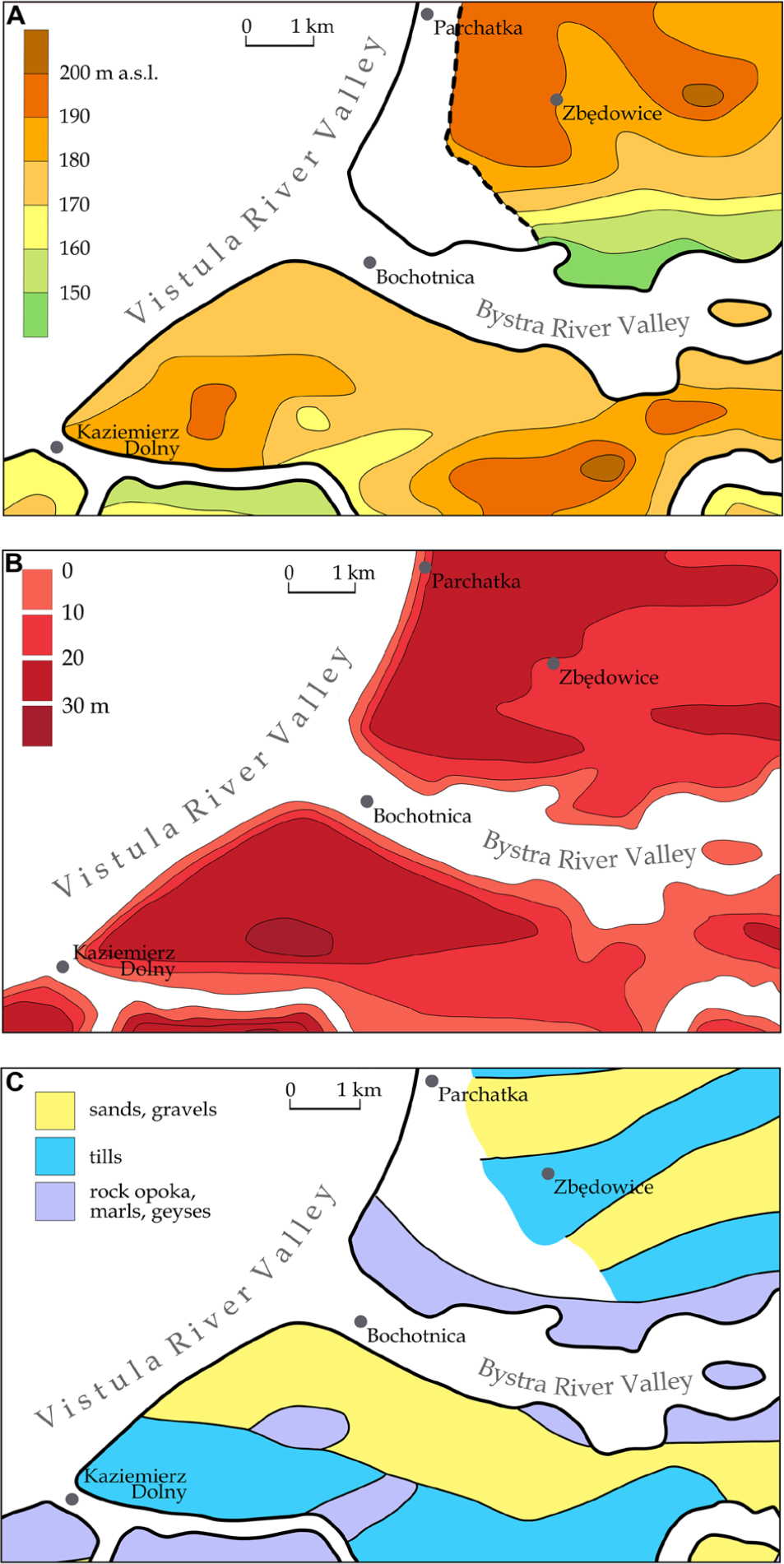
Fig. 2
Geological structure of the research area.
A – Geological map of the sub-loess surface of the western part of the Nałęczów Plateau, with the study area marked by a red box (Harasimiuk, Henkiel 1975/1976), B – Hypsometric tints of the sub-loess surface of the western part of the Nałęczów Plateau, with the study area marked (Harasimiuk, Henkiel 1975/1976), C – Map of loess cover thickness in the western part of the Nałęczów Plateau with marked study area (Harasimiuk, Henkiel 1975/1976).
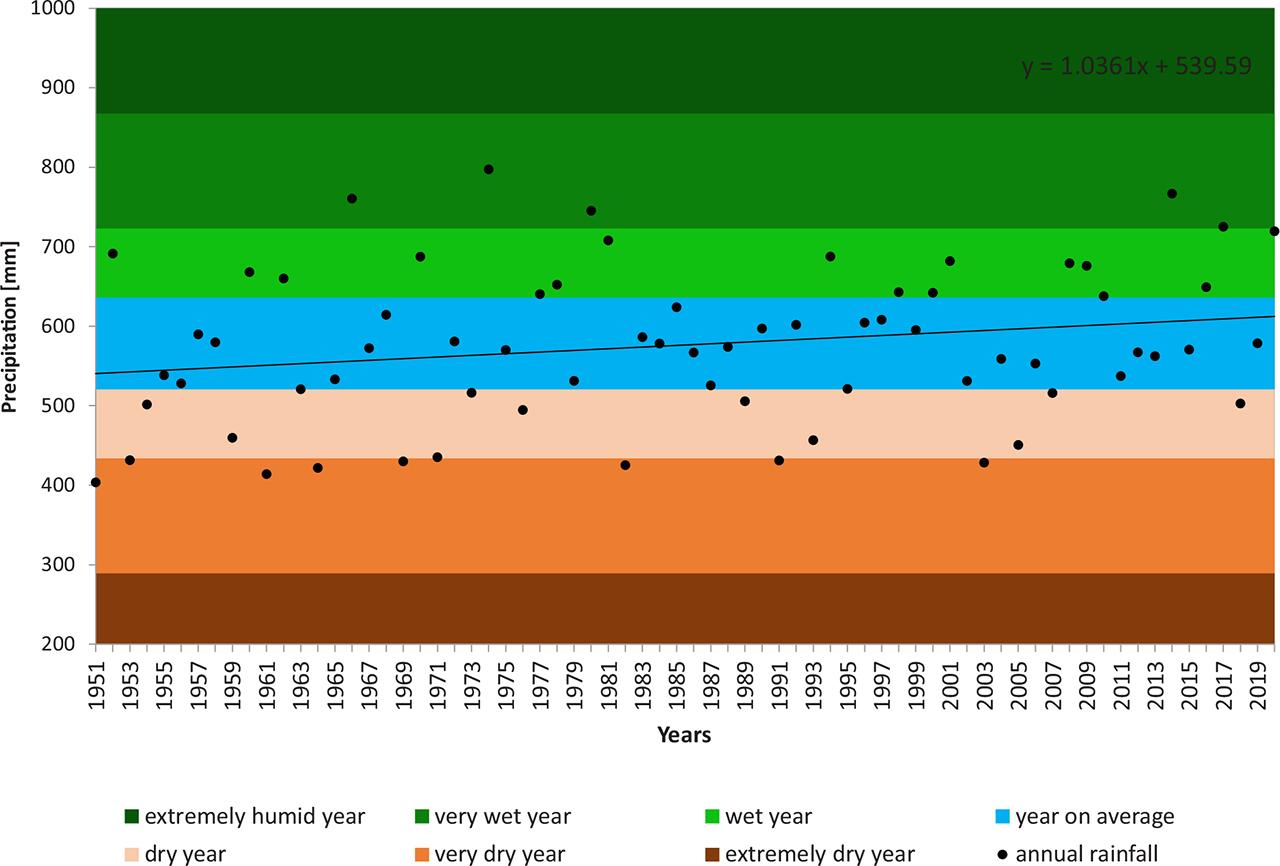
Fig. 3
Total annual precipitation for the years 1951–2020 at the IMGW station in Puławy plotted against the Kaczorowska classification (1962).
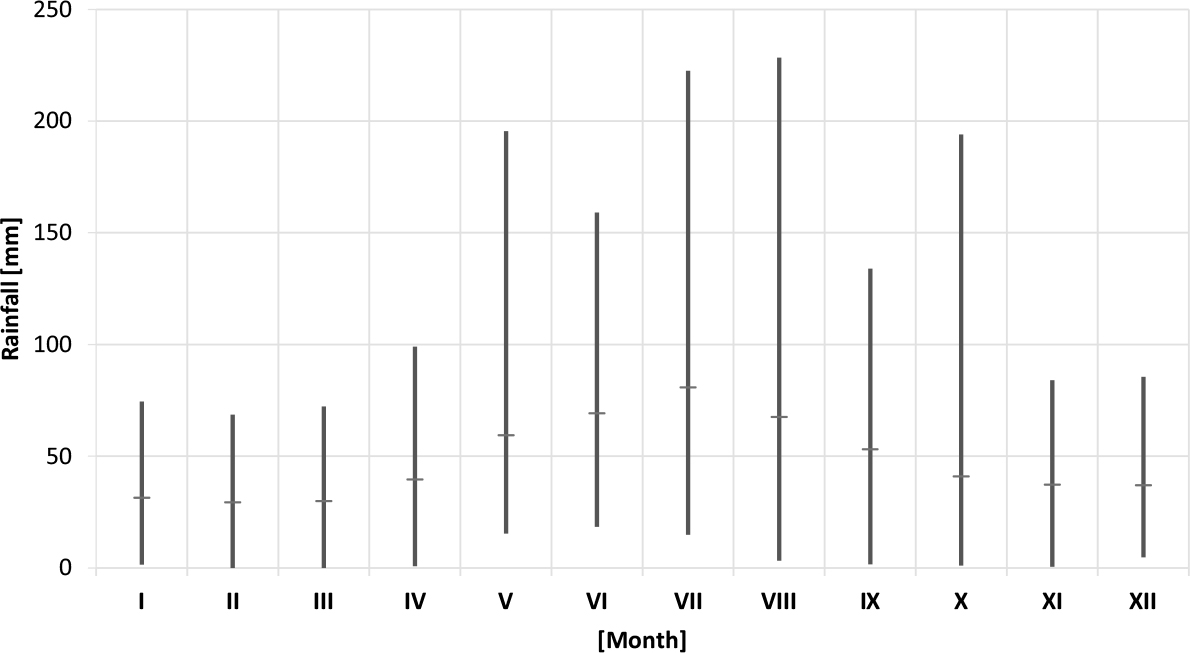
Fig. 4
Distribution of maximum, average and minimum monthly precipitation totals in the 1951–2020 period at the IMGW station in Puławy.
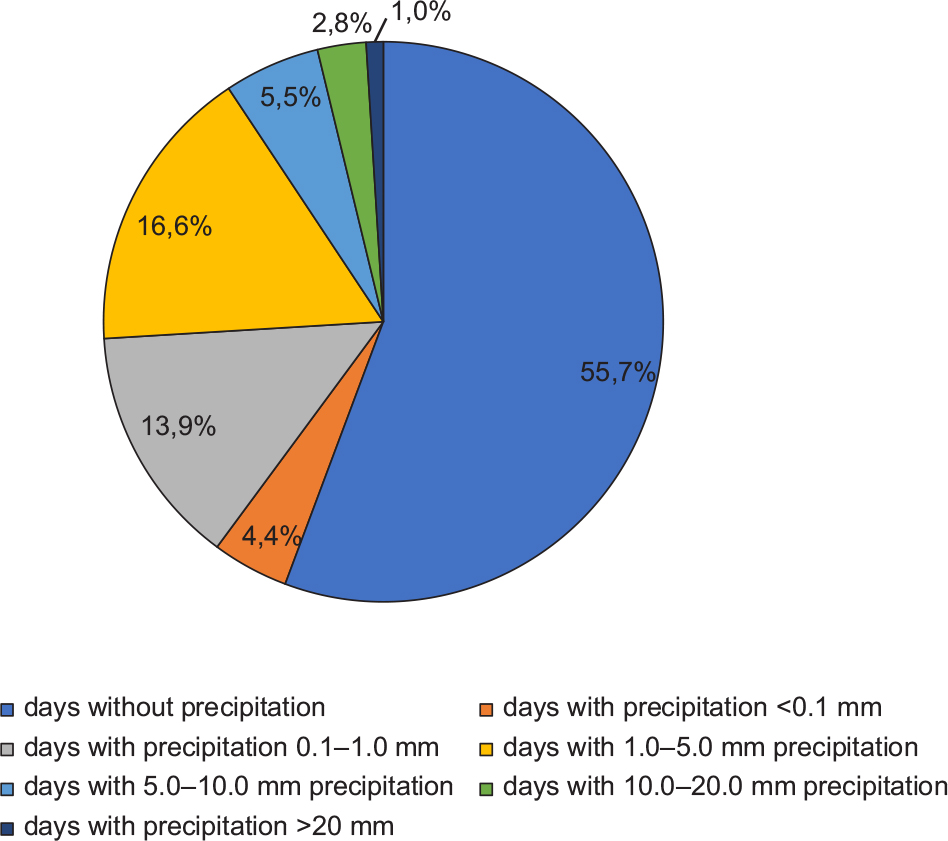
Fig. 5
Distribution of the average number of days with precipitation at various levels in the 1951–2020 period at the IMGW station in Puławy.
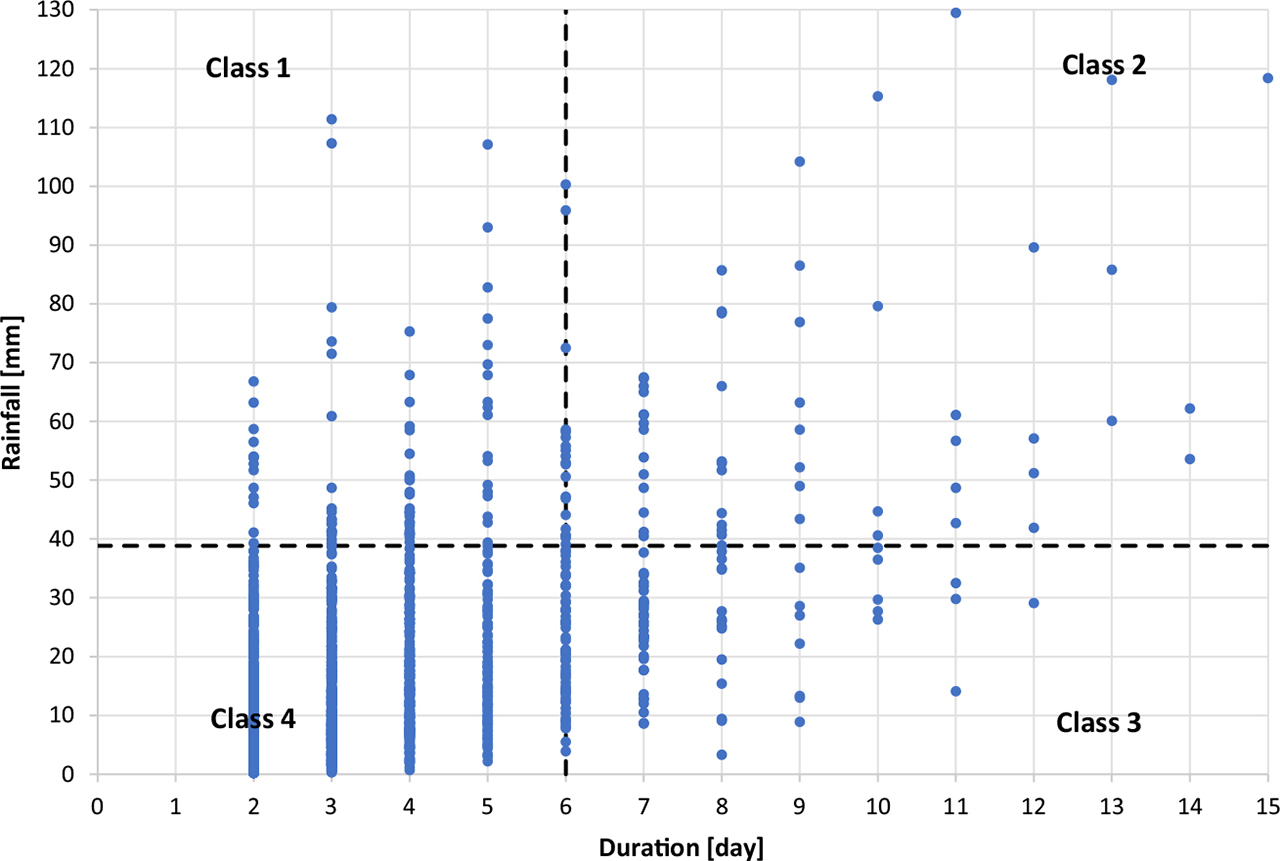
Fig. 6
Distribution of precipitation sequence lengths and totals in the 1951–2020 period at the IMGW station in Puławy.
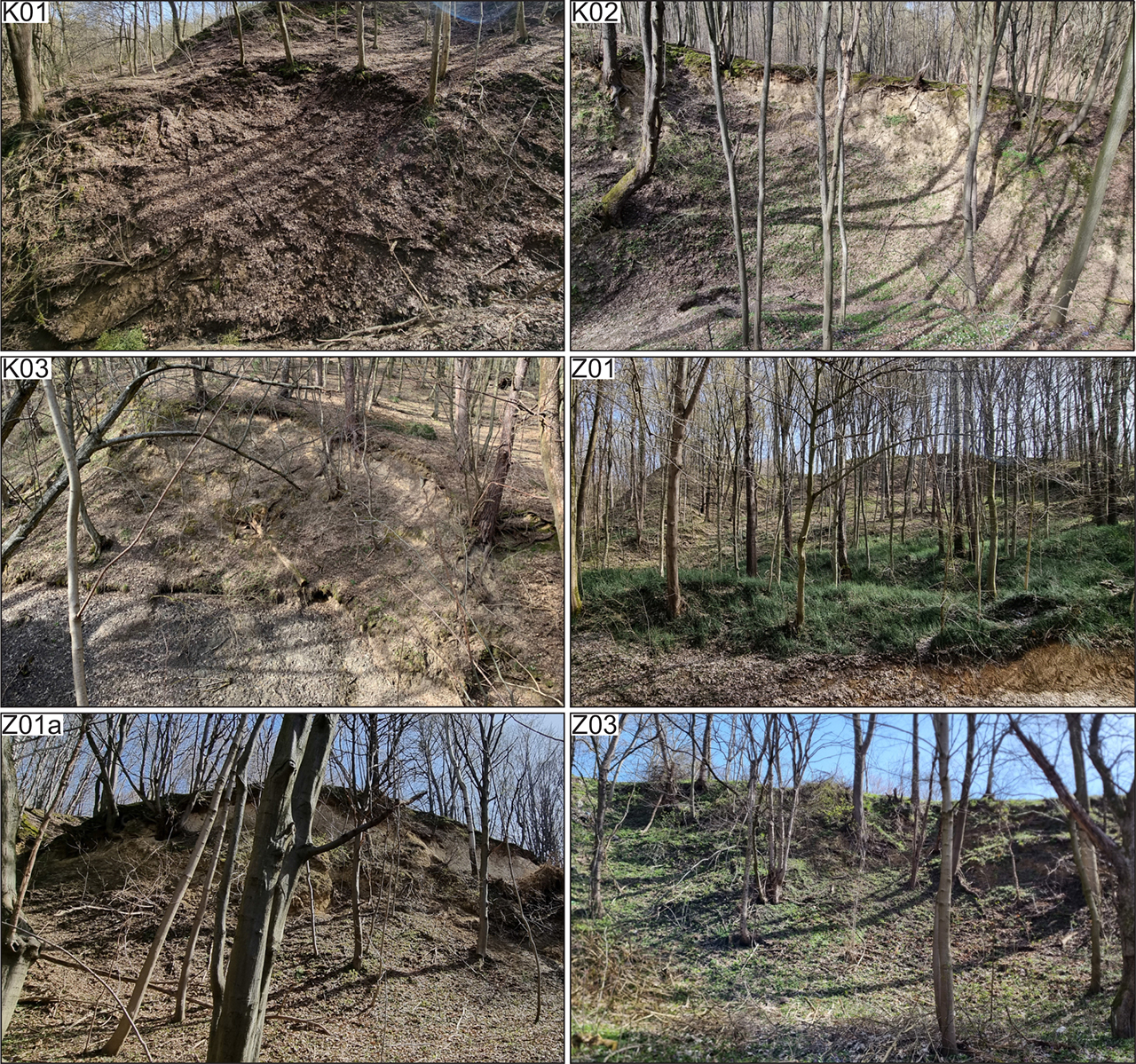
Fig. 7
Photos of the slopes covered by the research.
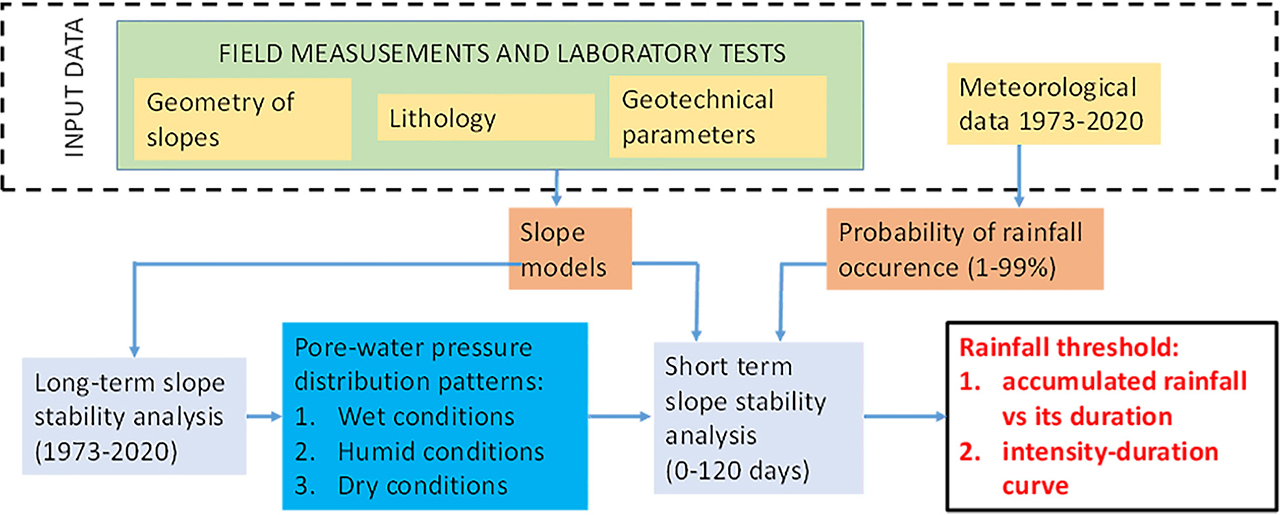
Fig. 8
Procedure for calculating the precipitation thresholds triggering landslides in the western part of the Nałęczów Plateau.
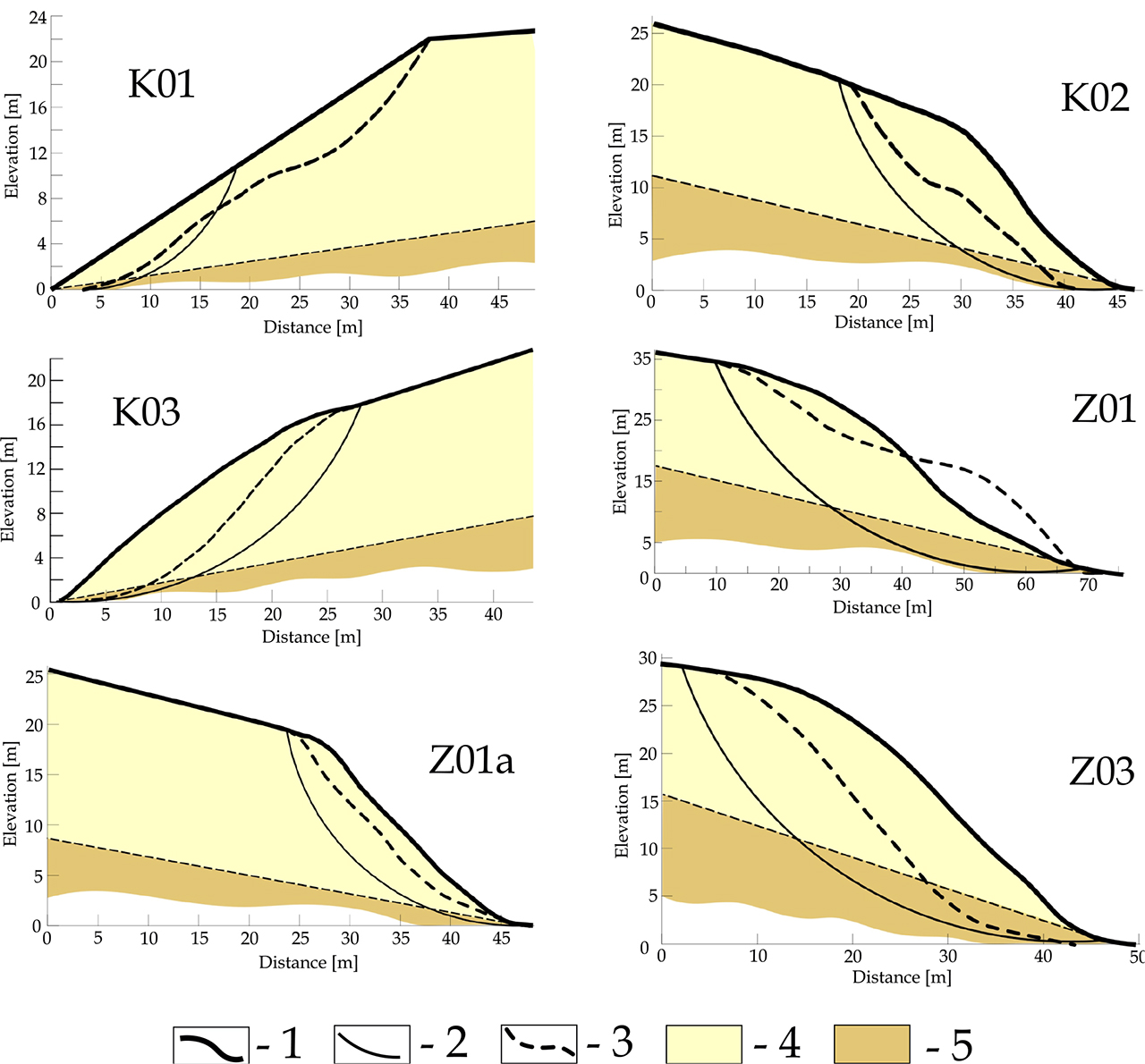
Fig. 9
Shape of reconstructed landslide slopes subjected to slope stability tests.
1 – assumed original slope shape, 2 – sliding surface, 3 – present slope shape, 4 – loess layer, 5 – layer with low water permeability.
Table 1
Parameters of research slopes.
| Case study | Location [WGS84] | Slope | Length | Height | Thickness of colluvium | Landuse | |
|---|---|---|---|---|---|---|---|
| E[°] | N [°] | [°] | [m] | [%] | |||
| K01 | 21.95956 | 51.32689 | 30.0 | 120 | 21.0 | 7.7 | Forest (100) |
| K02 | 21.97400 | 51.32232 | 46.5 | 116 | 16.8 | 3.1 | Forest (62), Fields (48) |
| K03 | 21.97799 | 51.32479 | 35.0 | 143 | 14.4 | 4.7 | Forest (100) |
| Z01 | 22.00966 | 51.36299 | 36.5 | 255 | 36.6 | 7.9 | Forest (50), Fields (50) |
| Z01a | 22.00535 | 51.35397 | 45.0 | 190 | 16.8 | 5.6 | Forest (74), Fields (26) |
| Z03 | 22.01034 | 51.34569 | 45.0 | 107 | 28.7 | 7.2 | Forest (73), Fields (23) |
Table 2
Main geotechnical parameters of loess cover at each site.
| Case study | Angle of internal friction | Cohesion | Permeability | Fraction content | USDA | PN-EN ISO 14668-2:2006 | ||
|---|---|---|---|---|---|---|---|---|
| Clay | Silt | Sand | ||||||
| [°] | [kPa] | [m/s] | [%] | |||||
| K01 | 33.9 | 3.2 | 3.27 × 10⁻⁶ | 6.4 | 67.0 | 26.6 | silt loam | silt |
| K02 | 31.4 | 0.0 | 7.14 × 10⁻⁶ | 5.4 | 66.2 | 28.4 | silt loam | silt |
| K03 | 30.4 | 0.0 | 3.86 × 10⁻⁶ | 4.8 | 61.4 | 33.8 | silt loam | silt |
| Z01 | 31.2 | 0.0 | 2.20 × 10⁻⁶ | 5.1 | 65.0 | 29.9 | silt loam | silt |
| Z01a | 34.3 | 0.0 | 2.36 × 10⁻⁶ | 4.9 | 64.9 | 30.2 | silt loam | silt |
| Z03 | 30.5 | 3.0 | 2.95 × 10⁻⁶ | 6.1 | 62.8 | 31.1 | silt loam | silt |
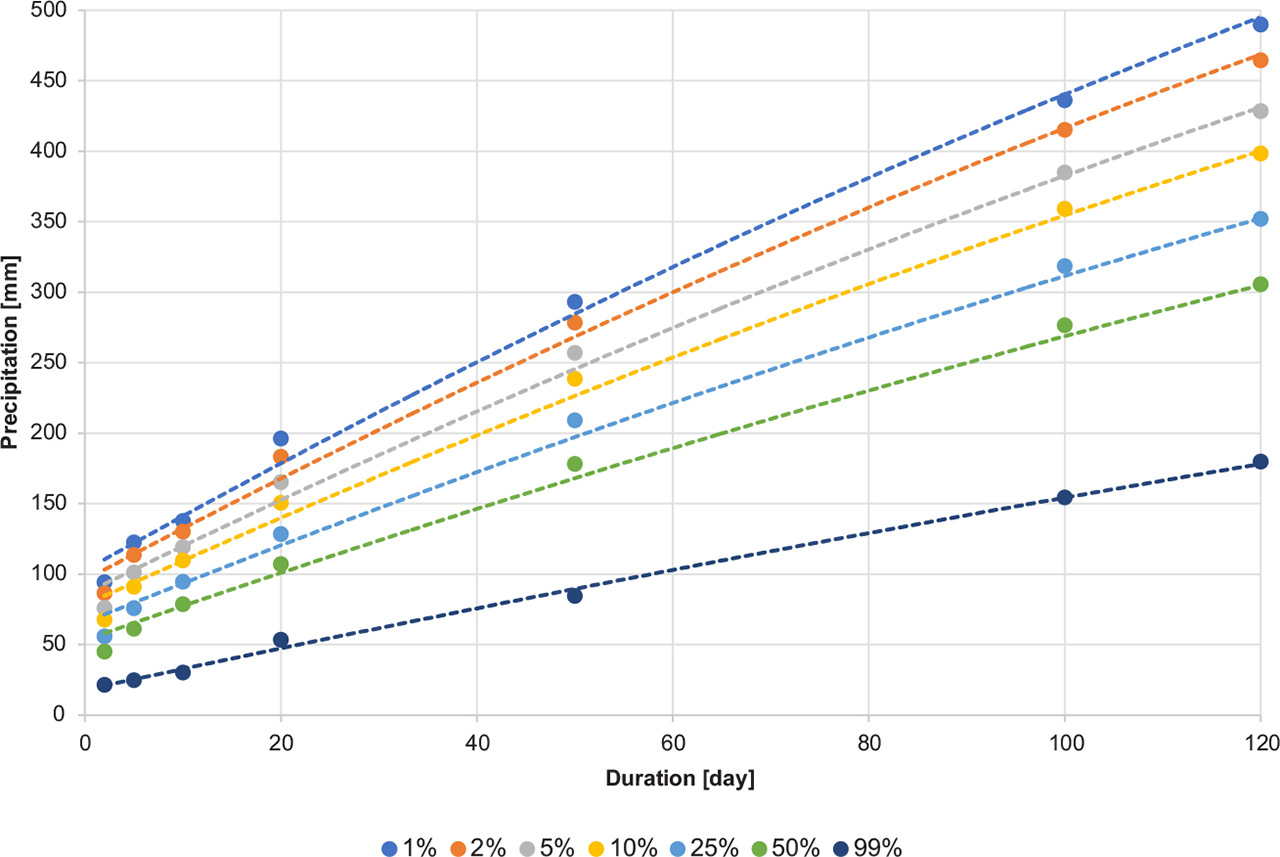
Fig. 10
Distribution of occurrence probability of maximum daily precipitation during the vegetation period, based on data from the IMGW station in Puławy from 1951 to 2020.
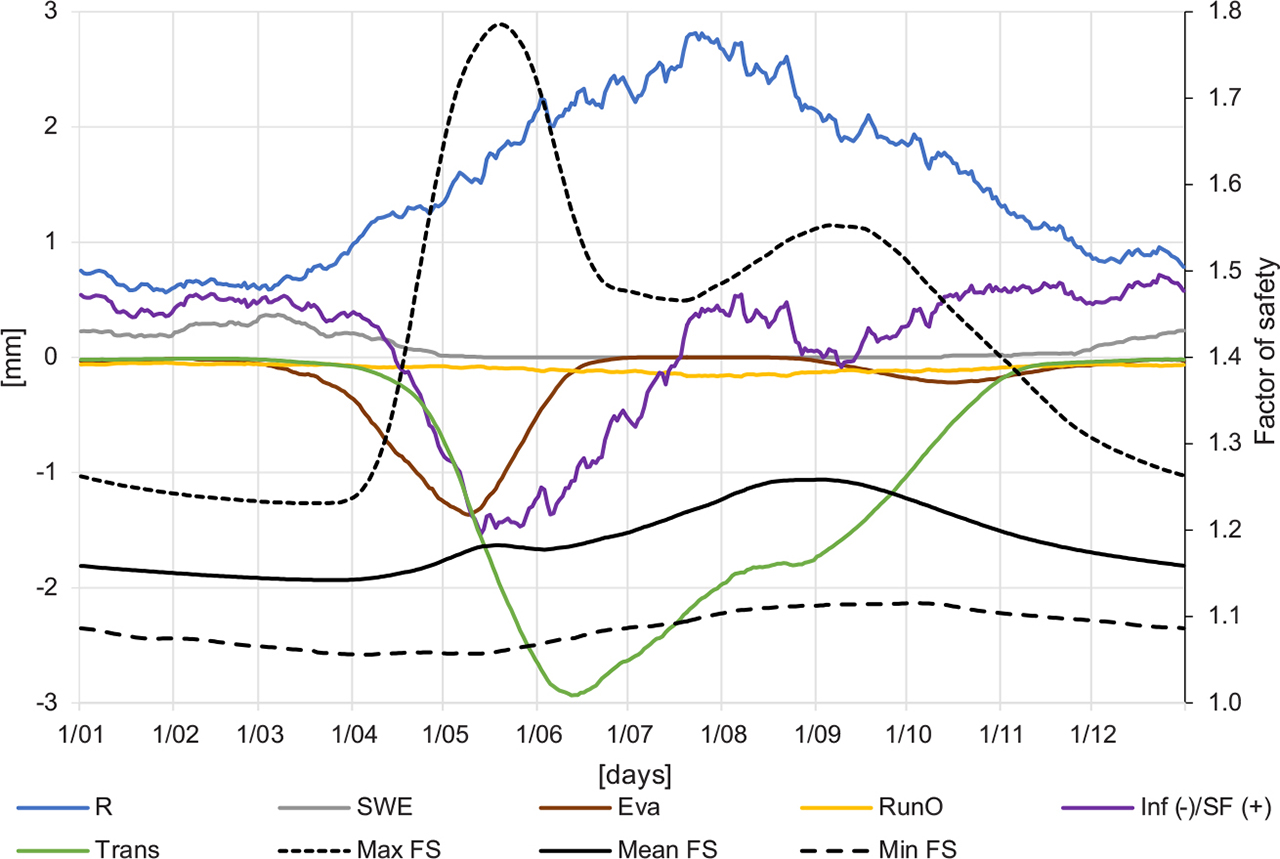
Fig. 11
Conceptual distribution of the FS against the background of annual hydrological balance components.
Eva – evaporation; FS – factor of safety; Inf (−)/SF(+) – infiltration (negative values)/subsurface flow (positive values); Max FS – maximum value of the FS; Mean FS – mean value of the FS; Min FS – minimum value of the FS; R – rainfall; RunO – runoff; SWE – snow water equivalent; Trans – transpiration.
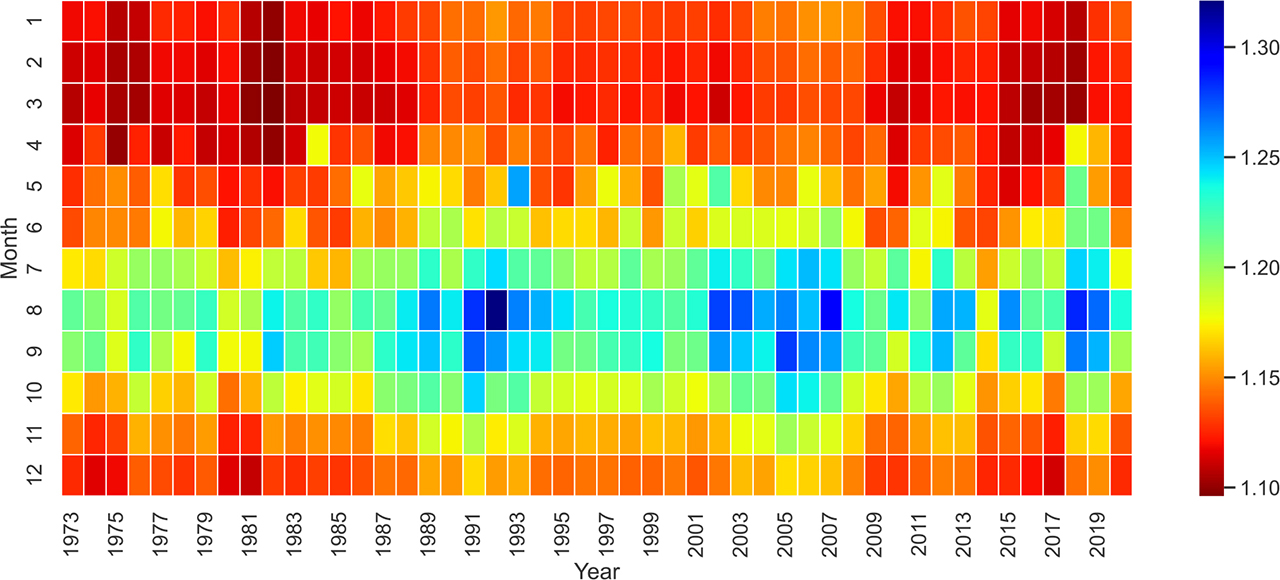
Fig. 12
Distribution of the mean value of the safety coefficient in a given month for a multipleyear period based on the selected slopes in the western part of the Nałęczów Plateau [chart generated using Matplotlib (Hunter 2007) and Seaborn (Waskom 2021) libraries in Python].
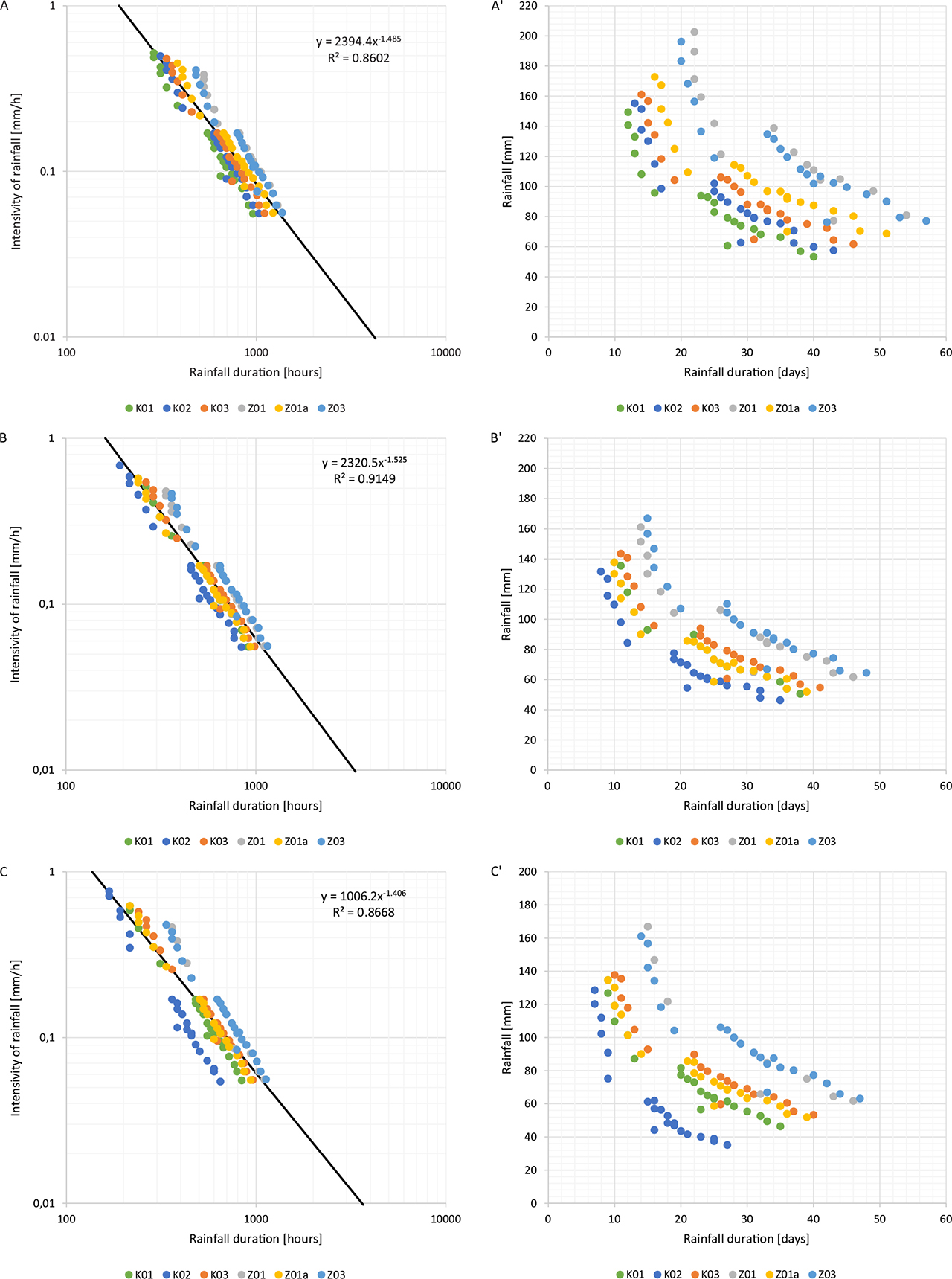
Fig. 13
Threshold precipitation values based on calculations of slope stability of the western part of the Nałęczów Plateau.
Intensity–duration thresholds: A-A’ – dry slope on the first analysis day; B-B’ – humid slope on the first analysis day; C-C’ – wet slope on the first analysis day.
Table 3
Critical precipitation level values triggering landslides in the western part of the Nałęczów Plateau in relation to initial slope cover moisture values.
| Nature of precipitation | Precipitation duration | Precipitation sum | Precipitation intensity | ||||||
|---|---|---|---|---|---|---|---|---|---|
| Min | Mean | Max | Min | Mean | Max | Min | Mean | Max | |
| [days] | [mm] | [mm/h] | |||||||
| Dry slope on the first analysis day | |||||||||
| Uniformly | 23 | 33.0 | 54 | 57.0 | 98.4 | 138.8 | 0.062 | 0.130 | 0.170 |
| Decreasing | 12 | 20.3 | 43 | 60.7 | 132.9 | 202.7 | 0.075 | 0.311 | 0.519 |
| Increasing | 28 | 40.0 | 57 | 53.4 | 82.9 | 110.9 | 0.056 | 0.089 | 0.116 |
| Humid slope on the first analysis day | |||||||||
| Uniformly | 19 | 27.1 | 44 | 48.0 | 80.7 | 110.2 | 0.062 | 0.130 | 0.170 |
| Decreasing | 8 | 15.1 | 33 | 54.5 | 114.8 | 167.0 | 0.085 | 0.368 | 0.686 |
| Increasing | 23 | 33.5 | 48 | 46.4 | 68.1 | 90.9 | 0.055 | 0.087 | 0.115 |
| Wet slope on the first analysis day | |||||||||
| Uniformly | 15 | 25.8 | 44 | 37.5 | 76.6 | 106.1 | 0.062 | 0.130 | 0.170 |
| Decreasing | 7 | 14.3 | 33 | 44.2 | 112.1 | 167.0 | 0.085 | 0.389 | 0.766 |
| Increasing | 18 | 31.7 | 47 | 35.2 | 64.1 | 88.0 | 0.054 | 0.086 | 0.115 |
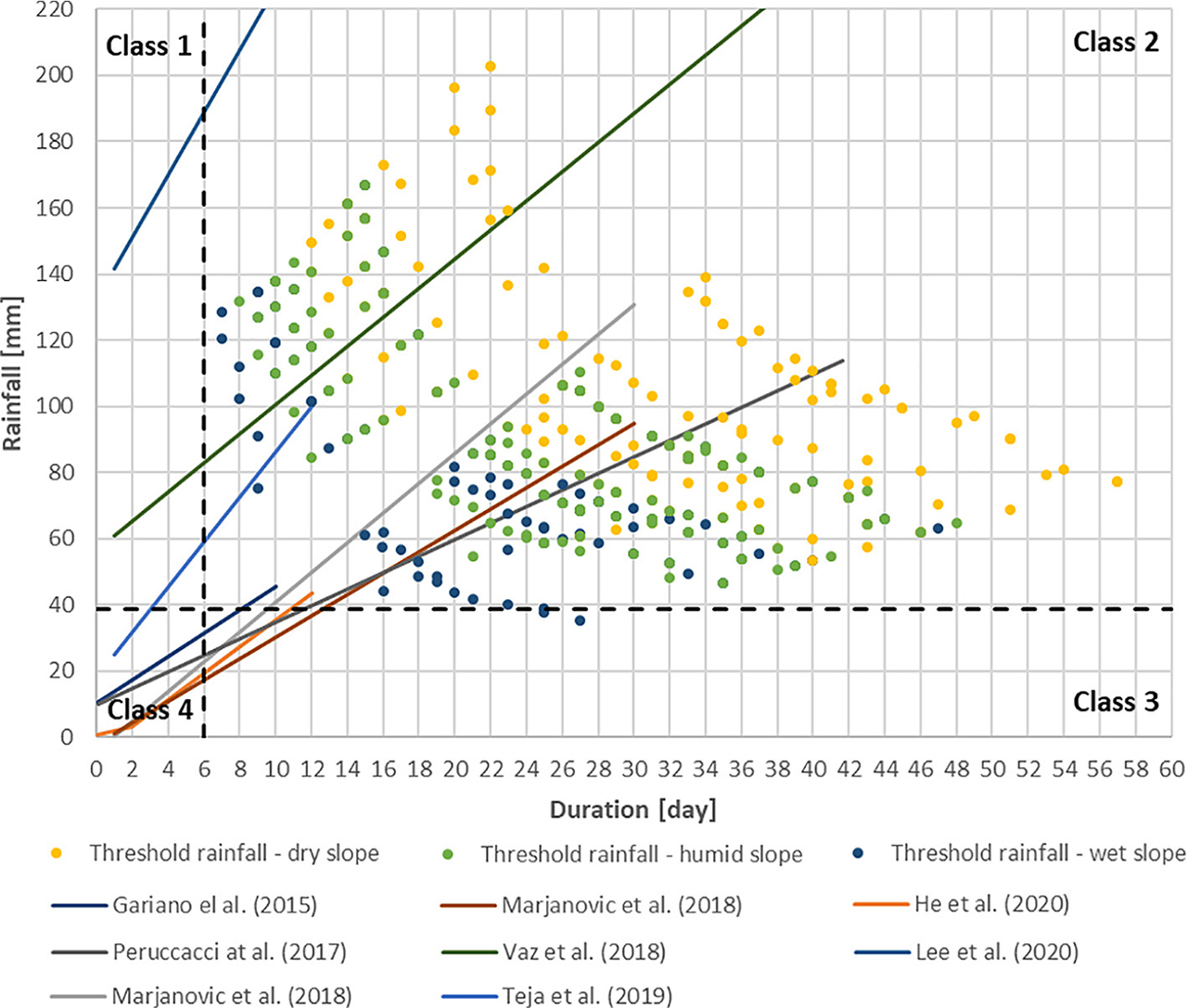
Fig. 14
Overview of the precipitation thresholds initiating landslides worldwide.