
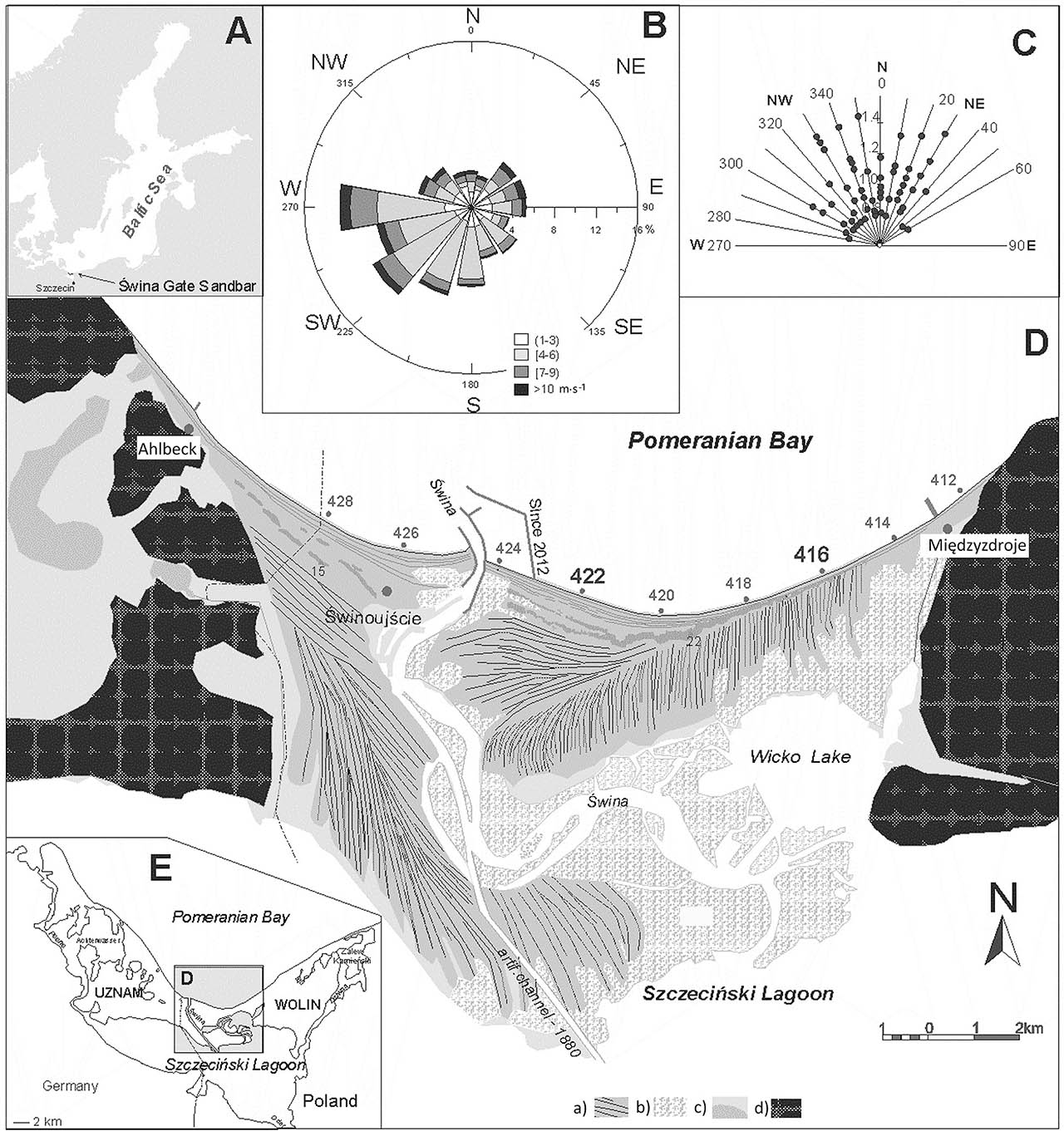
Fig. 1
Geographic characteristics of the study area.
A – location in the Baltic Sea coast, B – wind rose at station Świnoujście, 2000–2020, C – storm surge height and level in Świnoujście harbour, 2000–2020, D – coast exposure and morphology of the Świna Gate Sandbar (location of shore profile studied on kilometres 422 and 416); a) sandbar dune ridges, b) wetlands, c) lowlands and lakes, d) moriane. E – sandbar location in the Pomeranian Bay.
Table 1
The parameters of the highest storm surges observed on Świna Gate Sandbar in 2000–2022 (source of raw data: Maritime Office and IMGW station in Świnoujście (IMGW 2022) and Wetterzentrale (2022)).
| Year | Days, month | Max. sea level | Sea waving | Wind-waves direction | Wind velocity | Time with sea level HSL>1m | Storm name |
|---|---|---|---|---|---|---|---|
| [m AMSL] | [Bft] | [–] | [m · s−1] | [h] | [–] | ||
| 2000 | 17–20 Jan | 1.01 | 5–6 | NE–NW | 10–12 | 2 | Gilda |
| 2001 | 21–24 Nov | 1.04 | 7–8 | NW–NNE | 14–16 | 3 | Janika |
| 2002 | 19–22 Feb | 1.44 | 7 | NNW–NNE | 13–15 | 11 | Wisia |
| 2003 | 21–23Dec | 1.04 | 6 | NW–N | 16–18 | 3 | Jan |
| 2004 | 22–24 Nov | 1.37 | 10–12 | NW–NNE | 17–20 | 15 | Pia |
| 2005 | 21–26 Jan | 1.12 | 7 | NNW | 12–15 | 2 | Lutz |
| 2006 | 1–4 Nov | 1.48 | 8–12 | NW–N | 16–20 | 18 | Britta |
| 2007 | 18–21 Jan | 1.38 | 10 | WNW–NW | 15–19 | 24 | Kyrill |
| 2008 | 21–23 Mar | 1.06 | 7 | NE–N | 12–15 | 6 | – |
| 2009 | 12–16 Oct | 1.33 | 7 | NNE–NE | 12–15 | 30 | Wimar |
| 2010 | 14–15 Dec | 1.02 | 6 | NNE | 14–16 | 3 | Xynthia |
| 2011 | 16–19 Dec | 1.08 | 6–7 | NW–NNE | 14–16 | 3 | Joachim |
| 2012 | 13–16 Jan | 1.42 | 7–9 | WNW–N | 14–17 | 32 | Andrea |
| 2013 | 6–9 Dec | 1.04 | 10 | W–WNW | 16–24 | 4 | Xavier |
| 2014 | 20–21 Dec | 0.85 | 9 | W–NW | 13–17 | 0 | Aleksandra |
| 2015 | 7–8 Feb | 1.09 | 6–8 | W–NNW | 10–15 | 2 | Ole |
| 2016 | 4–6 Oct | 1.13 | 6–8 | NE–NNE | 14–18 | 6 | Angus |
| 2017 | 4–6 Jan | 1.42 | 7–11 | NW–NE | 16–20 | 28 | Axel |
| 2018 | 23–24 Oct | 0.80 | 6 | W–NW | 14–16 | 0 | Siglinde |
| 2019 | 1–3 Jan | 1.33 | 8–10 | W–NNE | 12–17 | 15 | Zeetje |
| 2020 | 14–15 Oct | 1.10 | 8 | NE | 17–18 | 11 | Gisela |
| 2021 | 4–5 Nov | 0.93 | 6–7 | NE–NW | 13–17 | 0 | Wanda |
| 2022 | 29–31 Jan | 0.99 | 7–9 | WSW–NNW | 14–18 | 0 | Nadine |
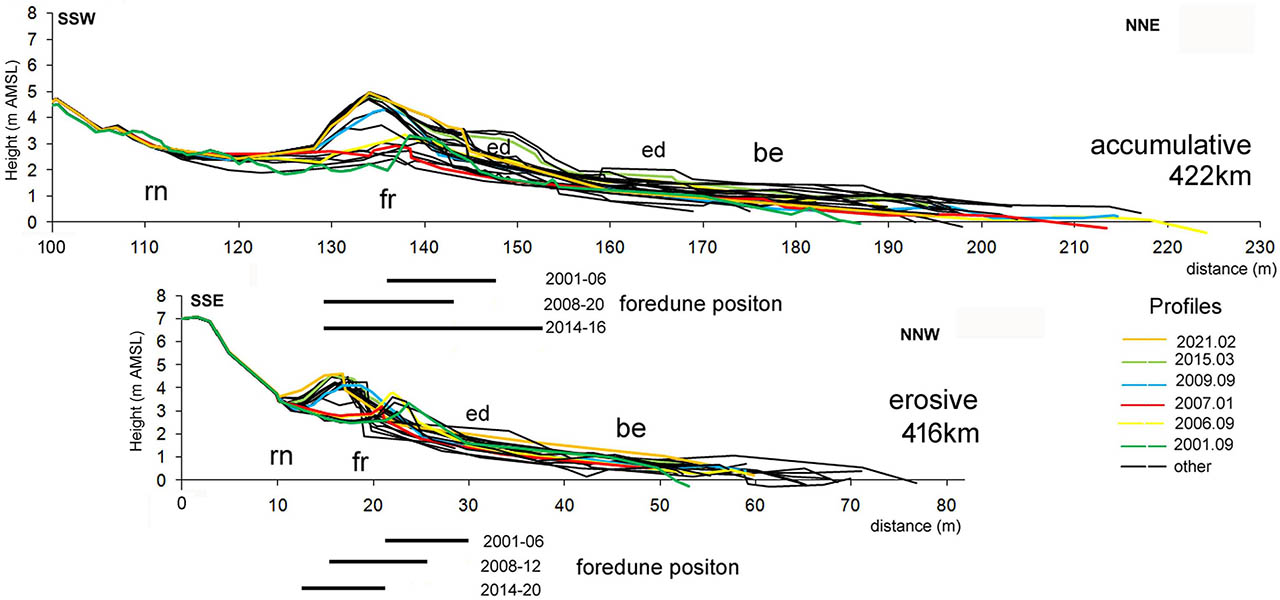
Fig. 2
Relief dynamics across the shore in 2001–2021 at two selected shore profiles (location on fig. 1D). Selected phases in colour, changes of foredune position caused by erosion marked below graphs. rn – runnel, fr – foredune, ed – embryo dune, be – beach.
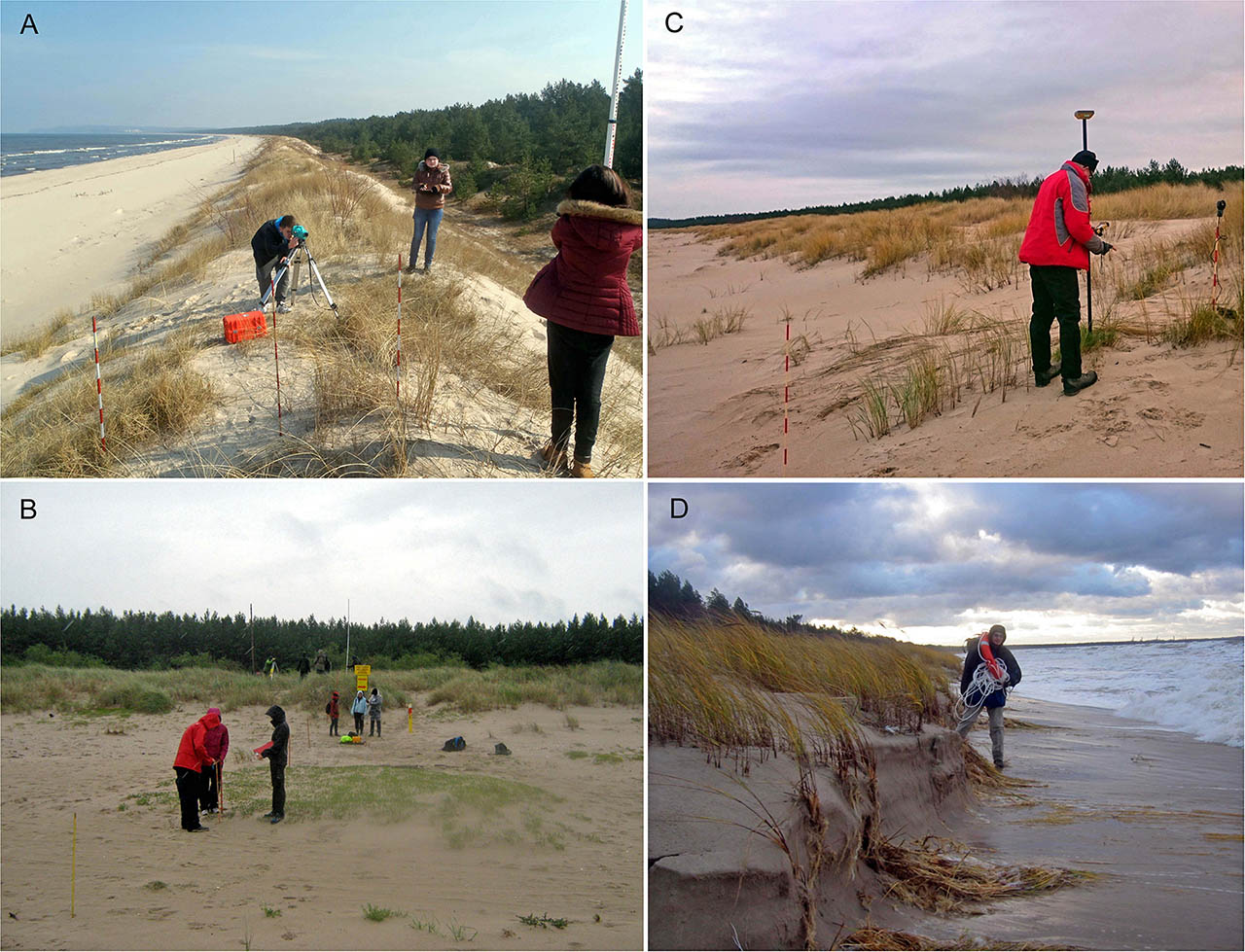
Fig. 3
Field measurements.
A – dune levelling, B – beach with embryo form levelling, C – relief measurements using GPS-RTK tool, D – observation of dune retreat during a surge.
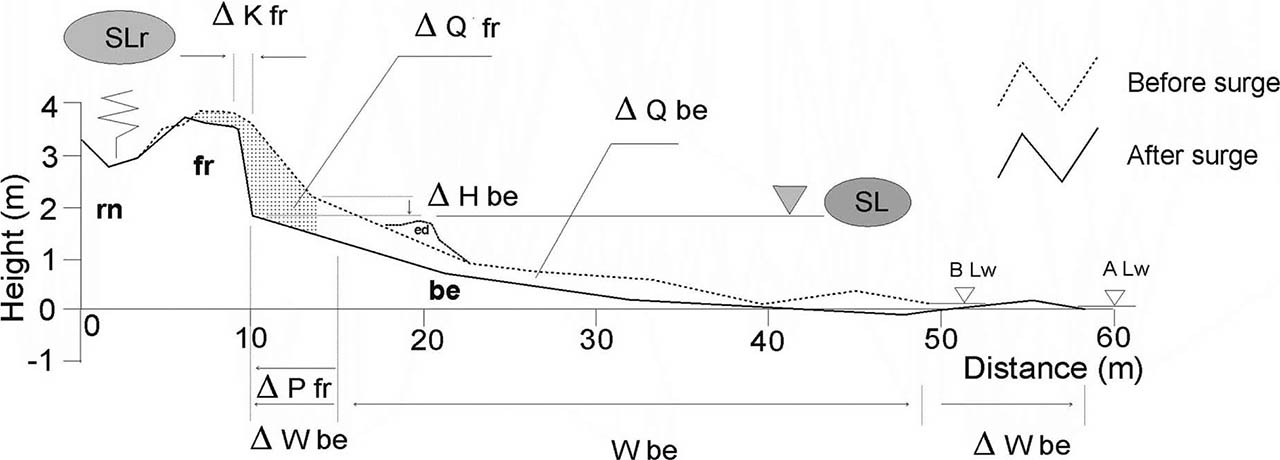
Fig. 4
Forms measured along the profile and indicators of their dynamics (B – before the surge, A – after the surge).
ΔHbe – beach height change, Wbe – beach width, ΔWbe – beach width change, ΔQbe – beach sand volume change, ΔPfr – foredune foot change, ΔKfr – foredune top/edge change, ΔQfr – foredune sand volume change, BLw – water line before the surge, ALw – water line after the surge, SL – max. sea level, SLr – water run-up.
Table 2
Coefficients correlation between the main input and output parameters of storm surge impact to the shore (B – parameters before the surge, A – parameters after the surge). Statistically significant correlations on the p < 0.05 value are typed in bold.
| Input (B) and output (A) parameters [HSL, m AMSL] | Max. sea level H | Sea level T | Run-up | Max. wind velocity | Wind-wave azimuth NW | Wind-wave azimuth NE | Wind-wave azimuth NW–NE | Beach width before | Beach height before | |
|---|---|---|---|---|---|---|---|---|---|---|
| [TSL, hours HSL> 1m] | [HSLr, m AMSL] | [V, m · s−1] | [degree] | [Wbe B, m] | [Hbe B, m] | |||||
| Main storm parameters | Max. sea level [HSL, m AMSL] | 1.00 | 0.87 | 0.92 | 0.31 | 0.12 | 0.24 | 0.40 | × | × |
| Sea level time [TSL, hours H>1m] | 0.87 | 1.00 | 0.75 | 0.29 | −0.03 | 0.10 | 0.09 | × | × | |
| Run-up [HSLr, m AMSL] | 0.92 | 0.80 | 1.00 | 0.49 | 0.34 | 0.08 | 0.40 | × | × | |
| Average morphometric indicators | Beach width [ΔWbe, m] | 0.01 | 0.10 | −0.03 | −0.06 | 0.24 | 0.16 | 0.32 | 0.85 | 0.45 |
| Beach height [ΔHbe, m] | 0.64 | 0.50 | 0.67 | 0.20 | −0.45 | −0.06 | 0.52 | 0.26 | 0.35 | |
| Beach volume [ΔQbe, m3] | 0.66 | 0.49 | 0.70 | 0.59 | 0.32 | 0.06 | 0.48 | 0.15 | 0.46 | |
| Dune foot [ΔPfr, m] | 0.74 | 0.59 | 0.85 | 0.47 | −0.03 | −0.17 | 0.43 | 0.26 | 0.52 | |
| Dune volume [ΔQfr, m3] | 0.71 | 0.57 | 0.71 | 0.41 | −0.20 | −0.22 | 0.42 | 0.29 | 0.49 | |
| Dune volume [ΔQfr, m3/m2] | 0.65 | 0.54 | 0.64 | 0.36 | 0.18 | 0.21 | 0.47 | 0.21 | 0.53 | |
| Indicators for accumulative shore, 422 km | Beach volume [ΔQ be, m3] | 0.55 | 0.13 | 0.64 | 0.65 | 0.42 | −0.12 | 0.31 | 0.19 | −0.08 |
| Dune foot [ΔPfe, m] | 0.64 | 0.34 | 0.85 | 0.45 | 0.31 | 0.28 | 0.59 | 0.33 | 0.48 | |
| Dune volume [ΔQfr, m3/m2] | 0.63 | 0.29 | 0.69 | 0.47 | 0.30 | 0.22 | 0.51 | 0.08 | 0.30 | |
| Indicators for erosive shore, 416 km | Beach volume [ΔQbe, m3/m2] | 0.79 | 0.57 | 0.83 | 0.54 | 0.32 | 0.06 | 0.45 | 0.30 | 0.30 |
| Dune foot [ΔP fe, m] | 0.86 | 0.77 | 0.90 | 0.51 | 0.29 | −0.07 | 0.29 | 0.10 | 0.62 | |
| Dune volume [ΔQfr, m3/m2] | 0.79 | 0.72 | 0.75 | 0.38 | 0.28 | 0.20 | 0.67 | −0.06 | 0.35 | |
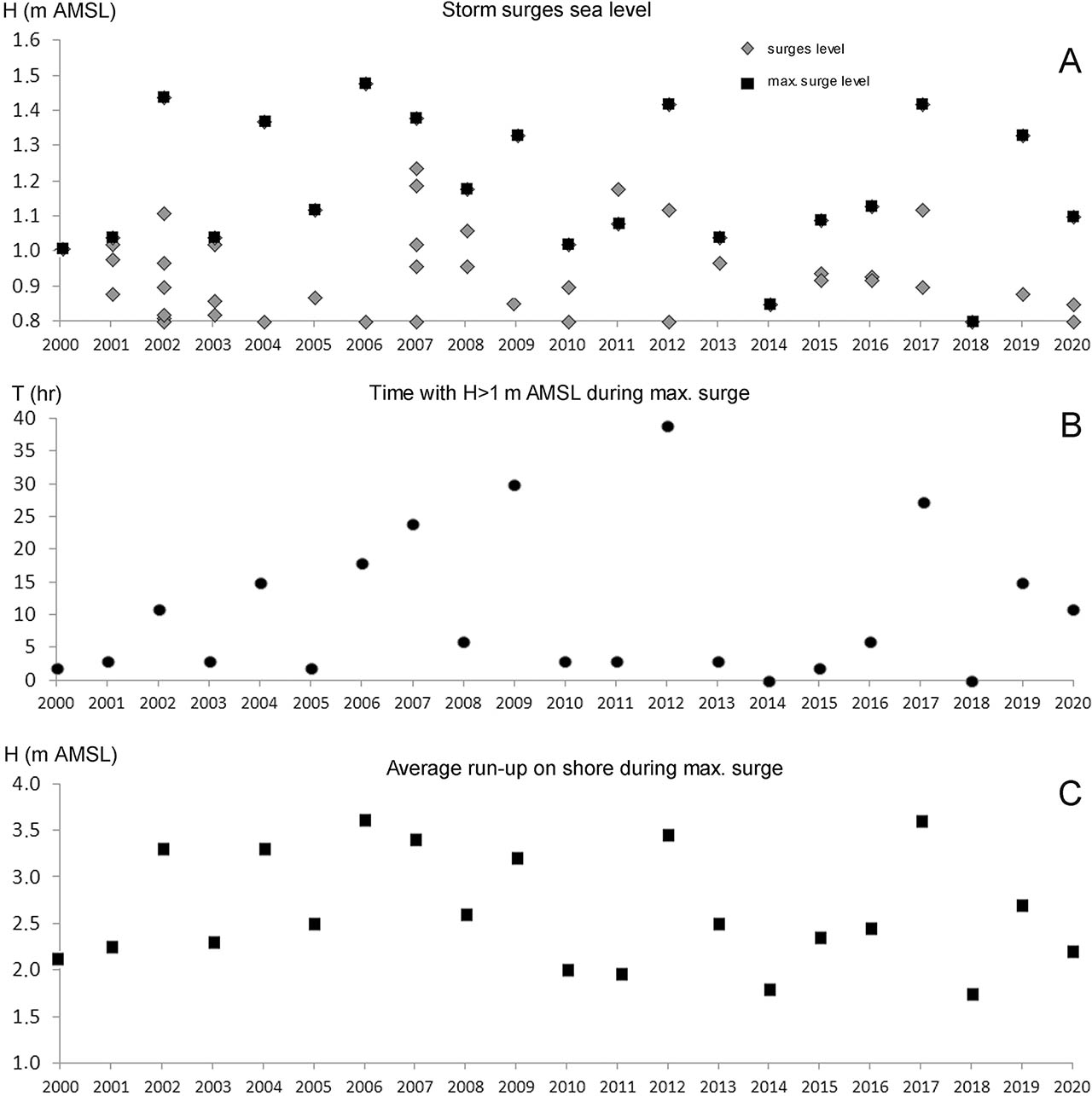
Fig. 5
Storm surge parameters in 2000–2020.
A – maximum surges and surges with HSL of 0.8 m, B – duration (TSL) of max. surges with HSL > 1 m, C – run-up during maximum surges (HSLr).
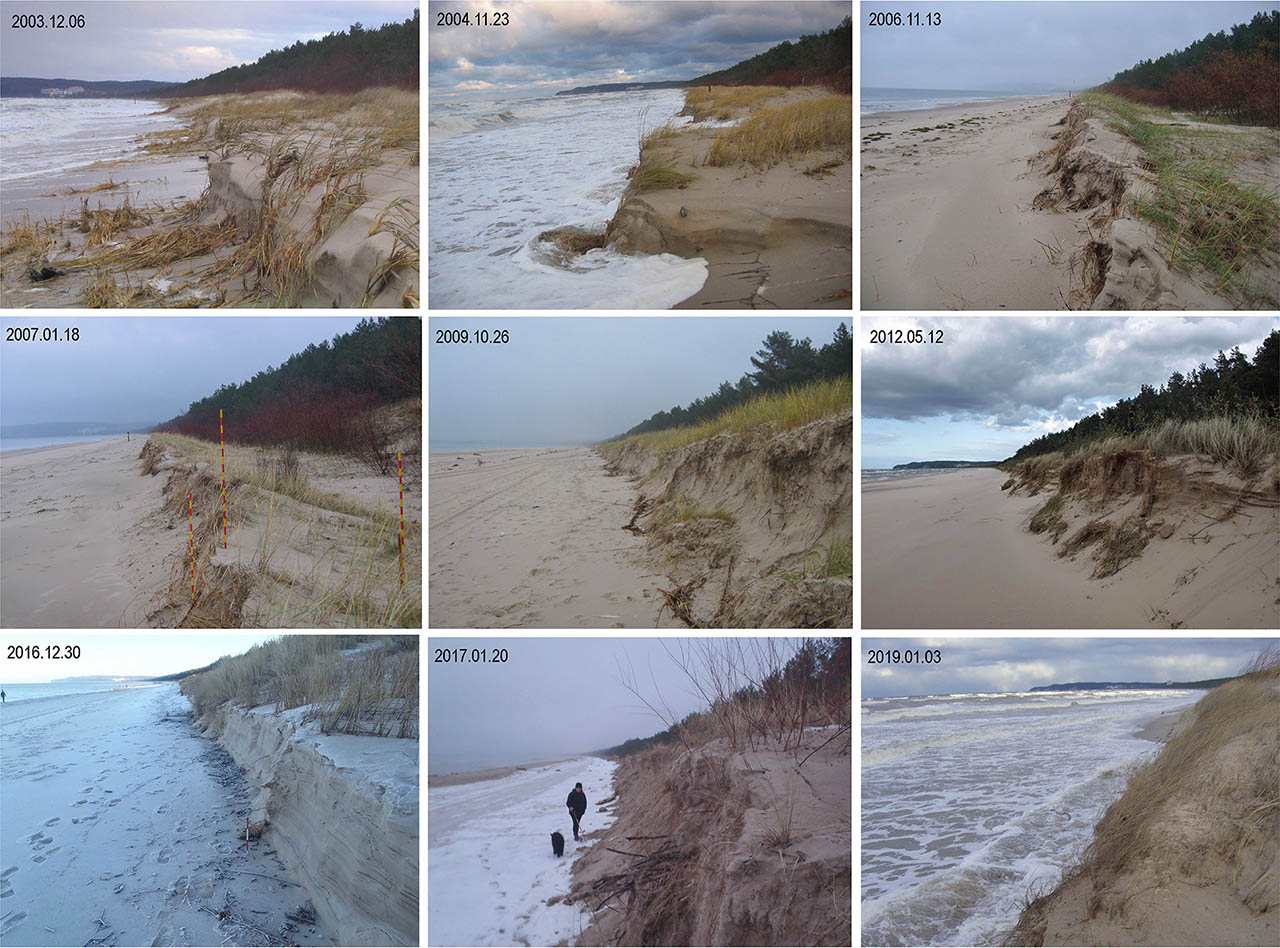
Fig. 6
Photographic documentation of storm surge consequences on the foredune in the eastern part of Świna Gate Sandbar (kilometre 416).
2003 – fresh escarpments during the surge, 2004 – inundated beach and eroded foredune during heavy surge associated with storm Pia, 2006 – 2/3 of foredune eroded after surge associated with storm Britta, 2007 – remnants of foredune between 3 surges associated with storm Kyrill, 2009 – rebuilt foredune eroded by a heavy surge, 2012 – erosion after double heavy surge associated with storm Andrea, 2016 – small cut-off after 3 surges in autumn (including storms Angus and Barbara), 2017 – high escarpment of foredune eroded and beach washed by heavy surge associated with storm Axel, 2019 – foredune erosion during heavy surge associated with storm Zeetje.
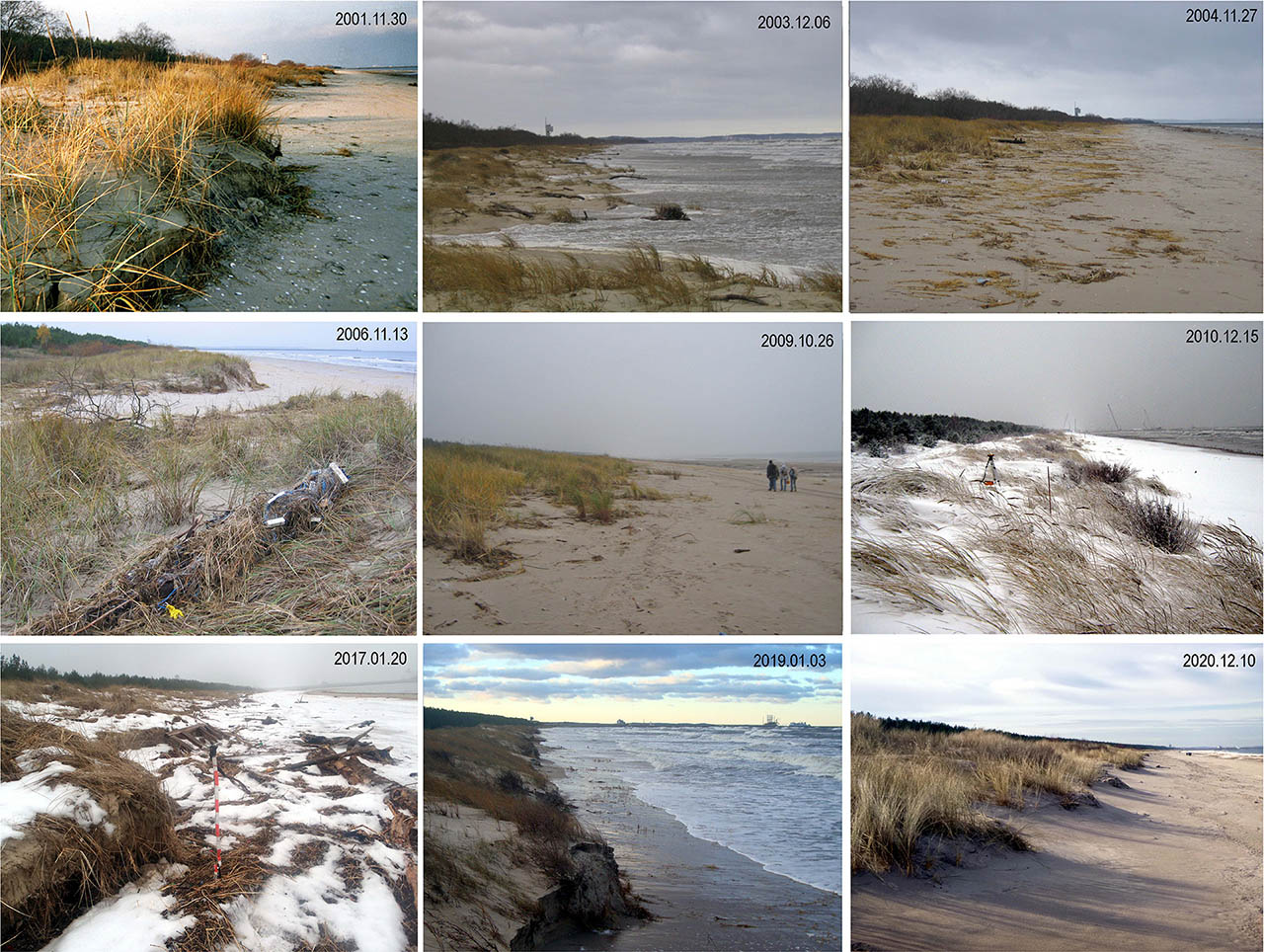
Fig. 7
Photographic documentation of storm surge consequences on the foredune in the western part of Świna Gate Sandbar (kilometre 422).
2001 – dune escarpment and flattened beach after 3 surges associated with storm Janika, 2003 – during surge, water entering low dune abraded in 2002, 2004 – eroded embryo dunes 3 days after surge associated with storm Pia, 2006 – washover fans and storm gates in foredune after surge associated with storm Britta, 2009 – dune protected by high beach, 10 days after heavy surge, 2010 – only lower beach eroded during storm Xynthia, 2017 – organic debris slipped on partly eroded foredune by heavy storm Axel, 2019 – abrasion of foredune during surge associated with storm Zeetje, 2020 – small escarpments just after surge associated with October storm Gisela.
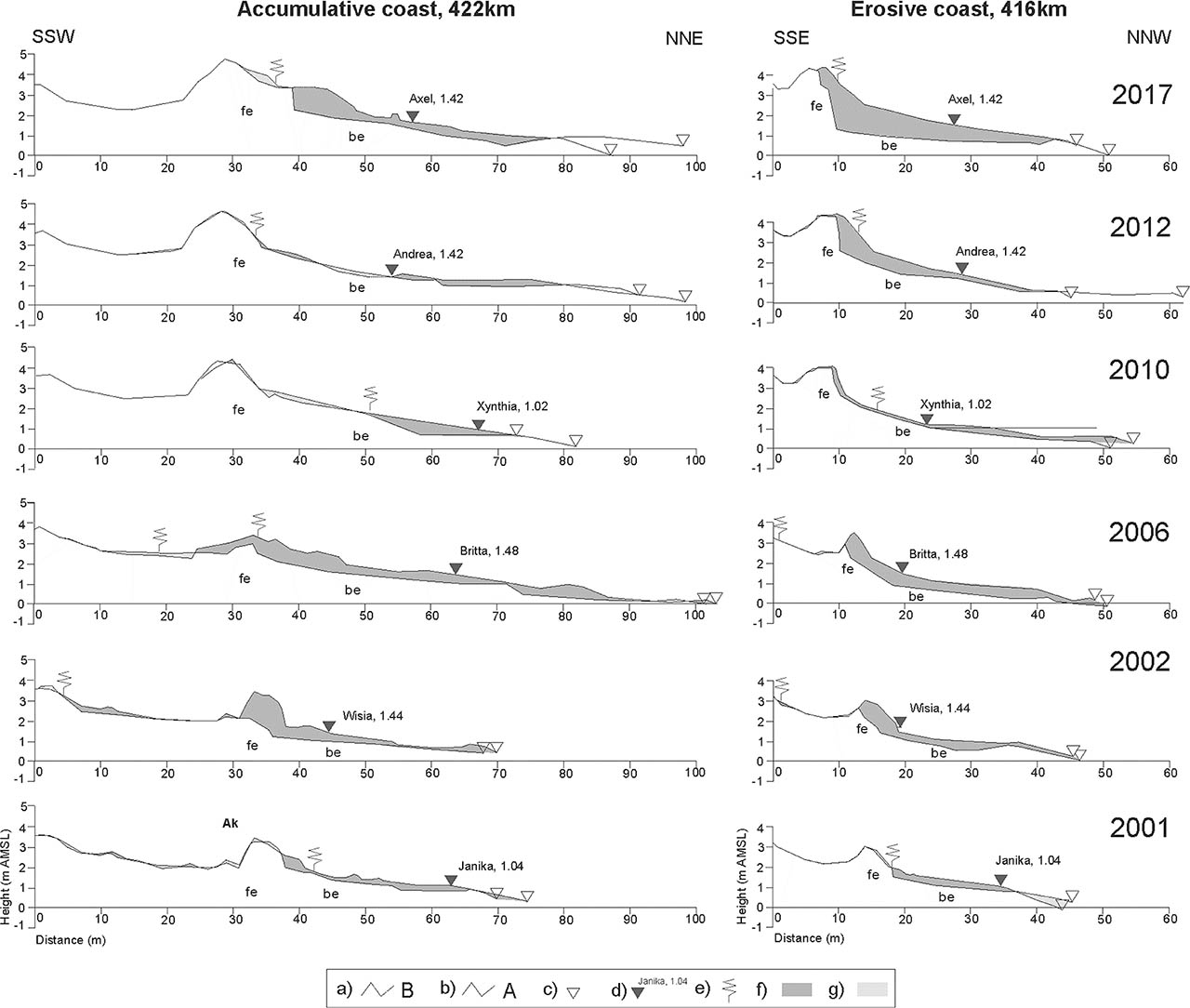
Fig. 8
Examples of shore erosion on accumulative and erosive shore section of Świna Gate Sandbar due to storm surges (substantial sea level and water run-up).
2001 – low sea level and low beach, 2002 – high sea level and low beach, 2006 – high sea level and low beach, 2010 – low sea level and high beach, 2012 – high sea level and high beach, 2017 – high sea level and high beach but heavy surge.
a) relief before surge (B), b) relief after surge (A), c) sea level on profile, d) max. sea level and storm name, e) run-up during surge, f) erosion layer, g) accumulation layer.
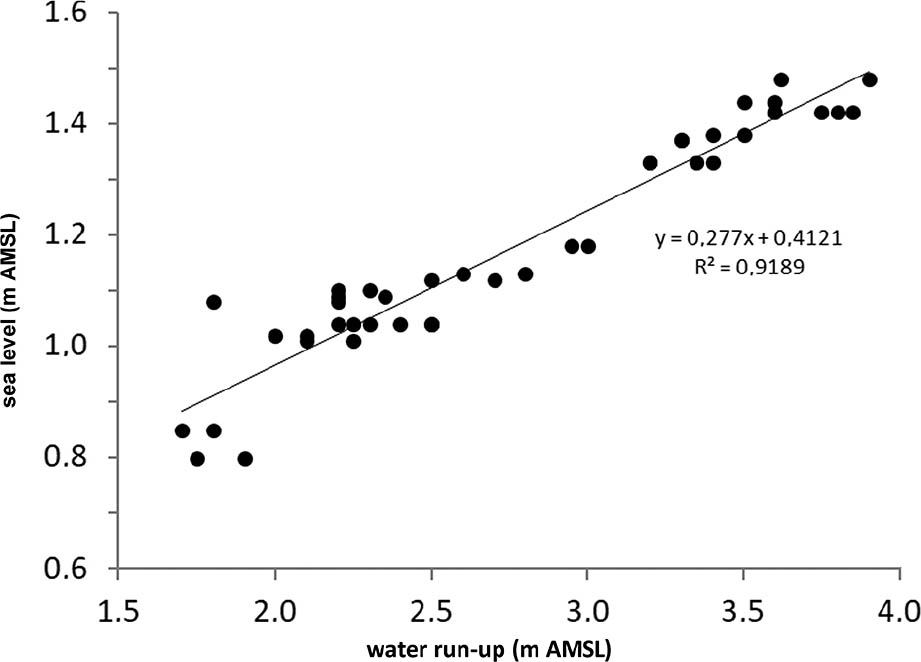
Fig. 9
Relationship between water run-up and the max. sea level on Świna Gate Sandbar.
Table 3
Average dune-beach parameters after surges with different water height on Świna Gate Sandbar.
| Sea level | Time length with H > 1 m | Run-up | Accumulative coast, the western part | Erosive coast, the eastern part | ||||||
|---|---|---|---|---|---|---|---|---|---|---|
| Beach erosion volume | Dune foot retreat | Dune erosion volume | Dune erosion volume | Beach erosion volume | Dune foot retreat | Dune erosion volume | Dune erosion volume | |||
| HSL | TSL | HSLr | ΔQbe | ΔPe | ΔQfr | ΔQbe | ΔQbe | ΔPfe | ΔQfr | ΔQbe |
| [m AMSL] | [h] | [m AMSL] | [m3] | [m] | [m3] | [m3/m2] | [m3] | [m] | [m3] | [m3/m2] |
| Average surge H = 1.2 | 10 | 2.8 | 7.0 | 2.0 | 2.0 | 0.3 | 8.5 | 3.1 | 3.8 | 0.7 |
| H > 0.8 | 0 | 1.6 | 2.6 | 0.0 | 0.0 | 0.0 | 2.2 | 0.3 | 0.1 | 0.2 |
| H > 1.0 | 3 | 2.2 | 4.3 | 0.6 | 0.4 | 0.2 | 4.5 | 0.7 | 0.5 | 0.5 |
| H > 1.3 | 20 | 3.3 | 7.5 | 4.9 | 4.0 | 0.7 | 11.2 | 6.6 | 5.4 | 1.3 |
| H > 1.4 | 24 | 3.6 | 12.1 | 5.2 | 5.5 | 0.8 | 14.6 | 7.0 | 10.0 | 1.6 |
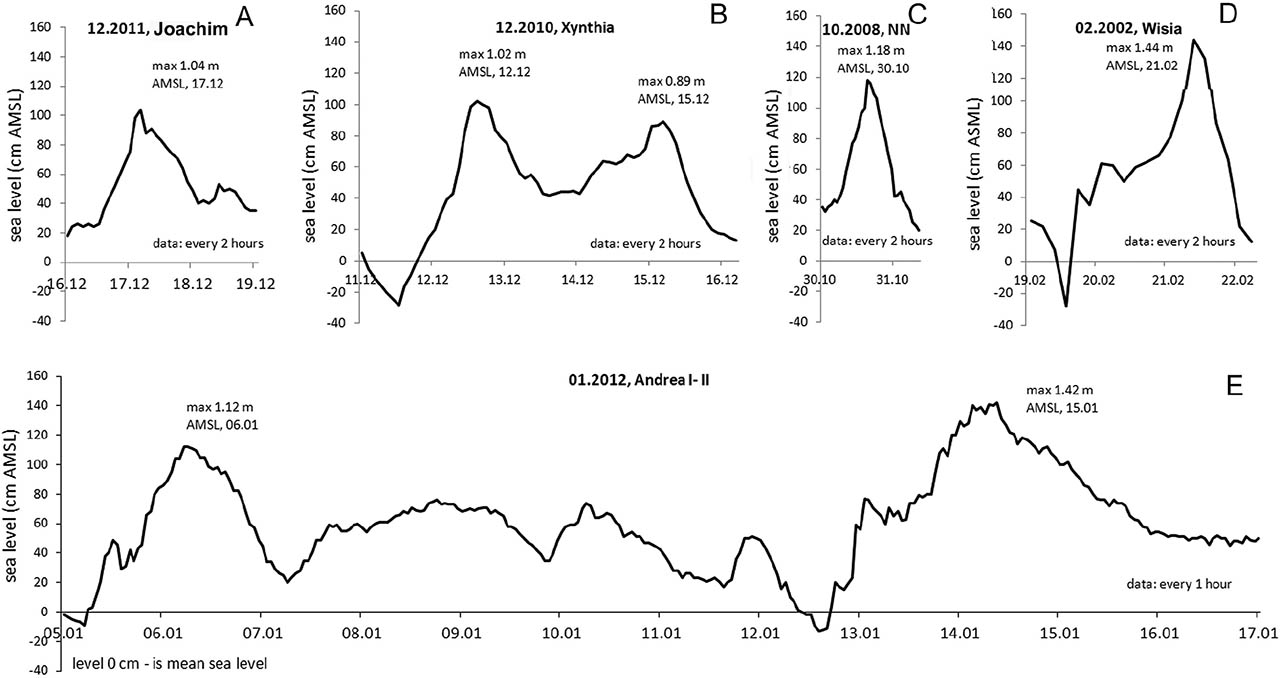
Fig. 10
Different storm surges with HSL > 1m and sea-level changes (author’s own graphs based on data from Świnoujście Maritime Office).
A – medium, single and long, no dune erosion, December 2011, storm Joachim, B – medium, double and long, no dune erosion, December 2010, storm Xynthia, C – high, single and short, no dune erosion, October 2008, D – very high, single and long, with large dune erosion, February 2002, storm Wisia, E – sequence of surges, with two high ones producing large dune erosion, January 2012, storm Andrea.
Table 4
Dune-beach relief parameters change on accumulative and erosive shore after storm surges on Świna Gate Sandbar.
| Shore profile type | Beach width | Beach height | Beach width change | Beach height change | Beach erosion | Beach erosion | Dune foot retreat | Dune erosion volume | Dune erosion volume |
|---|---|---|---|---|---|---|---|---|---|
| Wbe B | Hbe B | ΔWbe | ΔHbe | ΔQbe | ΔQbe | ΔPfe | ΔQfr | ΔQbe | |
| [m] | [m3] | [m3 m−2] | [m] | [m3] | [m3 m−2] | ||||
| Average: erosive, 416km | 35.6 | 2.6 | −1 | −1.2 | 8.9 | 0.3 | 3.3 | 4.0 | 0.8 |
| Average: accumulative, 422km | 54.8 | 2.9 | 0 | −1.3 | 7.4 | 0.1 | 2.2 | 2.1 | 0.3 |
| Max.: erosive, 416km | 23–45 | 1.7–3.0 | −11 to 10 | −1.8 | 16.6 | 0.6 | 9.5 | 12.3 | 2.0 |
| Max.: accumulative, 422km | 33–74 | 2.0–3.5 | −15 to 14 | −2.3 | 18.7 | 0.3 | 12.0 | 12.5 | 1.4 |
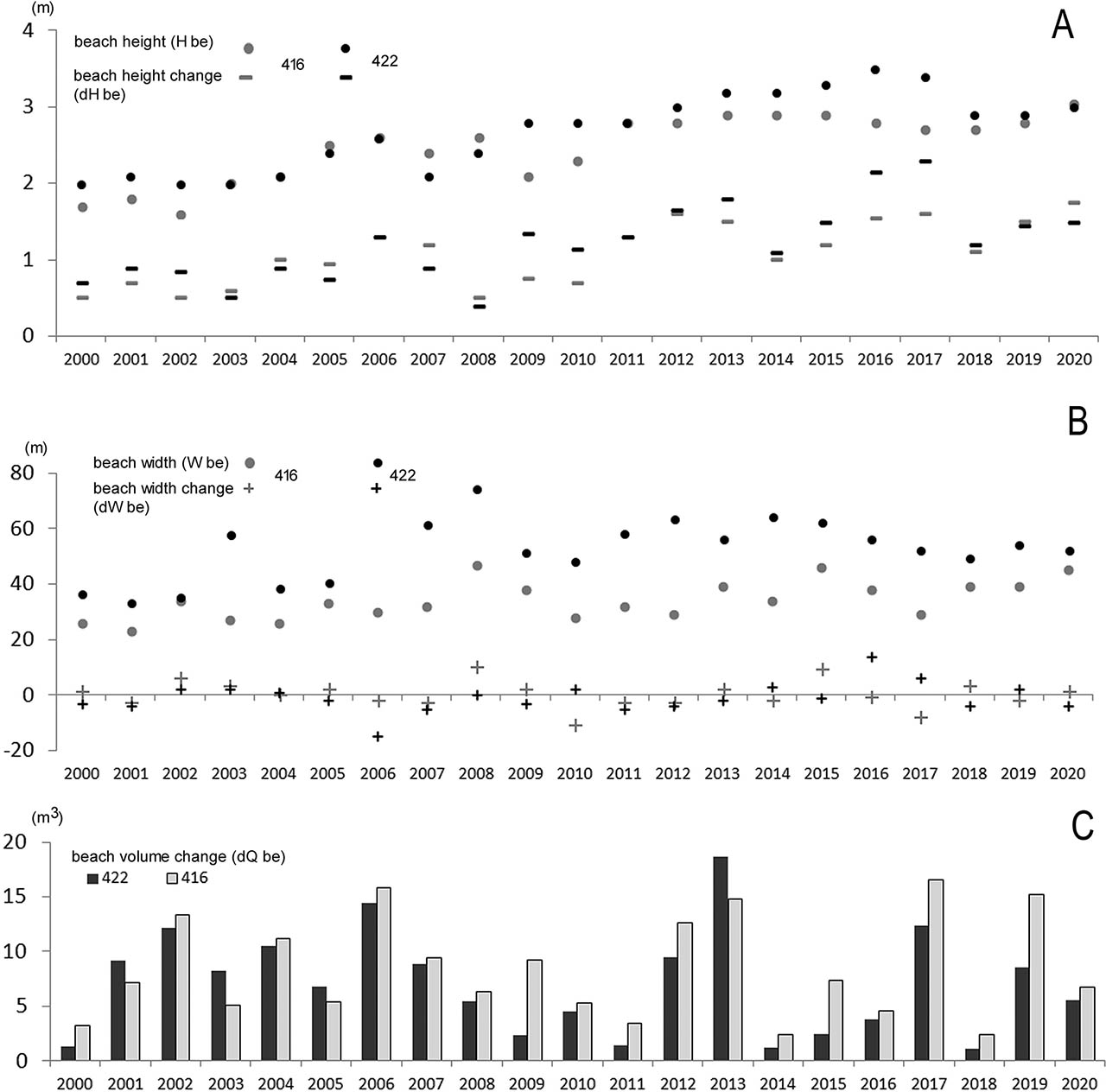
Fig. 11
Changes in beach characteristics after the heaviest surges (km 416 and 422).
A – pre-surge beach height (Hbe) vs its post-surge change (ΔHbe), B – pre-surge beach width (Wbe) vs its post-surge change (ΔWbe), C – the total volume of post-surge beach erosion (ΔQbe).
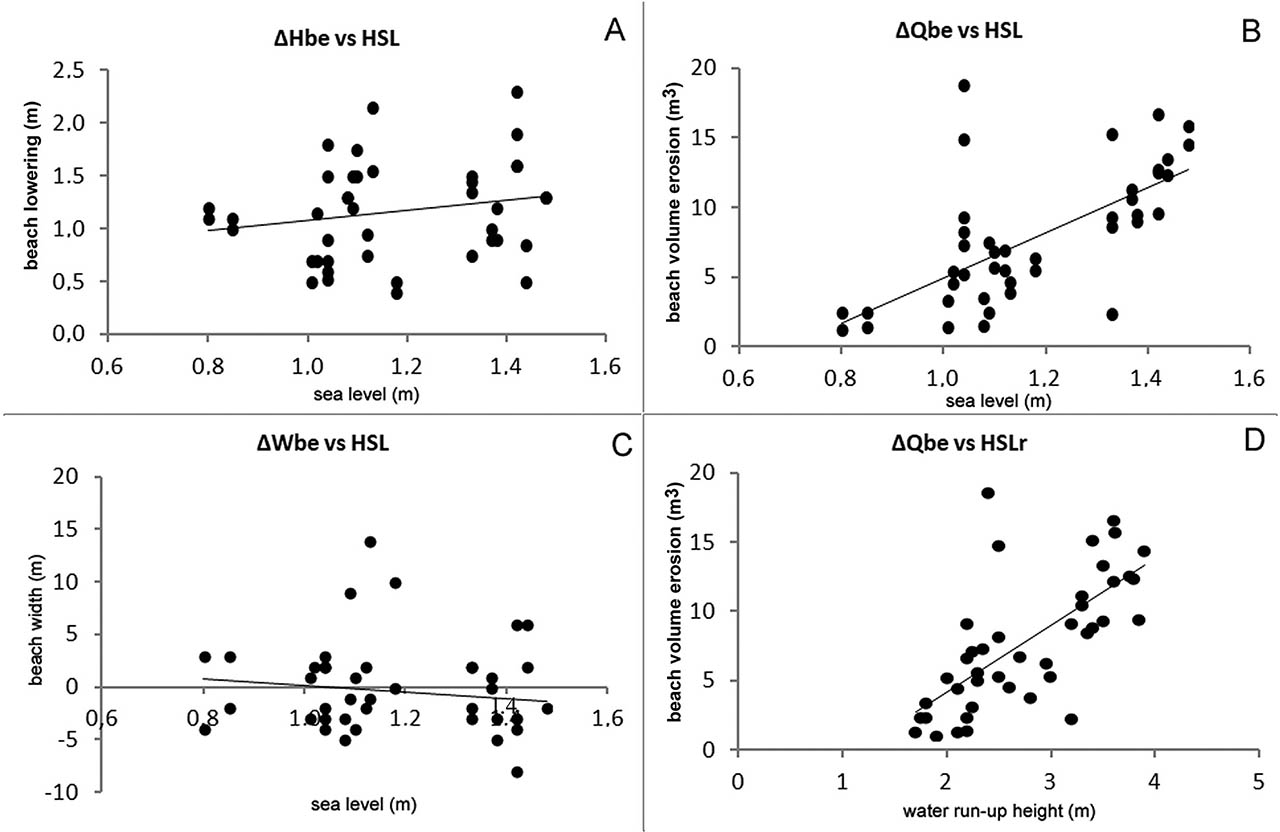
Fig. 12
Relationships between beach characteristics and surge level.
A – lowering of beach height (ΔHbe) vs sea level (HSL), B – abrasion of beach in cubic meters (ΔQbe) vs sea level (HSL), C – width change (ΔWbe) vs sea level (HSL), D – abrasion of beach in cubic meters (ΔQbe) vs water run-up (HSLr).
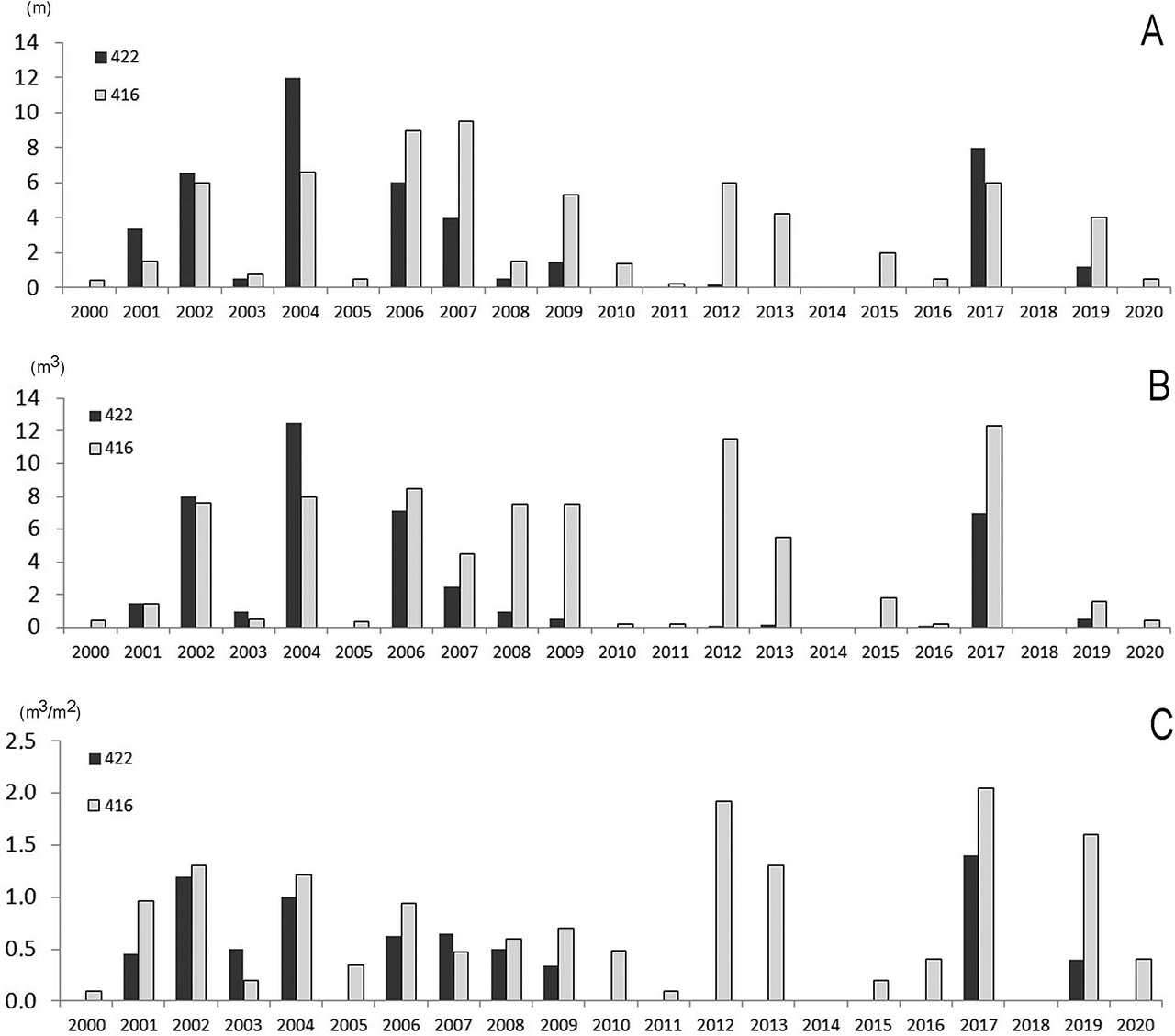
Fig. 13
Changes in foredune characteristics after the heaviest surges.
A – foredune retreat (ΔPfr), B – foredune erosion in cubic meters (ΔQfr), C – foredune erosion per 1 squre meter (ΔQfr/1m2).
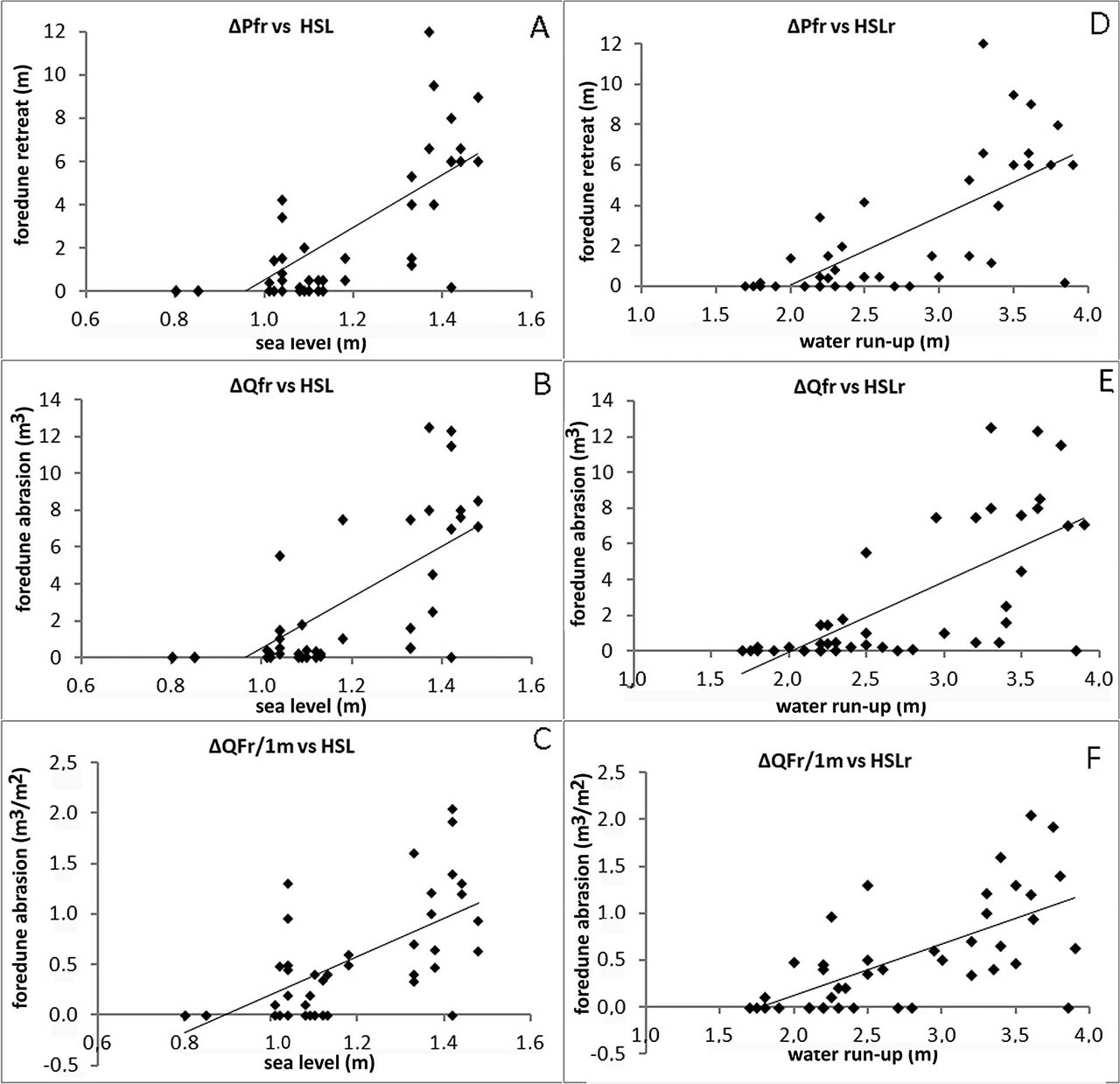
Fig. 14
Relationships between foredune characteristics and surge level.
A – foredune retreat (ΔPfe) vs sea level (HSL), B – foredune volume change (ΔQfe) vs sea level (HSL), C – foredune volume change per each meter (ΔQfe/1m) vs sea level (HSL), D – foredune retreat (ΔPfe) vs water run-up (HSLr), E – foredune volume change (ΔQfe) vs sea level (HSLr), F – foredune volume change per each meter (ΔQfe/1m) vs sea level (HSLr).