
Table 1
Different types of ecosystem services provided by wetlands.
| Ecosystem services | Examples |
|---|---|
| Provisioning services | |
| Food | Manufacturing of fish, wild game, fruits and grains |
| Fresh water | Storage of water for domestic, industrial and agricultural use |
| Fibre and fuel | Production of logs, fuel wood, peat, fodder |
| Biochemical | Medicines extraction and other materials from biota |
| Genetic materials | Genes for resistance to plant pathogens, ornamental species and so on |
| Regulating services | |
| Climate regulation | Storages of greenhouse gases; influence local and regional temperature, precipitation, and other climatic processes |
| Water regulation | Groundwater extraction rate and recharge |
| Water purification and waste water treatment | Retention, recovery and removal of excess nutrients and other pollutants |
| Erosion regulation | Retention of soils and sediments |
| Natural hazard regulation | Management of flood control, storm protection |
| Pollination | Habitat for pollinators |
| Cultural services | |
| Spiritual and inspirational | Source of inspiration; many religions attach spiritual and religious values to aspects of wetland ecosystems |
| Recreational | Opportunities for recreational activities |
| Aesthetic | Many people find beauty or aesthetic value in aspects of wetland ecosystems |
| Educational | Opportunities for formal and informal education and training |
| Supporting services | |
| Soil formation | Sediment retention and accumulation of organic matter |
| Nutrient cycling | Storage, recycling, processing, and acquisition of nutrients |
[i] Source: Millennium Ecosystem Assessment (2005).
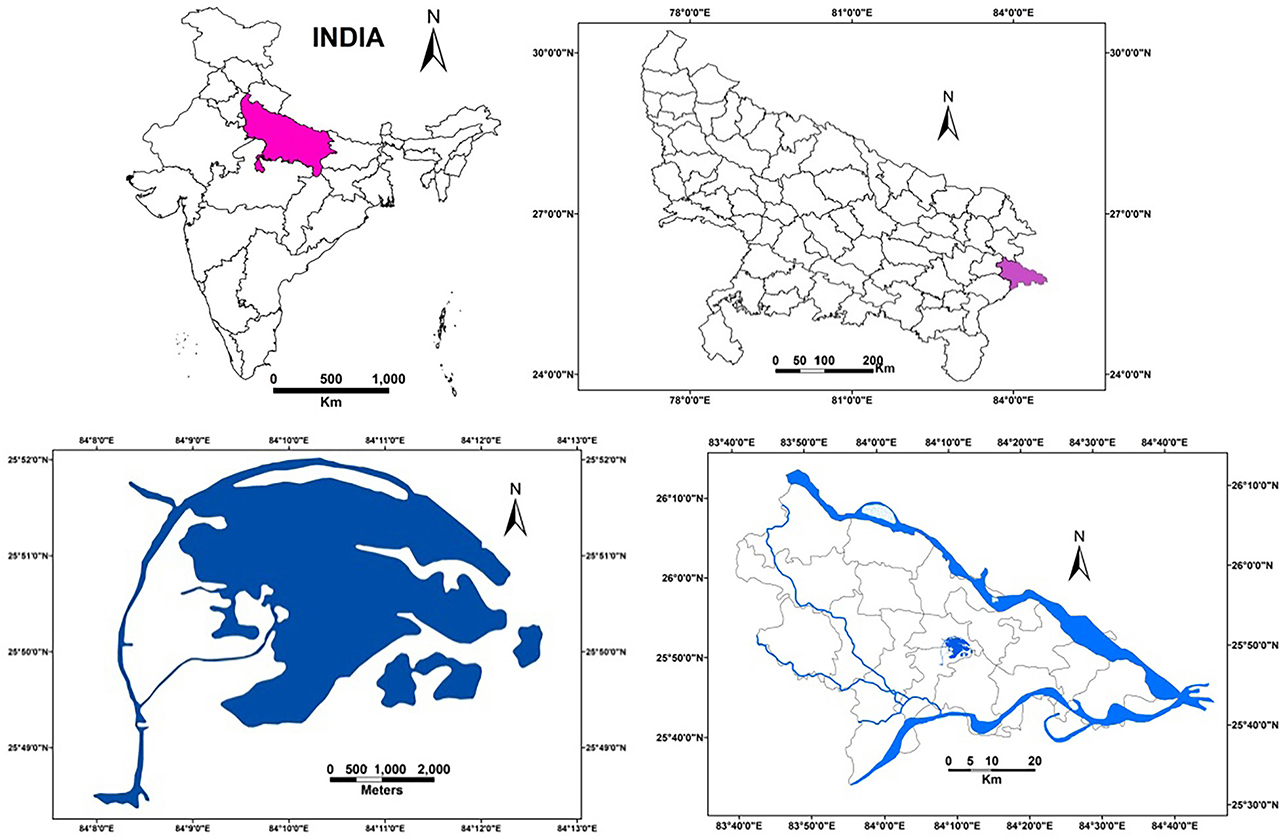
Fig. 1
Location of Suraha Tal Wetland in Uttar Pradesh, India.
Source: own study.
Table 2
Steps followed for the valuation of the wetland.
| Activities | Methods |
|---|---|
| Making checklist of use and non-use values of wetland | Observation of functions, discussions with stakeholders and local communities, review of related literature |
| Point out important use and non-use values | Ranking of goods, services and threats by stakeholders and local communities |
| Selection of valuation technique | Review of literature related to wetland valuation and selection of most efficient technique |
| Questions set up | Preparation of questionnaires for stakeholders, local communities and govt. officials |
| Collection of data | Survey (household/govt. offices/tourists), market survey for valuation of goods |
| Quantification of values of goods and services | Analysis |
[i] govt. – government
[ii] Source: IUCN Report 1998, Basnyat et al. 2010, Boral et al. 2016.
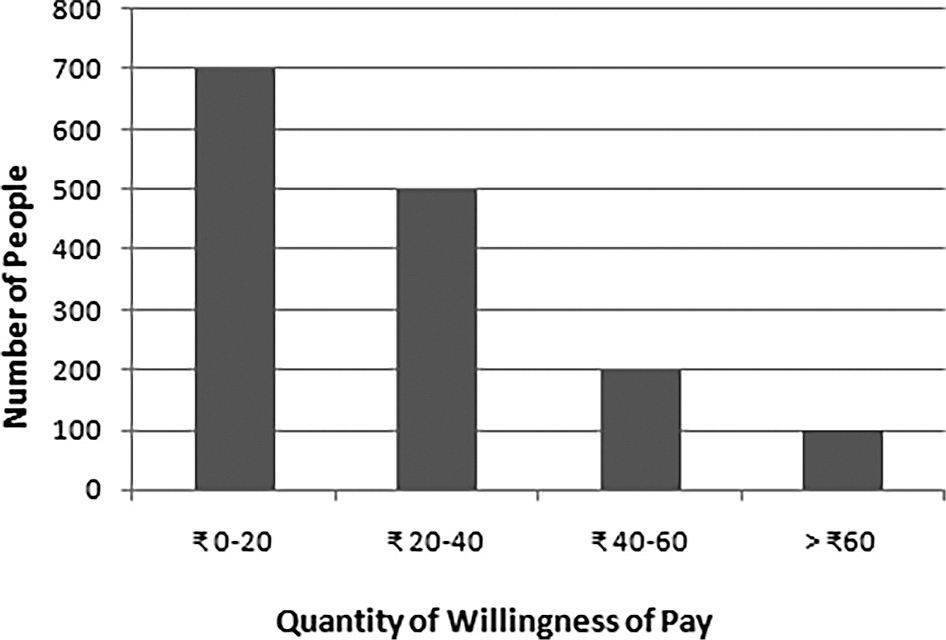
Fig. 2
The number of people willing to pay.
Table 3
Explanatory indicators for willingness to pay.
| No. | Indicators | Explanation of indicators |
|---|---|---|
| 1 | AGE | Respondent’s age |
| 2 | EDU | Respondent’s education level |
| 3 | FAM | Respondent’s family size or number of family members |
| 4 | INC | Family’s annual income |
| 5 | DIS | Distance of respondent’s home from Suraha Tal Wetland |
| 6 | ENV | Whether respondent is part of eco-development community or not |
| 7 | LND | Family’s total landholding size |
[i] Source: own study.
Table 4
List of literature included for CMA.
| Study name | Year of publication (number of observation) |
|---|---|
| Fish diversity | |
| Singh et al. | 2009 (42) |
| Swarup and Singh | 1975 (52) |
| Singh et al. | 2012 (56) |
| Pandey et al. | 2010 (59) |
| Lakshman Ram | 1976 (48) |
| Srivastava and Srivastava | 2009 (53) |
| Water quality | |
| Shukla et al. | 2015 (20) |
| Pandey et al. | 2015 (20) |
| Mishra and Sharma | 2015 (22) |
| Mishra et al. | 2015 (24) |
| Sharma and Soni | 2013 (96) |
| Other faunal diversity | |
| Sharma and Agarwal (a) | 2012 (29) |
| Sharma and Agarwal (b) | 2012 (20) |
| Srivastava and Srivastava | 2012(92) |
| Cultural aspects | |
| Srivastava and Srivastava | 2012 (7) |
[i] CMA – comprehensive meta-analysis.
[ii] Source: own study.
Table 5
Major functions of Suraha Tal Wetland.
| People’s perception of functions of Suraha Tal | Strongly accepted | Moderately accepted | Accepted in weak manner | Not accepted |
|---|---|---|---|---|
| Fishing is one of important functions of Suraha Tal | 56 | 22 | 18 | 4 |
| Water of Suraha Tal is used for irrigation puposes | 57 | 31 | 9 | 3 |
| Suraha Tal is also useful for agriculture | 54 | 32 | 8 | 6 |
| Aquaculture is popular function in Suraha Tal | 56 | 30 | 10 | 4 |
| Suraha Tal is useful for water drainage | 52 | 30 | 8 | 10 |
| Suraha Tal controls flood | 50 | 33 | 17 | 10 |
| Suraha Tal helps to purify air | 42 | 38 | 12 | 8 |
| Water of Suraha Tal is used for household works | 56 | 22 | 18 | 4 |
| Suraha Tal is popular tourist destination | 58 | 23 | 17 | 2 |
| Suraha tal helps to maintain flora and fauna diversity | 40 | 32 | 31 | 7 |
| Mean | 52.1 | 29.3 | 14.8 | 5.8 |
| Median | 54 | 30 | 14.8 | 5.8 |
| Standard deviation | 5.754122369 | 4.810492005 | 6.393178182 | 2.586679163 |
[i] Source: own compilation.
Table 6
Major threats of Suraha Tal Wetland.
| People’s perception | Strongly accepted | Moderately accepted | Accepted in weak manner | Not accepted |
|---|---|---|---|---|
| Water holding capacity is decreased by sedimentation of Suraha Tal | 45 | 30 | 20 | 5 |
| Household sewage increases eutrophication in Suraha Tal | 52 | 30 | 8 | 10 |
| Overfishing destroys the fish diversity in Suraha Tal | 42 | 33 | 18 | 7 |
| Excessive aquaculture destroys the balance of ecosystem of Suraha Tal | 40 | 32 | 31 | 7 |
| Solid waste is dumped in Suraha Tal | 46 | 28 | 19 | 7 |
| Agricultural washout decreases water quality | 55 | 25 | 12 | 8 |
| Flora and fauna diversity of Suraha Tal is at risk | 32 | 35 | 1 | 20 |
| Suraha Tal is shrinking by size | 52 | 28 | 12 | 8 |
| Mean | 45.5 | 30.125 | 16.625 | 9 |
| Median | 45.5 | 30 | 15.5 | 7.5 |
| Standard deviation | 7.55929 | 3.18198 | 7.13017 | 4.65986 |
[i] Source: own compilation.
Table 7
Valuation of the market price of fish production in Suraha Tal Wetland in 2015.
| Season | Production of fish | Total market price of fish |
|---|---|---|
| Pre-monsoon | 2,000 kg | INR 250,000 |
| Monsoon | 5,000 kg | INR 2,250,000 |
| Post-monsoon | 3,000 kg | INR 750,000 |
[i] Source: own compilation.
Table 8
Total value of lotus and associated parts in Suraha Tal Wetland in 2015.
| Ingredients of lotus | Market price | Production of last year | Total price |
|---|---|---|---|
| Lotus flower | INR 2 × piece−1 | 650,000 flowers | INR 1,300,000 |
| Petals | INR 30 × kg−1 | 74 kg | INR 2,220 |
| Stamen | INR 200 × kg−1 | 43 kg | INR 8,600 |
| Leaf | INR 300 × hundred leaves−1 | 2,700 leaves | INR 8,100 |
| Root | INR 25 × kg−1 | 62 kg | INR 1,550 |
[i] Source: own compilation.
Table 9
Total valuation of water lily in Suraha Tal Wetland in 2015.
| Ingredients of water lily | Market price | Production of last year | Total market price |
|---|---|---|---|
| Water lily flower | INR 20 × kg−1 | 244.75 kg | INR 4,895 |
| Water lily root | INR 30 × kg−1 | 326.34 kg | INR 9,790 |
[i] Source: own compilation.
Table 10
Total valuation of cultivated crops.
| Cultivated crops | Production in last year (in kg) | Total profit (INR) |
|---|---|---|
| Wheat | 242 | 40,522 |
| Arahar | 247 | 23,269 |
| Peas | 265 | 32,466 |
| Maize | 229 | 20,795 |
| Gram | 222 | 27,284 |
[i] Source: own compilation.
Table 11
Pearson’s correlation among the indicators.
| WTP | AGE | EDU | FAM | INC | DIS | ENV | LND | |
|---|---|---|---|---|---|---|---|---|
| WTP | 1 | 0.42 | 0.95 | 0.31 | 0.84 | 0.34 | 0.75 | 0.82 |
| AGE | 0.42 | 1 | 0.72 | −0.34 | 0.68 | −0.22 | −0.18 | 0.82 |
| EDU | 0.95 | 0.72 | 1 | −0.25 | 0.86 | −0.64 | 0.21 | 0.75 |
| FAM | 0.31 | −0.34 | −0.25 | 1 | 0.76 | 0.66 | 0.81 | 0.92 |
| INC | 0.84 | 0.68 | 0.86 | 0.76 | 1 | 0.97 | −0.35 | 0.89 |
| DIS | 0.34 | −0.22 | −0.64 | 0.66 | 0.97 | 1 | −0.51 | 0.64 |
| ENV | 0.75 | −0.18 | 0.21 | 0.81 | −0.35 | −0.51 | 1 | 0.56 |
| LND | 0.52 | 0.82 | 0.75 | 0.92 | 0.89 | 0.64 | 0.56 | 1 |
[i] Source: own compilation.
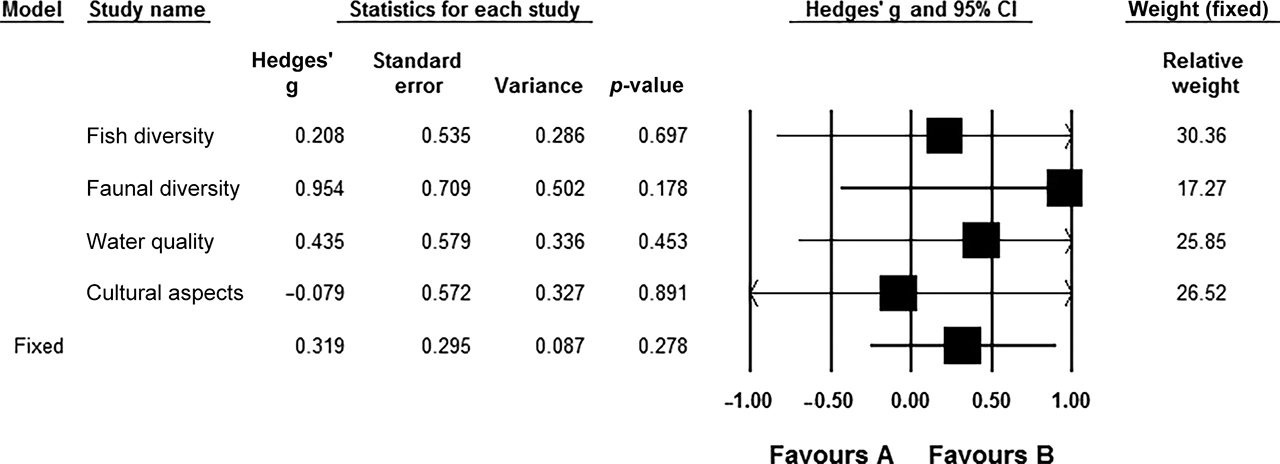
Fig. 3
The application of CMA to draw out the environmental value.
CMA – comprehensive meta-analysis.
Source: own study.