
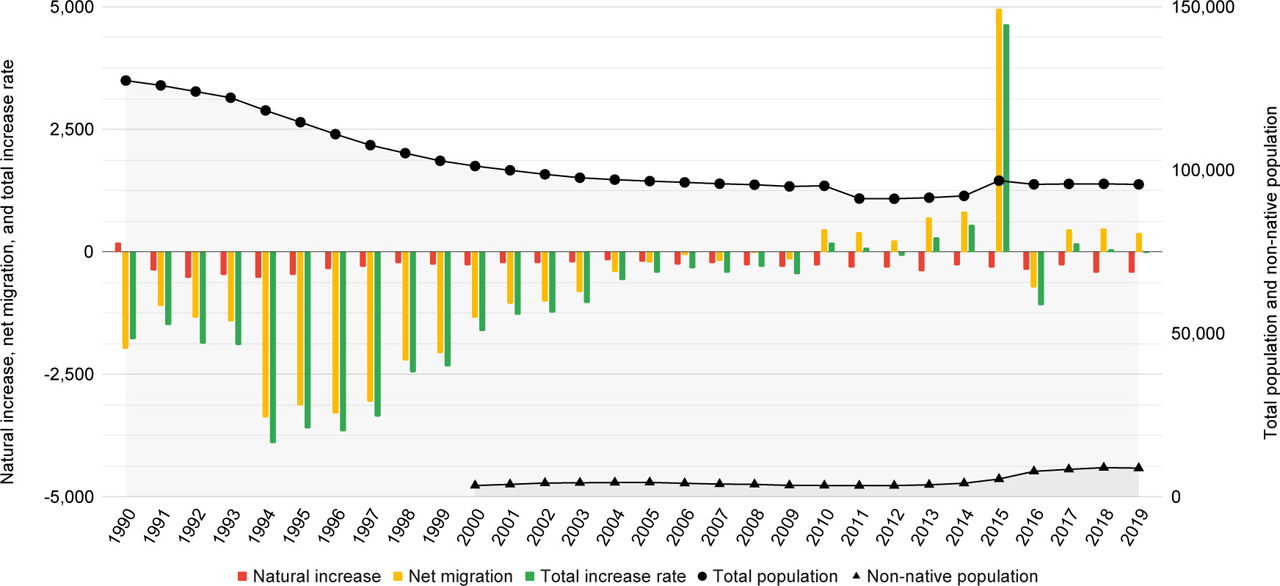
Fig. 1
Population dynamics and growth in Schwerin, 1990–2019.
Source: author's elaboration based on Stadtverwaltung Schwerin (2021).
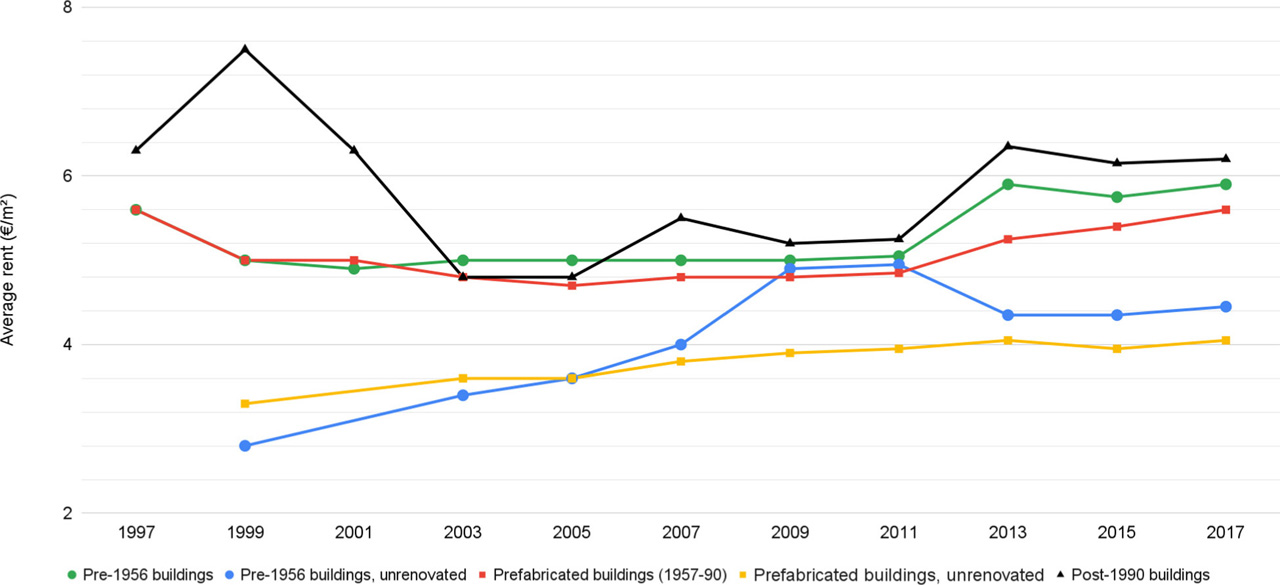
Fig. 2
Average monthly rents per m2 for different housing types in Schwerin, 1997–2017.
Source: author's elaboration based on Stadtverwaltung Schwerin (2021). Note: Rents refer to a good quality apartment of approximately 60 m2 and exclude utility costs. As of 2011, nearly every third building was built before 1956, roughly half were completed between 1957 and 1990, and the remaining were erected after 1990 (Stadt Schwerin, 2015).
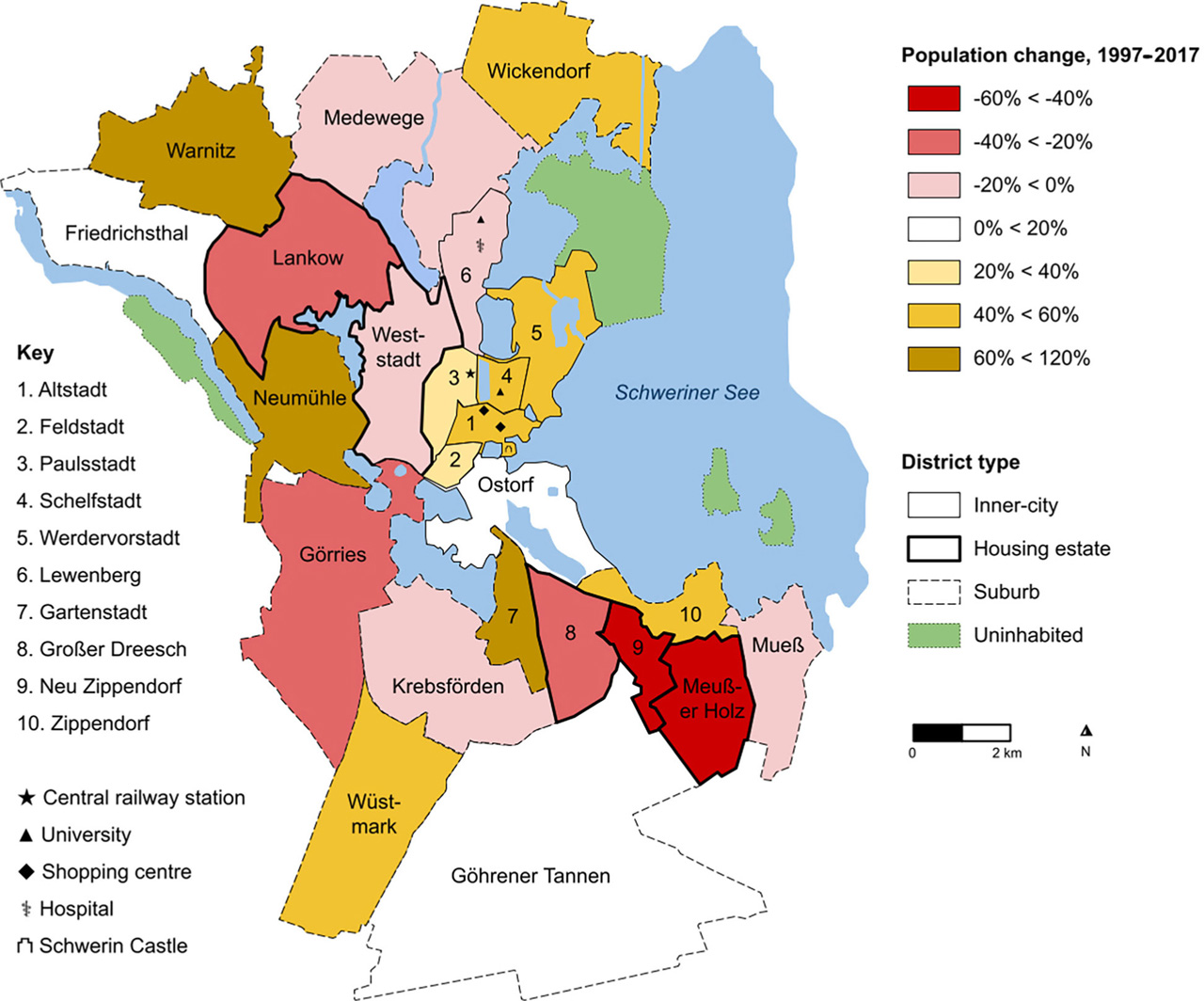
Fig. 3
Population change in Schwerin by district, 1997–2017.
Source: author's elaboration based on Stadtverwaltung Schwerin (2021).
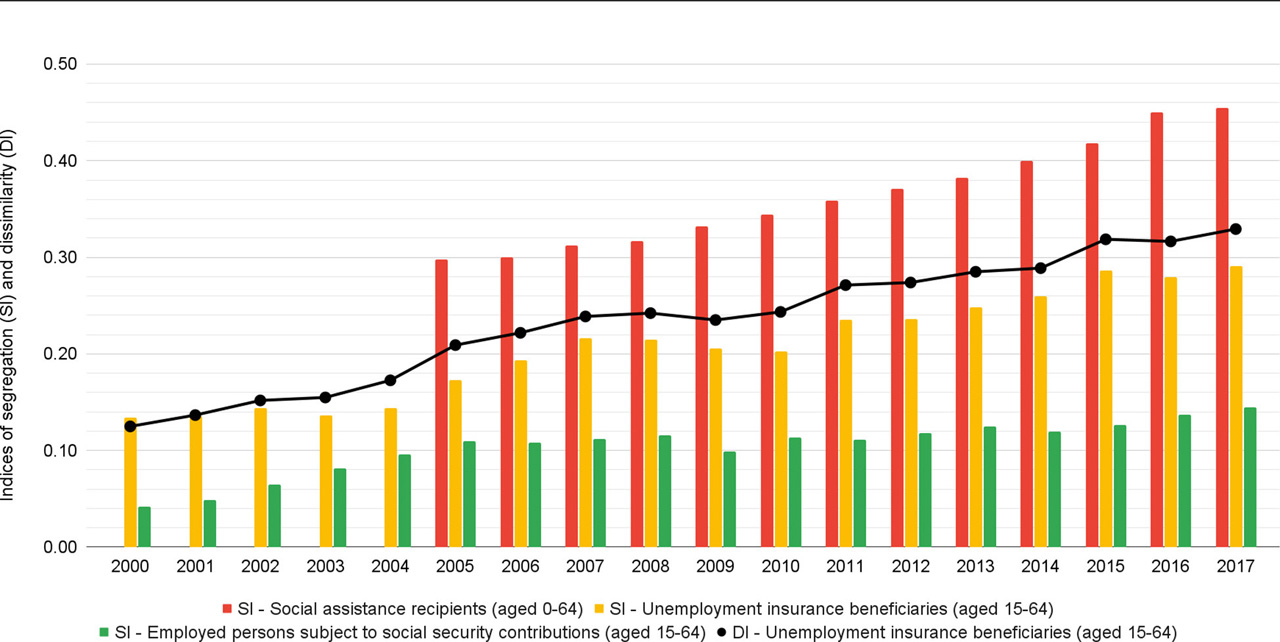
Fig. 4
Indices of segregation (SI) and dissimilarity (DI) for socio-economic population groups in Schwerin, 2000–2017.
Source: author's elaboration based on Stadtverwaltung Schwerin (2021).
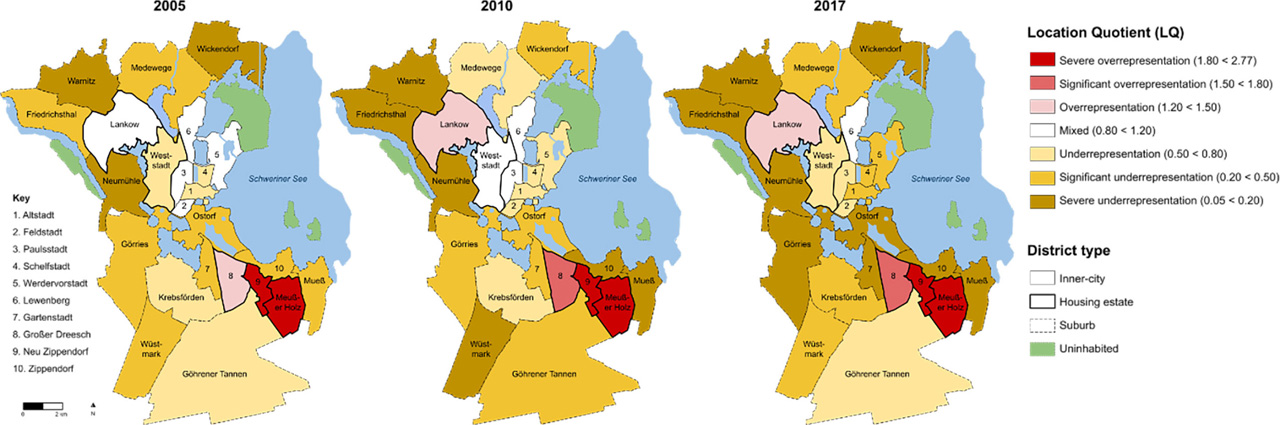
Fig. 5
Concentrations of social assistance recipients under the age of 65 in Schwerin by district, 2005–2017.
Source: author's elaboration based on Stadtverwaltung Schwerin (2021).
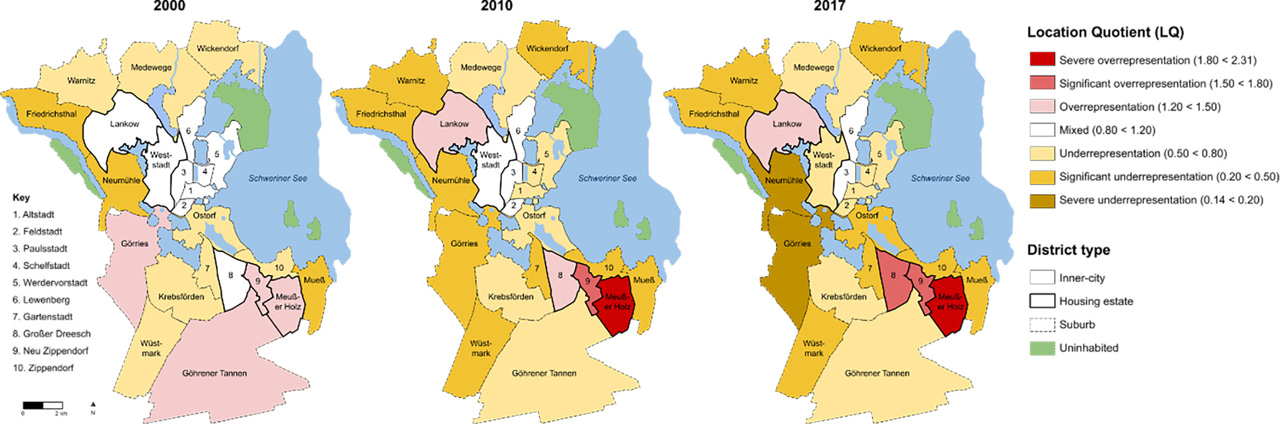
Fig. 6
Concentrations of unemployment insurance beneficiaries aged 15 to 64 in Schwerin by district, 2000–2017.
Source: author's elaboration based on Stadtverwaltung Schwerin (2021).
Table 1
Correlations of housing oversupply with concentrations of select vulnerable socio-economic groups in Schwerin, 2001–2017 (Pearson's r; *p < 0.05, **p < 0.01; n = 24).
| Vacancy rates | |||||||||
|---|---|---|---|---|---|---|---|---|---|
| 2001 | 2003 | 2005 | 2007 | 2009 | 2011 | 2013 | 2015 | 2017 | |
| Location quotient of social assistance recipients | N/A | N/A | 0.489* (0.015) | 0.425* (0.039) | 0.529** (0.008) | 0.383 (0.064) | 0.760** (0.000) | 0.670** (0.000) | 0.530** (0.008) |
| Location quotient of unemployment insurance beneficiaries | 0.477* (0.018) | 0.738** (0.000) | 0.469* (0.021) | 0.399 (0.054) | 0.533** (0.007) | 0.405* (0.049) | 0.777** (0.000) | 0.727** (0.000) | 0.542** (0.006) |
[i] Source: author's calculations based on Stadtverwaltung Schwerin (2021).