
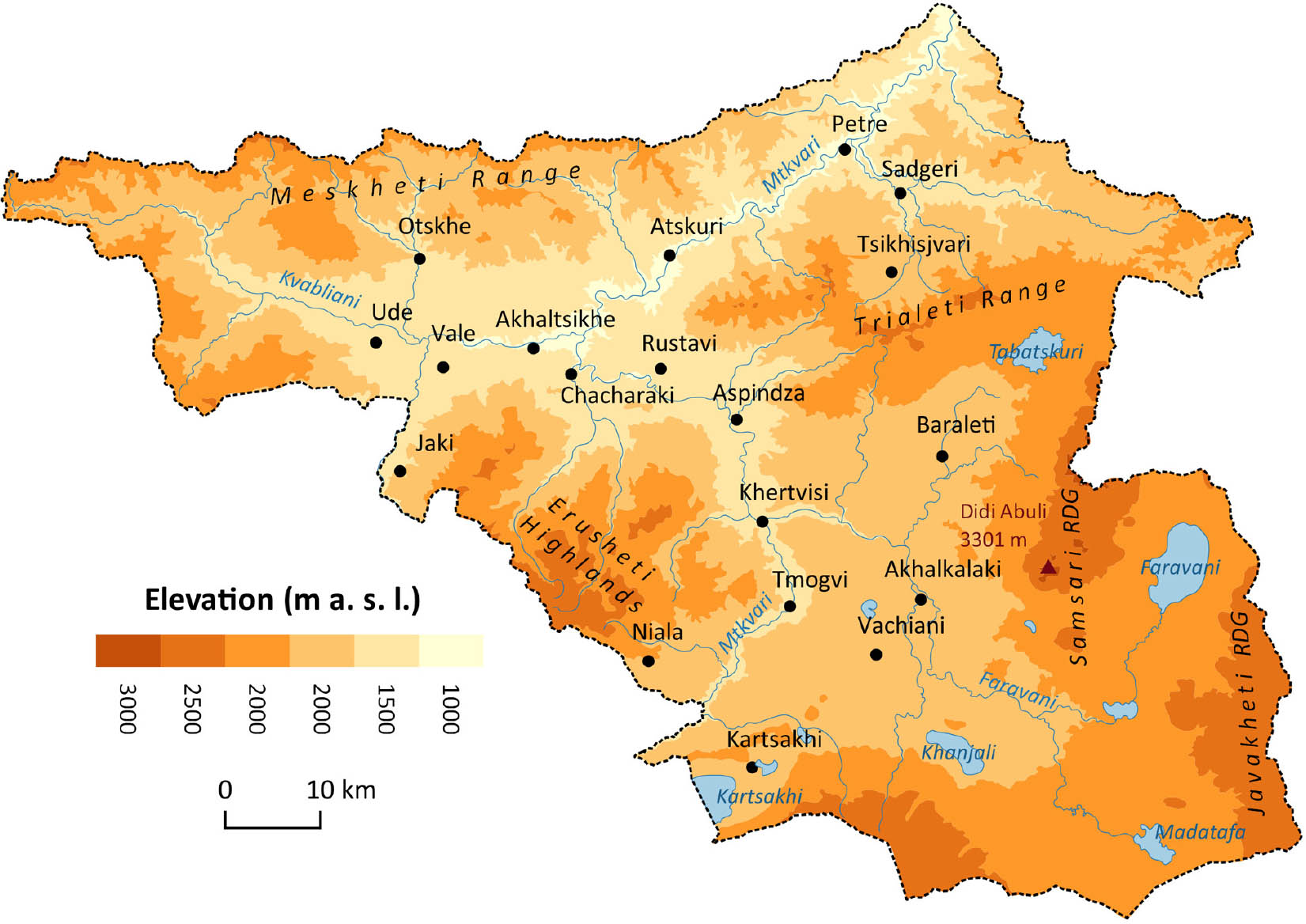
Fig. 1
Samtskhe-Javakheti relief.
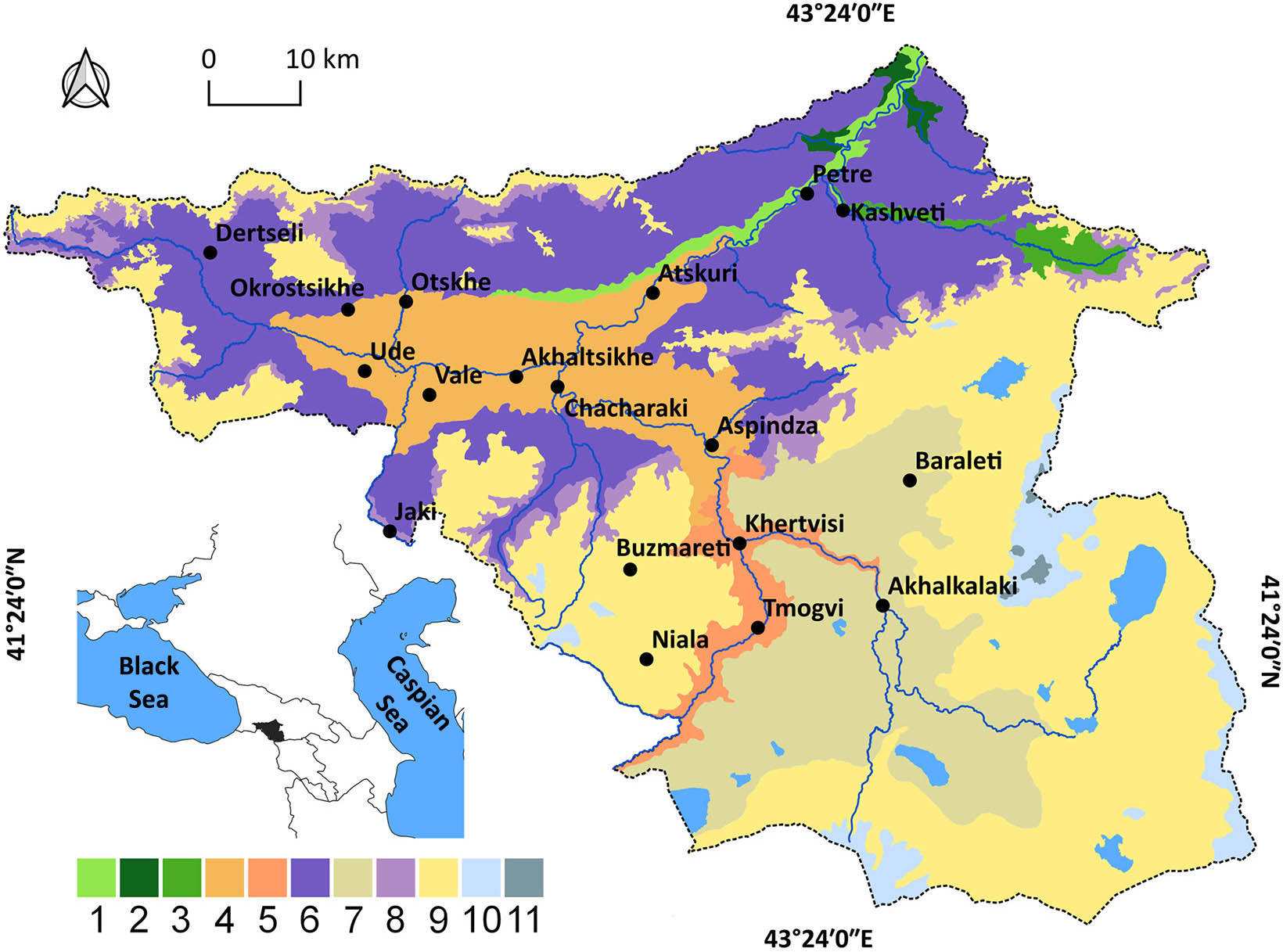
Fig. 2
Location of the study area and its landscapes.
1 – lower mountain semi-humid forest, 2 – middle mountain Colchian forest, 3 – middle mountain forest, 4 – mountain valleys with steppes, meadows and semi-aird shurbs, 5 – middle mountain arid forest, shrubs, and steppes, 6 – middle mountain dark coniferous forest, 7 – plateau with steppes and meadows, 8 – upper mountain pine and brich forest, 9 – highland subalpine sparse forests and shruby meadows, 10 – high mountain alpine meadows, 11 – high mountain sub-nival.
Table 1
Sixteenth-century settlements, population and architectural style.
| Architectural type of building | Number of settlements | The share of settlements [%] | Population | The share of the population [%] |
|---|---|---|---|---|
| Fortress Rabat with stone houses | 22 | 3.8 | 5530 | 13.8 |
| Stone houses | 60 | 10.5 | 2142 | 5.3 |
| Semi-underground houses mixed with stone houses | 192 | 33.5 | 15,071 | 37.6 |
| Semi-underground houses | 214 | 37.3 | 13,741 | 34.3 |
| Terraced semi-underground houses | 47 | 8.2 | 2688 | 6.7 |
| Cave dwellings | 3 | 0.5 | 35 | 0.1 |
| Wooden log houses | 35 | 6.1 | 903 | 2.3 |
| Total | 573 | 100.0 | 40,068 | 100.0 |
Table 2
Landscapes, settlements, population and architectural style.
| Landscape | Architectural type of building | Number of settlements | The share of settlements [%] | Population | The share of the population [%] |
|---|---|---|---|---|---|
| Middle mountain Colchian forest | G | 100.00 | |||
| Total | 4 | 100.00 | |||
| Lower mountain semihumid forest | A | 1 | 8.333 | ||
| B | 9 | 75 | |||
| C | 2 | 16.67 | 84 | 100.00 | |
| Total | 12 | 100.00 | 84 | 100.00 | |
| Middle mountain forest | B | 2 | 66.67 | ||
| G | 1 | 33.33 | |||
| Total | 3 | 100.00 | |||
| Middle mountain arid forests, shrubs and steppes | A | 2 | 4.54 | 1330 | 34.67 |
| D | 37 | 84.09 | 2226 | 58.03 | |
| F | 3 | 6.82 | 77 | 2.01 | |
| Total | 45 | 100.00 | 3836 | 100.00 | |
| Mountain valleys with steppes, meadows and semiarid shrubs | A | 8 | 4.49 | 3773 | 21.41 |
| B | 12 | 6.74 | 798 | 4.53 | |
| C | 146 | 81.02 | 11,977 | 67.98 | |
| D | 10 | 5.62 | 917 | 5.2 | |
| E | 2 | 1.12 | 154 | 0.87 | |
| Total | 178 | 100.00 | 17,619 | 100.00 | |
| Plateau with steppes and meadows | A | 1 | 0.87 | 21 | 0.25 |
| C | 2 | 1.74 | 273 | 3.28 | |
| D | 112 | 97.39 | 8022 | 96.46 | |
| Total | 115 | 100.00 | 8316 | 100.00 | |
| Middle mountain dark coniferous forest | A | 8 | 6.35 | 343 | 5.3 |
| B | 36 | 28.57 | 1344 | 20.76 | |
| C | 39 | 30.95 | 2562 | 39.57 | |
| E | 14 | 11.11 | 1281 | 19.78 | |
| G | 29 | 23.02 | 945 | 14.59 | |
| Total | 126 | 100.00 | 6475 | 100.00 | |
| Upper mountain pine and birch forest | A | 2 | 25 | 63 | 64.29 |
| C | 1 | 12.5 | |||
| E | 4 | 50 | 35 | 35.71 | |
| Total | 8 | 100.00 | 98 | 100.00 | |
| Highland subalpine sparse forests and shrubby meadows | C | 53 | 67.09 | 2506 | 70.2 |
| E | 26 | 32.91 | 1064 | 29.8 | |
| Total | 79 | 100.00 | 3570 | 100.00 |
[i] A – Fortress Rabat with stone houses, B – Stone houses, C – Semi-underground houses mixed with stone houses, D – Semi-underground houses, E – Terraced semi-underground houses, F – Cave dwellings, G – Wooden log houses.
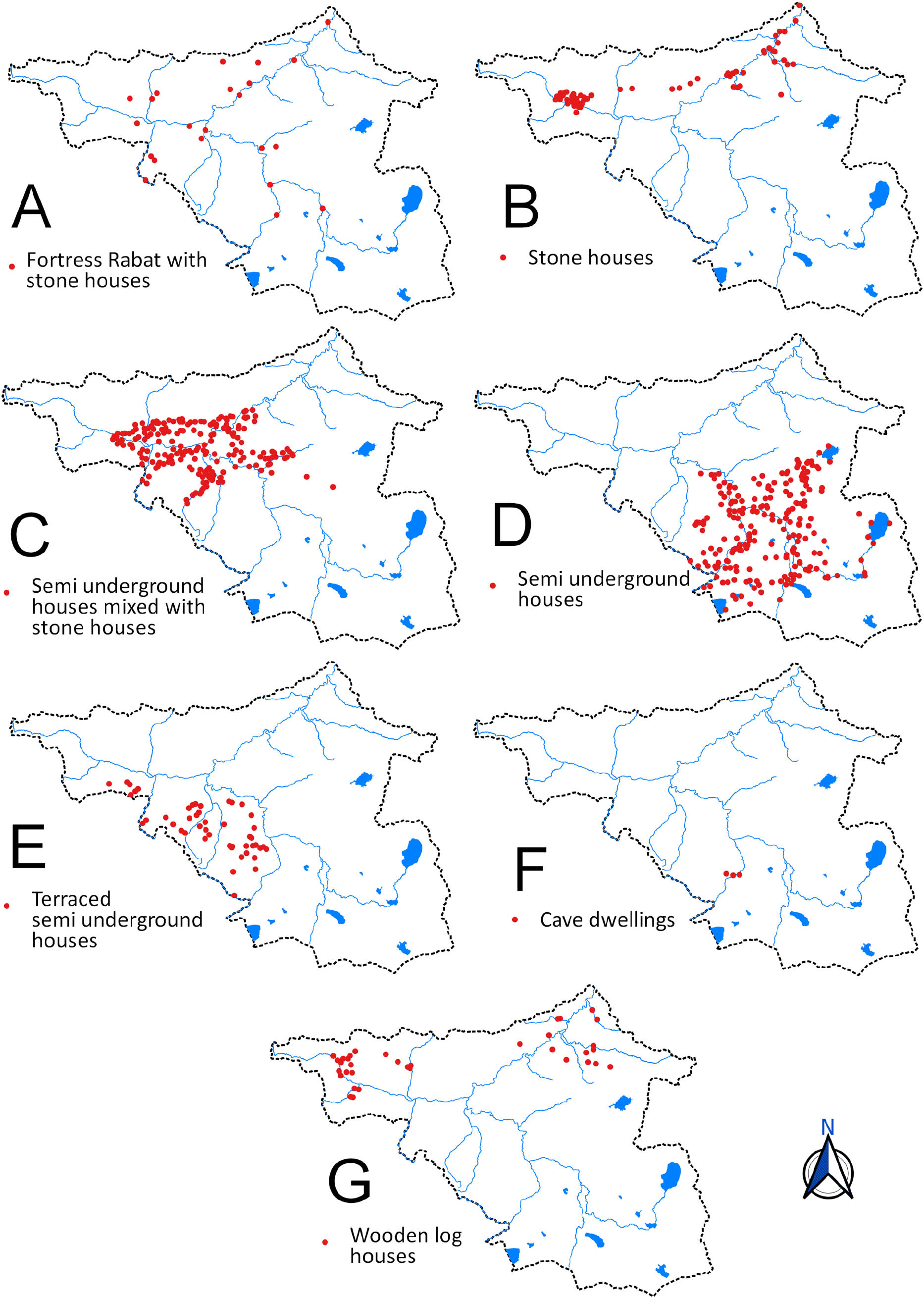
Fig. 3
The geographical allocation of the folk architecture.
A – Fortress Rabat with stone houses, B – Stone houses, C – Semi-underground houses mixed with stone houses, D – Semi-underground houses, E – Terraced semi-underground houses, F – Cave dwellings, G – Wooden log houses.
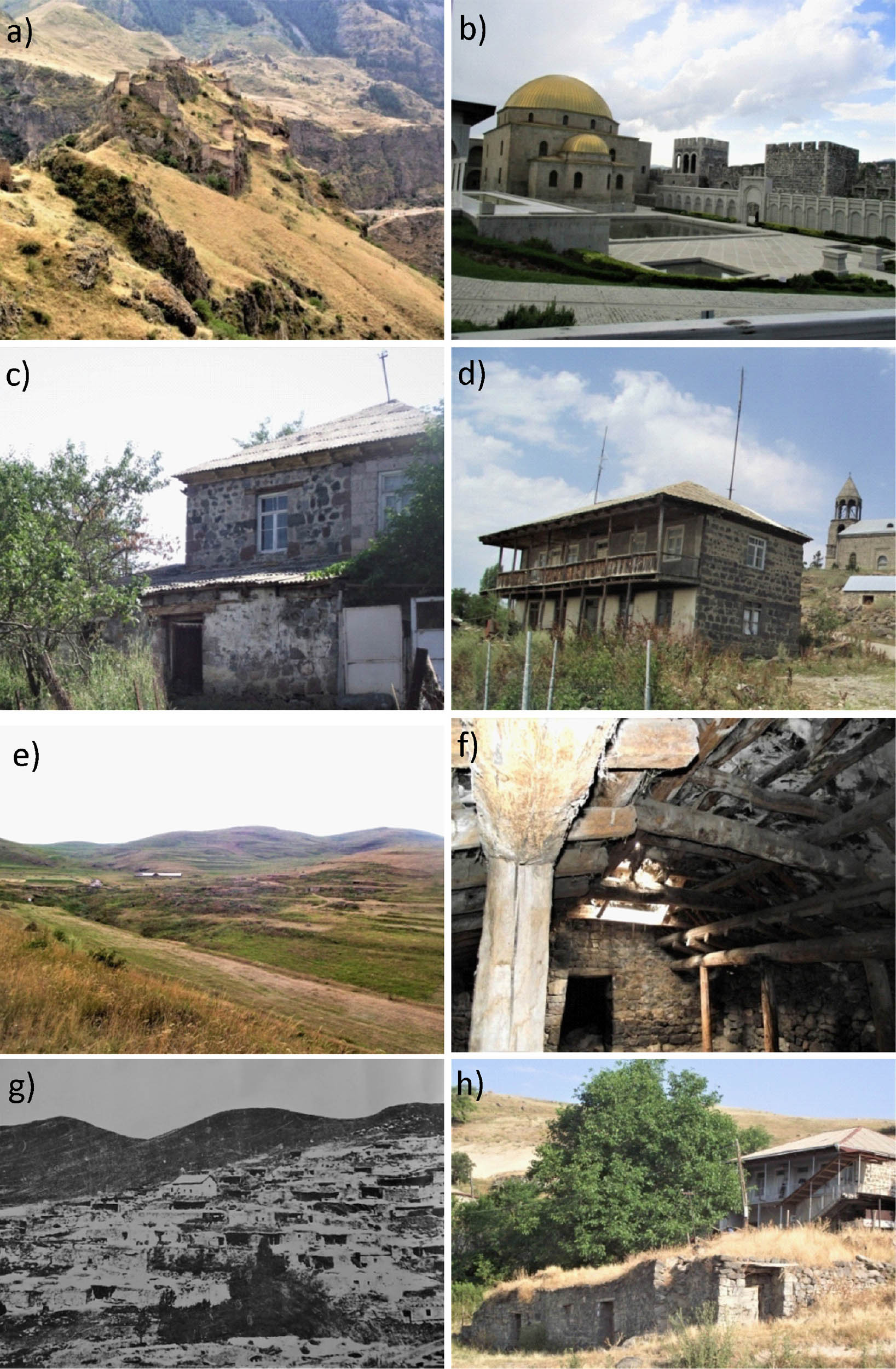
Fig. 4
Architectural types of buildings from Samtskhe-Javakheti.
A – Tmogvi Castel – fortress Rabat with stone houses, B – Akhaltsikhe Rabat – fortress Rabat with stone houses, C – Village Muskhi – stone houses, D – Village Khizabavra – stone houses, E – Village Zeda Tmogvi – semi-underground houses, F – Village Zeda Tmogvi – the interior of the semi-underground house, G – Village Chobareti – terraced semi-underground houses (from Zedginidze family archive from village Chobareti, the 1920s), H – Village Chobareti – modern condition of the terraced semi-underground houses. (Photo by R. Maisuradze, 2017–2018).
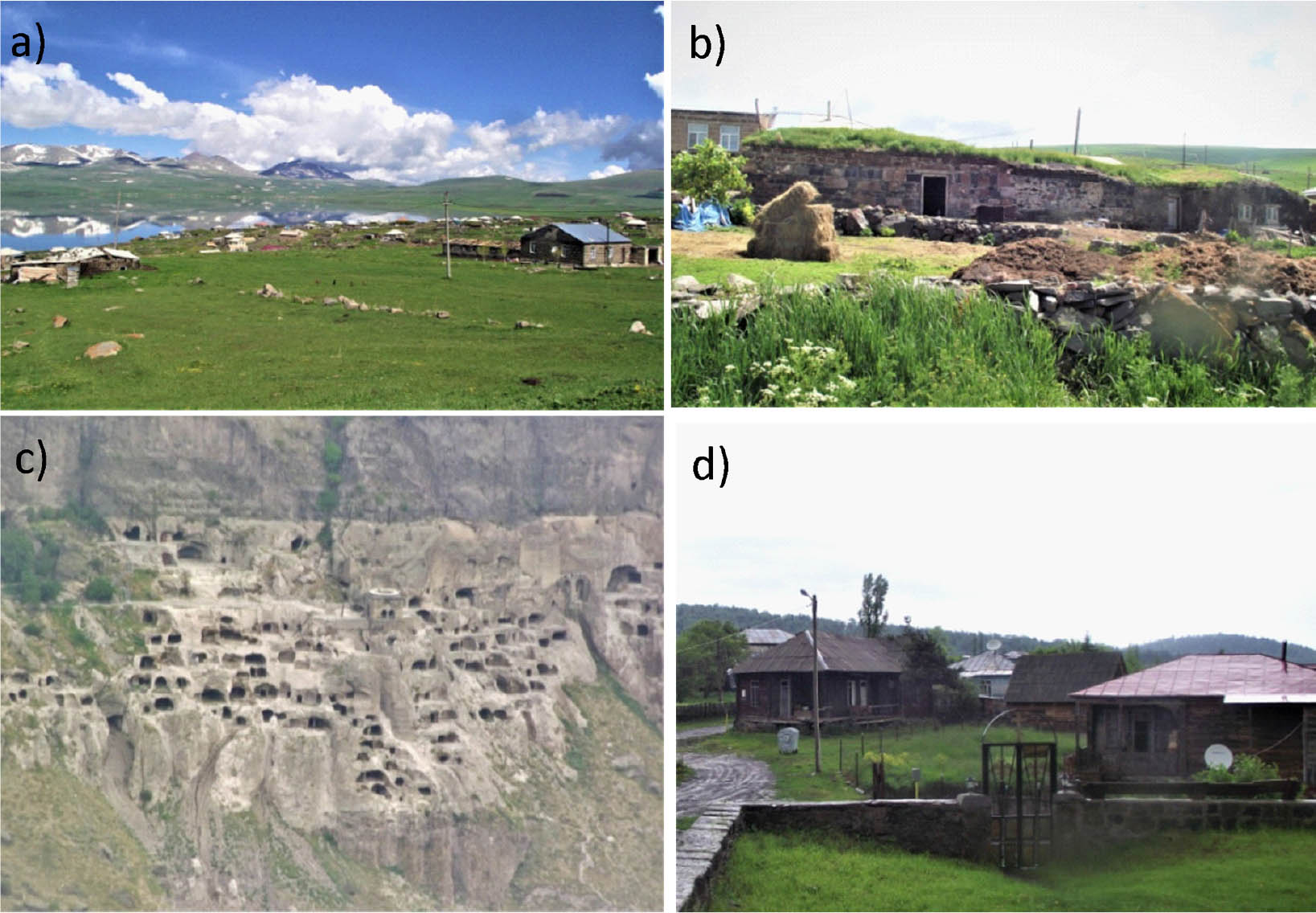
Fig. 5
Architectural types of buildings from Samtskhe-Javakheti.
A – Village Faravana – semi-underground houses mixed with stone houses, B – Village Saghamo – the modern condition of the semi-underground houses mixed with stone houses, C – Cave city Vardzia – Cave dwellings, D – Village Tsikhisdjvari – wooden log houses. (Photo by R. Maisuradze, 2017–2018).