
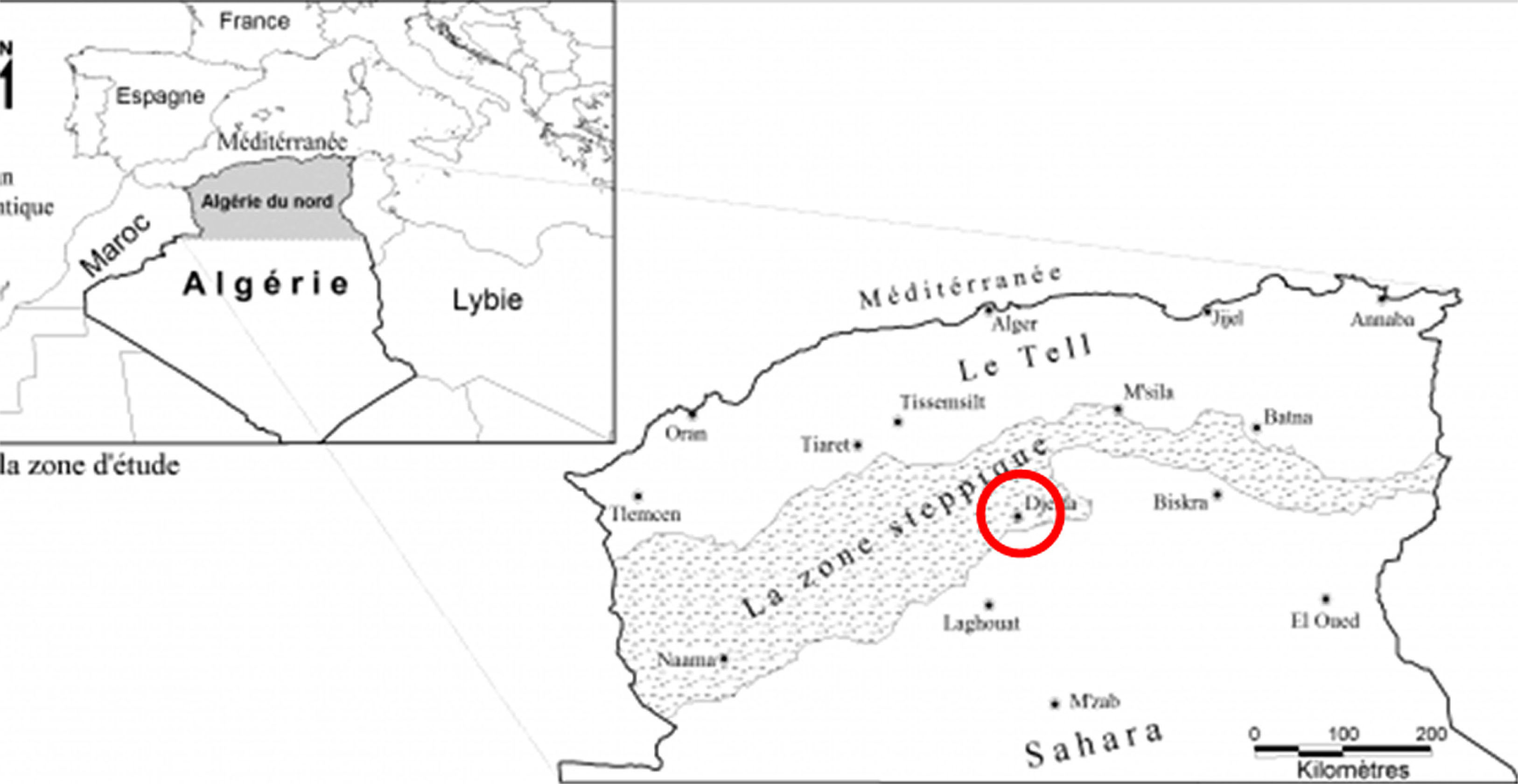
Fig. 1
Location of the city of Djelfa on highlands band (Benslimane et al. 2009).
Source: own elaboration.
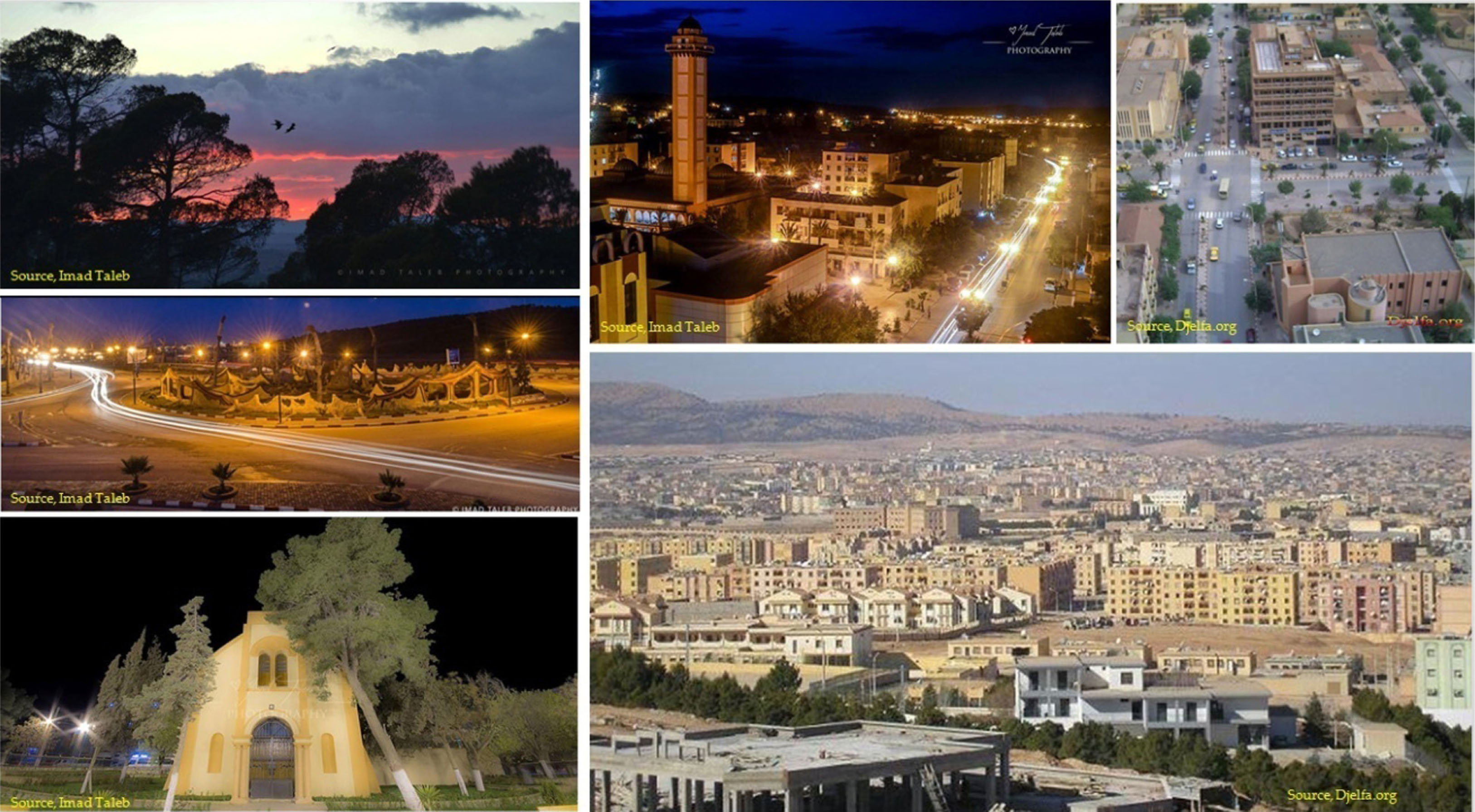
Fig. 2
Djelfa in images, composed by authors.
Table 1
Number of studies selected per country.
| Country | Algeria | Belgium | Canada China | Denmark | international | Norway | Netherlands | UK | USA |
|---|---|---|---|---|---|---|---|---|---|
| Number of studies | 1 | 2 | 1 6 | 1 | 2 | 1 | 3 | 2 | 9 |
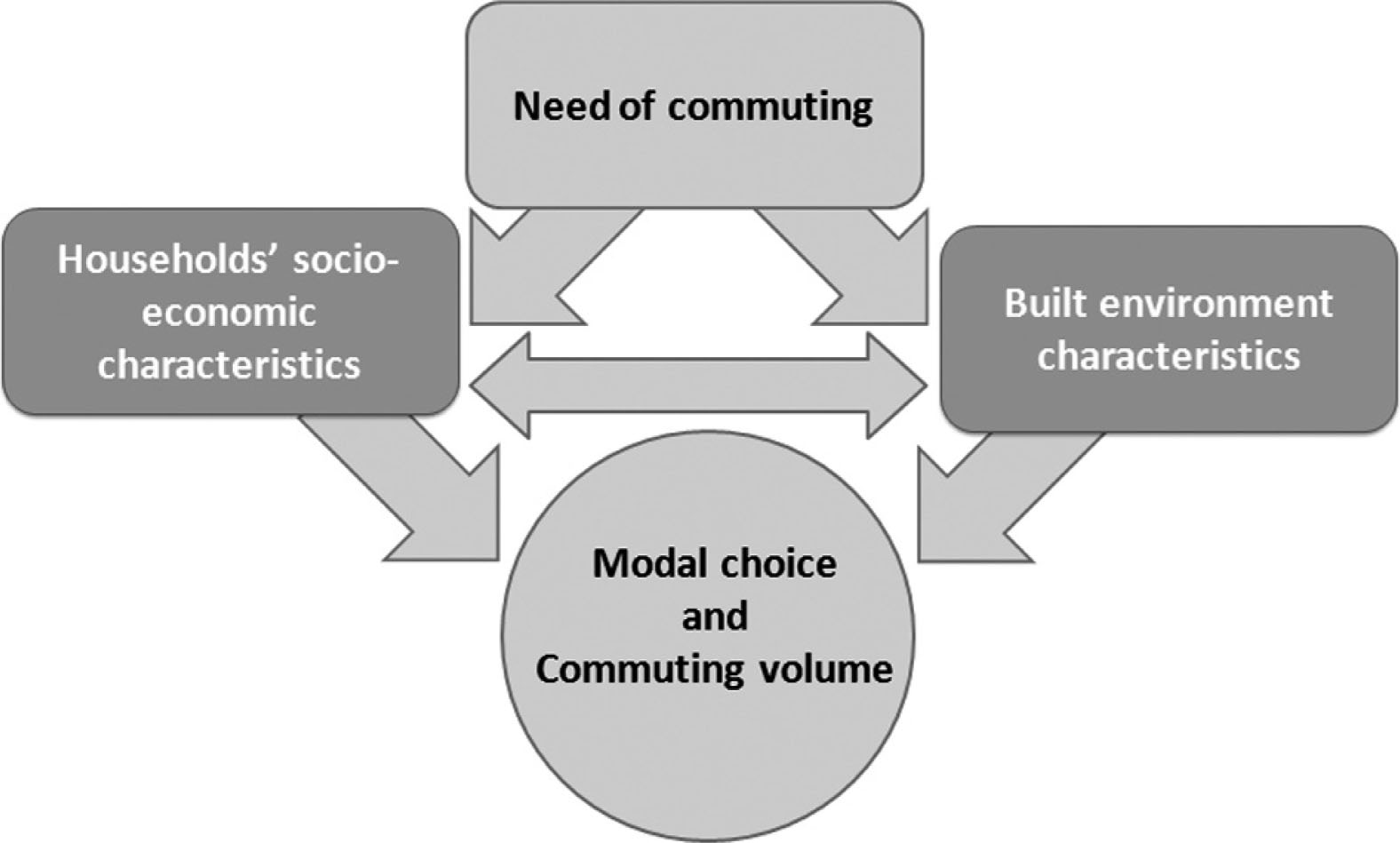
Fig. 3
Conceptual model explaining the need of commuting.
Source: own study.
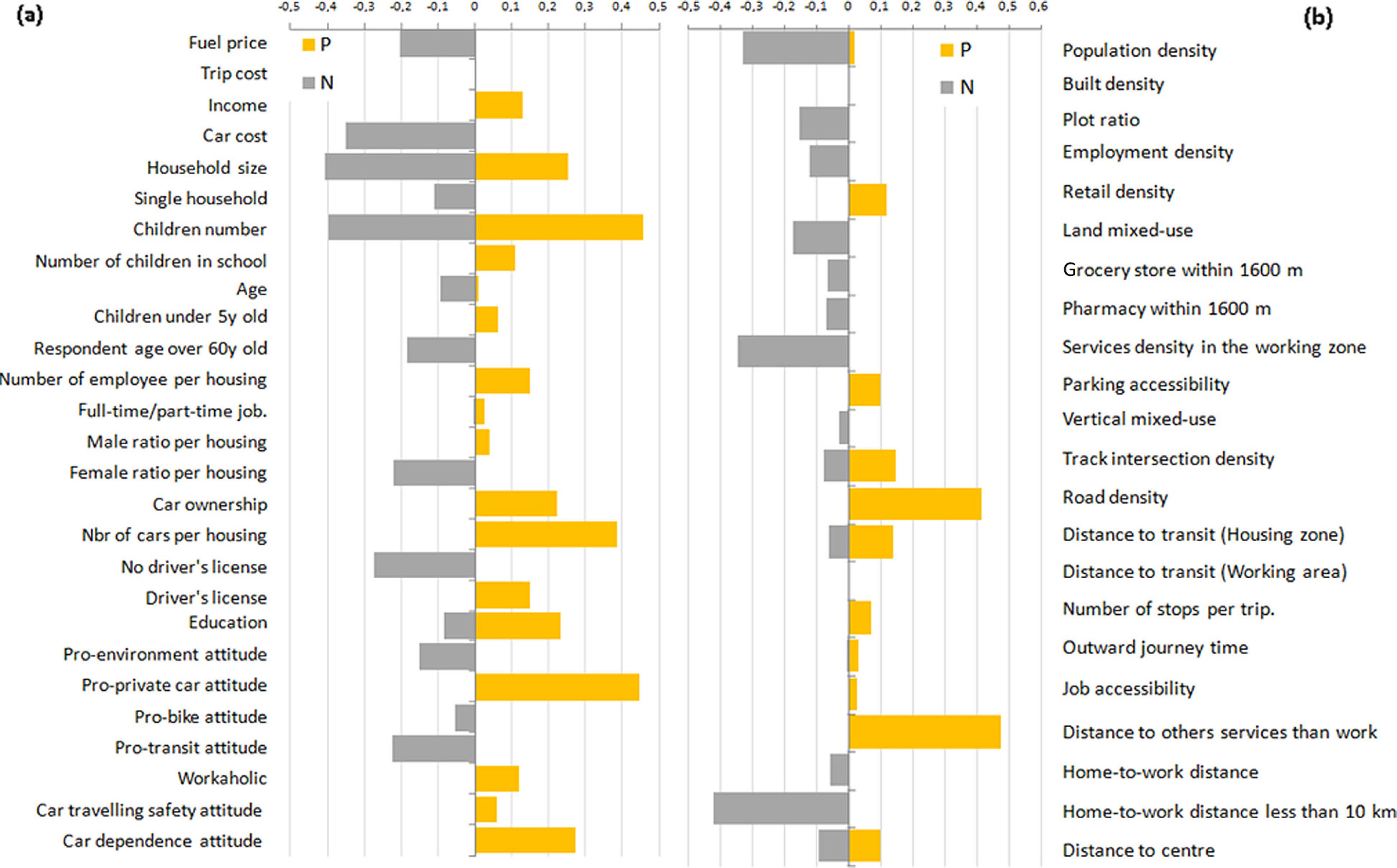
Fig. 4
Maximum values (B standardised) for the impact of the drivers related to: (a) – socio-economic characteristics of households, (b) – the built environment. P – positive; N – negative.
Source: own compilation.
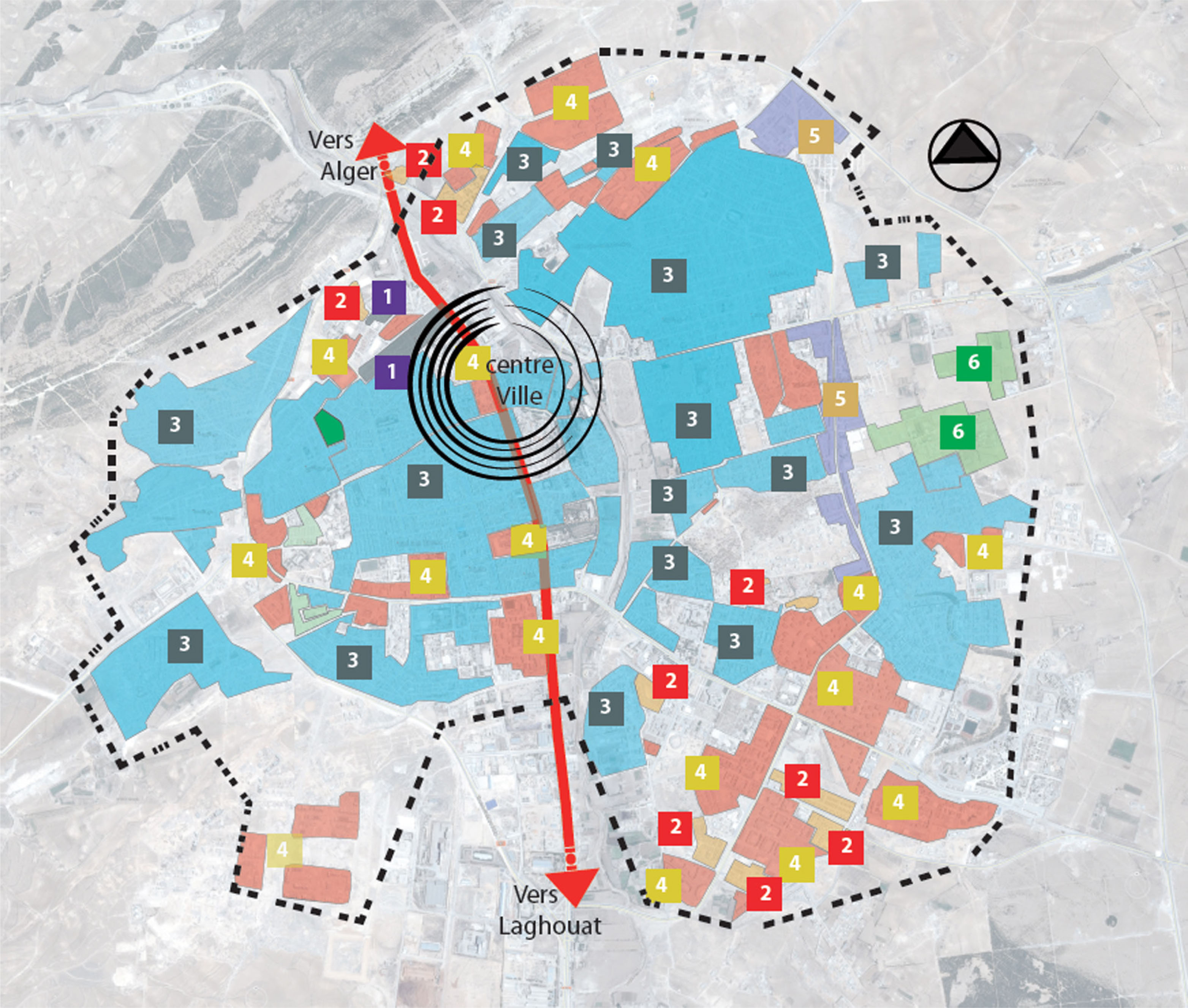
Fig. 5
Study area and types of housings in the municipality of Djelfa. 1 – Very compact individual housing, 2 – Identical individual housing, 3 – Individual housing of housing estate type, 4 – Discontinuous collective housing, 5 – High continuous collective housing, and 6 – Village housing. The discontinuous line represents the study area.
Source: own study.
Table 2
Descriptive statistics.
| Variables | N | Type | Min | Max | AVG | Std dev |
|---|---|---|---|---|---|---|
| Accessibility | ||||||
| Outward journey time (min.) | 175 | Continuous | 2 | 200 | 20.59 | 18.26 |
| Home-to-work distance (m) | 162 | Continuous | 50 | 18,000 | 2,206.91 | 1,966.96 |
| Number of bus rotations | 150 | Continuous | 0 | 3 | 1.20 | 0.556 |
| Density | ||||||
| Plot ratio* | 139 | Continuous | 0.17 | 1.00 | 0.59 | 0.32 |
| Built density* | 139 | Continuous | 0.60 | 3.20 | 2.02 | 0.74 |
| Design | ||||||
| Distance to centre (m)* | 148 | Continuous | 17.59 | 2,659.18 | 1,219.54 | 696.57 |
| Distance from national road (m)* | 151 | Continuous | 25.62 | 2,569.23 | 1,163.83 | 629.94 |
| Average number of floors (n)* | 139 | Continuous | 2.00 | 6.00 | 3.79 | 1.08 |
| Block's area (m2)* | 139 | Continuous | 770 | 36,061 | 7,398.83 | 9,150.32 |
| Housing type (1: collective, 2: individual) | 184 | Nominal | 1 | 2 | 1.54 | 0.50 |
| Distance to public transit | ||||||
| Distance to public transit (housing zone) (0: < 300, 4: > 1 km) | 173 | Ordinal | 1.00 | 4.00 | 2.3237 | 0.98 |
| Distance to public transit (work zone) (0: < 300, 4: > 1 km) | 172 | Ordinal | 0.00 | 4.00 | 1.6919 | 0.97 |
| Bus frequency | 184 | Continuous | 0.00 | 5.00 | 2.4620 | 1.56 |
| Diversity | ||||||
| Mixed use index (from 5 to 40)* | 175 | Continuous | 12 | 36 | 24.23 | 5.38 |
| Households’ socio-economic characteristics | ||||||
| Household's average age* | 42 | Continuous | 16.33 | 43.80 | 27.1681 | 8.44 |
| Respondent age | 120 | Continuous | 27 | 70 | 43.95 | 10.82 |
| Round trip frequency | 172 | Continuous | 1 | 4 | 1.66 | 0.51 |
| Household's education level | 46 | Continuous | 2.00 | 5.00 | 3.5230 | 0.77 |
| Respondent's education level | 174 | Ordinal | 0 | 4 | 3.26 | 1.06 |
| Number of cars owned | 184 | Continuous | 0 | 2 | 0.60 | 0.57 |
| Profession (1: public, 2: liberal) | 181 | Nominal | 1 | 3 | 1.19 | 0.52 |
| Income (from 15,000 to +60,000 Da) | 181 | Ordinal | 1 | 4 | 2.15 | 0.95 |
| Occupancy rate per housing | 139 | Continuous | 2 | 12 | 5.34 | 1.87 |
| Modal share | ||||||
| Public transit (1: TC, 0: others) | 184 | Nominal | 0.00 | 1.00 | 0.31 | 0.46 |
| Car (1: vehicle, 0: others) | 184 | Nominal | 0.00 | 1.00 | 0.26 | 0.44 |
| Walking (1: MAP, 0: others) | 184 | Nominal | 0.00 | 1.00 | 0.42 | 0.49 |
[i] Source: own compilation.
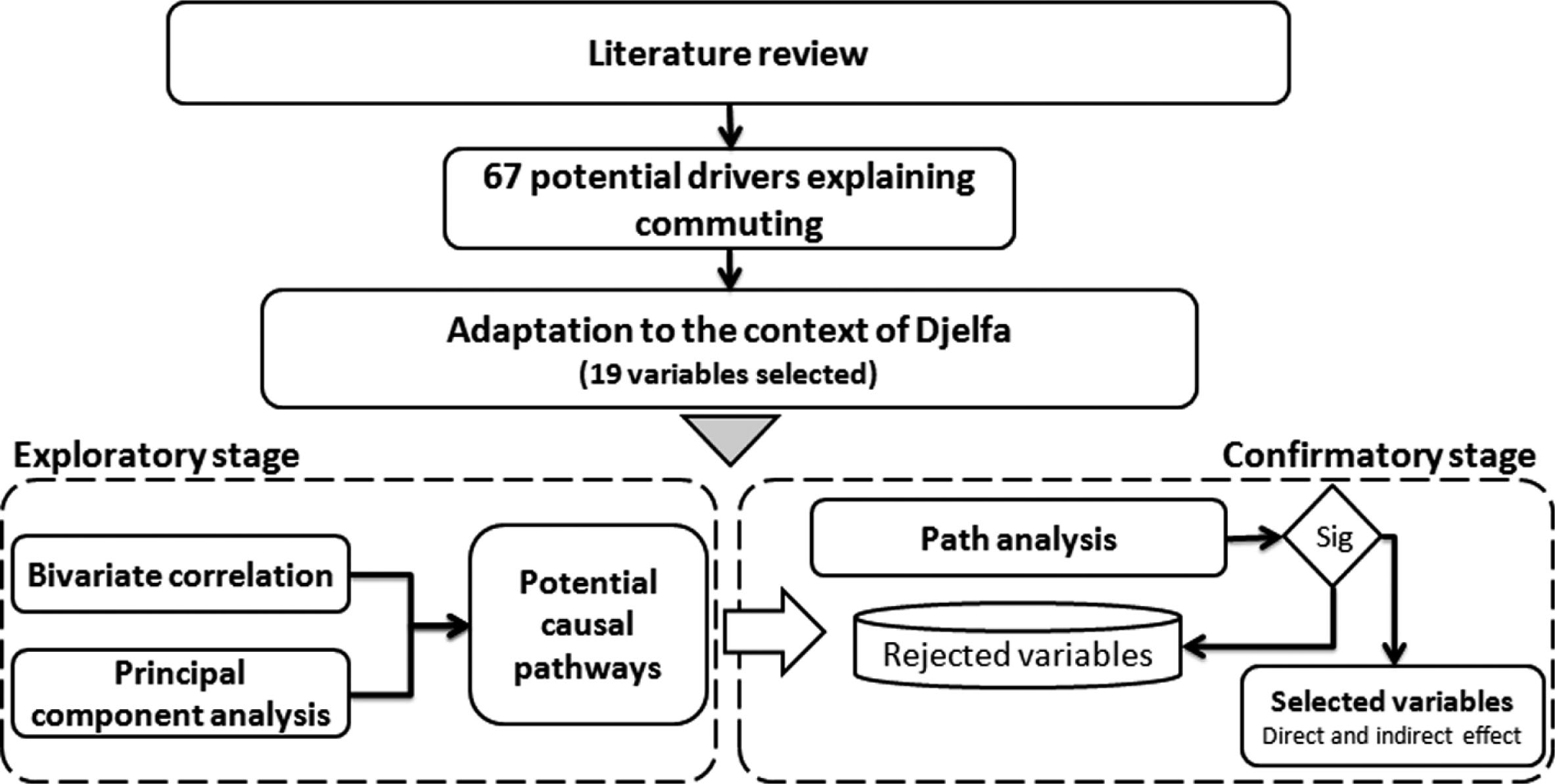
Fig. 6
Method framework.
Source: own study.
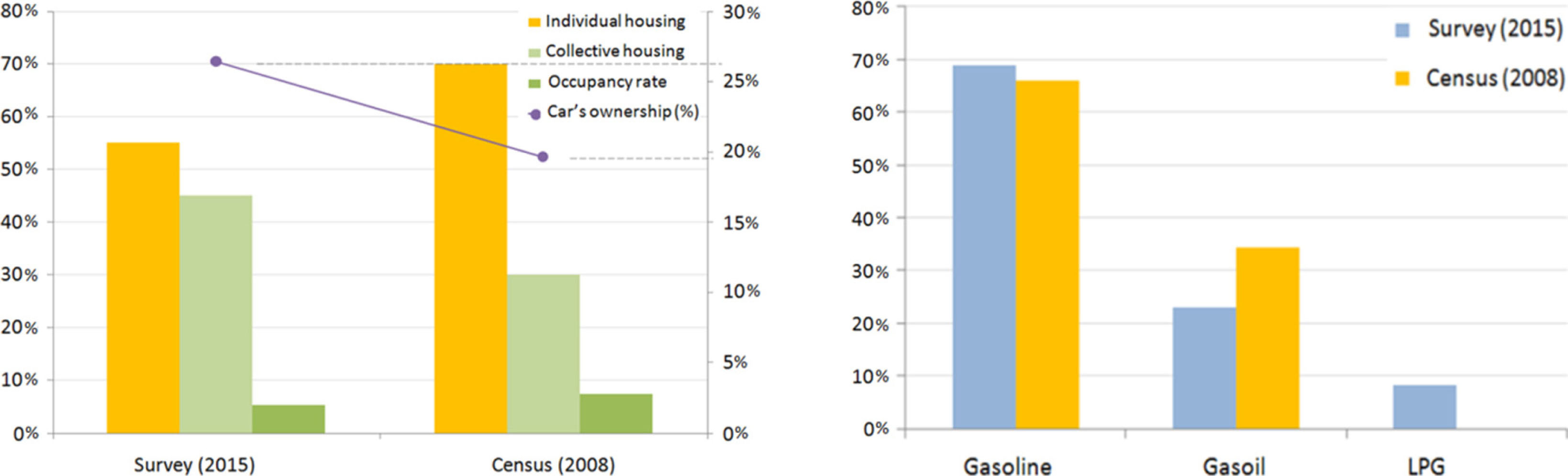
Fig. 7
Comparison between survey's and census data.
Source: own compilation.
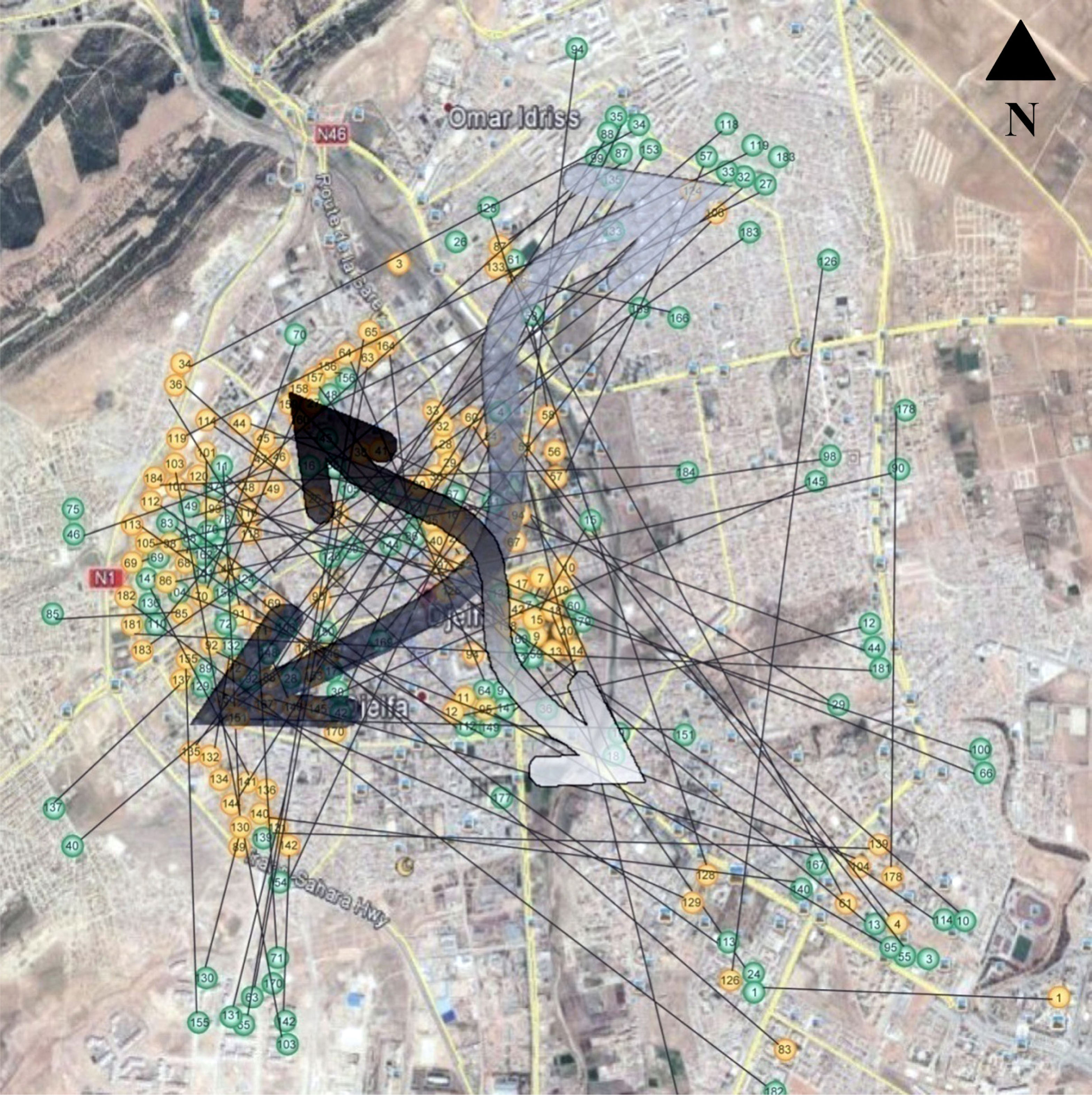
Fig. 8
Mesh representing home-to-work trips. Green colour – homes; yellow colour – workplaces; grey arrows – the main directions for commuting. Markings are carried out in Google earth (2015).
Source: own study.
Table 3
Results of Pearson's bivariate correlation.
| Car | Walking | Public transit | ||||
|---|---|---|---|---|---|---|
| Correlation | Sig | Correlation | Sig. | Correlation | Sig | |
| Accessibility | ||||||
| Home-to-work distance (m) | 0.247** | 0.002 | −0.407** | 0.000 | 0.214** | 0.006 |
| Outward journey time (min.) | −0.100 | 0.187 | −0.308** | 0.000 | 0.431** | 0.000 |
| Number of bus rotations | 0.128 | 0.118 | −0.329** | 0.000 | 0.237** | 0.004 |
| Density | ||||||
| Built density (COS) | −0.071 | 0.408 | 0.087 | 0.306 | −0.026 | 0.757 |
| Plot ratio (CES) | −0.037 | 0.662 | 0.082 | 0.336 | −0.052 | 0.546 |
| Design | ||||||
| Housing type | 0.021 | 0.802 | 0.035 | 0.673 | −0.055 | 0.501 |
| Distance from national road | 0.205* | 0.011 | −0.287** | 0.000 | 0.111 | 0.175 |
| Distance to centre | 0.149 | 0.072 | −0.336** | 0.000 | 0.212** | 0.010 |
| Block's area | 0.140 | 0.100 | −0.280** | 0.001 | 0.164 | 0.054 |
| Average number of floors | 0.047 | 0.584 | −0.119 | 0.162 | 0.082 | 0.339 |
| Diversity | ||||||
| Mixed use index | −0.069 | 0.362 | 0.126 | 0.096 | −0.064 | 0.399 |
| Distance to public transit | ||||||
| Distance to public transit (housing) | −0.125 | 0.100 | 0.008 | 0.914 | 0.099 | 0.194 |
| Bus frequency | −0.070 | 0.343 | 0.113 | 0.126 | −0.051 | 0.492 |
| Distance to public transit (work zone) | 0.045 | 0.559 | −0.010 | 0.898 | −0.031 | 0.687 |
| Households’ socio-economic characteristics | ||||||
| Profession | 0.198** | 0.008 | −0.115 | 0.123 | −0.060 | 0.421 |
| Respondent age | −0.086 | 0.349 | 0.158 | 0.084 | −0.079 | 0.388 |
| Respondent's education level | −0.004 | 0.962 | −0.037 | 0.628 | 0.079 | 0.302 |
| Income | 0.204** | 0.006 | −0.086 | 0.247 | −0.124 | 0.097 |
| Number of cars owned | 0.459** | 0.000 | −0.182* | 0.013 | −0.267** | 0.000 |
| Occupancy rate per housing | −0.086 | 0.310 | 0.077 | 0.368 | −0.004 | 0.967 |
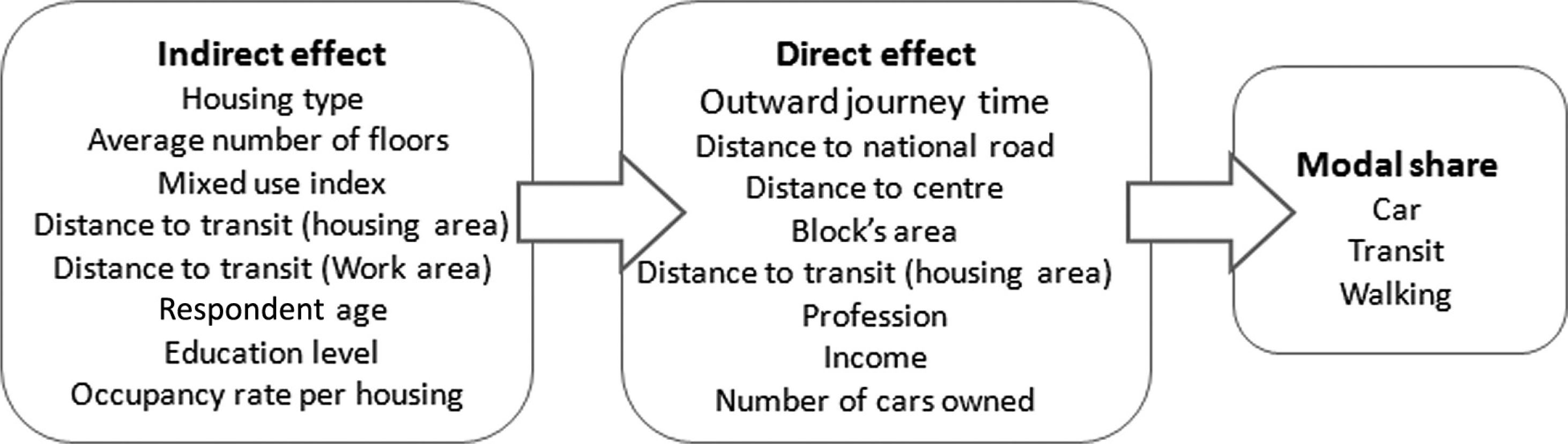
Fig. 9
Hypothetical causal pathways between variables and modal share.
Source: own compilation.
Table 4
Projection of variables in PCA space.
| Axes | |||||||
|---|---|---|---|---|---|---|---|
| 1 | 2 | 3 | 4 | 5 | 6 | 7 | |
| Home-to-work distance | 0.253 | 0.651 | 0.074 | 0.036 | −0.263 | 0.131 | −0.394 |
| Outward journey time | 0.259 | 0.181 | −0.391 | 0.505 | 0.218 | −0.499 | −0.085 |
| Number of bus rotations | 0.168 | 0.536 | −0.396 | 0.274 | 0.096 | −0.298 | −0.495 |
| Built density (COS) | −0.833 | 0.295 | 0.187 | 0.056 | −0.158 | −0.183 | 0.075 |
| Plot ratio (CES) | −0.889 | 0.295 | 0.145 | 0.113 | −0.110 | −0.193 | 0.083 |
| Housing type | −0.829 | 0.258 | 0.246 | 0.212 | 0.021 | −0.004 | 0.153 |
| Distance from national road | 0.436 | 0.597 | 0.174 | 0.274 | −0.304 | 0.220 | 0.222 |
| Distance to centre | 0.677 | 0.450 | 0.081 | 0.245 | −0.177 | 0.211 | 0.276 |
| Block's area | 0.709 | −0.057 | 0.018 | 0.214 | −0.053 | −0.065 | 0.237 |
| Average number of floors | 0.870 | −0.115 | −0.057 | −0.004 | −0.041 | 0.253 | −0.093 |
| Mixed use index | 0.452 | −0.424 | 0.283 | −0.226 | 0.074 | −0.292 | 0.021 |
| Distance to public transit (housing) | −0.297 | 0.202 | −0.629 | 0.344 | 0.098 | 0.237 | 0.055 |
| Bus frequency | −0.459 | 0.063 | −0.197 | 0.165 | 0.291 | 0.571 | 0.248 |
| Distance to public transit (work zone) | 0.131 | −0.044 | −0.395 | 0.194 | 0.707 | 0.015 | 0.165 |
| Profession | −0.218 | −0.182 | −0.114 | −0.279 | 0.270 | 0.263 | −0.352 |
| Respondent age | −0.065 | −0.596 | −0.026 | 0.654 | −0.217 | 0.119 | −0.025 |
| Respondent's education level | 0.287 | 0.471 | −0.041 | −0.318 | 0.148 | −0.292 | 0.465 |
| Income | 0.096 | −0.308 | 0.483 | 0.596 | 0.274 | −0.180 | 0.201 |
| Number of cars owned | 0.032 | 0.234 | 0.616 | 0.161 | 0.532 | 0.070 | −0.204 |
| Occupancy rate per housing | −0.079 | −0.327 | 0.165 | 0.551 | −0.331 | 0.016 | −0.230 |
| Car's modal share | 0.194 | 0.334 | 0.633 | 0.059 | 0.398 | 0.177 | −0.232 |
[i] Extraction method: Principal component analysis.
[ii] Source: own compilation.
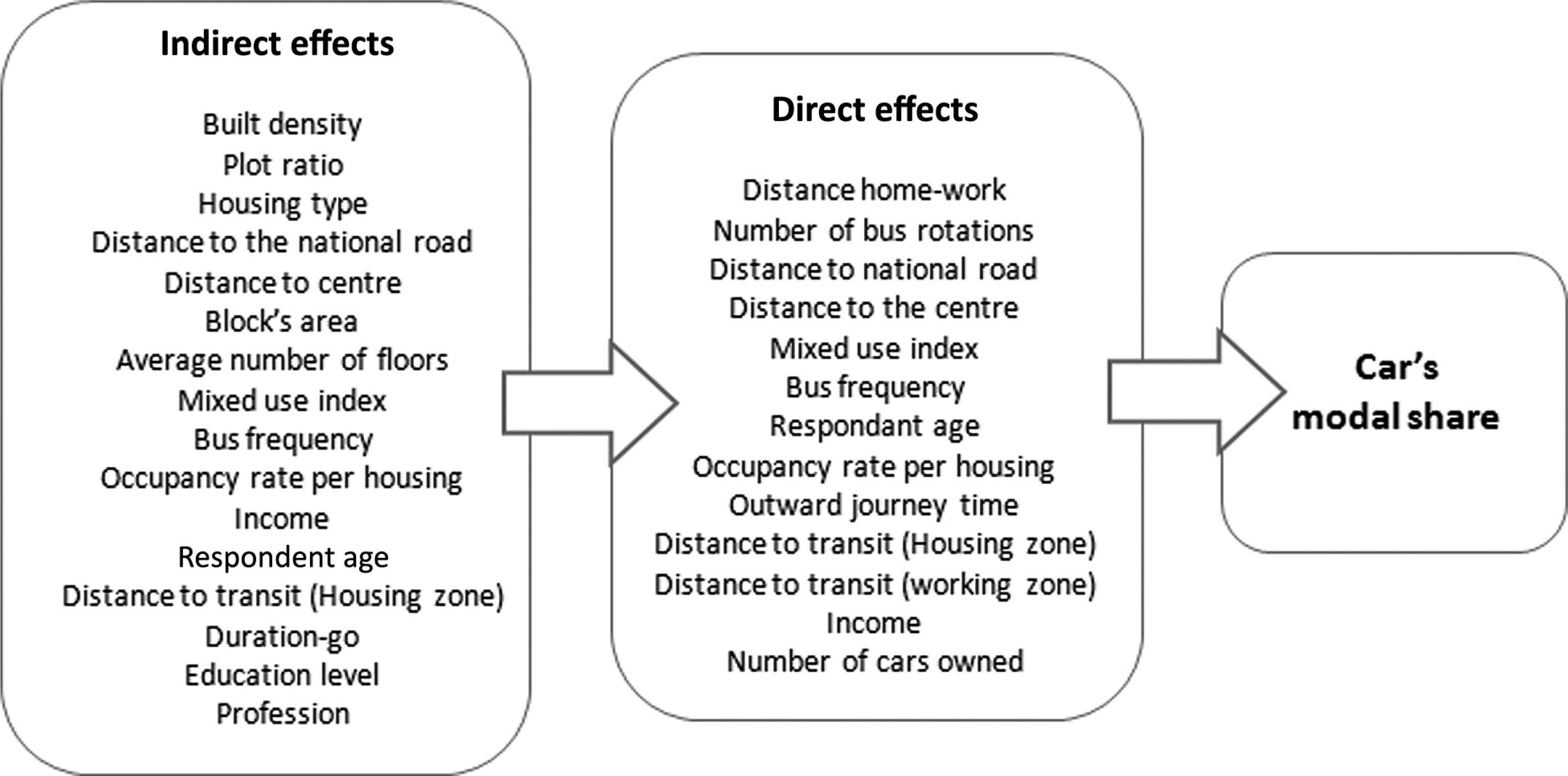
Fig. 10
Hypothetical causal pathways between variables and the modal share of the car.
Source: own compilation.
Table 5
Projection of explanatory variables for the modal share of walking and transit.
| Axes | |||||||
|---|---|---|---|---|---|---|---|
| 1 | 2 | 3 | 4 | 5 | 6 | 7 | |
| Home-to-work distance | −0.019 | 0.787 | −0.122 | −0.079 | 0.198 | −0.252 | −0.022 |
| Outward journey time | −0.113 | 0.032 | 0.058 | 0.046 | 0.837 | 0.305 | −0.062 |
| Number of bus rotations | −0.018 | 0.318 | −0.114 | 0.053 | 0.827 | −0.231 | 0.002 |
| Built density | 0.935 | 0.027 | −0.003 | 0.043 | −0.061 | −0.022 | −0.020 |
| Plot ratio | 0.974 | −0.022 | 0.014 | 0.109 | −0.012 | −0.010 | −0.005 |
| Housing type | 0.885 | 0.016 | 0.088 | 0.239 | −0.103 | 0.076 | 0.141 |
| Distance from national road | −0.167 | 0.779 | −0.135 | 0.146 | −0.067 | 0.308 | 0.053 |
| Distance to centre | −0.447 | 0.676 | −0.160 | 0.133 | −0.017 | 0.394 | 0.044 |
| Block's area | −0.576 | 0.201 | 0.029 | −0.114 | 0.079 | 0.479 | −0.063 |
| Average number of floors | −0.874 | 0.283 | 0.035 | −0.085 | −0.012 | 0.028 | 0.017 |
| Mixed use index | −0.406 | −0.220 | 0.007 | −0.565 | −0.095 | 0.189 | 0.128 |
| Distance to public transit (housing) | 0.147 | −0.003 | 0.068 | 0.715 | 0.324 | −0.075 | −0.273 |
| Bus frequency | 0.228 | −0.092 | 0.045 | 0.773 | −0.193 | −0.062 | 0.124 |
| Distance to public transit (working zone) | −0.279 | −0.391 | −0.170 | 0.478 | 0.403 | 0.177 | 0.244 |
| Profession | −0.009 | −0.220 | 0.024 | 0.093 | −0.037 | −0.524 | 0.122 |
| Respondent age | −0.091 | −0.173 | 0.855 | 0.141 | −0.026 | 0.201 | −0.119 |
| Respondent's education level | −0.046 | 0.141 | −0.733 | −0.085 | 0.090 | 0.399 | −0.075 |
| Income | 0.001 | −0.111 | 0.470 | −0.102 | 0.058 | 0.609 | 0.470 |
| Number of cars owned | 0.098 | 0.213 | 0.004 | −0.077 | 0.069 | 0.019 | 0.880 |
| Occupancy rate per housing | 0.070 | 0.100 | 0.752 | −0.094 | 0.022 | 0.063 | −0.039 |
| Walking's modal share | 0.009 | −0.724 | −0.100 | 0.132 | −0.198 | −0.238 | 0.025 |
| Transit's modal share | 0.018 | 0.382 | 0.179 | −0.021 | 0.221 | 0.245 | −0.695 |
[i] Extraction method: principal component analysis.
[ii] Source: own compilation.
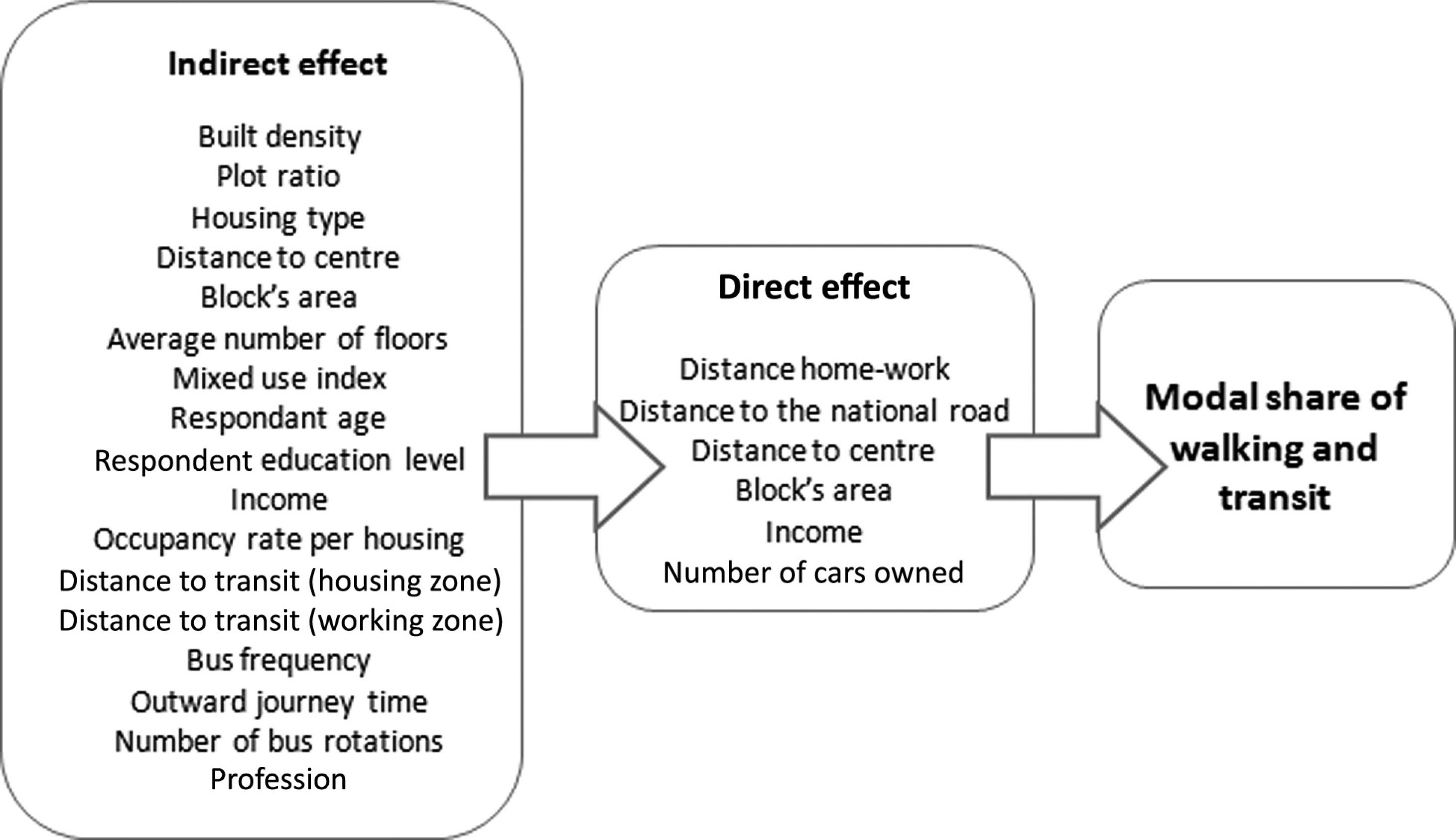
Fig. 11
Hypothetical causal pathways between variables and the modal share of walking and transit.
Source: own compilation.
Table 6
Models fit indices.
| Modal share | df | χ2 | Probability level (> 0.05) | RMSE (< 0.06 or 0.08)** | NFI (> 0.9 or > 0.95)*** | CFI (> or closer to 0.95)*** |
|---|---|---|---|---|---|---|
| Car | 59 | 39.35 | 0.977 | 0.000 | 0.954 | 1.000 |
| Transit | 34 | 21.20 | 0.957 | 0.000 | 0.964 | 1.000 |
| Walking | 34 | 28.03 | 0.755 | 0.000 | 0.949 | 1.000 |
Source: own compilation.
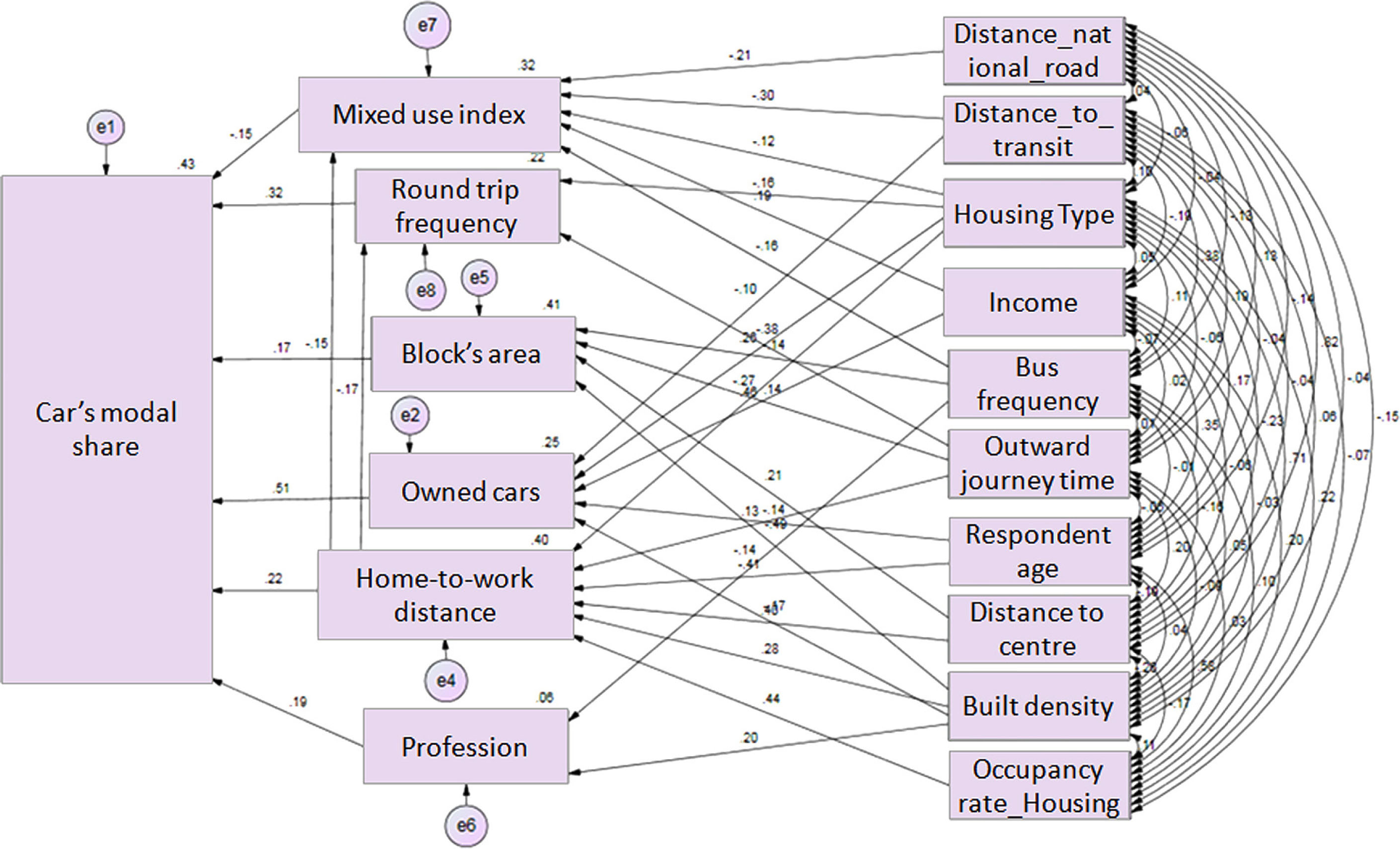
Fig. 12
Path analysis of the modal share of the car.
Source: own compilation.
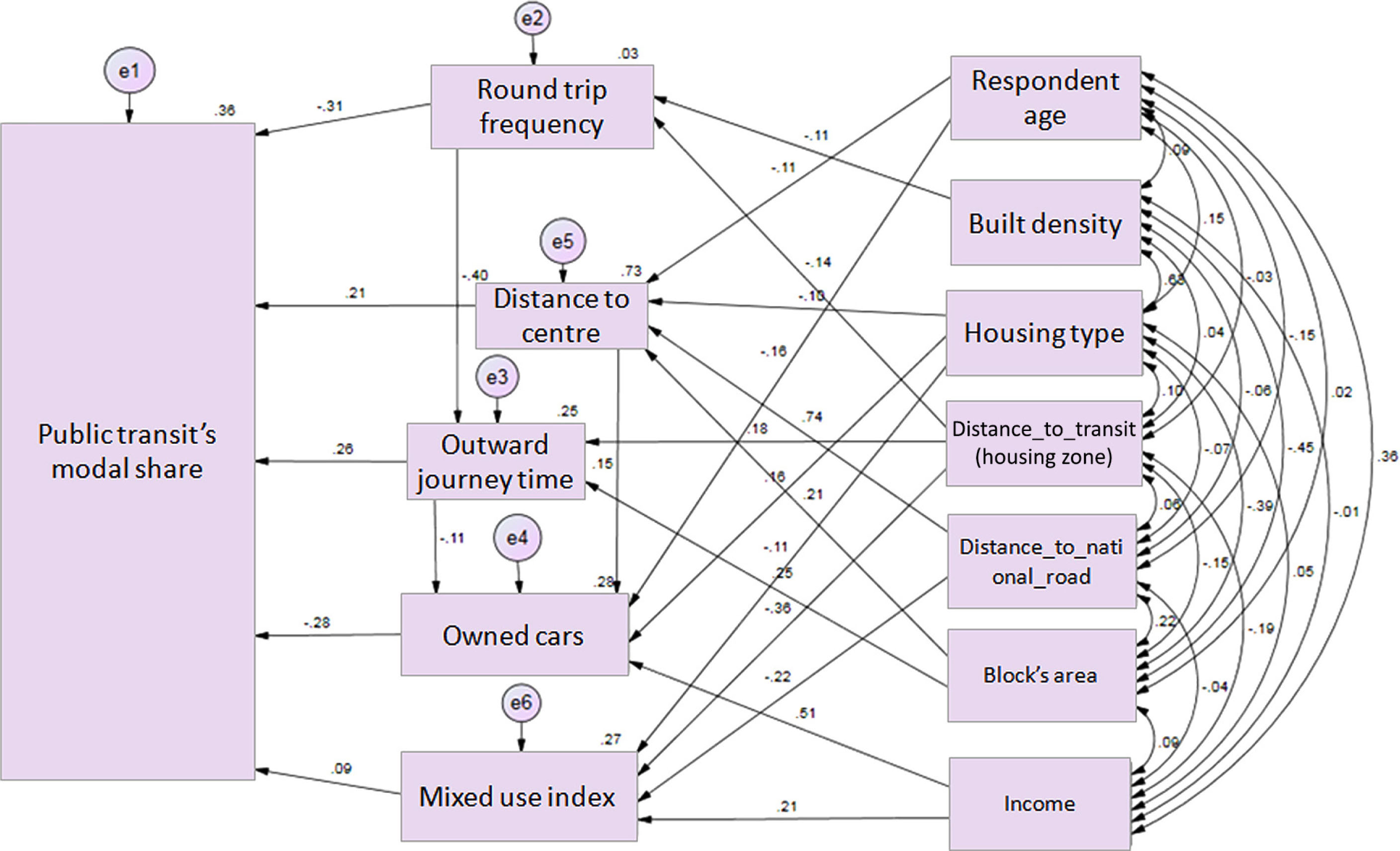
Fig. 13
Path analysis of the modal share of public transit.
Source: own compilation.
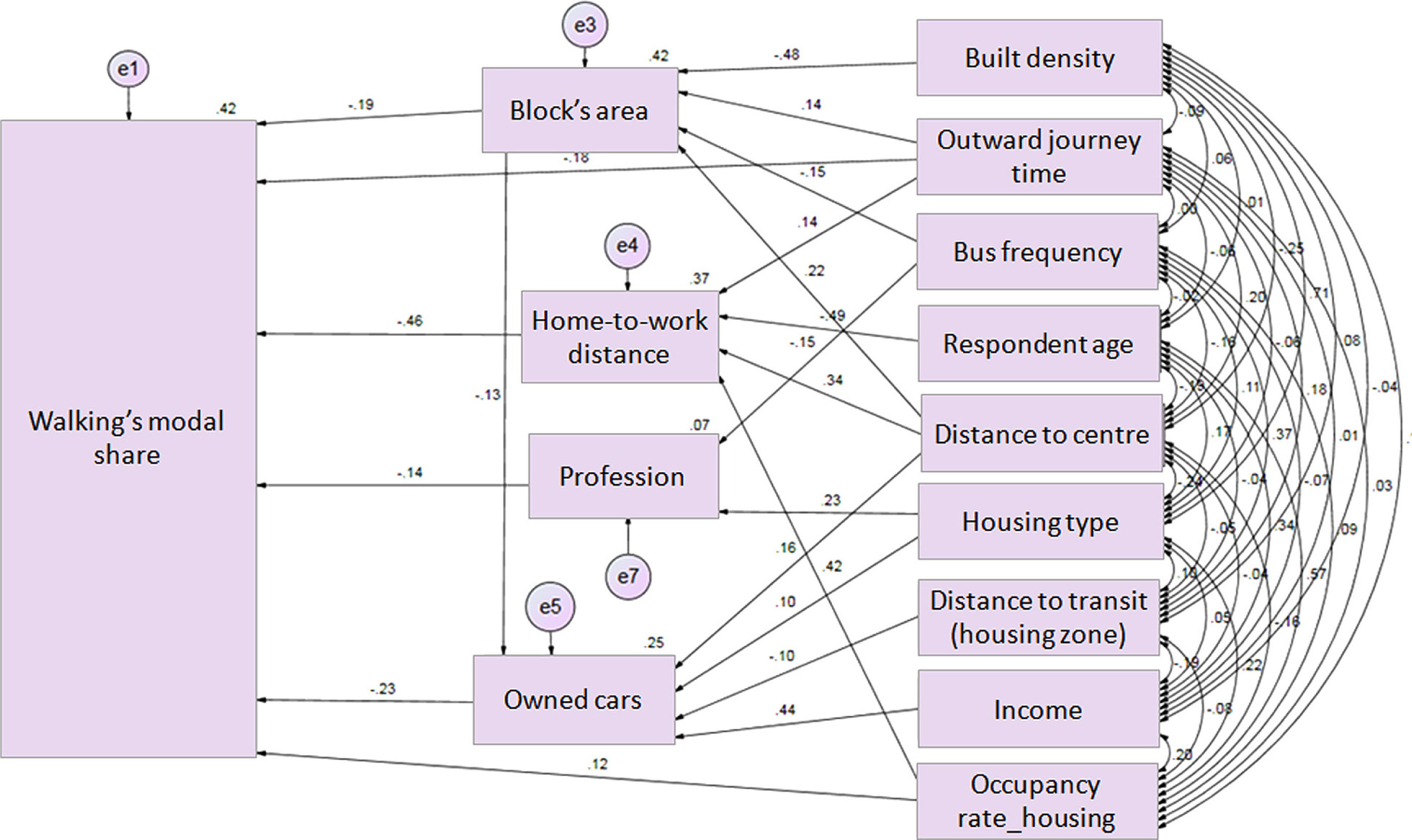
Fig. 14
Path analysis of the modal share of walking.
Source: own compilation.
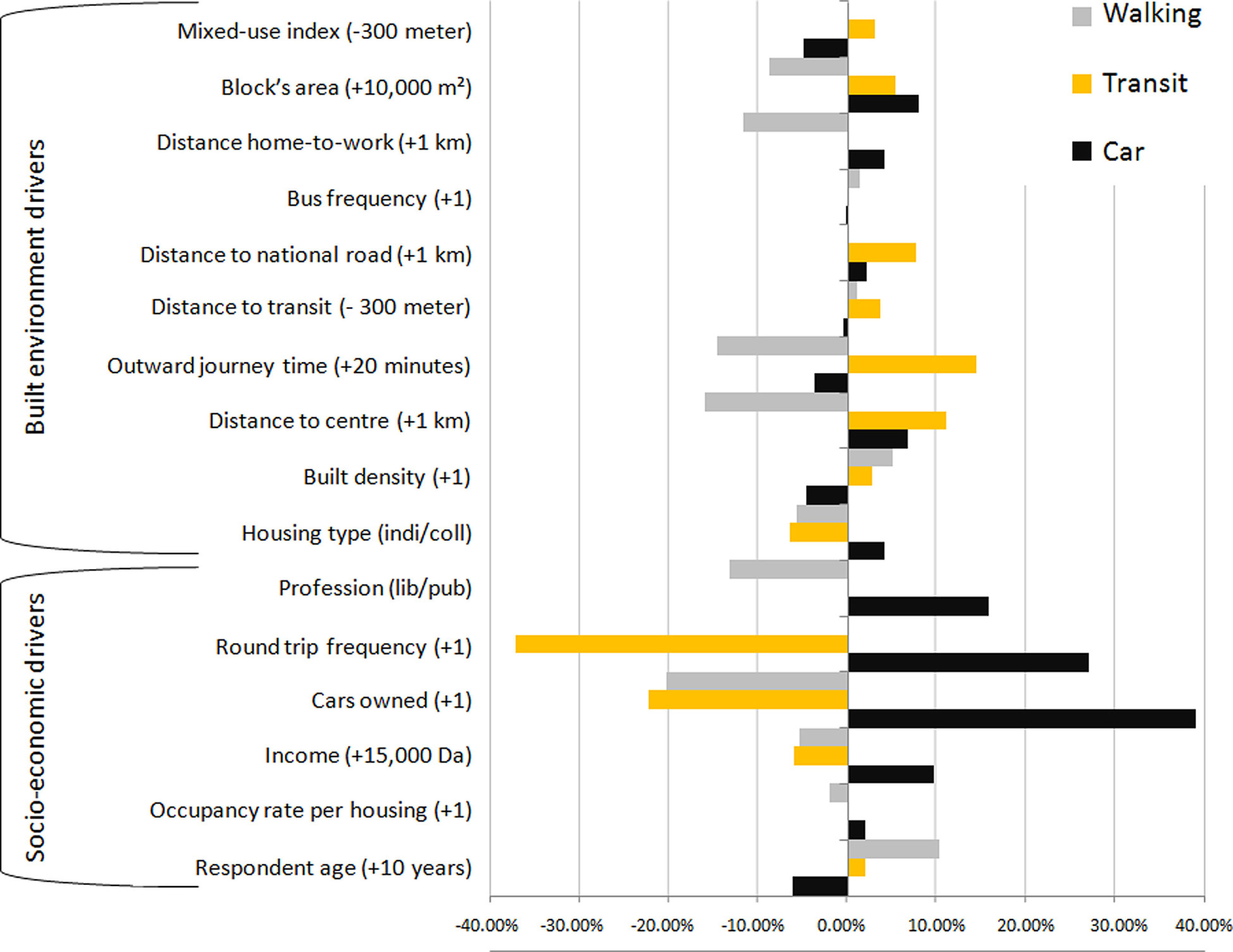
Fig. 15
Synthesis of the effects of the built environment and socio-economic drivers in shaping the modal share of the car, public transit and walking.
Source: own compilation.
Table A1
Presentation of the papers chosen for the literature review.
| Authors | Country | Period | Data sources | Study scale | Sensitivity analysis method | Sample size | Mobility type | Drivers | Explanatory power of modal | |||
|---|---|---|---|---|---|---|---|---|---|---|---|---|
| C | S | L | SE | BE | ||||||||
| Acker and Witlox (2010) | Belgium | 2000–2001 | Survey on behaviour of travellers in Ghent on people aged 18 and over | City | Structural equation modelling | 2,500 households | X | X | X | X | X | R2 = 20.1% |
| Breheny (1995) | Wales, UK | 1961–1991 | Aggregated data from Ecotec project (1993) | National | Interpolation from data from Ecotec project (1993) | Ecotec project sample (1993) | X | X | X | X | – | |
| Brownstone and Golob (2008) | California, USA | 2001 | National Household Transportation Survey. Aggregate data | National | Structural equation modelling | 2,079 households | X | X | X | X | X | R2 = 0.37 and 0.42 |
| Calabrese et al. (2012) | Massachusetts, USA | 2011 | Deducted by detecting signal of mobile phones carried out by AirSag | Metropolitan area | Multiple linear regression | 1,101 households | X | X | X | X | X | R2 = 49.40% and 56.48% |
| Newman and Kenworthy (1989) | 32 cities of different countries | 1980 | Collection of fuel consumption data and calculation of density excluding rural areas. Urban planning agency of different countries. Aggregate data | City | Bivariate correlation analysis | 32 cities | X | X | X | X | X | / |
| Cervero and Murakami (2010) | USA | 2003 | Data collected from Highway Statistics. Department of Commerce | National | Structural equation modelling | 370 urban areas | X | X | X | X | CFI (>0:900) 0.969 NFI (>0:950) 0.961 NNFI (>0:900) 0.942 | |
| Cervero and Radisch (1995) | USA | 1990–1991 | Bay Area Travel questionnaire survey | Neighbourhood | Binary logistic regression | 2 neighbourhoods: 620 households for non-commuting and 840 households for commuting | X | X | X | X | X | Pseudo R2 = 0.29, Predicted cases = 88.6% |
| Chen et al. (2007) | NY, USA | 1997/1998 | Household survey | Metropolitan area | Structural equation modelling | 2,089 trips | X | X | X | R2 = 0.45 and 0.58 | ||
| Dargay (2004) | UK | 1970–1995 | Survey of family spending | National | Semi-logistic regression | 256 pseudo panels | X | X | X | X | X | R2 = 0.989 |
| Dieleman et al. (2002) | Netherlands | 1996 | National Mobility Survey in Netherlands | National | Multinomial logistic regression | 70,000 households | X | X | X | X | X | R2 = 0.31 |
| Ding et al. (2017) | Baltimore, USA | 2001 | Household survey | Metropolitan area | Structural equation modelling | 3,519 households | X | X | X | / | ||
| Feng et al. (2013) | China and Netherlands | 2008 | Household survey on mobility in both countries | City | Multiple linear regression | 2,989 respondents for 10 districts in China and 1,322 respondents for Randstad | X | X | X | X | X | China: R2 = 0.115 Randstad: R2 = 0.124 |
| Handy et al. (2005) | California, USA | 2003 | e-mail questionnaire carried out on 8 neighbourhoods | District in metropolitan area | Linear regression | 1,466 respondents | X | X | R2 = 0.16 R2 adjusted = 154 | |||
| Holden and Norland (2005) | Oslo, Norway | 2003 | Questionnaire distributed by mail | Regional | Linear regression | 650 for daily trips, 778 for leisure travel, and <100 respondents per zone (eight zones selected for the study) | X | X | X | X | R2 = 0.231 for commuting | |
| Karathodorou et al. (2010) | 42 countries | 1995 | Millennium Cities Database for Sustainable Transport (1999) for 100 countries and car occupancy from Mobility in Cities database (2006) | Cities | Linear regression | 84 cities | X | X | X | X | R2 = 0.61 | |
| Khan et al. (2014) | Seattle, USA | 2006 | Questionnaire/Puget Sound Regional Council | Metropolitan area | Regression modelling | 10,510 respondents of 4,741 households | X | X | X | X | / | |
| Kitamura et al. (1997) Attitude is very important more than the others. | San Francisco, USA | 1994 | Questionnaire. And land use information is obtained from Metropolitan Transportation Commission | Neighbourhood | Multiple linear regression | 5 neighbourhoods, 640 respondents | X | X | X | X | R2 = 0.2125 | |
| Limtanakool et al. (2006) | Netherlands | 1996 | National Mobility Survey conducted by telephone interview and questionnaire | Regional | Binary logistic regression | Commuting:2,326 Shopping: 932 Leisure: 3,072 | X | X | X | X | X | |
| Ma et al. (2014) | China | 2007 | Questionnaire | Neighbourhood | Logistic regression | 60 households, 699 trips of 10 neighbourhoods | X | X | X | X | X | Pseudo R2 = 0.16 |
| Manaugh et al. (2009) | Montréal, Canada | 2003 | Origin-destination survey | Neighbourhood | Linear regression | 17,000 trips | X | X | X | SE: R2 = 0.06; SE+BE modal: R2=0.40 | ||
| Marique (2013) | Belgium | 2001 | 2001 Socio-economic survey | National | Multiple linear regression | 966,247 respondents | X | X | X | R2 = 0.457 | ||
| Næss (2010) | Hangzhou, China | 2005 | Qualitative interview and questionnaire in 40 urban areas | Urban zone | Multiple linear regression | 28 interviews 3,150 questionnaire respondents | X | X | X | R2 = 0.189 | ||
| Naess (2014) | Hangzhou, China and Copenhagen, Denmark | 2005 | Interview and questionnaire | Regional | Linear regression | 1,932 questionnaires for Copenhagen and 3,150 for Hangzhou | X | X | X | Copenhagen:R2 = 0.233 Hangzhou: = 095 | ||
| Pan et al. (2009) | Shanghai, China | 2001 | Questionnaire | Neighbourhood | Multiple logistic regression | 1,709 respondents in 4 neighbourhoods | X | X | X | X | Pseudo R2 = 0.2714 | |
| Zhang et al. (2014) | Zhongshan, China | 2010 | Questionnaire | Neighbourhood | Linear regression | 25,618 respondents | X | X | X | X | X | Pseudo R2 = 0.2823 |
| Baouni et al. (2013) | Algiers, Algeria | 2013 | Questionnaire | Regional | Bivariate correlation | 175 respondents | – | |||||
| Bakour (2016) | Algiers, Algeria | 2004 | Household survey conducted by an organisation | City | Linear regression | 1,200 respondents | X | R2 = 0.5–0.9 | ||||
[i] C – commuting; S – shopping; L – leisure; SE – socio-economic; BE – built environment.
[ii] Source: own compilation.