
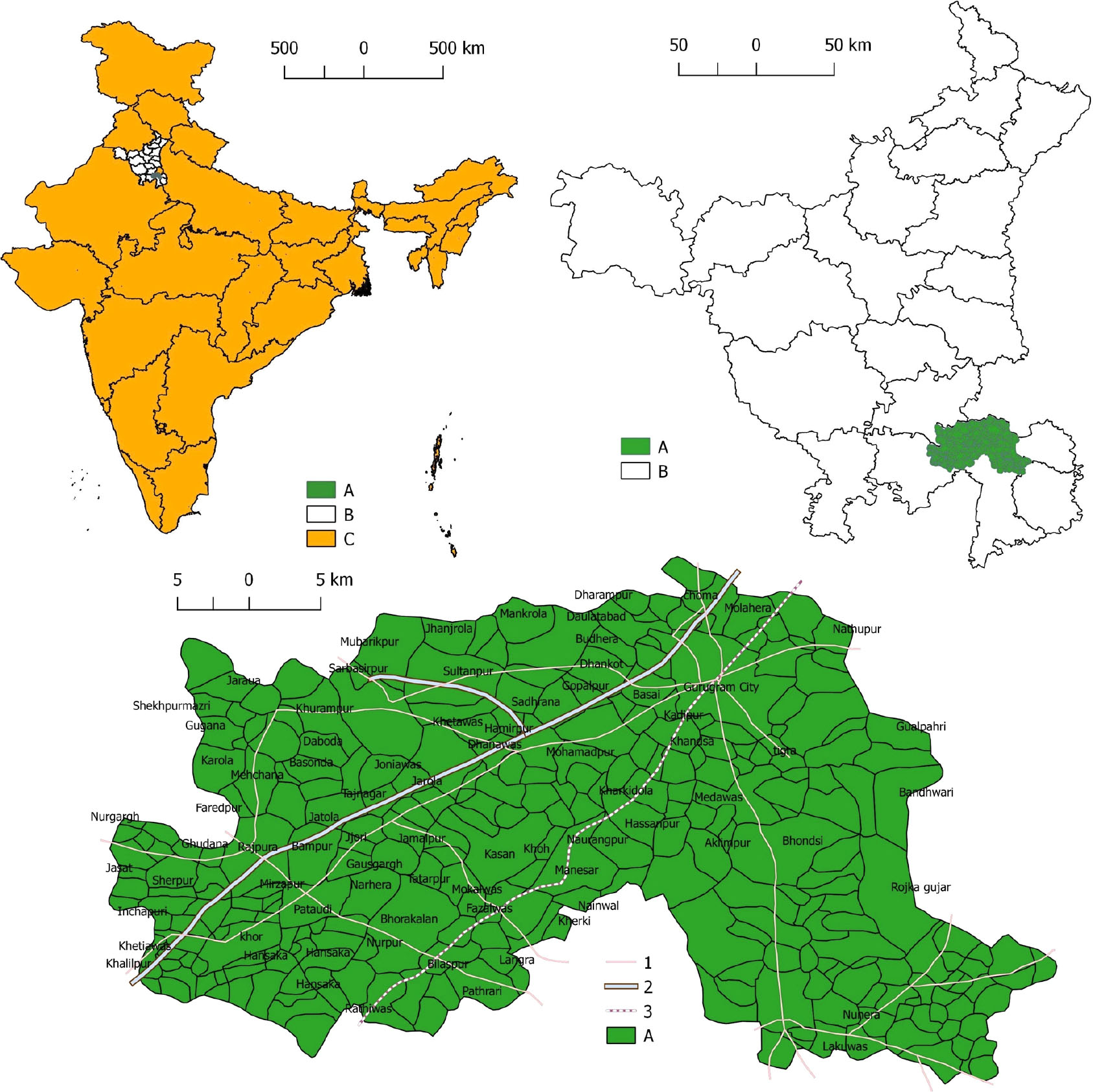
Fig. 1
Location map of the study area.
A – Gurugram district, B – Haryana, C – India, 1 – road network, 2 – railway line, 3 – national highway (NH-8).
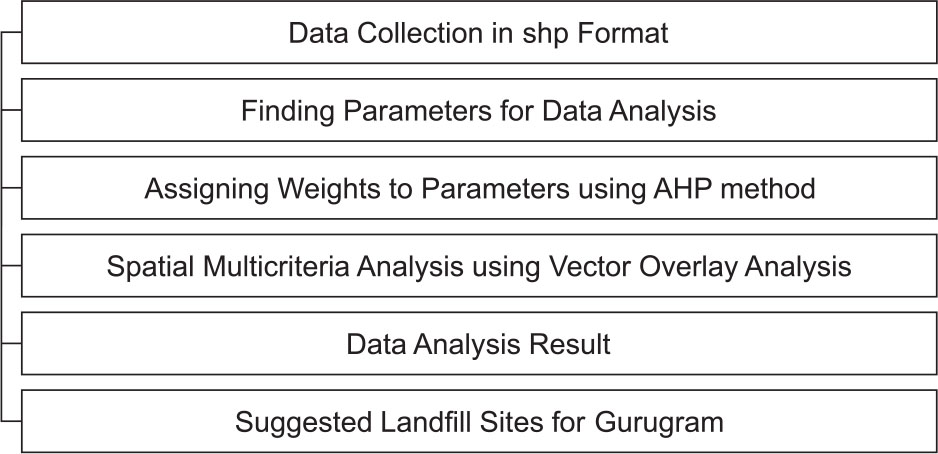
Fig. 2
Flowchart of methodology.
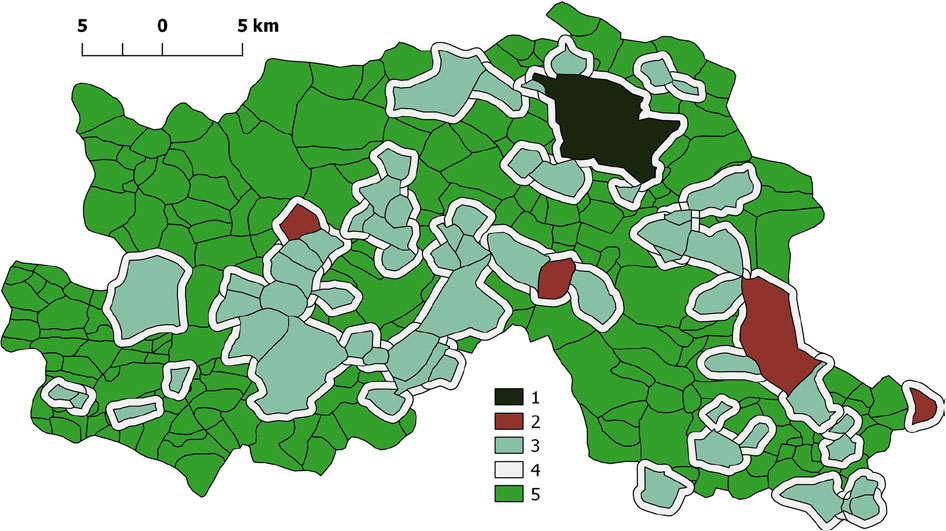
Fig. 3
Residential area analysis for Gurugram district.
1 – high population density, 2 – medium population density, 3 – low population density, 4 – 500 m buffer around the residential zone, 5 – Gurugram district boundary.
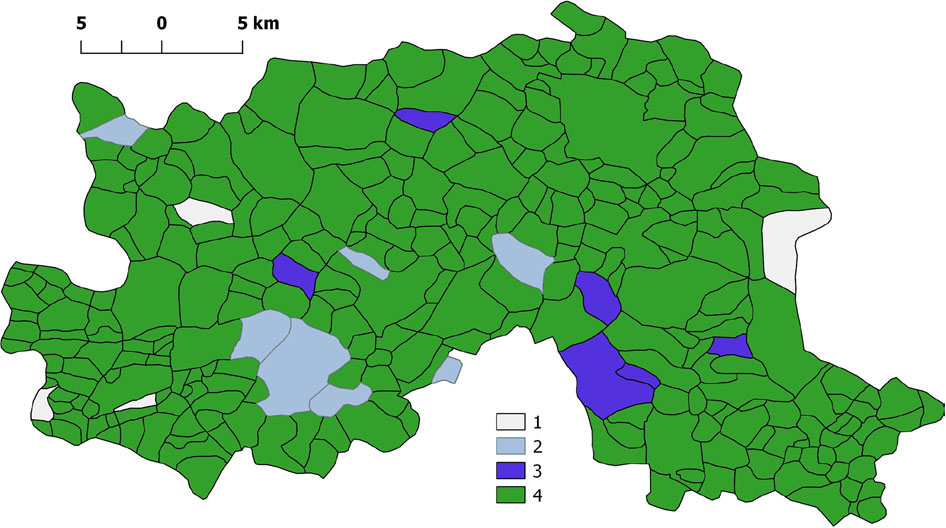
Fig. 4
Analysis of depth of underground water table analysis in Gurugram district (>20 m).
1 – 20–30 m, 2 – 30–40 m, 3 – 40–50 m, 4 – Gurugram district boundary.
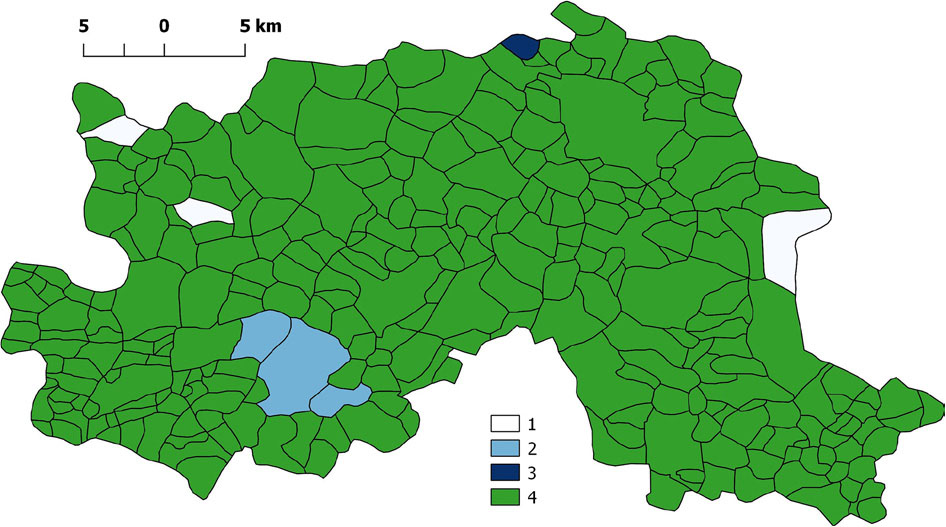
Fig. 5
Water Bodies Analysis for Gurugram district.
1 – dried ponds, 2 – sewage contaminated ponds, 3 – dirty pond, 4 – Gurugram district boundary.
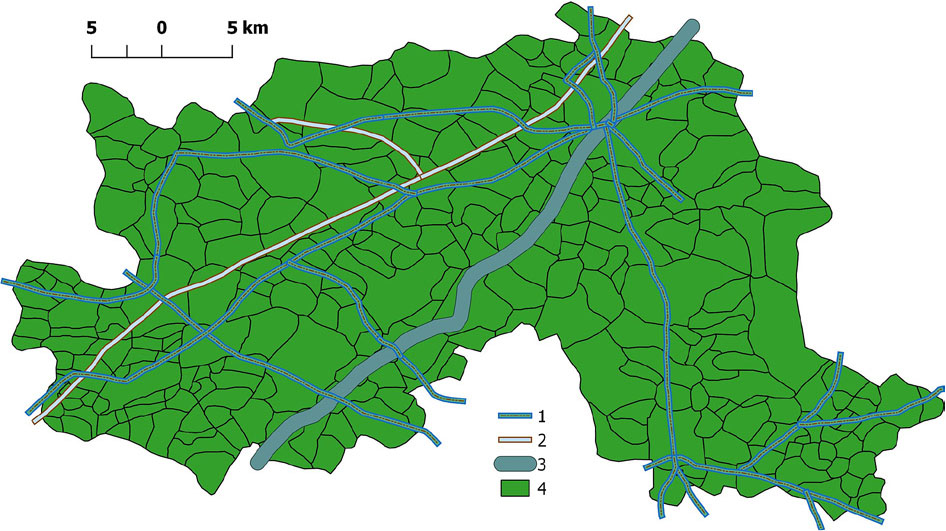
Fig. 6
Road Network Analysis for Gurugram district.
1 – road network, 2 – railway line, 3 – 200 m buffer around national highway (NH-8), 4 – Gurugram district boundary.
Table 1
Preference value scale.
| Strength of importance | Description |
|---|---|
| 1 | Equal value |
| 2 | Equal to moderate value |
| 3 | Moderate value |
| 4 | Moderate to strong value |
| 5 | Strong value |
| 6 | Strong to very strong value |
| 7 | Very strong value |
| 8 | Very to extremely strong value |
| 9 | Extreme value |
Table 2
Pairwise comparison and relative weights of different parameters.
| Sr. no. | Parameters for landfill site selection | Depth to groundwater | Proximity to residential area | Proximity to NH-8 | Presence of ponds | Criteria weights |
|---|---|---|---|---|---|---|
| 1. | Depth to Groundwater | 1.00 | 5.00 | 4.00 | 7 | 0.6038 |
| 2. | Proximity to Residential Area | 0.20 | 1.00 | 0.50 | 3 | 0.1365 |
| 3. | Proximity to National Highways (NH-8) | 0.25 | 2.00 | 1.00 | 3 | 0.1958 |
| 4. | Presence of Ponds | 0.14 | 0.33 | 0.33 | 1 | 0.0646 |
Table 3
Random Index for different ‘m’ values.
| ‘m’ value | 1 | 2 | 3 | 4 | 5 | 6 | 7 | 8 | 9 | 10 |
|---|---|---|---|---|---|---|---|---|---|---|
| Random Index (R.I.) | 0.00 | 0.00 | 0.58 | 0.90 | 1.12 | 1.24 | 1.32 | 1.41 | 1.45 | 1.49 |
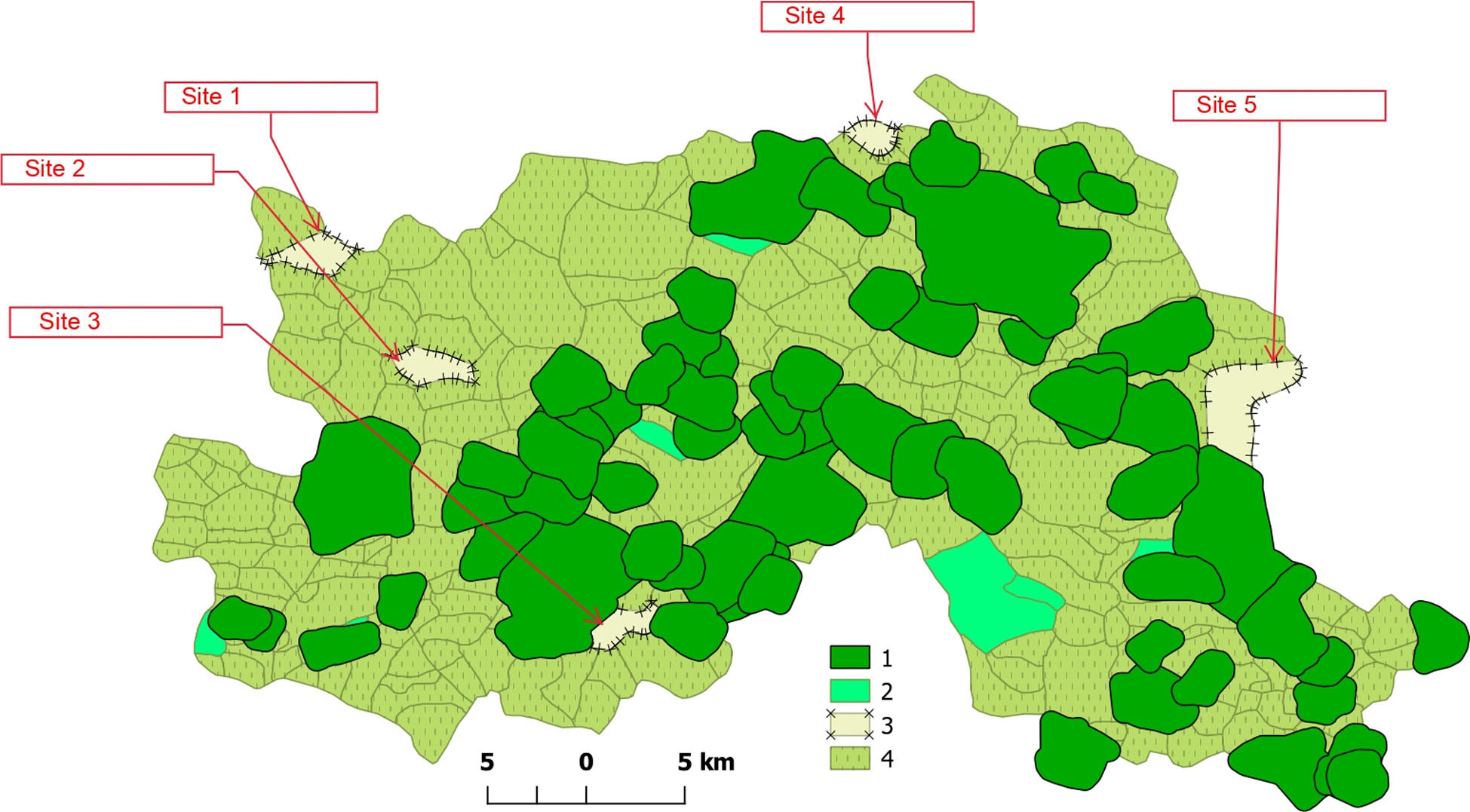
Fig. 7
Map for suggested landfill sites.
1 – unsuitable zones, 2 – suitable zones, 3 – landfill sites, 4 – moderately suitable zones.
Table 4
Calculated value of criterion weight, CI, RI, CR.
| Sr. no. | Parameters for landfill site selection | Criteria weight | λmax | Consistency index [CI] | Random index [RI] | Consistency ratio [CR] |
|---|---|---|---|---|---|---|
| 1. | Depth to groundwater | 0.6038 | 4.1007 | 0.03358 | 0.90 | 0.037311 |
| 2. | Proximity to residential area | 0.1365 | ||||
| 3. | Proximity to NH-8 | 0.1958 | ||||
| 4. | Presence of ponds | 0.0646 |