
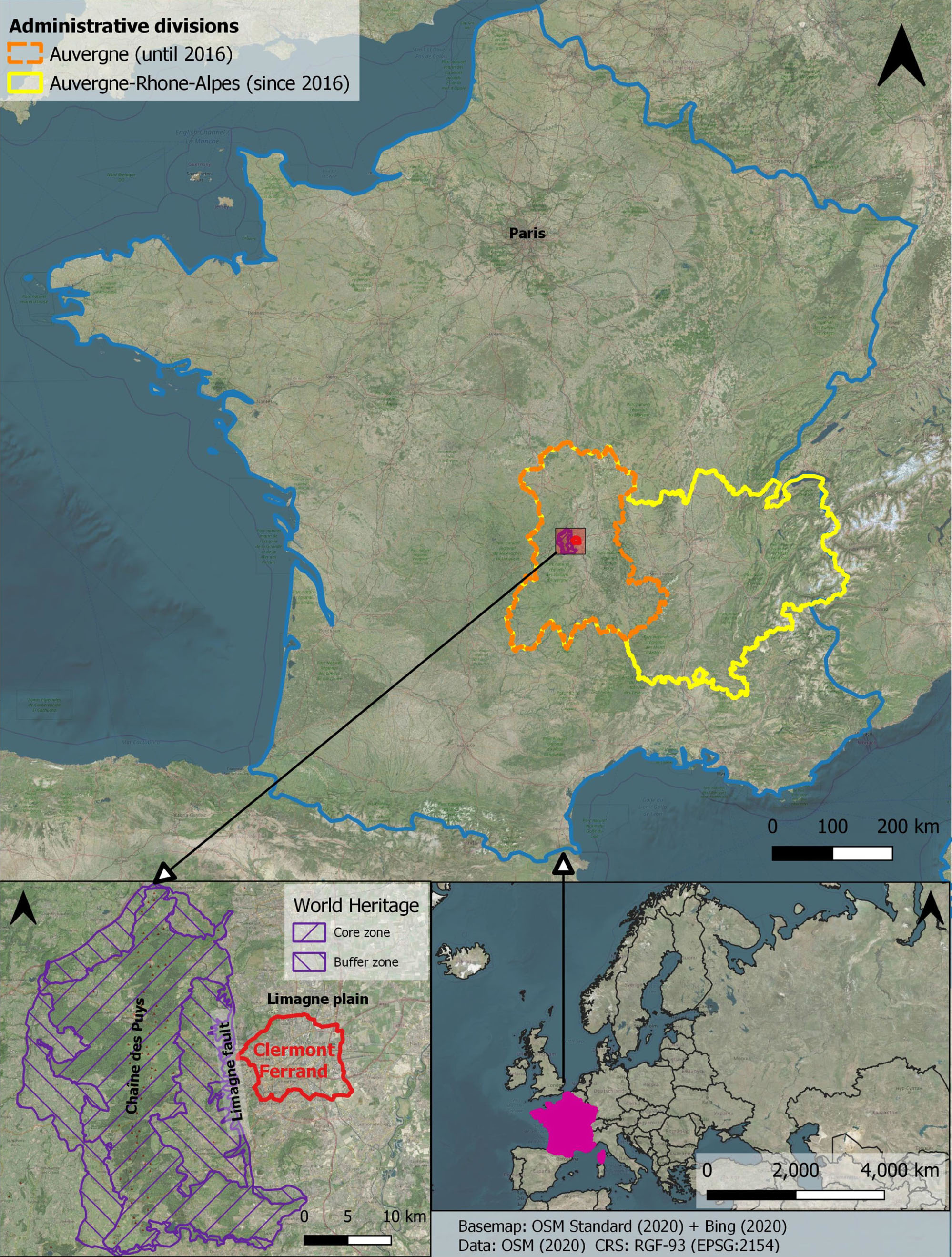
Fig. 1
The location of Clermont-Ferrand in France and in Auvergne.
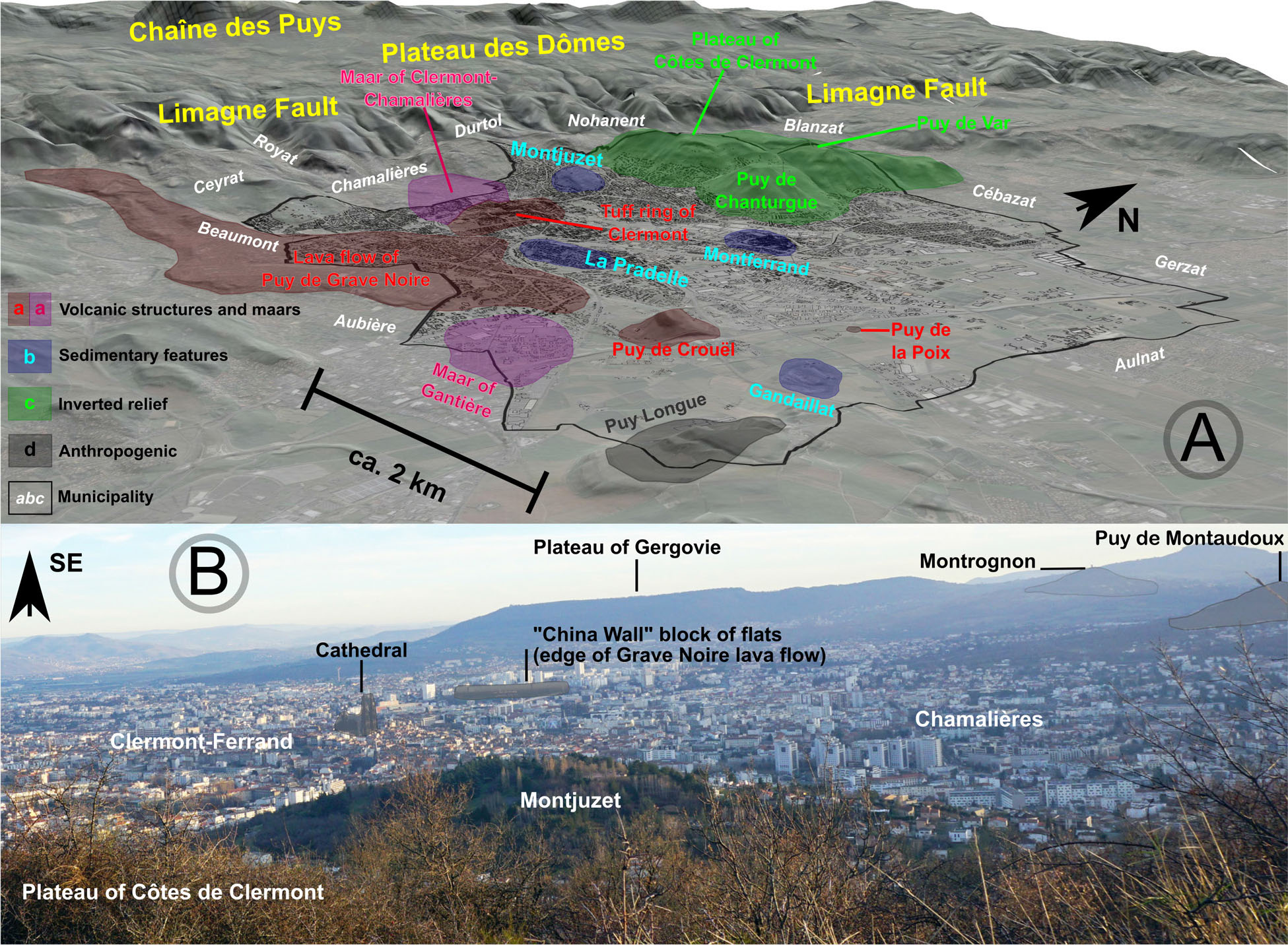
Fig. 2
The main geological – geomorphological features of Clermont-Ferrand.
A – A DEM (CRAIG 2013) view from southeast, indicating the extension of built-up areas as well (OSM 2020).
B – the view of the city from its highest point, the Plateau of Côtes du Clermont. The Plateau of Gergovie in the background is an inverted relief feature as well, but outside the city limits.
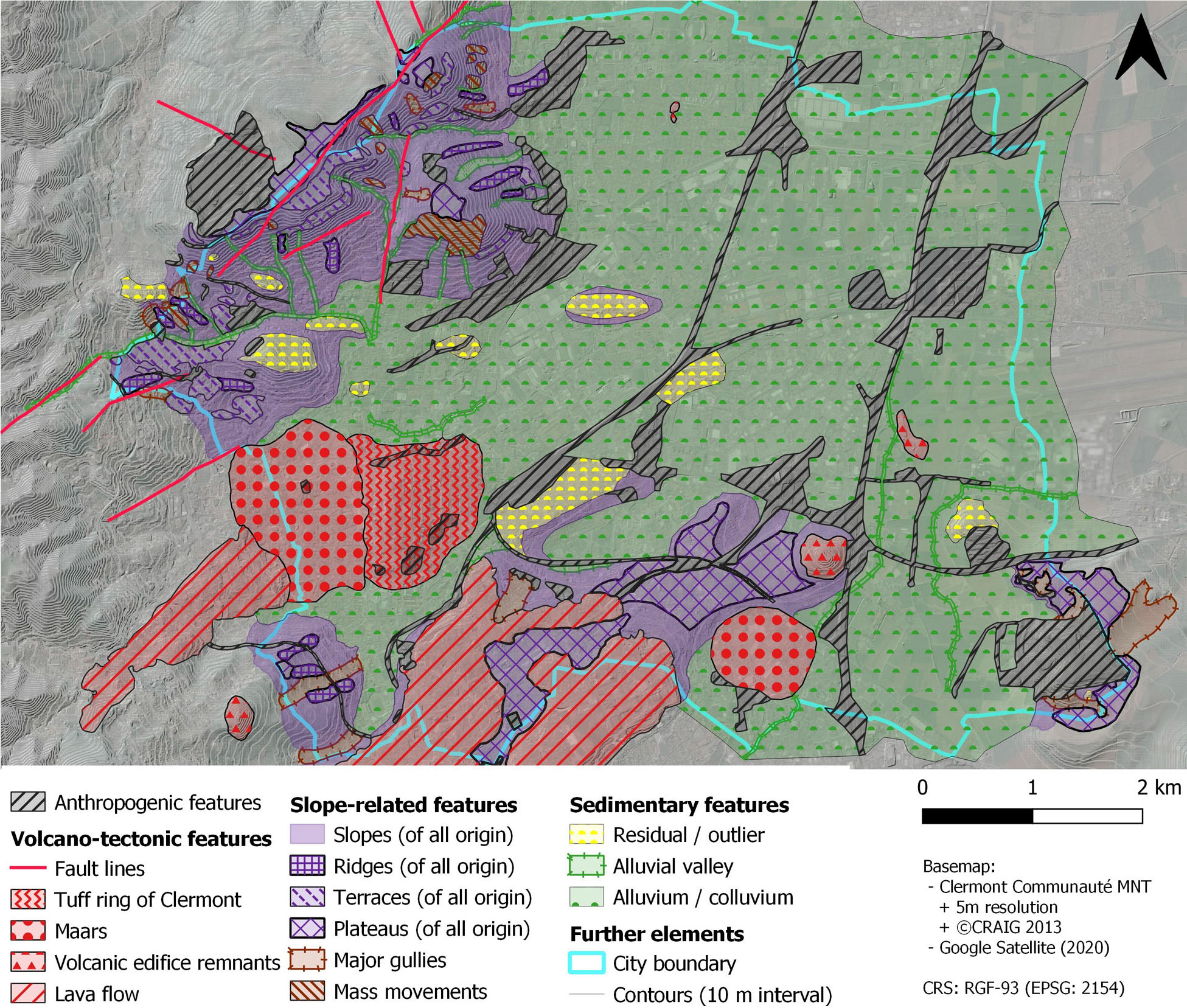
Fig. 3
The simplified geomorphological map of Clermont-Ferrand.
Table 1
Synthesis of the national geosite inventorying method of France, the INPG, based on de Wever et al. (2015).
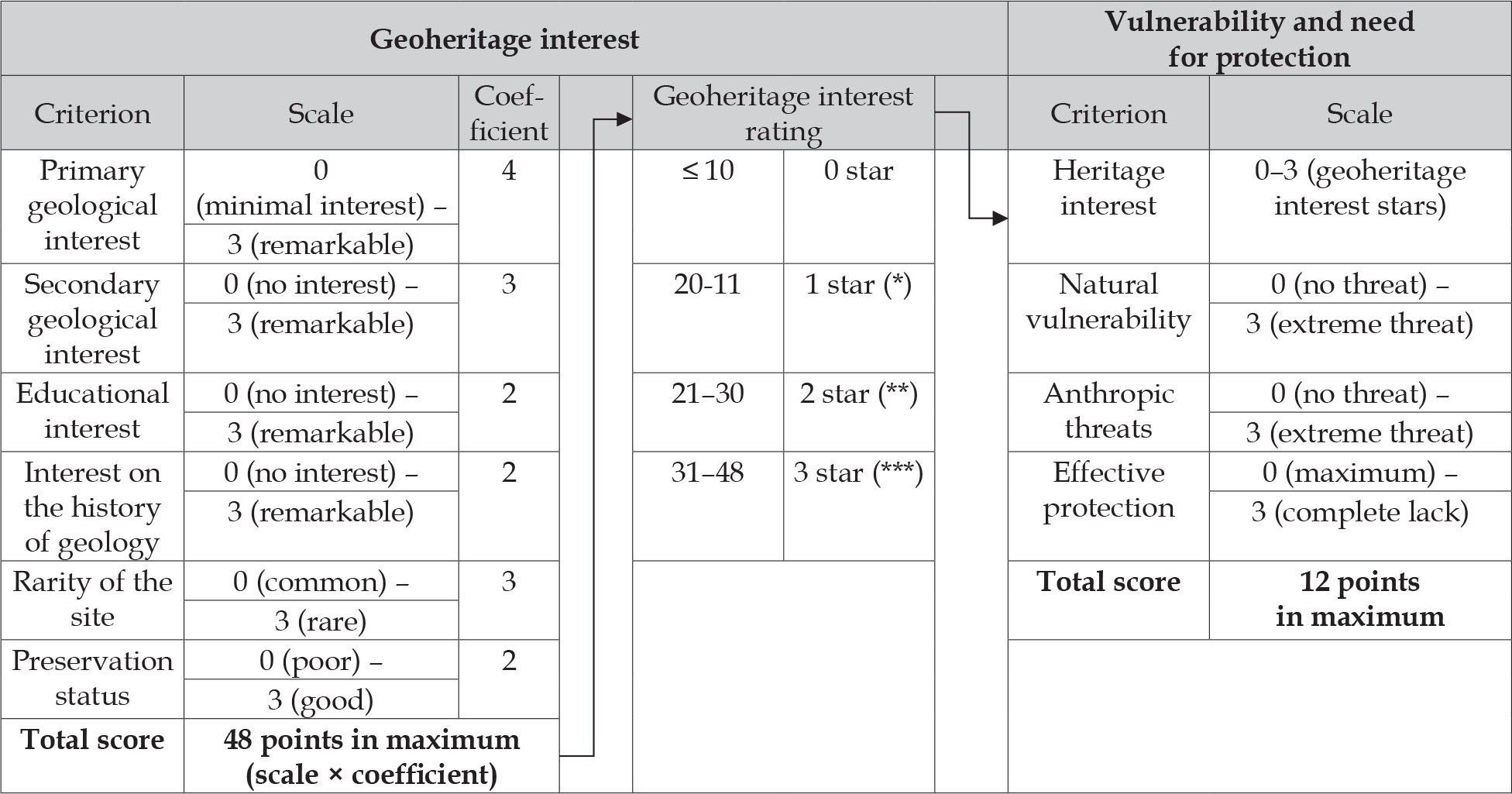
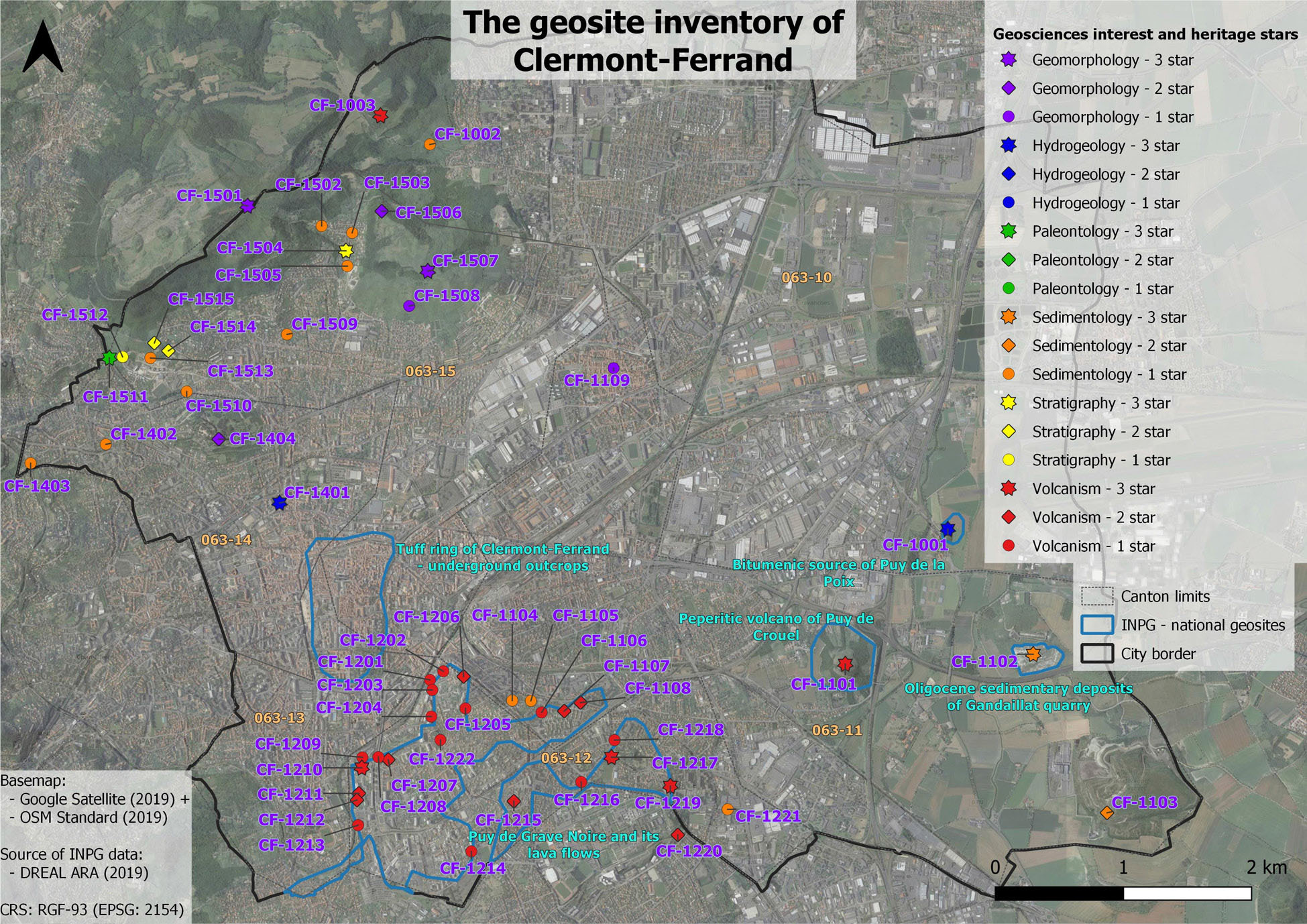
Fig. 4
Geographical distribution of geosites and geodiversity sites in Clermont-Ferrand according to the local inventory.
Table 2
The list of current geosites in the geoheritage inventory of Clermont-Ferrand. GS/GDS means a site that was classified as geosite (GS) or geodiversity site (GDS) on the basis of expert decision (final decision in parenthesis).
| Geosite ID | Name of geo(diversity) site | Geoheritage Interest score | Number of geoheritage interest stars | Vulnerability and need for protection | Status by geoheritage stars | Primary Geological interest |
|---|---|---|---|---|---|---|
| CF–1001 | Puy de la Poix – bitumen spring | 37 | 3 | 8 | geosite | hydrogeology |
| CF–1002 | R. Cheval – Oligocene sediments | 20 | 1 | 8 | geodiversity site | sedimentology |
| CF–1003 | Puy de Var – inverted relief | 37 | 3 | 8 | geosite | volcanism |
| CF–1101 | Puy de Crouël – peperitic volcanic neck | 46 | 3 | 6 | geosite | volcanism |
| CF–1102 | Quarry of Gandaillat – Oligocene sediments | 40 | 3 | 8 | geosite | sedimentology |
| CF–1103 | Puy Longue – Anthropogenic garbage deposit | 23 | 2 | 10 | GS / GDS (GDS) | sedimentology |
| CF–1104 | R. Oradou 62 – Oligocene sediments | 18 | 1 | 7 | geodiversity site | sedimentology |
| CF–1105 | R. Oradou 98 – Oligocene sediments | 14 | 1 | 7 | geodiversity site | sedimentology |
| CF–1106 | R. Oradou 98 – Grave Noire lava flow | 14 | 1 | 7 | geodiversity site | volcanism |
| CF–1107 | R. Oradou 118 – Grave Noire lava flow | 21 | 2 | 11 | GS / GDS (GDS) | volcanism |
| CF–1108 | R. Oradou 128 – Grave Noire lava flow | 26 | 2 | 9 | GS / GDS (GS) | volcanism |
| CF–1109 | Montferrand – marls mount | 17 | 1 | 8 | geodiversity site | geomorphology |
| CF–1201 | R. Pont–de–Naud 21 – Grave Noire lava flow | 14 | 1 | 5 | geodiversity site | volcanism |
| CF–1202 | R. Marivaux 9 – Grave Noire lava flow | 20 | 1 | 6 | geodiversity site | volcanism |
| CF–1203 | R. Docteur Chibret 2 – Grave Noire lava flow | 16 | 1 | 6 | geodiversity site | volcanism |
| CF–1204 | Av. Léon Blum 65– Grave Noire lava flow | 11 | 1 | 6 | geodiversity site | volcanism |
| CF–1205 | R. Neuf Soleils 38– Grave Noire lava flow | 18 | 1 | 6 | geodiversity site | volcanism |
| CF–1206 | Résidence Cheops 2 – Grave Noire lava flow | 23 | 2 | 8 | GS / GDS (GDS) | volcanism |
| CF–1207 | R. Henry Andraud 21 – Grave Noire lava flow | 30 | 2 | 9 | GS / GDS (GS) | volcanism |
| CF–1208 | Pilon of the viaduct of Saint–Jacques – Grave Noire lava flow | 11 | 1 | 6 | geodiversity site | volcanism |
| CF–1209 | R. Pont Saint Jacques 62 – Grave Noire lava flow | 11 | 1 | 4 | geodiversity site | volcanism |
| CF–1210 | R. Desdevises du Dèzert 20 – Grave Noire lava flow + spring | 34 | 3 | 10 | geosite | volcanism |
| CF–1211 | Cité Universitaire Dolet – Grave Noire lava flow | 28 | 2 | 9 | GS / GDS (GS) | volcanism |
| CF–1212 | Imp. Dr. Cohendy – Grave Noire lava flow | 25 | 2 | 10 | GS / GDS (GS) | volcanism |
| CF–1213 | R. Étienne Dolet 60 – Grave Noire lava flow | 14 | 1 | 8 | geodiversity site | volcanism |
| CF–1214 | R. Roty 35 – Grave Noire lava flow | 14 | 1 | 8 | geodiversity site | volcanism |
| CF–1215 | Al. Rocailles 2 – Grave Noire lava flow | 26 | 2 | 8 | GS / GDS (GDS) | volcanism |
| CF–1216 | Av. Landais 8 – Grave Noire lava flow | 20 | 1 | 8 | geodiversity site | volcanism |
| CF–1217 | Creux de l’enfer – Grave Noire lava flow | 41 | 3 | 8 | geosite | volcanism |
| CF–1218 | R. Louis Dabert 20–24 – Grave Noire lava flow | 14 | 1 | 8 | geodiversity site | volcanism |
| CF–1219 | Saint–Astrimoine – Grave Noire lava flow | 33 | 3 | 12 | geosite | volcanism |
| CF–1220 | Margeride tram stop – Grave Noire lava flow | 31 | 2 | 9 | GS / GDS (GS) | volcanism |
| CF–1221 | R. Étienne et George Sauvestre – Alluvial infill of Maar de Gantière | 16 | 1 | 8 | geodiversity site | sedimentology |
| CF–1222 | Av. Léon Blum 76 – Grave Noire lava flow | 14 | 1 | 7 | geodiversity site | volcanism |
| CF–1401 | Saint–Alyre – travertine spring | 44 | 3 | 7 | geosite | hydrogeology |
| CF–1402 | R. Durtol 85 – Oligocene sediments | 16 | 1 | 7 | geodiversity site | sedimentology |
| CF–1403 | R. Farnettes 31 – Oligocene sediments | 16 | 1 | 8 | geodiversity site | sedimentology |
| CF–1404 | Montjuzet – Oligocene sedimentary residual | 27 | 2 | 8 | GS / GDS (GS) | geomorphology |
| CF–1501 | Plateau of Côtes de Clermont inverted relief | 37 | 3 | 8 | geosite | geomorphology |
| CF–1502 | Ch. Mouchette 40 – Oligocene sediments | 20 | 1 | 8 | geodiversity site | sedimentology |
| CF–1503 | Al. Écureuils 1 – Oligocene sediments | 16 | 1 | 9 | geodiversity site | sedimentology |
| CF–1504 | R. Blanzat 245 – tephra and paleosol | 40 | 3 | 10 | geosite | stratigraphy |
| CF–1505 | R. Blanzat 237 – Oligocene sediments | 20 | 1 | 9 | geodiversity site | sedimentology |
| CF–1506 | Puy de Chanturgue – Miocene lava flow quarry | 24 | 2 | 8 | GS / GDS (GDS) | geomorphology |
| CF–1507 | Puy de Chanturgue – landslides | 32 | 3 | 8 | geosite | geomorphology |
| CF–1508 | Puy de Chanturgue – gullies with sedimentary flank outcrops | 16 | 1 | 6 | geodiversity site | geomorphology |
| CF–1509 | R. Puyou 7 – Oligocene sediments | 16 | 1 | 8 | geodiversity site | sedimentology |
| CF–1510 | R. Bouys 43 – Oligocene sediments | 14 | 1 | 7 | geodiversity site | sedimentology |
| CF–1511 | R. Nohanent 184 – stromatolithes | 35 | 3 | 10 | geosite | paleontology |
| CF–1512 | R. Victor Charreton 18 – Oligocene sediments | 16 | 1 | 9 | geodiversity site | stratigraphy |
| CF–1513 | Rue V. Charreton x – Oligocene sediments | 20 | 1 | 8 | geodiversity site | sedimentology |
| CF–1514 | Rue V. Charreton y – Oligocene sediments | 23 | 2 | 9 | GS / GDS (GDS) | stratigraphy |
| CF–1515 | R. de Trémonteix – Oligocene sediments | 27 | 2 | 8 | GS / GDS (GDS) | stratigraphy |
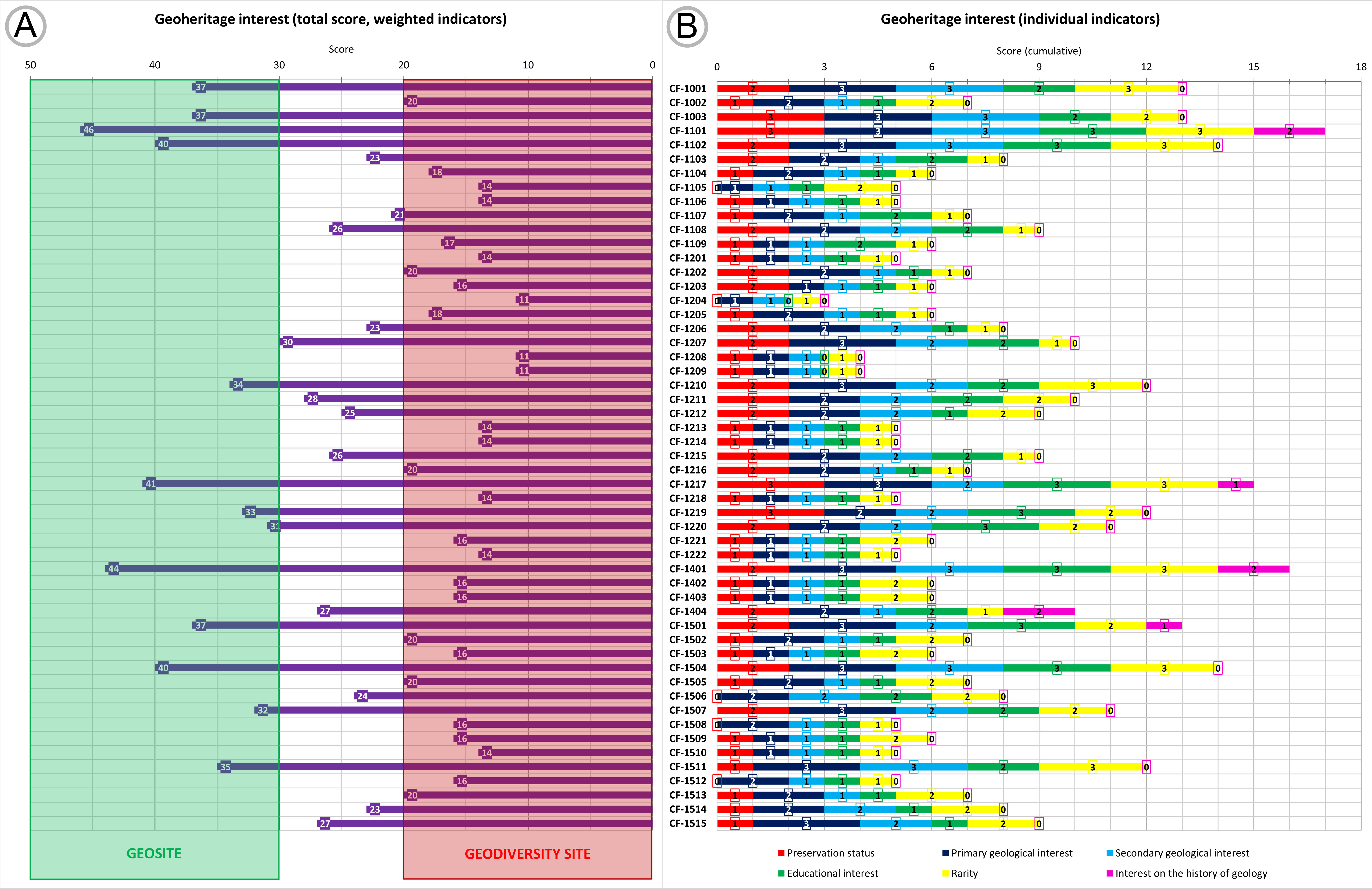
Fig. 5
Quantitative assessment of geoheritage interest of the local geosites and geodiversity sites of Clermont-Ferrand with INPG.
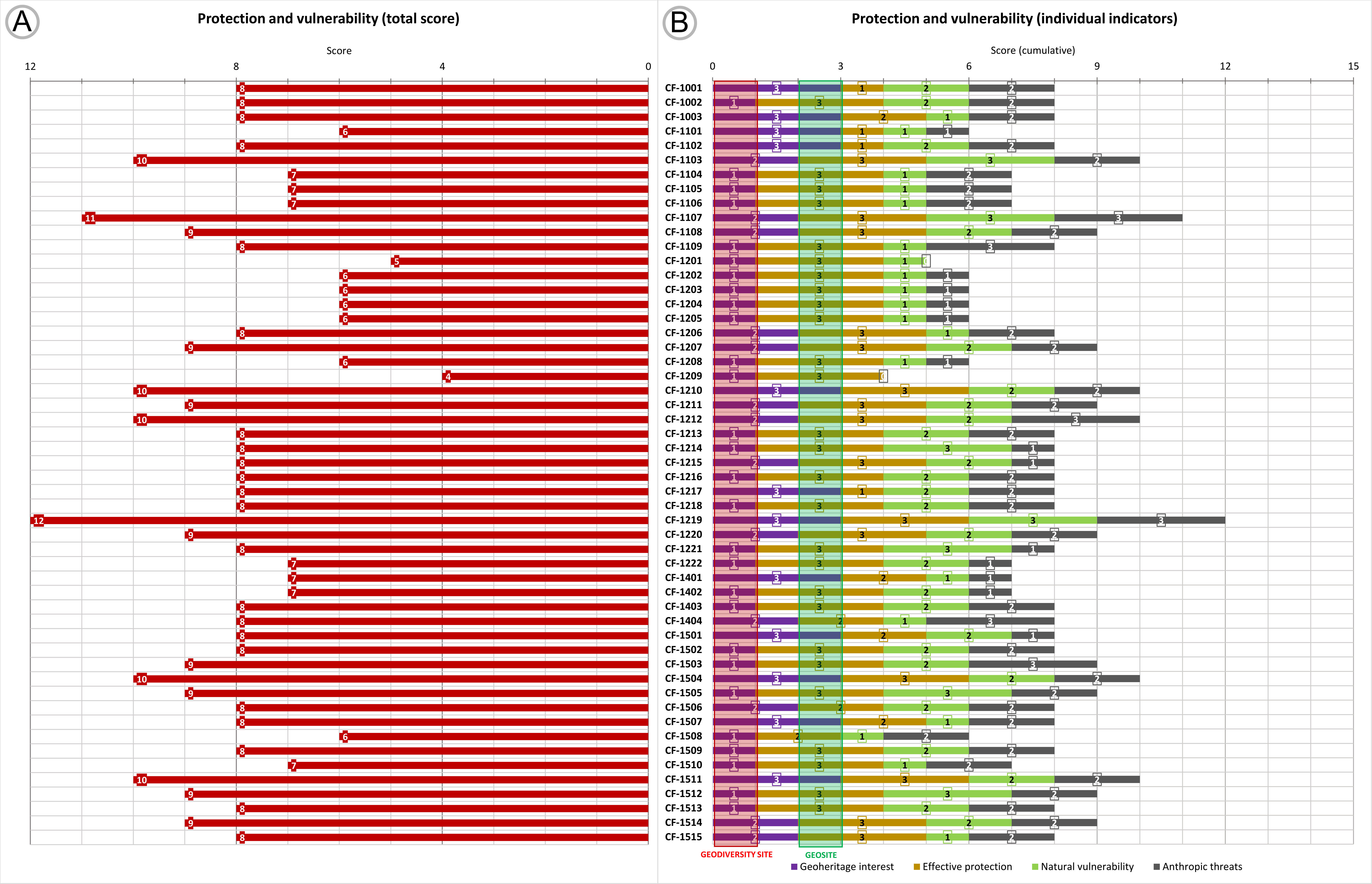
Fig. 6
Quantitative assessment of vulnerability and protection of the local geosites and geodiversity sites of Clermont-Ferrand with INPG.
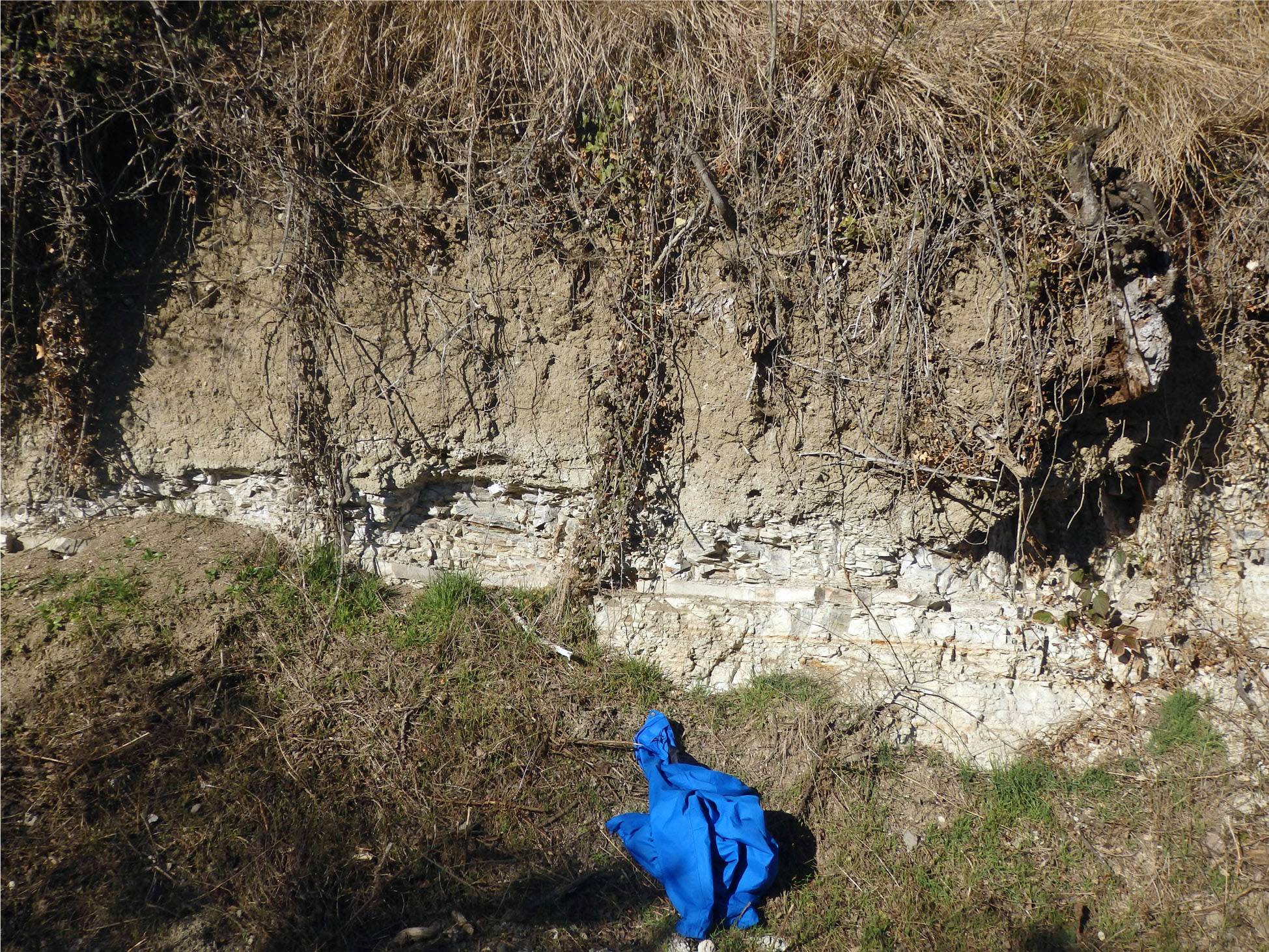
Fig. 7
Common conditions of an exposure of Oligocene sedimentary outcrops; example of CF1515 geosite at Rue de Trémonteix. Soil and colluvium top the small exposure, with a grassy talus.
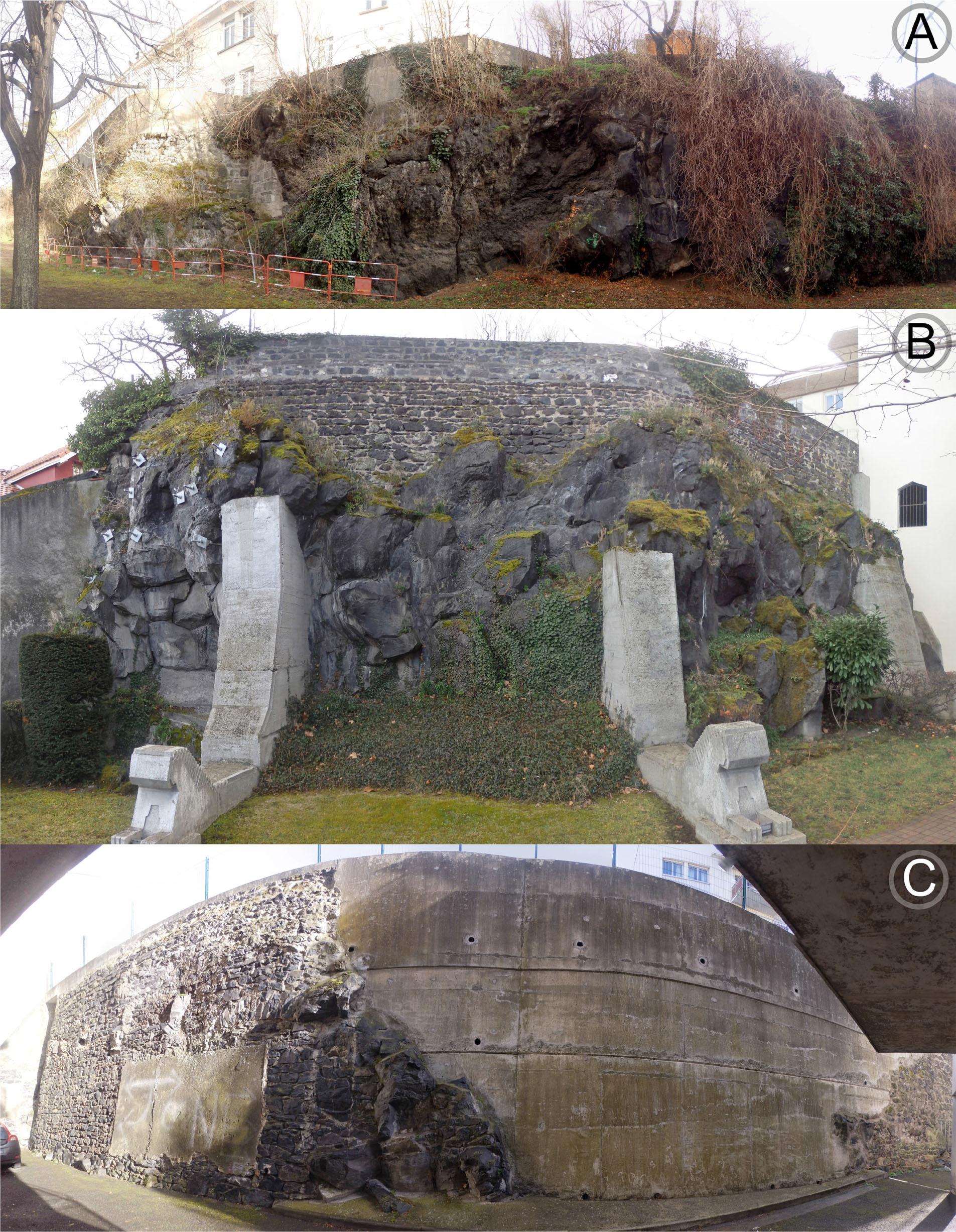
Fig. 8
Three examples of slope stabilization of outcrops of Grave Noire lava flow.
A – a still unconsolidated site at Rue Henry Arnaud 21 – CF1207. The temporary fence suggests an acknowledgement of some hazard, the danger is that poorly thought out remediation may destroy the sites values.
B – a gentle and intelligent solution of stabilization that preserves geoheritage value at Résidence Cheops 2 – CF1206, and adds some architectural value.
C – a brutal solution that mostly destroyed geoheritage value at Rue Pont de Naud 21 – CF1201. Note the older more harmonious stone wall on the left side is a more reasonable way to stabilise the rock.
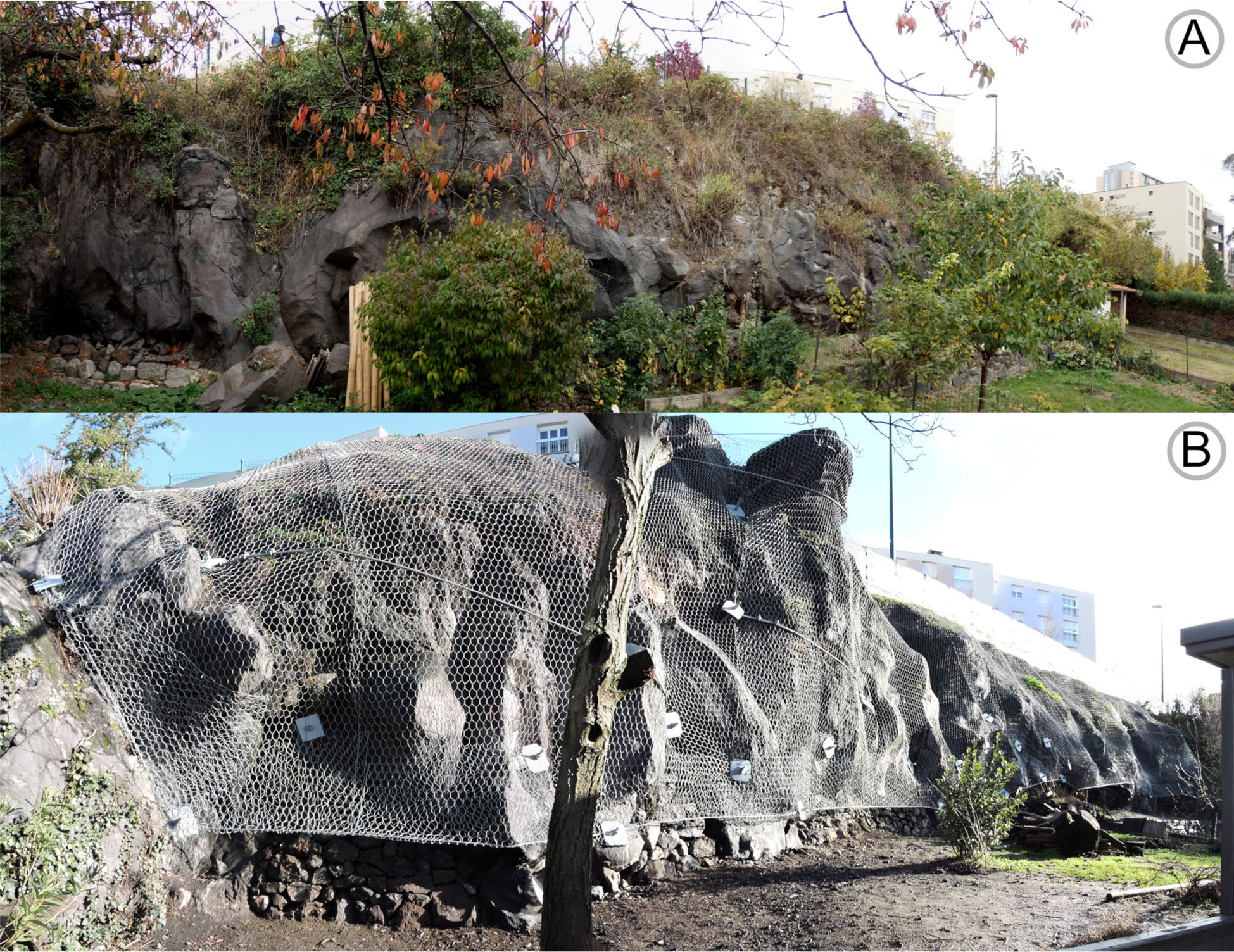
Fig. 9
The outcrop of Grave Noire lava flow at Impasse Dr. Cohendy (CF1212).
A – before the stabilization.
B – after the stabilization with bolting and mesh. While we still think that the meshing is an overreaction, it is a compromise between total destruction and the perceived hazard.
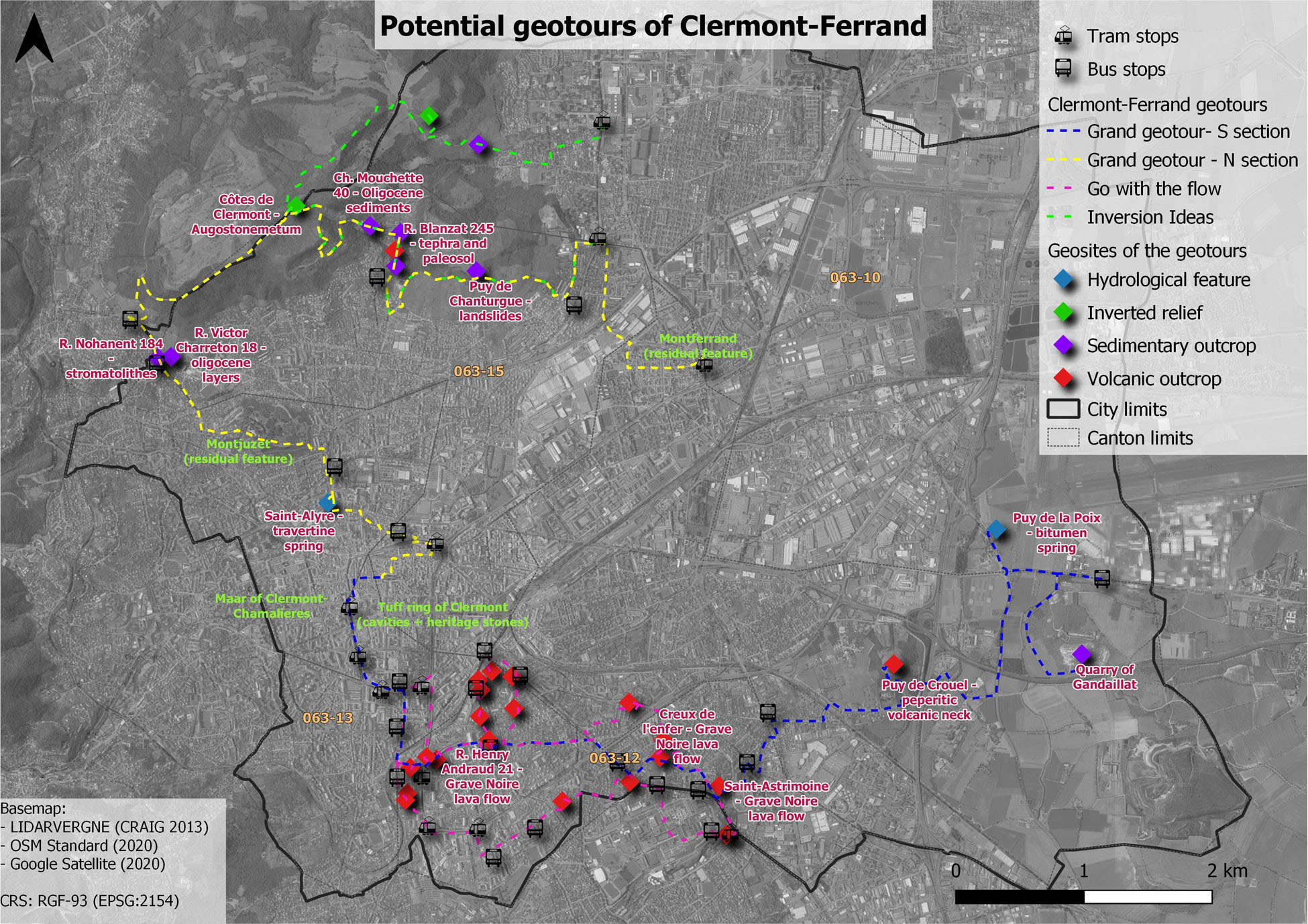
Fig. 10
The proposed geotouristic routes in Clermont-Ferrand with the names of the most important geosites along the tracks.