
Table 1
Distinguished ranges of changes according to the value of the structural convergence index.
| Structural convergence index (c) | Range of changes |
|---|---|
| 0.000 | total changes |
| 0.001; 0.399 | great |
| 0.400; 0.849 | average |
| 0.850; 0.974 | small |
| 0.975; 0.999 | very small |
| 1.000 | no changes |
[i] Source: own study.
Table 2
Potential possibilities of transformation of the land cover options considered.
| Forests (F.) | Grasslands (G.) | Surface waters (W.) | Built-up areas (B.) | |
|---|---|---|---|---|
| Forests (F.) | F. → G. | F. → W. | F. → B. | |
| Grasslands (G.) | G. → F. | G. → W. | G. → B. | |
| Surface waters (W.) | W. → F. | W. → G. | W. → B. | |
| Built-up areas (B.) | B. → F. | B. → G. | B. → W. |
[i] Source: own study.
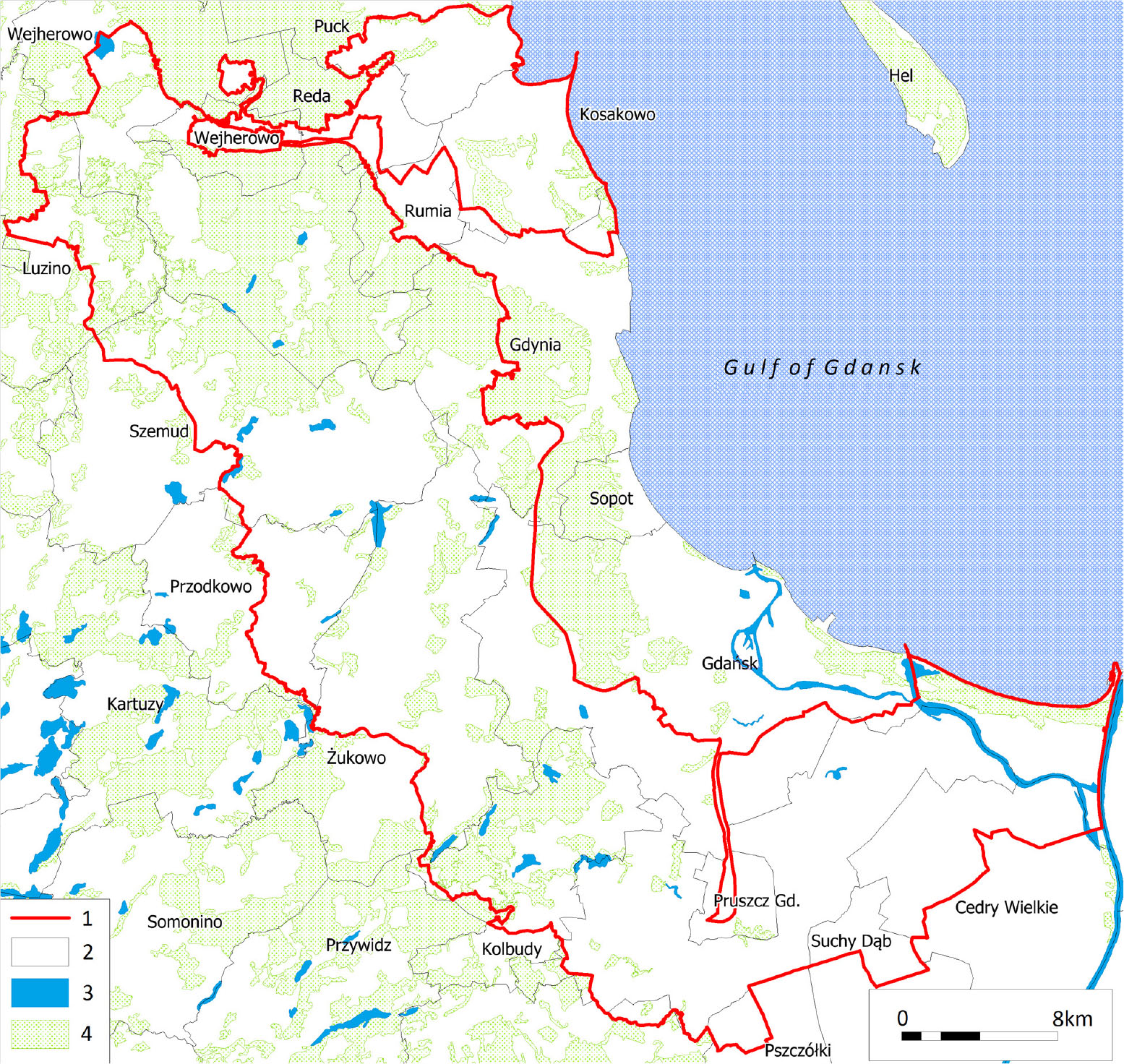
Fig. 1
Location of the research area on the background of the administration division of the Pomeranian Voivodeship.
1 – border of the study area, 2 – communes, 3 – surface waters, 4 – forests.
Source: own study.
Table 3
Characteristics of surface area, location and land cover of the selected testing grounds.
| Location of research area* | Characteristics |
|---|---|
| A – Area: 10.5 km2 Mesoregion: Pobrzeże Kaszubskie (Kashubian Coast) Microregions: Pradolina Kaszubska (Kashubian Glacial Valley); Kępa Rekowska (fragment). | The testing ground includes a fragment of the Reda valley, the so-called Mostowe Błota, between Rekowo Dolne and Reda-Ciechocino in the west, the Połchowo area in the north and the Łyski Channel in the south. The testing ground has an agricultural character. |
| B – Area: 12 km2 Mesoregion: Pojezierze Kaszubskie (Kashubian Lake District). Microregions: Wysoczyzna (Upland) Gniewowsko-Bieszkowicka; the Valley of Zagórska Struga; Wysoczyzna Łężycko-Chwaszczyńska. | The relief is very dynamic and the main natural axis is Zagórska Struga. There are numerous small natural water reservoirs. The landscape of the testing ground changes its character from agricultural to residential and recreational. |
| C – Area: 17.25 km2 Mesoregion: Pojezierze Kaszubskie (Kashubian Lake District). Microregions: Wysoczyzna Gdańska; the Valley of the Radunia River; Wysoczyzna Arciszewsko-Jagatowska | The Radunia valley, which constitutes the entire testing ground, is characterised by strong dynamics of relief formation processes due to its steep slopes. The development of the testing ground has a residential and recreational character. |
| D – Area: 17.25 km2 Mesoregions: Pojezierze Kaszubskie (Kashubian Lake District); Żuławy Wiślane. Microregions: Wysoczyzna Arciszewsko-Jagatowska; the Valley of the Kłodawa River (fragment). | The area includes a fragment of Żuławy on the border with Gdańsk Upland. The development is connected with the southern part of the city of Pruszcz Gdański (mainly industrial and warehousing) and the villages of Rusocin and Cieplewo (residential). The eastern part still plays an agricultural role, while the north-eastern part is occupied by a military airport. |
[i] Source: mesoregions according to Solon et al. 2018, microregions according to Przewoźniak 1985.
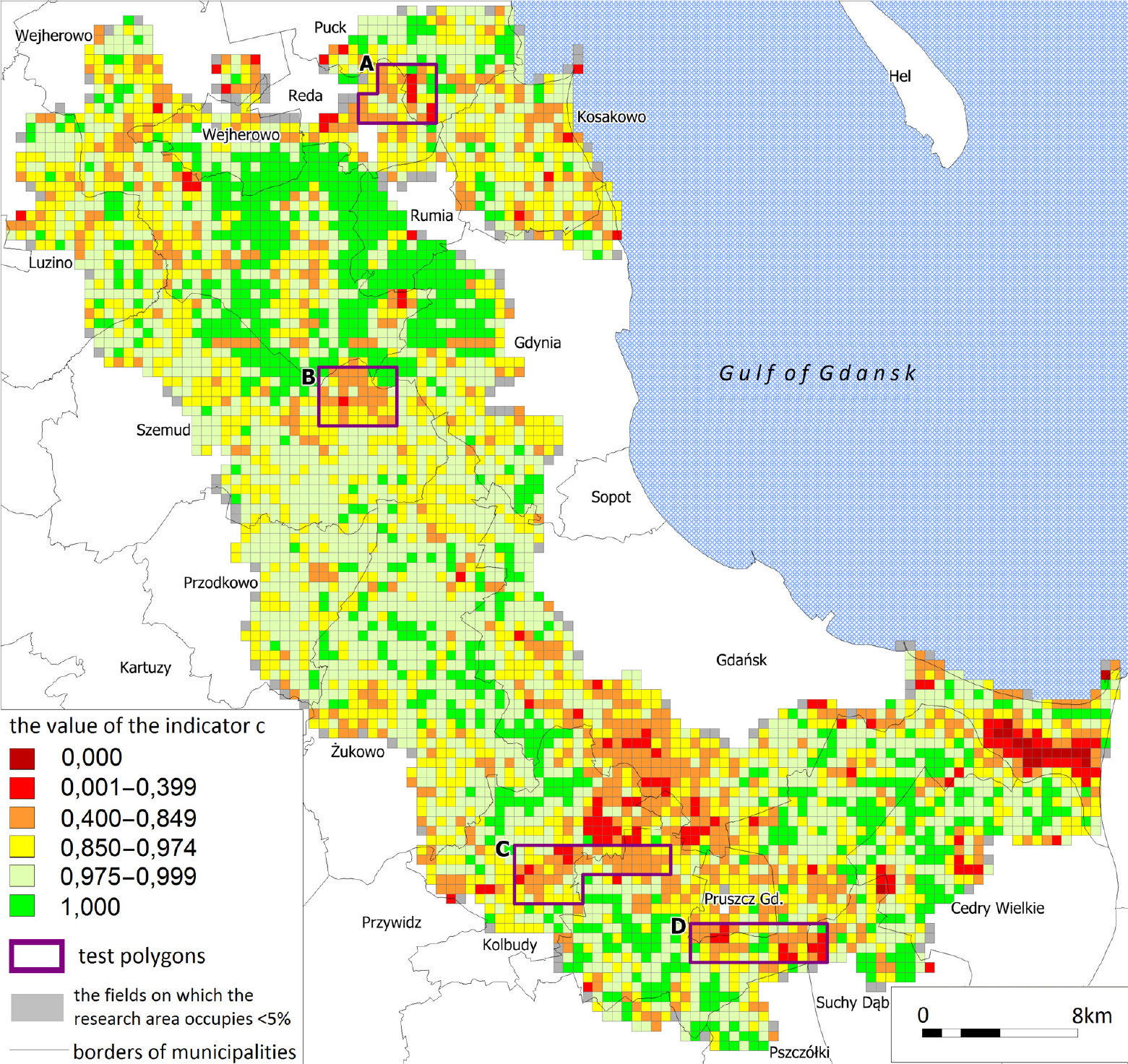
Fig. 2
Spatial distribution of indicator c and location of the testing grounds within the research area.
Source: own study.
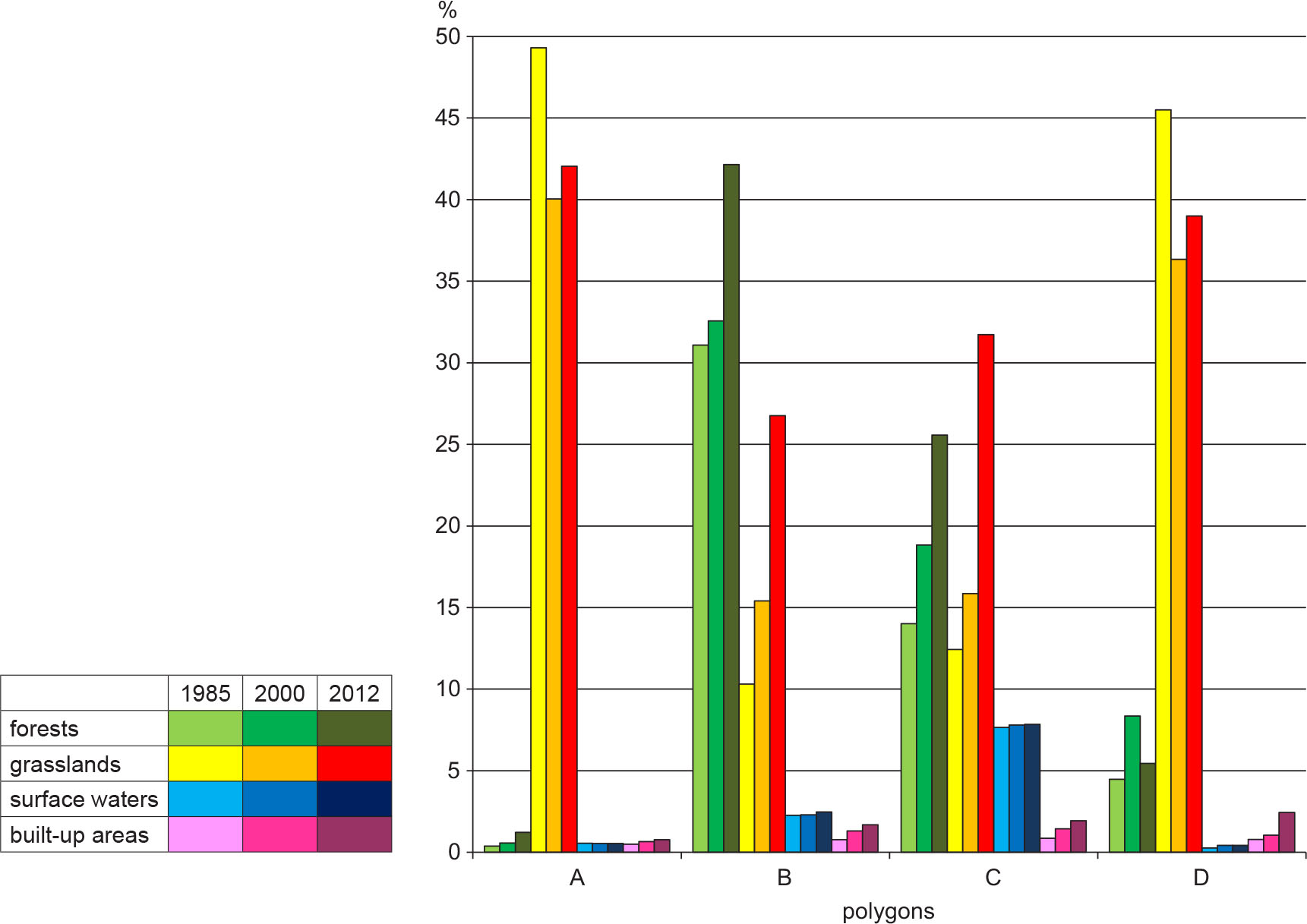
Fig. 3
Percentage of area occupied by selected forms of land cover in testing grounds in 1985, 2000 and 2012.
Source: own study.
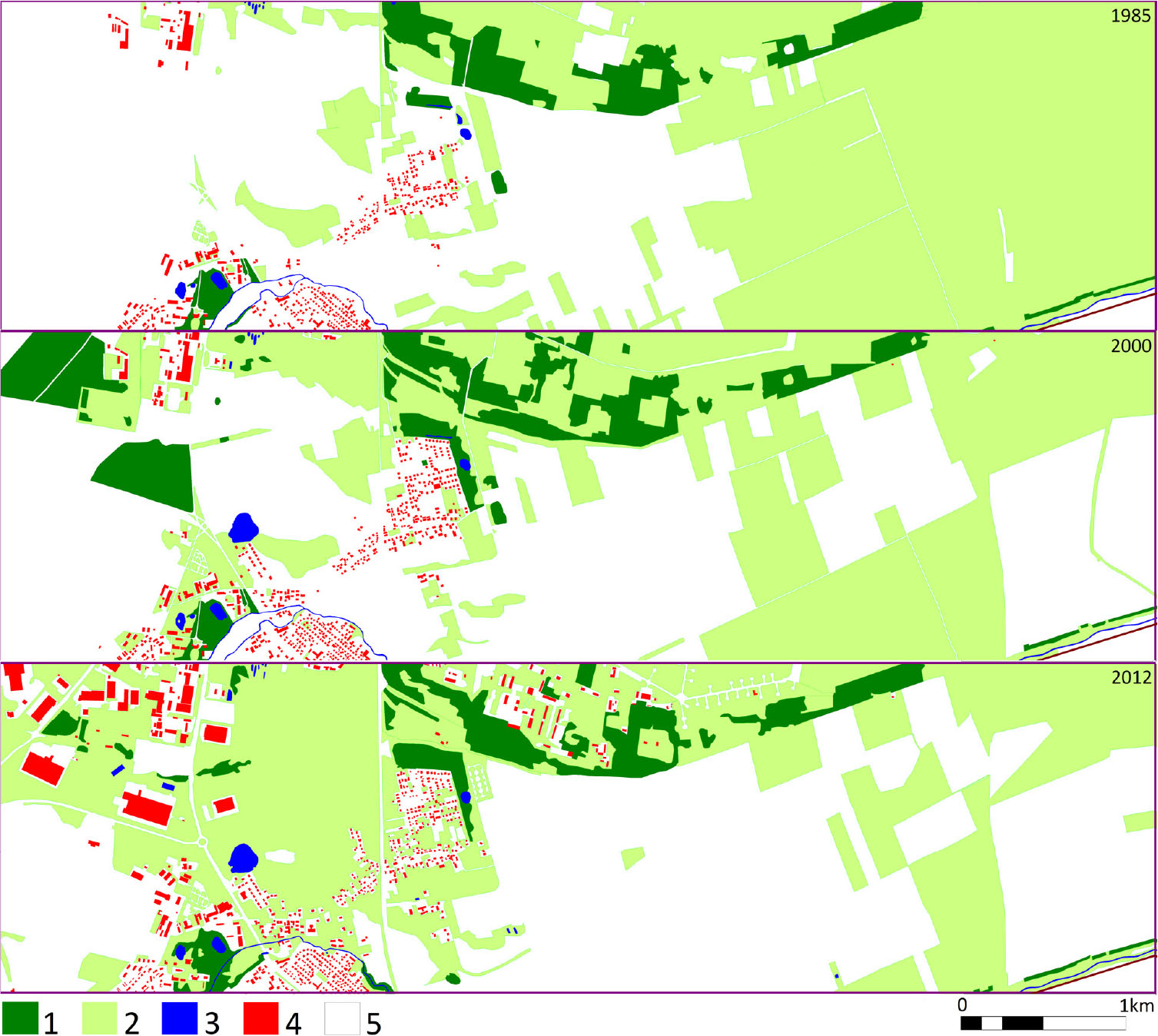
Fig. 4
State of the coverage of testing ground D in 1985, 2000 and 2012.
1 – forests, 2 – grasslands, 3 – surface waters, 4 – built-up areas, 5 – other land cover forms.
Source: own study.
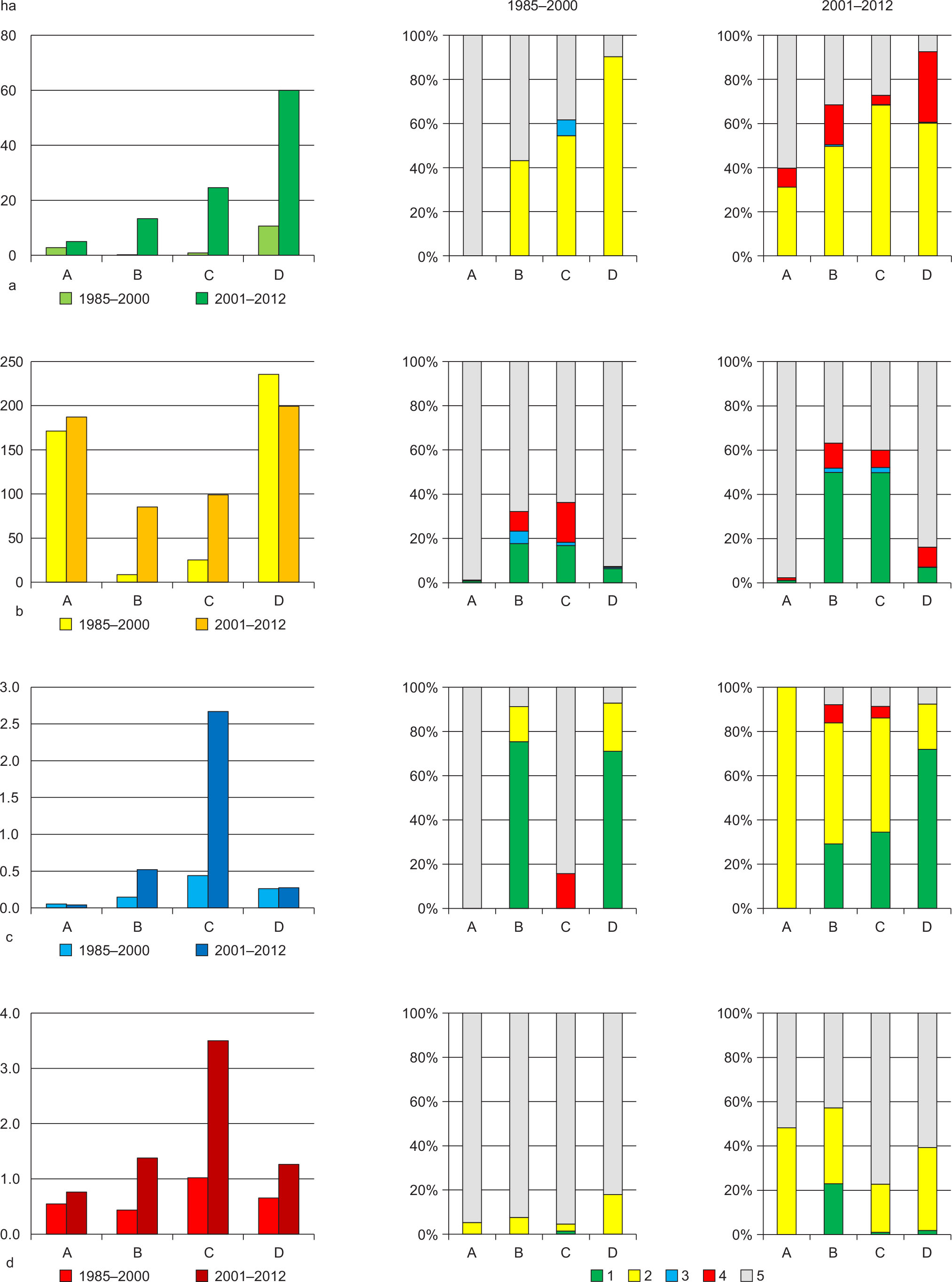
Fig. 5
Loss [ha] of forest (a), grassland (b), water (c) and built-up areas (d) in testing grounds A–D and the share of [%] types of land cover, which in the years 1985–2000 and 2001–2012 were transformed into: 1 – forests, 2 – grassland, 3 – water, 4 – built-up areas, 5 – other type of cover.
Source: own study.
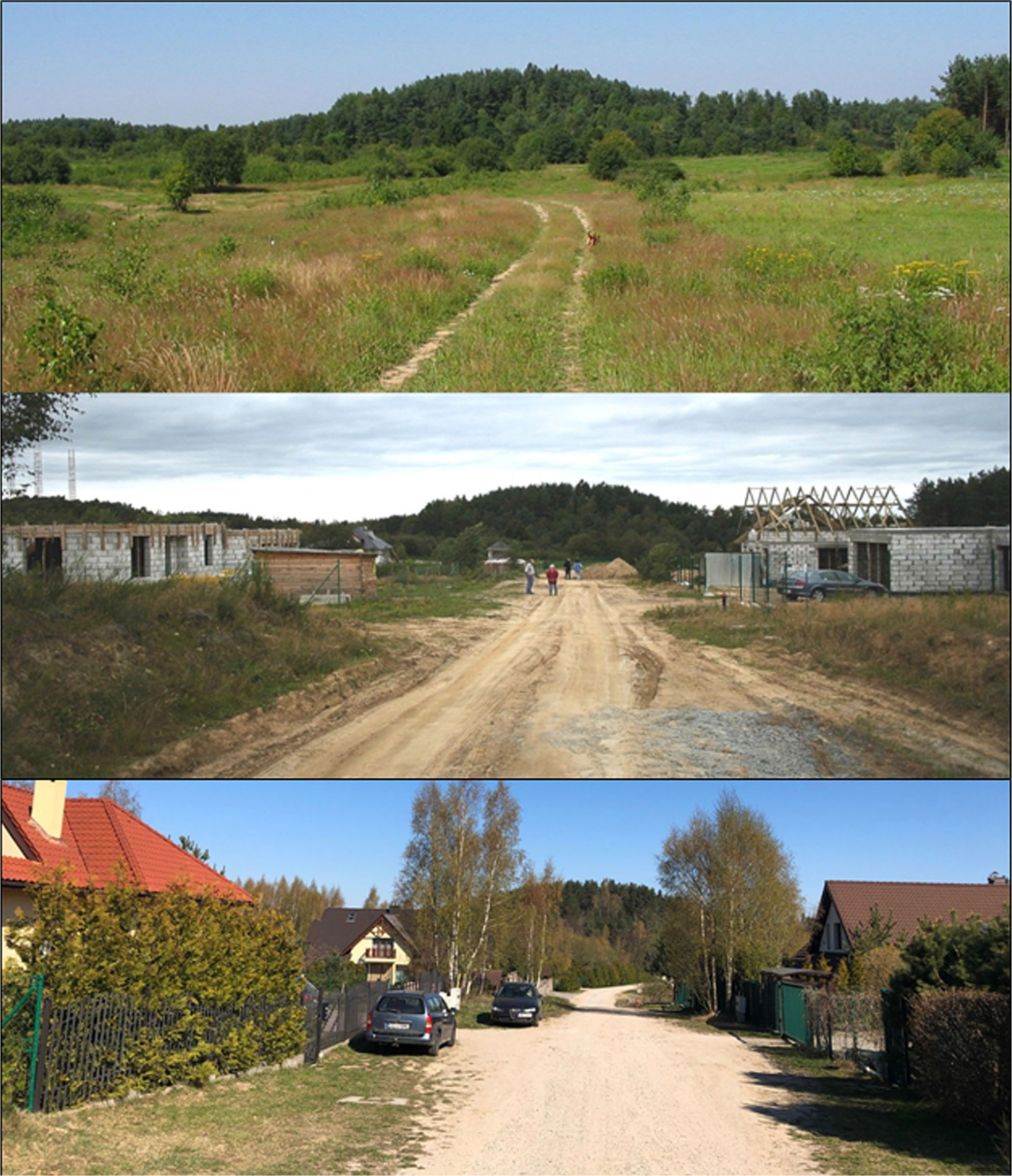
Fig. 6
Change of grasslands into detached houses near Kielno (testing ground B) in 2004, 2007 and 2019.
Source: photos taken by P. Baszanowski.
Table 4
Loss of selected forms of land cover in the years 1985–2000 and 2001–2012.
| Losses [km2] | 1985–2000 | 2001–2012 | Multiple of losses in second period in relation to first period |
|---|---|---|---|
| Forests | 1.5963 | 10.6659 | ×6.7 |
| Grasslands | 33.4734 | 66.8310 | ×2.0 |
| Surface waters | 0.7859 | 1.1892 | ×1.5 |
| Built-up areas | 0.7295 | 5.1754 | ×7.0 |
[i] Source: own study.