
Table 1
Differences in defining social risks.
| Domain | Definition of social risks |
|---|---|
| Sociology | Social risks represent the probability of some threats and uncertainties which have arisen as a result of modernising the society, which imply irreversible damage for all forms of life (Beck 1992) |
| Social risks represent key-factors for economic and social cohesion, which contribute to increasing the local community’s quality of life (Hruska-Tvrdy, Foldynova 2011) | |
| Geography | The social risk refers to the possibility for a potential social disturbance, conflicts and social damages, caused by insecurity factors from different fields. Modern social risks refer to dangers and insecurity from the systematic process of modernisation (Li Hong et al. 2017) |
| Risk is the combination of the probability of an event and its negative consequences (Bălteanu, Sima 2013) | |
| The probability of possible losses (loss of human life, injury, disturbance in economic activities, goods deteriorated or destroyed, alterations of the environment) determined by a certain danger, under some circumstances of exposure and vulnerability (UNISDR 2009) | |
| Psychology | The social risk represents the susceptibility in compromising one’s survival/quality of life, or in provoking socio-economic disturbances. (Larousse 1999) |
| The probability of a loss as a level or degree of a possible loss, as a weighted loss according to its probability, or as a variant of an event. For the public, the risk can be any of these occurrences and maybe even more than that, risks can be seen in almost every field in our lives (Havârneanu 2015) | |
| Law and social security | The social risk refers to a series of unfavourable events (loss of income, incapacity for work, etc.) which involve income discontinuity; the total or the partial loss of income (Convention No. 102/1952 of the International Labour Organisation) |
| The probability of potential losses as a consequence of the post-industrial transition, of deindustrialisation, of poor employment, of increased instability of family structures (Bonoli 2007) | |
| Economy | The social risk is a potential danger under the action of a possible event, predictable or unpredictable, which generates profits or material losses that should not be seen only as a negative event, because it can also bring extraordinary opportunities for those who are able to assess and deal with it (Ziman 2013) |
| The social risks are a phenomenon which must be evaluated from the viewpoint of society and not from that of an individual, having two essential dimensions: economic inequality and the inequal distribution of the resources among society members (Rohde I., Rohde K. 2015) | |
| The social risk is the possibility for some potential threats to emerge and as a threat to the possibility of maintaining social relations and social cohesion as a result of negative events (Míka 2009) | |
| Public policy | The social risk represents the probability for a person to be affected by an unexpected, uncertain situation (unemployment, debts, family disintegration) associated with loss of control over one’s personal actions (Sirovatka, Winkler 2010) |
Table 2
Sources of social risk.
| Categories | Sources |
|---|---|
| Natural | earthquakes, landslides, volcanic eruptions, storms, floods, tornadoes, aridity and drought, avalanches, frost, forest fires, hail and heavy rainfall, etc. |
| Technological | industrial pollution, industrial accidents, nuclear radiations, toxic wastes, dam failures, transportation hazards, plant explosions, fires, chemical spills, etc. |
| Biological | epidemics, epizootic diseases, etc. |
| Economic | changes/economic shocks, financial crisis, labour-market instability |
| Demographic | population ageing, death, increased mortality among children in single-parent households, demographic dependency |
| Political | political transformations, wars |
| Health | disease, accidents |
[i] According to Nelson 2018; Damian 2013; Holzman, Jorgensen 1999.
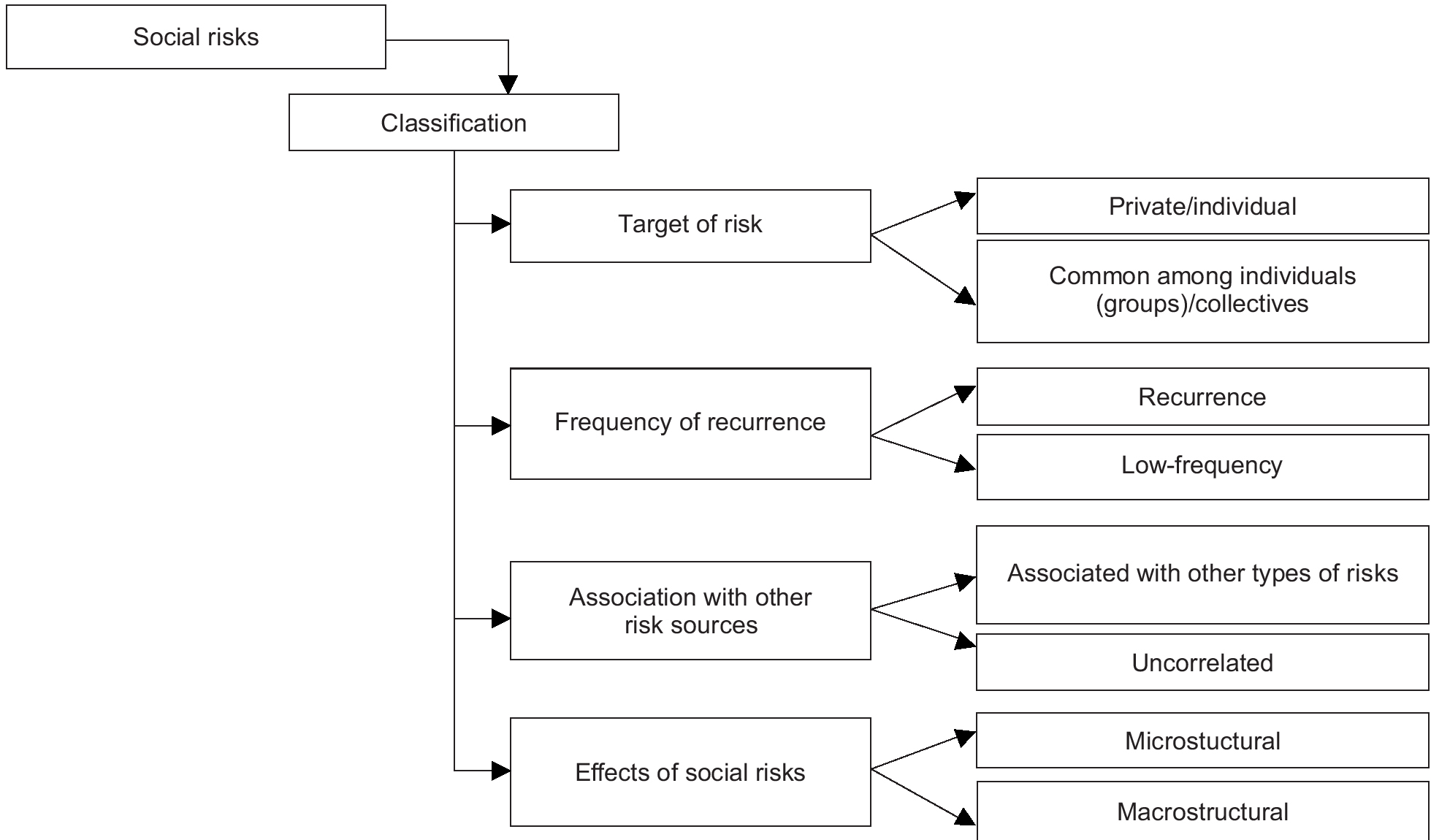
Fig. 1
Classification of social risks.
According to Holzman, Jorgensen 1999.
Table 3
Key concepts in social risk research.
| Concept | Definition | Author/source |
|---|---|---|
| Hazard | A potentially damaging physical event, phenomenon, or human activity that may cause loss of life or injury, property damage, social and eco- nomic disruption, or environmental degradation and can have different origins: natural (geological, hydrometeorological and biological), or induced by human processes (environmental degradation and technological hazards) | Hyogo Framework for Action 2015–2030 |
| Social impact | Refers to everyday life disturbances which lead to the interruption of activities, or the unavailability of some services or utilities, over various periods of time, for a variable number of persons, for a variable number of services. | Bădescu 2017 |
| Vulnerability | Represents the degree in which an individual, a community, a system is exposed to the effects of a hazard based on some essential conditions: physical, economic, social, environmental factors and the processes that increase the susceptibility of an individual, or a community at the impact with various dangers. | UNISDR 2017 |
| Risk | The probability for some potential losses (injuries, losses of human lives, disturbances of economic activities, destroyed or deteriorated goods, alternations of the environment) caused by a danger that can occur within a time-period, in some exposure conditions, vulnerability and capacity. | UNISDR 2017 |
| Adaptive capacity | The ability of people to face risk situations and disasters, using all the available resources. | UNISDR 2017 |
| Resilience | The capacity of society exposed to hazards to resist, to adapt itself and to recover after the impact. | Bălteanu, Sima 2013 |

Fig. 2
Social risk assessment model.
According to Bădescu 2017.
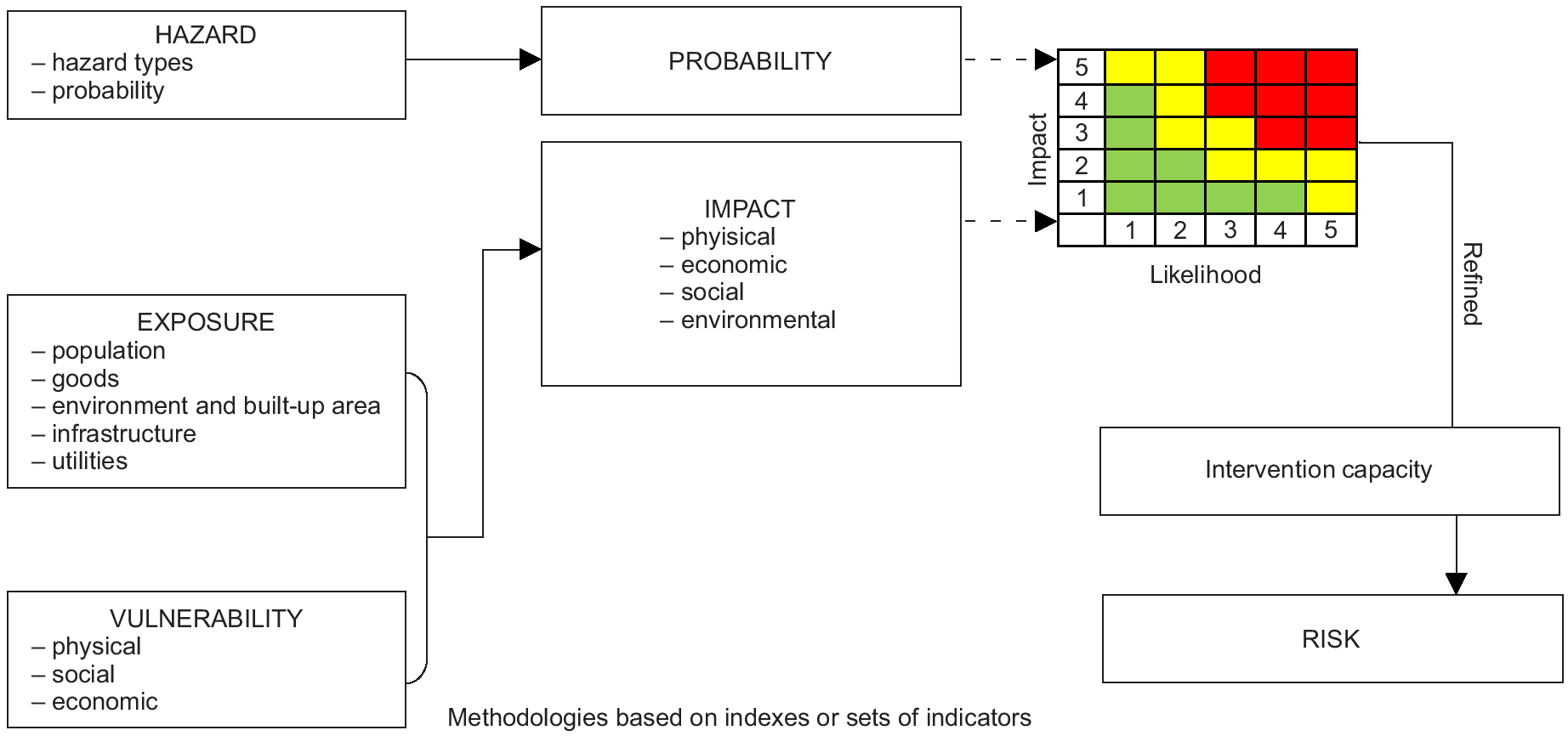
Fig. 3
Assessment model of social risks.
According to Glade, Crozier 2005; van Westen, Greiving 2017; Aerts et al. 2018.