
Table 1
Ecological and health effects of climate elements
| Climate element | Measure | Ecological effects | Health effects | Selected references |
|---|---|---|---|---|
| Solar radiation | UV increase | Destruction of living cells | Increase in skin cancer | Lityńska et al. 2001, Lucas et al. 2006, Błażejczyk, Błażejczyk 2012b |
| Insolation | No data | Solar stroke Road accidents | Jendritzky 1995, Błażejczyk et al. 1999 | |
| Air temperature | Heat waves | Increase in tropospheric ozone concentration | Increase in mortality Heat stroke Dehydration Asthma | Desai 2002, Kuchcik 2003, , Diazet al. 2006, d’Ipoliti et al. 2010, Baccini et al. 2011, |
| Cold waves | Increase in PM10 and SO2 | Overcooling Respiratory system Accidents Asthma | Donaldson, Keatinge 1997, Eurowinter Group 1997, Gyllerup 1998, Eng, Mercer 1998, Analitiset al. 2008 | |
| Hot summers | Ticks gradation Water pollution | Digestive intoxications Vector born diseases | Błażejczyk & McGregor 2008, Błażejczyk 2009, Michelozzi et al. 2009, Błażejczyk, Błażejczyk 2012a | |
| Warm winters | Early flowering and pollens | Increase in allergies and asthma Early boreliosis infections | Siuda 1993, Kiewra et al. 2004, Lindgren, Jaenson 2006 | |
| Precipitation | Heavy rains | Flooding, pollution of drinking water, bad road conditions | Digestive intoxication Drownings Road accidents | Mączyński 1972, Kuchcik 1998, Confalonieri et al. 2007, Błażejczyk 2009, Skotak 2010,Błażejczyk, Błażejczyk 2012b |
| Droughts | Air pollution, Allergens | Asthma Allergies | Małolepszy 1996, Peternel et al. 2004 | |
| Wind | Calms | Air pollution increase | Asthma Respiratory system disorders | Thompson et al. 1996, Samoliński et al. 2009, |
| Strong winds | Destruction of building and trees | Fatal accidents Nervous system troubles | Keatinge, Donaldson 1998, Keatinge 2002 | |
| Air pressure | Extreme pressure Changes in pressure | No data | Circulatory system and nervous system disorders | Huszcza 1951, Kozłowska-Szczęsna et al. 2004 |
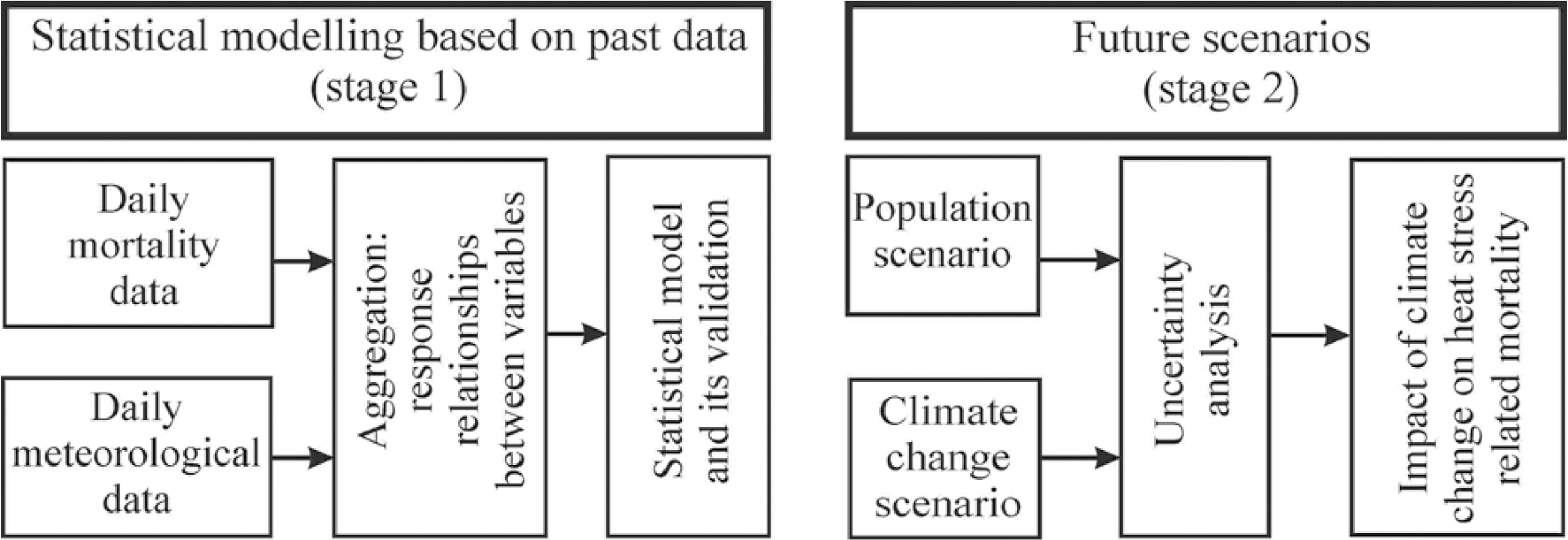
Fig. 1
Scheme of research (adapted from Gosling et al. 2007).
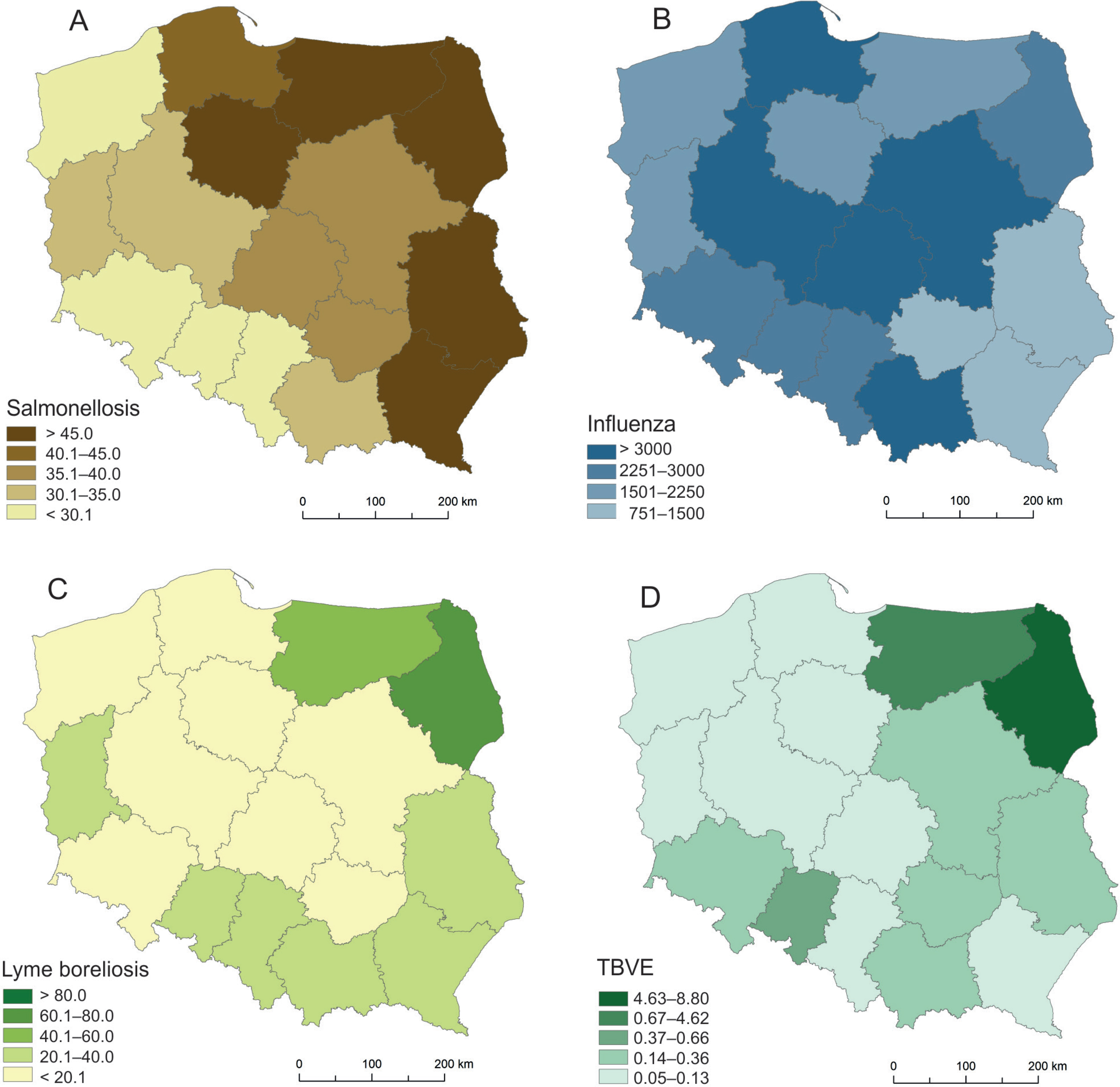
Fig. 2
Mean yearly number (per 100 000 inhabitants) of selected CRD: A – salmonellosis intoxication (1999–2014), B – influenza infections (1973–2014), C – Lyme boreliosis (2003–2014), D – tick born viral encephalitis (TBvE, 1999–2014).
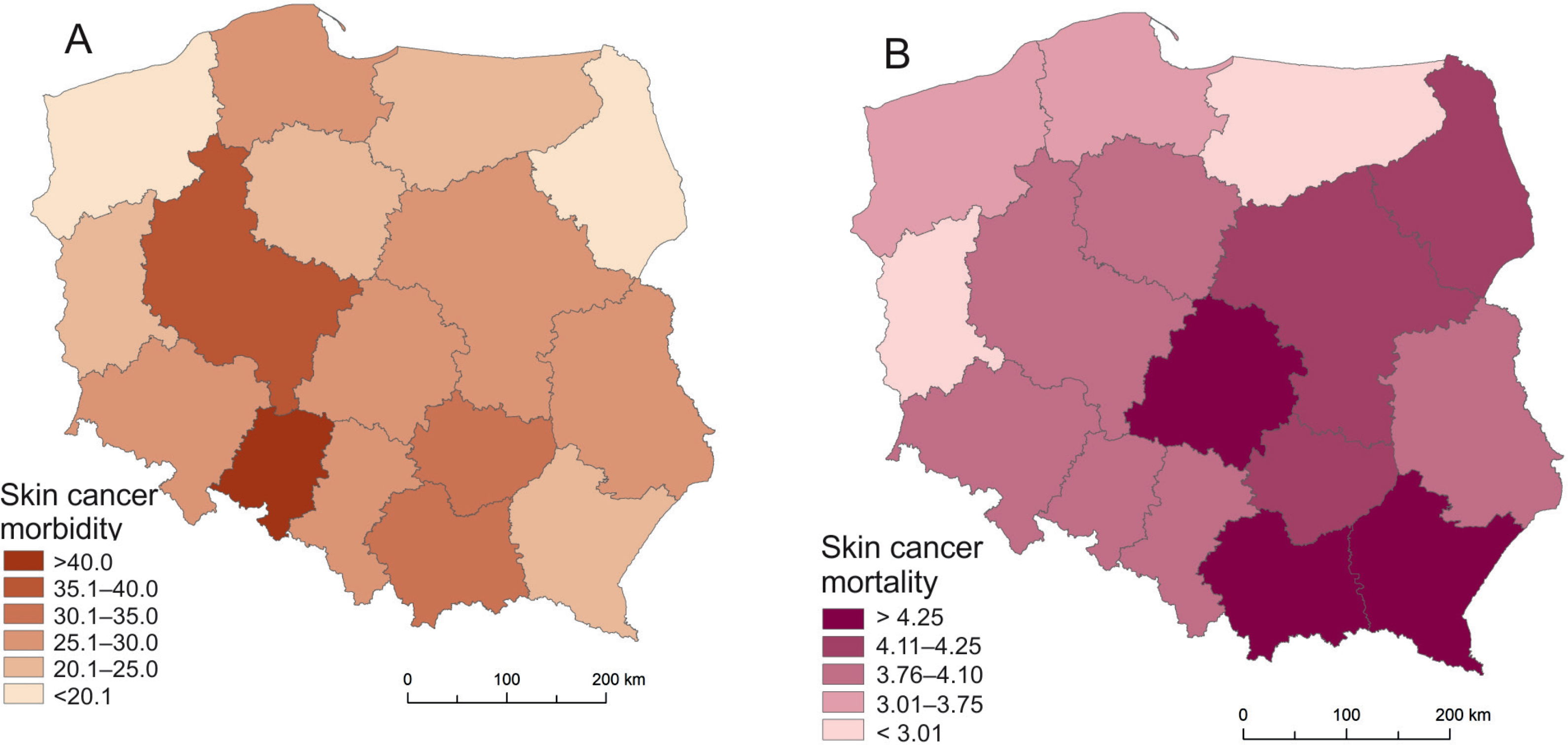
Fig. 3
Mean yearly number (per 100 000 inhabitants, 1999–2012) of skin cancers morbidity (A) and mortality (B).
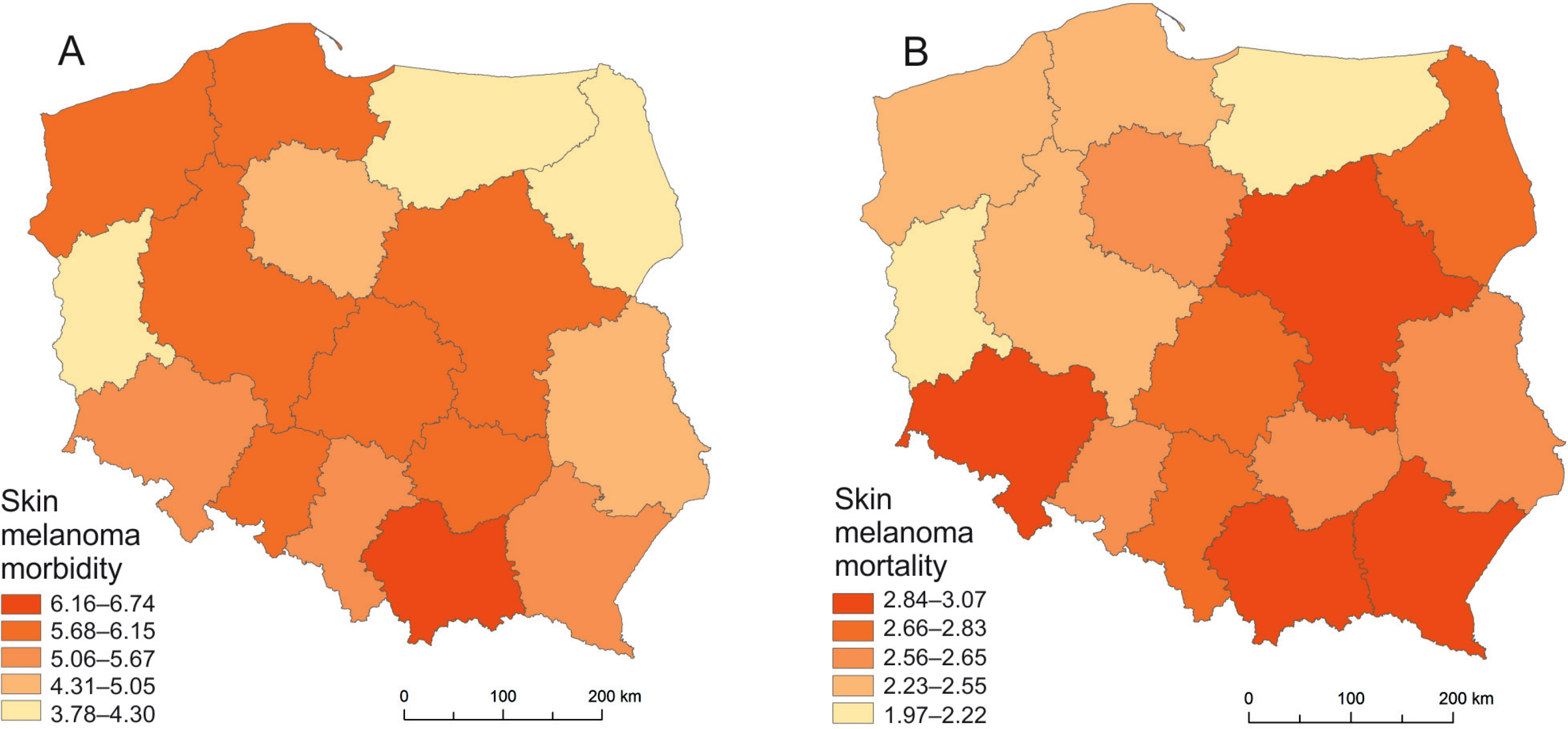
Fig. 4
Mean yearly number (per 100 000 inhabitants, 1999–2012) of skin melanoma morbidity (A) and mortality (B).
Table 2
Regression models of climate related mortality and morbidity.
| Regression model | Mean absolute error | Determination coefficient (%) | Confidencelevel (%) |
|---|---|---|---|
| Skin cancer morbidity / 100 000 | |||
| –60.8 + 0.05311·Kglob_summer | 2.83 | 54.88 | 95 |
| Skin cancer mortality / 100 000 | |||
| 1.3 + 0.001597·Kglob_summer | 0.102 | 39.07 | 95 |
| Lyme boreliosis morbidity / 100 000 | |||
| –59.1 + 3.71·Tmin_avg_XI–III + 0.046·Prec_totals –IX + 3.25·Tmax_avg_–IX | 5.39 | 40.96 | 85 |
| Salmonellosis intoxications / 100 000 | |||
| –307.8 – 9.42·Tmin_avg_summer – 1.9·Tmax>25_summer + 29.4·Tavg_summer – 6.6·Tmax_avg_summer + 4.9·Tmax_summer | 13.46 | 30.59 | 95 |
| Influenza morbidity / 100 000 | |||
| 18178.5 – 1598.9·Tavg_winter – 12.3·Tmax<0_winter + 1807.2·Tmin_avg_winter – 1799.7·Tmax_avg_winter | 2094.56 | 25.42 | 95 |
| Circulatory mortality / 100 000 | |||
| 325.6 + 4.2·Tmin<–10 – 1.6·Tmax>25 – 2.1·Sultry + 12.9·Tmin_avg – 93.3·Tmax_avg + 143.9·Tavg | 49.57 | 22.79 | 85 |
| Respiratory mortality / 100 000 | |||
| 72.1 – 45.0·Tśr_winter + 17.4·Tmax_avg_winter – 1.1·Tavg + 21.7·Tmin_avg_winter – 0.5·Tmax<0 + 0.044·Tmin<–10 + 1.0·v>8_winter | 4.26 | 48.10 | 95 |
| Overcooling deaths | |||
| 183.0 + 13.2·Tmin_winter – 3.8·Tmin_avg_winter | 72.34 | 24.48 | 90 |
[i] Kglob_summer – summer totals of global solar radiation (MJ/m2),
[ii] Tavg – mean yearly air temperature (°C),
[iii] Tavg_summer, Tavg_winter – mean air temperature for summer and winter periods (°C),
[iv] Tmin_avg – mean yearly minimum air temperature (°C),
[v] Tmin_avg_summer, Tmin_avg_winter, Tmin_avg_v-IX, Tmin_avg_XI-III – mean minimum air temperature for particular periods (°C),
[vi] Tmax_avg – mean yearly maximum air temperature (°C),
[vii] Tmax_avg_summer, Tmax_avg_winter, Tmax_avg_v-IX, Tmax_śr_XI-III – mean maximum air temperature for particular periods (°C),
[viii] Tmin – lowest yearly minimum air temperature (°C),
[ix] Tmin_summer, Tmin_winter, Tmin_v-IX, Tmin_XI-III – lowest minimum air temperature for particular periods (°C), Tmax – highest yearly maximum air temperature (°C),
[x] Tmax_summer, Tmax_winter, Tmax_v-IX, Tmax_XI-III – highest maximum air temperature for particular periods (°C), Tmax<0 – annual number of days with maximum air temperature <0°C,
[xi] Tmax >25 – annual number of days with maximum air temperature >25°C,
[xii] Tmax >25_summer – summer number of days with maximum air temperature >25°C,
[xiii] Tmin<−10 – annual number of days with minimum air temperature <−10°C,
[xiv] Sultry – annual number of sultry days,
[xv] Prec_totals_v-IX – precipitation totals for period (mm),
[xvi] v>8_winter – number of windy days in winter.
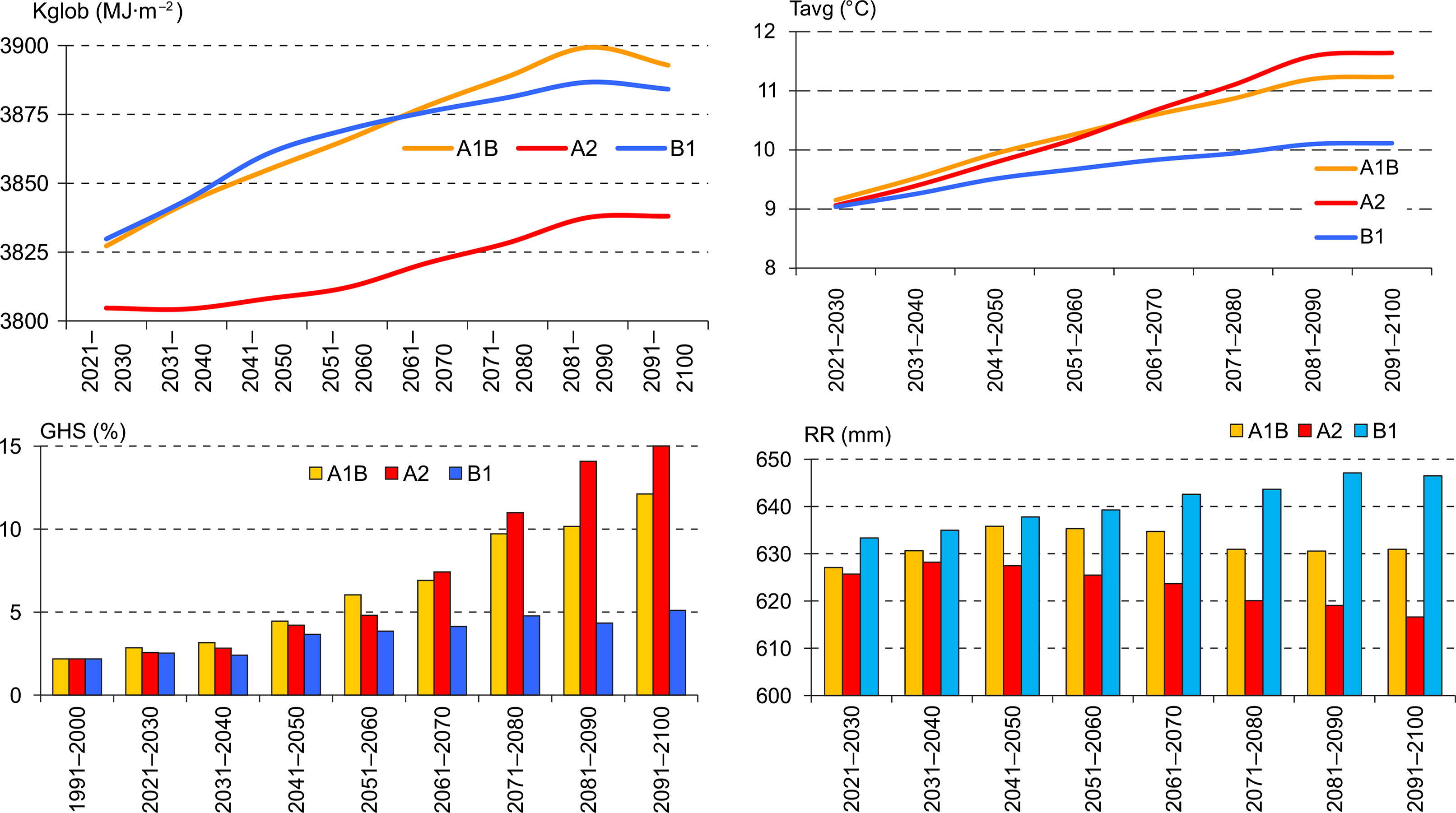
Fig. 5
Projected changes of yearly totals of global solar radiation (Kglob), mean yearly air temperature (Tavg), percentage of days with great heat stress (GHS) and precipitation totals (RR) in consecutive decades of 21st century due to A1B, A2 and B1 SRES scenarios.
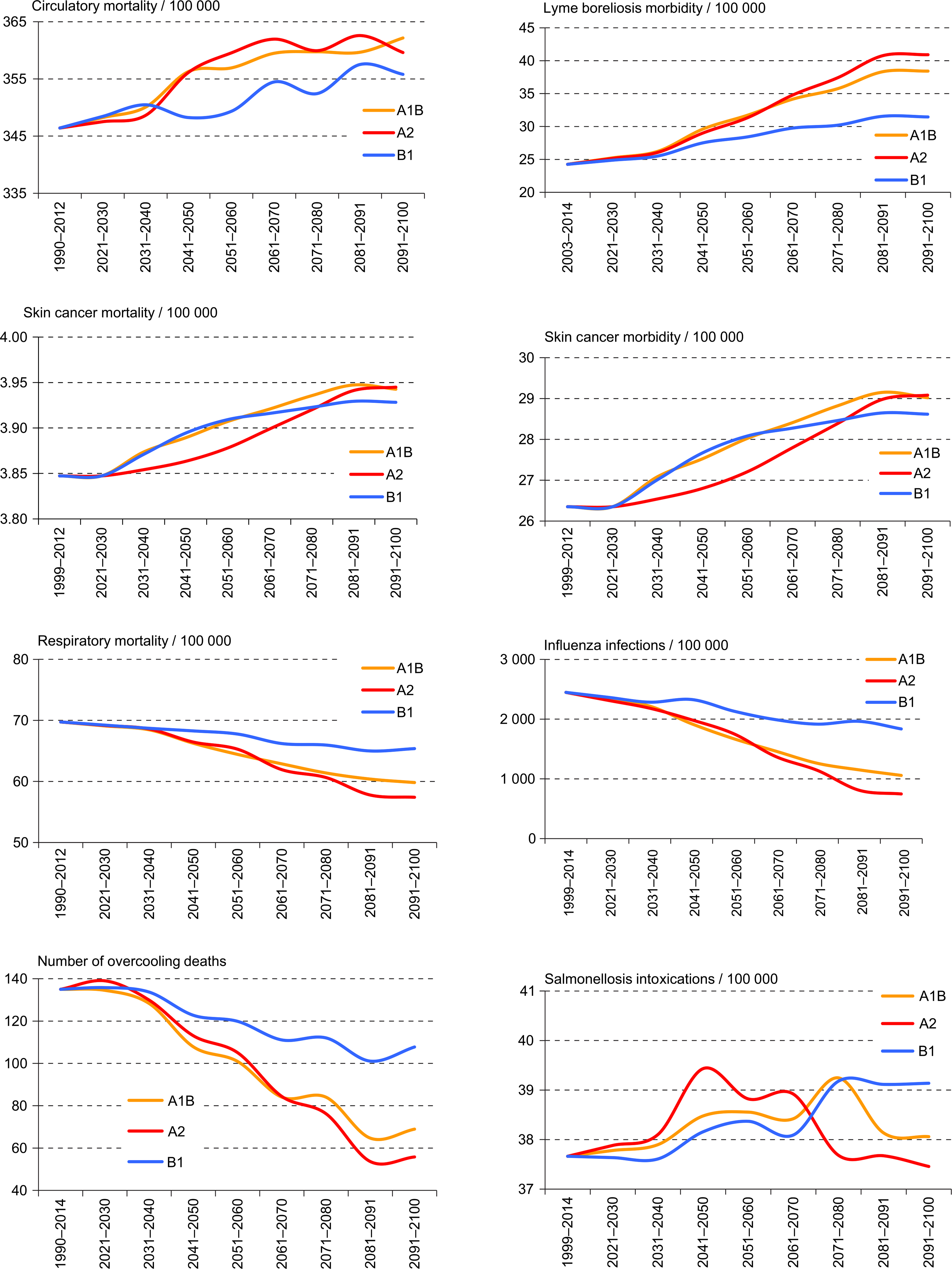
Fig. 6
Projected, for the consecutive decades of 21st century, CRD indicators: circulatory mortality, Lyme boreliosis infections, skin cancer mortality, skin cancer morbidity, respiratory mortality, influenza morbidity, overcooling deaths, salmonellosis intoxications.
Table 3
Projected changes of the indicators of climate related diseases in Poland for the years 2081–2100.
| Health indicator | Tendency | Confidence of projections |
|---|---|---|
| Skin cancer morbidity | 9–10% increase | great |
| Skin cancer mortality | 2–3% increase | great |
| Lyme boreliosis infections | 22–68% increase | great |
| Circulatory mortality | 3–4% increase | moderate |
| Salmonellosis intoxications | 1–3% increase | small |
| Respiratory mortality | 7–17% decrease | great |
| Overcooling deaths | 23–50% decrease | moderate |
| Influenza infections | 23–68% decrease | moderate |
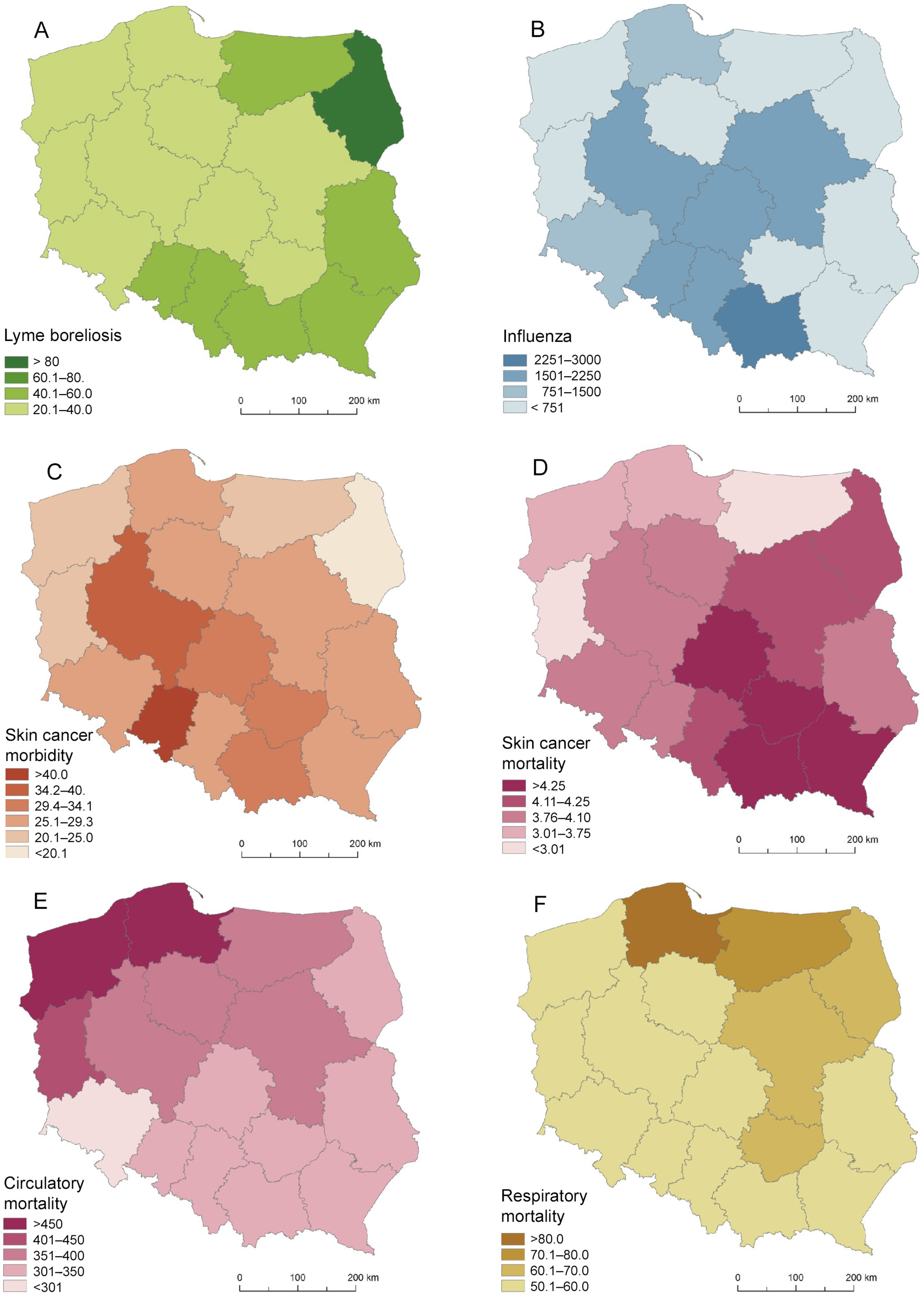
Fig. 7
Spatial distribution of projected risks (per 100 000 inhabitants) of selected CRD at the last decade of 21st century due to A1B SRES scenario, A – Lyme boreliosis, B – influenza, C – skin cancer morbidity, D – skin cancer mortality, E – circulatory mortality, F – respiratory mortality.