
1. Introduction
The study of polaron effects in low-dimensional quantum systems has been a subject of intense research due to their profound influence on the optoelectronic properties of semiconductor nanostructures. Among these systems, quantum wells (QWs) with asymmetric confinement potentials—particularly the asymmetrical Gaussian potential (AGP)—have emerged as a versatile platform for designing tunable two-level qubits. In such structures, the electron–longitudinal optical (LO) phonon interaction under strong coupling conditions fundamentally governs the dynamical properties of the qubit, especially its coherence time, which is a critical parameter for quantum information processing.
Recent theoretical advances have elucidated the critical influence of external fields and confinement engineering on polaron properties [1–11]. Suvajit Pal’s team [12] constructed quantum confinement potentials using effective mass approximation and compact density matrix method, discovering optical response enhancement with increasing potential parameters following quantum-confined system modulation principle; Raja Ghosh [13] built Holstein model employing variational calculations, revealing molecular weight promoting polaron delocalization consistent with coherence length enhancement in conjugated polymers; X-Y Zhu [14] analyzed dielectric properties using large polaron model, proposing protective mechanism through heavy effective mass and organic dipole synergy obeying carrier-phonon scattering suppression; R Khordad [15] applied LLP unitary transformation with Pekar-type variational method, finding electron-phonon coupling inversely regulating energy levels and frequency following strongcoupling system renormalization; A Thilagam [16] utilized su(1,1) algebra with coherent state variational approach, demonstrating quantum-enhanced polaron properties conforming to symmetry-optimized parameter enhancement; Wang Xiuqing [17] employed quantum statistical theory combined with LLP and linear combination operator methods, revealing temperature differentially modulating energy and phonon number consistent with statistical thermal excitation law. Despite these significant advances, a unified theoretical framework for strong-coupling bound polaron coherence times in AGPQW systems remains underdeveloped—requiring self-consistent incorporation of asymmetric confinement, phonon coupling, impurity binding, and external field effects. To address this gap, we integrate the Pekar-type variational method with LLP unitary transformation to systematically investigate coherence behavior of strong-coupling bound polarons in AGPQWs. By deriving analytical expressions for coherence time and numerically evaluating its dependence on AGP profile, magnetic field strength, electron–phonon coupling constant, and impurity potential, our study not only consolidates existing understanding but also provides predictive insights to support the design of robust long-lifetime polaron-based quantum devices. In addition to these theoretical advancements, significant attention has been devoted to GaAs/AlGaAs-based nanostructures due to their exceptional optoelectronic properties and well-established fabrication techniques. Core/shell GaAs/AlGaAs quantum wells, for instance, have emerged as promising platforms for polaron-based quantum devices, benefiting from high electron mobility and tunable quantum confinement effects at the heterointerface [18]. However, the coherence time modulation in such structures primarily relies on barrier engineering at the core/shell interface, and the investigation of polaron coherence properties under asymmetric potential fields remains incomplete. Furthermore, studies on rectangular GaAs/AlGaAs quantum dots have demonstrated that under symmetric confinement potentials, the coherence time of polarons exhibits monotonic dependence on structural parameters [19]. In contrast, the asymmetric Gaussian potential quantum well investigated in the present work breaks this monotonic behavior, enabling non-monotonic modulation of coherence time and thereby offering enhanced flexibility for qubit design.
By developing a theoretical model for strongly coupled bound polarons in asymmetric Gaussian potential quantum wells and employing a combination of the Pekar-type variational method and the Lee-Low-Pines unitary transformation, we systematically investigate the coherence properties of the qubit under external fields. Our findings reveal the dependence of the polaron coherence time on key parameters including the confinement potential, electronphonon coupling strength, and impurity potential, thereby providing a theoretical foundation for the design of high-performance polaron-based quantum devices.
2. Theoretical Model
Here, we consider an electron moving in the RbCl crystal asymmetric Gaussian confinement potential quantum well (AGCPQW), and is interacting with bulk LO phonons [20–27]. Within the framework of effective mass approximation, the Hamiltonian of the electron-phonon interaction system [28–35] can be written as follows:
whereThe band mass of the electron is denoted as m, where represents the creation (annihilation) operator of bulk longitudinal optical (LO) phonons with wave vector k, and p and r correspond to the momentum operator and position vector of the electron, respectively. As shown in Equation (2), V0 and R refer to the barrier height of asymmetric Gaussian-confined potential quantum wells (AGCPQWs) and the confinement potential range parameter, respectively. represents the Coulomb attractive potential from a hydrogen-like central Coulomb impurity located at the geometric center of the asymmetric Gaussian potential quantum well. The parameter , where e is the electron charge and ε∞ is the relative permittivity of the RbCl crystal.
Vk and α refer to the barrier height of asymmetric Gaussian-confined potential quantum wells (AGCPQWs) and the remote longitudinal polarization (RLP) parameter, respectively.
One can apply the following unitary transformations [19] to Eq. 1:
where are the variational parameter. If one introduces the linear combination operator and bj the momentum and position operators can be written as [20]The expectation value is calculated using the ground state wave function
where is the vacuum state of b operator, is the FES of the b operator and is the unperturbed zero-phonon state.Combining all terms and performing the necessary integrations over the phonon wave vectors, the expectation value of the system Hamiltonian can be denoted as:
To derive the expectation value Eqs. (9), we start from the Hamiltonian after applying the unitary transformations in Eq. (4) and the linear combination operators in Eqs. (5) and (6). The trial wave functions in Eqs. (7) and (8) adopt Gaussian-type forms, where the wave packet width is governed by the variational parameters λ and fk.
The variation of with respect to λ is given by:
This parameter λ is a variational parameter obtained from the energy minimization procedure, specifically by solving .Its physical significance lies in characterizing the spatial localization of the electron wave packet—a larger λ corresponds to stronger quantum confinement and a more localized electron distribution within the asymmetric Gaussian potential well. Thus, λ serves as an intermediate theoretical parameter that quantifies the degree of wave function localization, rather than a directly observable physical quantity.
These variational parameters are optimized through energy minimization to obtain the ground state and first excited state properties of the strongly coupled bound polaron system. Ground energy and the first excited state energy can be written as:
It is important to clarify the physical meaning of the variational parameter λ appearing in Eqs. (11) and (12). The excitation-energy can be written as:
where λ is the variational parameter. It is essential to distinguish between the variational parameter λ and the physically observable vibrational frequency ωL0 of the polaron. While λ is a variational parameter obtained from energy minimization that characterizes the spatial localization of the electron wave packet, the vibrational frequency ωL0 is a physically measurable quantity that can be probed experimentally through spectroscopic techniques.And the superposition state can be represented as:
Under the dipole approximation and using Fermi’s Golden Rule [17], the spontaneous emission rate is given by [18]:
where indicates the energy separation, C is the speed of light in vacunm, ε0 is the vacuum dielectric constant and τ is the coherence time. The ground state (GS) and the first excited state (FES) of the polaron in this AGPQW system form a well-defined two-level system, which is the fundamental building block of a qubit. This system satisfies the essential criteria for a functional qubit: (i) Distinguishability due to their non-degenerate energy levels with a clear gap ΔE; (ii) Controllability, as the transition frequency can be tuned by external fields and confinement parameters; and (iii) Coherence, evidenced by the periodic oscillation of the electron probability density in a superposition state, with a coherence time τ that can be optimized.3. Results and Discussion
In an asymmetric Gaussian potential quantum well (AGPQW), we systematically investigated the ground state energy (E0) of a strong-coupling bound polaron as a function of the barrier height (V0) and the confinement potential range (R), as illustrated in Figure 1. The results indicate that E0 increases monotonically with V0 but decreases significantly with R. This behavior highlights the critical role of quantum confinement effects in modulating polaron energy states: an increase in V0 enhances spatial confinement, raising the quantized energy levels and consequently E0; conversely, expanding R weakens electron localization, broadens the wave function extension, and reduces the kinetic energy component, leading to a decrease in E0. These fundamental findings establish the foundation for understanding how confinement parameters control the basic energy landscape of polarons in nanostructured systems. According to Figure 1 and Equation (15), the monotonic increase of E0 with V0 directly reduces the energy separation thereby increasing the coherence time. Conversely, the decrease of E0 with expanding R enlarges ΔE, leading to shortened coherence time. This quantitative linkage demonstrates that the ground state energy serves as a fundamental parameter for predicting and controlling the coherence properties through the energy level splitting mechanism. These findings not only establish a direct bridge between static energy parameters and dynamic coherence characteristics, but also provide a quantitative basis for optimizing qubit performance through the modulation of potential field parameters.
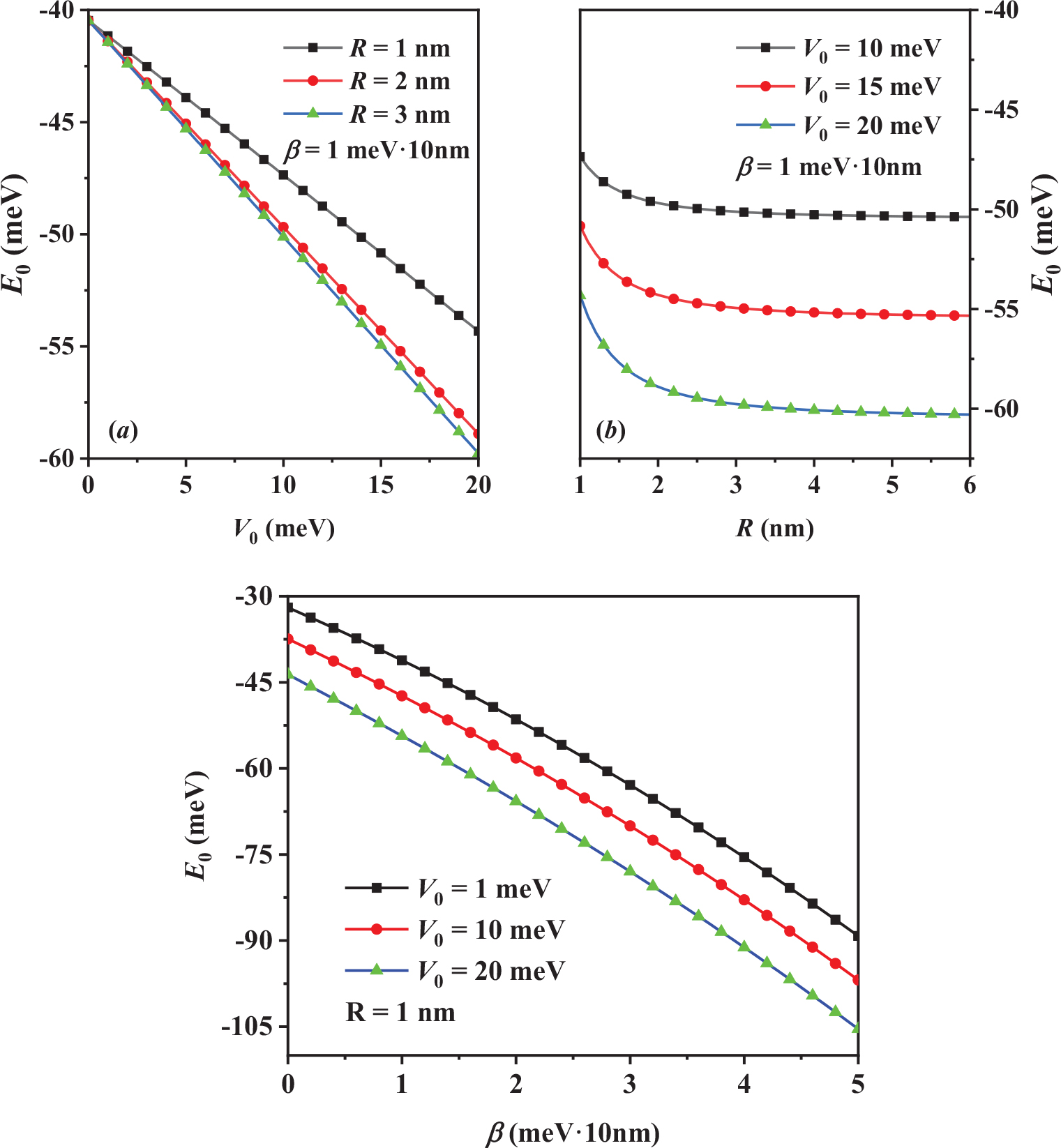
Figure 1.
Ground-state energy E0 as a function of (a) parameter V0 the AGCPS’ barrier height and (b) parameter R the range of the AGCP and (c) parameter β.
Building upon the established energy landscape, we further analyzed the variation of the ground-state binding energy Eb of the strongly coupled bound polaron with potential parameters (Figure 2). The results demonstrate that Eb exhibits a significant positive correlation with the barrier height V0, while showing a clear negative correlation with the confinement potential range R. This trend reveals the regulatory mechanism of quantum confinement on polaron binding characteristics: when V0 increases, the enhanced spatial confinement strengthens the electron-phonon interaction, leading to intensified polaron self-trapping and consequently higher Eb; conversely, when R expands, the spatial extension of the electron wave function weakens the electron-phonon coupling strength, reducing the stability of the polaron bound state and thus decreasing Eb. These findings confirm that the binding properties of polarons can be effectively manipulated by tuning the confinement potential parameters. Importantly, the binding energy Eb satisfies an exponential relationship with the coherence time. Therefore, the observed increase of Eb with V0 leads to an exponential suppression of the coherence time, while the decrease of Eb with expanding R results in an exponential enhancement of the coherence time. This quantitative relationship reveals that the binding energy directly modulates the strength of the electron-phonon coupling, which is the primary source of phonon-assisted decoherence in polaron systems, thereby providing important theoretical guidance for designing polaron-based quantum devices with optimized coherence properties.
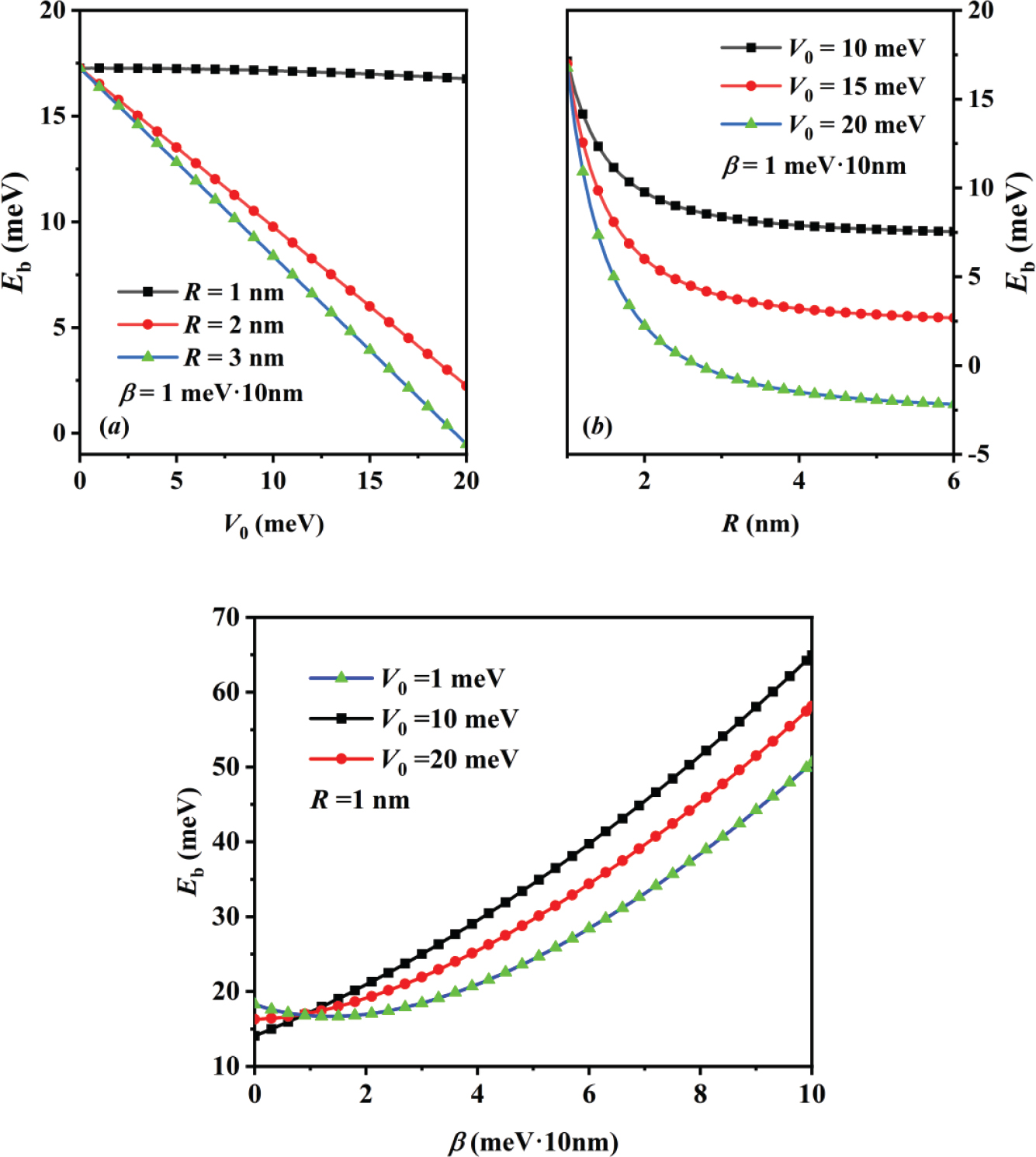
Figure 2.
Ground-state binding energy Eb as a function of (a) parameter Vo the AGCPS’ barrier height and (b) parameter R the range of the AGCP and (c) parameter β.
Extending our investigation to dynamic properties, we conducted an in-depth analysis of the vibrational frequency characteristics of strongly coupled bound polarons (Figure 3). The study reveals that the polaron vibrational frequency increases monotonically with the barrier height V0 while demonstrating a clear decreasing trend with the expansion of the confinement potential range R. This pattern elucidates fundamental features of lattice dynamics in quantum-confined systems: when V0 increases, enhanced spatial confinement leads to a more localized electron cloud distribution, thereby strengthening the effective stiffness of the electron-phonon coupled system and resulting in an elevated vibrational frequency; conversely, when R expands, the spatial extension of electron wave functions reduces the equivalent confinement strength of the system, weakening the quantum confinement effect on phonon modes and consequently lowering the vibrational frequency. These dynamic measurements provide crucial insights for understanding the microscopic mechanisms of electron-phonon coupling in confined systems, bridging the gap between static energy profiles and lattice responses.
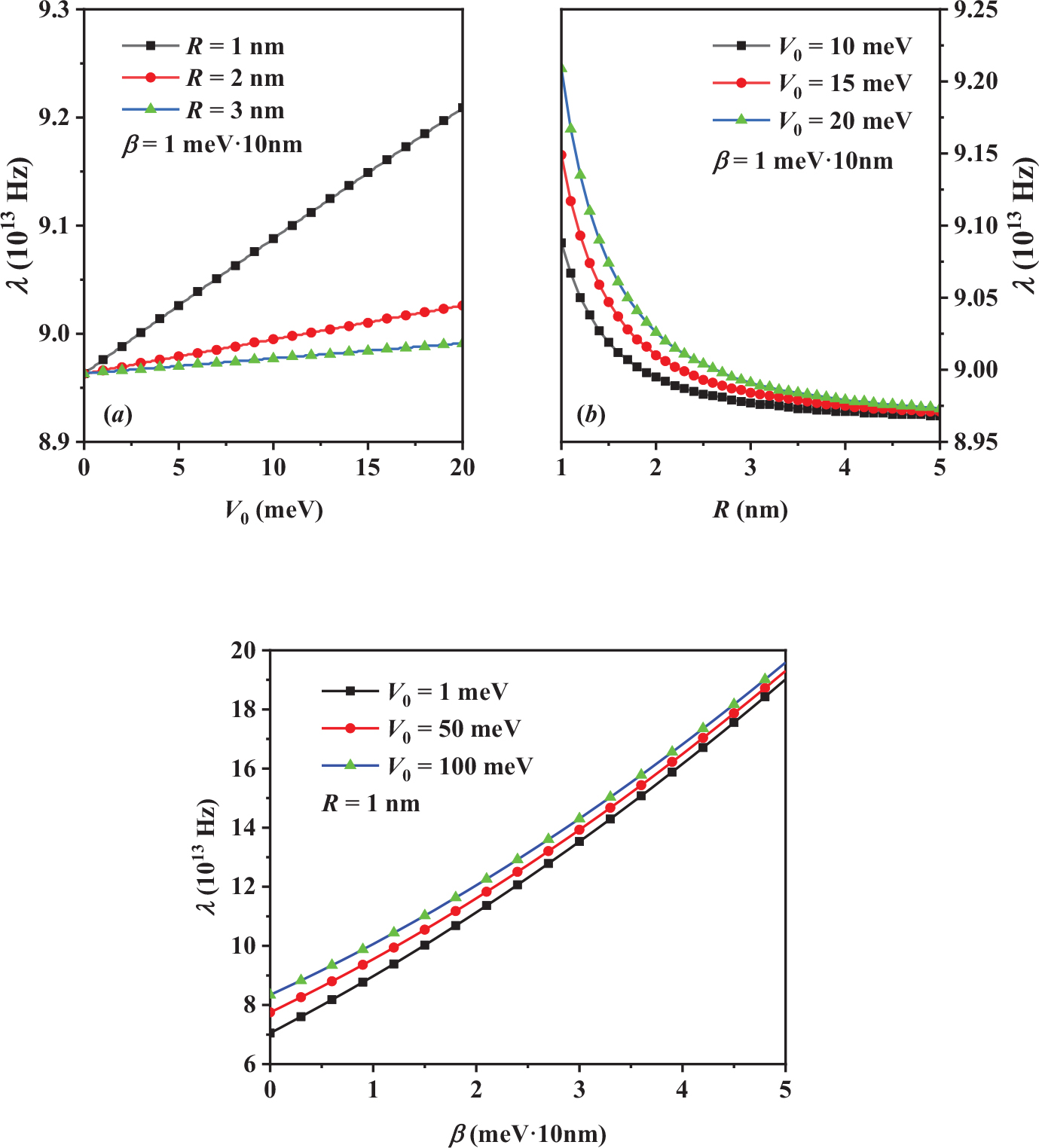
Figure 3.
Vibrational frequency λ as a function of (a) parameter V0 the AGCPS’ barrier height and (b) parameter Rthe range of the AGCP and (c) parameter β.
As shown in Figure 4(b), the non-monotonic dependence of the coherence time on the confinement potential range exhibits a minimum at a critical value, which has a clear physical interpretation: it represents the balance point where quantum confinement effects compete with electron-phonon coupling effects. In the strong confinement regime (below the critical value), quantum confinement effects dominate, and the strong localization of the electron wave packet enhances electron-phonon coupling, leading to a monotonic decrease in coherence time as the confinement potential range increases. In the weak confinement regime (above the critical value), electron-phonon coupling effects become dominant; the spatial extension of the wave packet weakens the coupling strength and reduces the spontaneous emission rate, resulting in a monotonic increase in coherence time with further increase of the confinement potential range. This critical value marks the crossover where the dominant decoherence mechanism shifts from confinement-enhanced electron-phonon coupling to confinement-weakened coupling and reduced radiative transitions, providing important guidance for optimizing confinement potential parameters to maximize coherence time and enhance qubit performance.
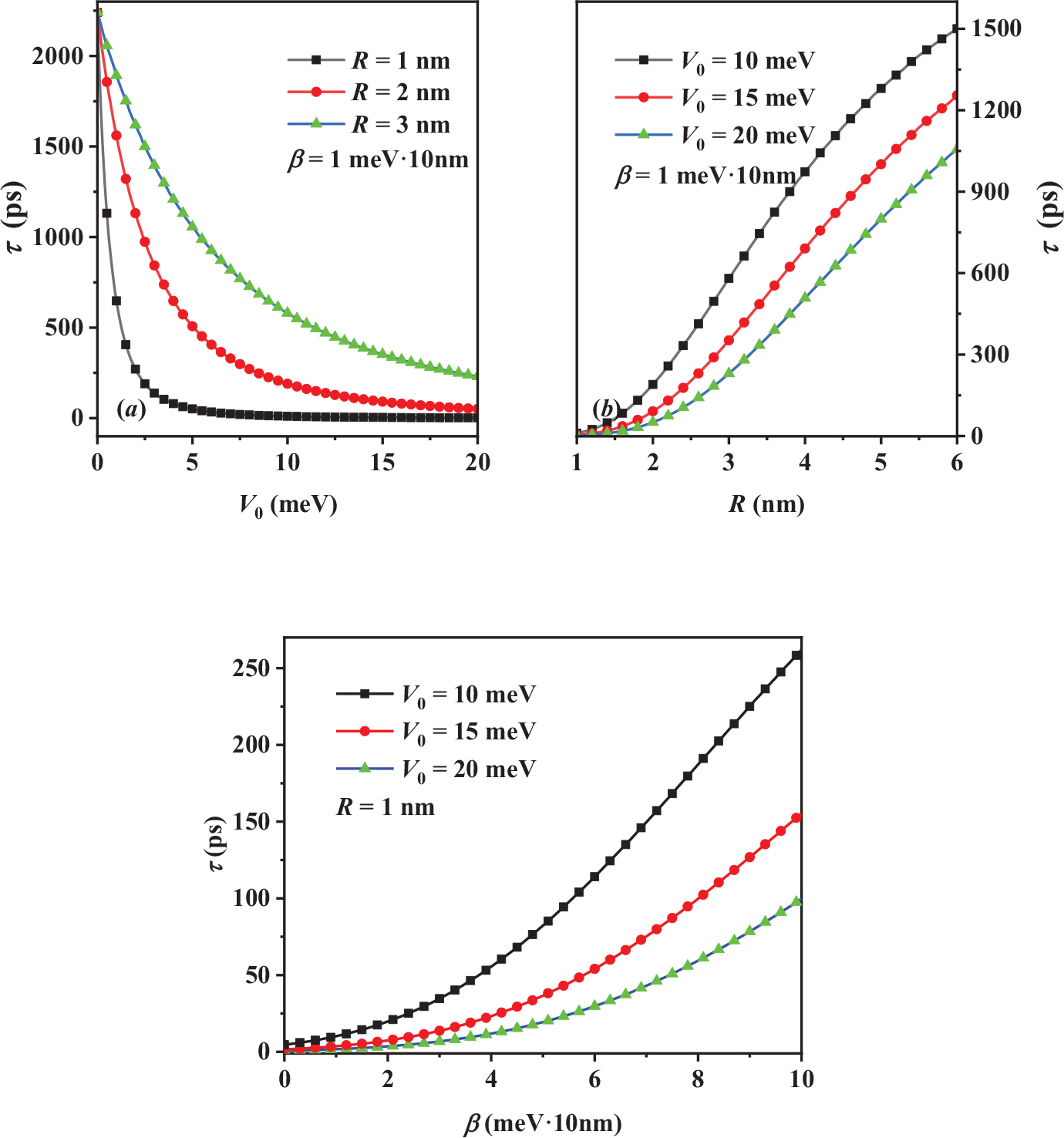
Figure 4.
Coherence time τ as a function of (a) parameter V0 the AGCPS’ barrier height and (b) parameter R the range of the AGCP and (c) parameter β.
4. Conclusion
Based on a systematic investigation of strongly coupled bound polarons in asymmetric Gaussian potential quantum wells, we have elucidated the critical regulatory roles of barrier height and confinement range on the ground state energy, binding energy, vibrational frequency, and coherence time of polarons. Through quantitative analysis, the study reveals intrinsic correlations between ground state energy and radiative transition rate, between binding energy and electron-phonon coupling strength, and between vibrational frequency and lattice dynamics timescale. The results indicate that increasing the barrier height enhances quantum confinement effects, leading to elevated energy levels and stronger electron-phonon coupling, thereby shortening the coherence time. Conversely, expanding the confinement range generally weakens localization and decoherence, although the coherence time exhibits a non-monotonic variation. These findings provide a systematic theoretical foundation for engineering potential landscapes and optimizing coherence properties through precise potential engineering. Furthermore, through in-depth theoretical analysis, we have clarified the distinction and connection between the variational parameter characterizing electron wave packet localization and the observable vibrational frequency. This establishes a comprehensive theoretical framework bridging variational descriptions and observable dynamics, laying a solid foundation for understanding and manipulating polaron behavior from both theoretical and experimental perspectives.
Notes
[1] Contributed by Author Contributions
Conceptualization, Jun Ge, Da-quan Liu, Shu-Juan Zhang, Le-di Cai, Xin-Xue Zhang, Yong Sun and Jing-Lin Xiao; methodology, Le-di Cai, Xin-Xue Zhang; software, Le-di Cai, Xin-Xue Zhang; investigation, Jun Ge, Da-quan Liu, Shu-Juan Zhang, Le-di Cai, Xin-Xue Zhang; writing—original draft preparation, Jun Ge, Da-quan Liu, Shu-Juan Zhang, Yong Sun and Jing-Lin Xiao; writing—review and editing, Jun Ge, Da-quan Liu, Shu-Juan Zhang, Yong Sun and Jing-Lin Xiao; visualization, Jun Ge; supervision, Yong Sun and Jing-Lin Xiao; project administration, Yong Sun and Jing-Lin Xiao; funding acquisition, Jun Ge, Da-quan Liu. All authors have read and agreed to the published version of the manuscript.
[2] Conflicts of interest Conflict of Interest Statement
The authors declare no conflicts of interest.
[3] Data Availability Statement
No new data were created.