
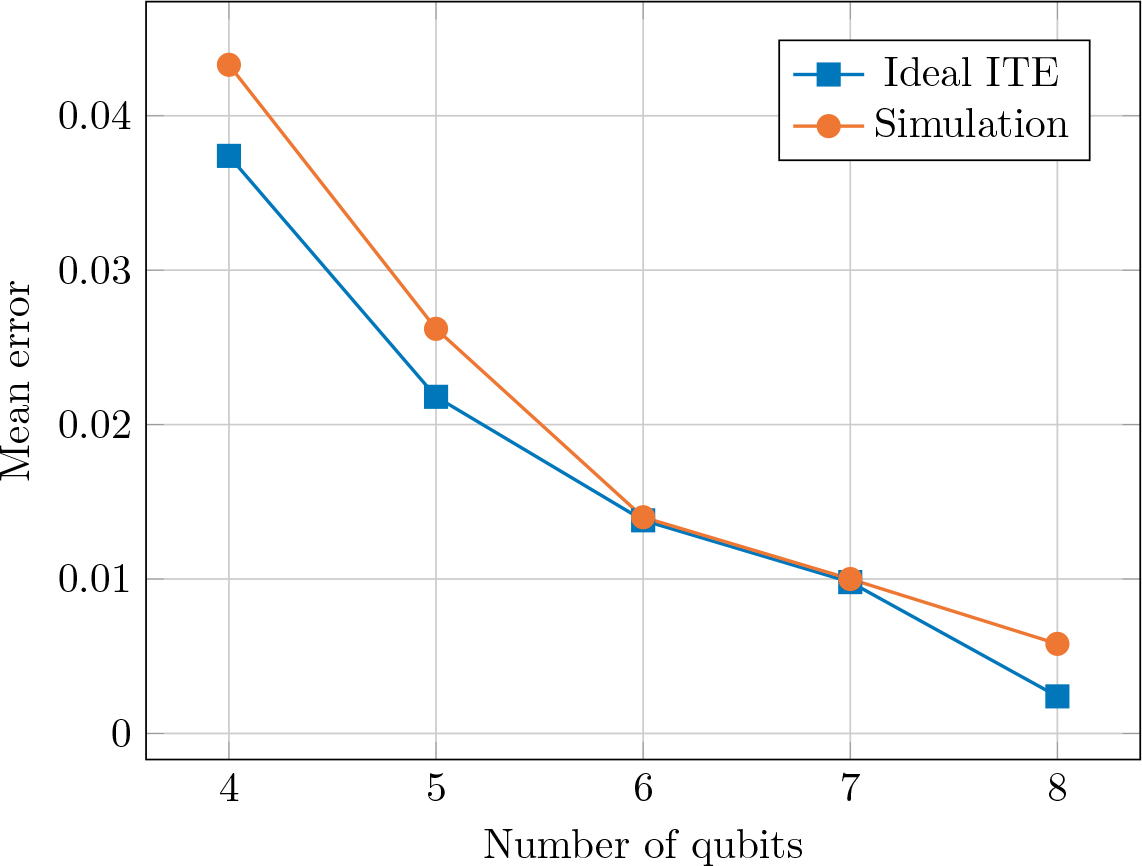
Figure 1.
Thermal expectation value estimation using ITE. For each data point, we average the error in the thermal expectation value |〈ψi|Oj|ψi〉 – tr(|ψβ〉〈ψβ|Oj)| over 30 randomly chosen Pauli observables Oj and 10 random TPQ states |ψi〉 = e−0.02HUi|0〉⊗n, where H is the 1D Heisenberg Hamiltonian on n qubits and Ui is a randomly chosen Clifford unitary. The blue and orange points show the values for exact and simulated ITE, respectively, where the simulation implements Algorithm 1.
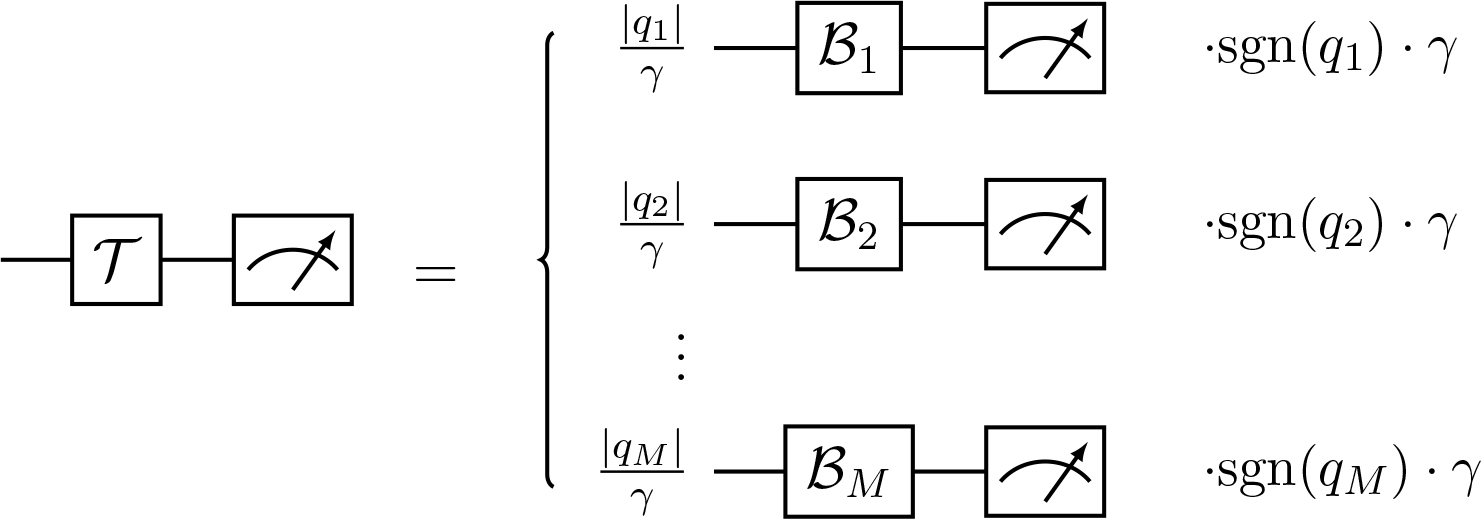
Figure 2.
A schematic of a linear map 𝒯 implemented by sampling from its quasiprobability distribution (see Eq. (4), Algorithm 1). Given a quasiprobability decomposition of the map 𝒯, circuits are randomly sampled according to the distribution |qi|/γ, and their measurement outcomes are weighted by the factors sgn(qi)γ.
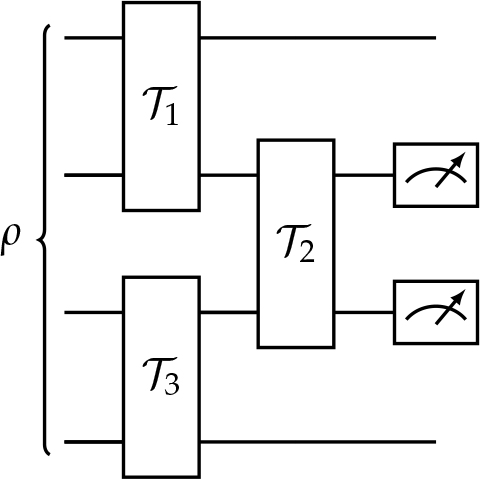
Figure 3.
Example of an operation 𝒯′ = 𝒯1 𝒯2 𝒯3 that we implement. Here 𝒯1, 𝒯2, 𝒯3 are 2-qubit operations applied on nearest-neighbor qubits at different locations. In the analysis of Lemma 2, we assume for simplicity that 𝒯1 = 𝒯2 = 𝒯3 = 𝒯.
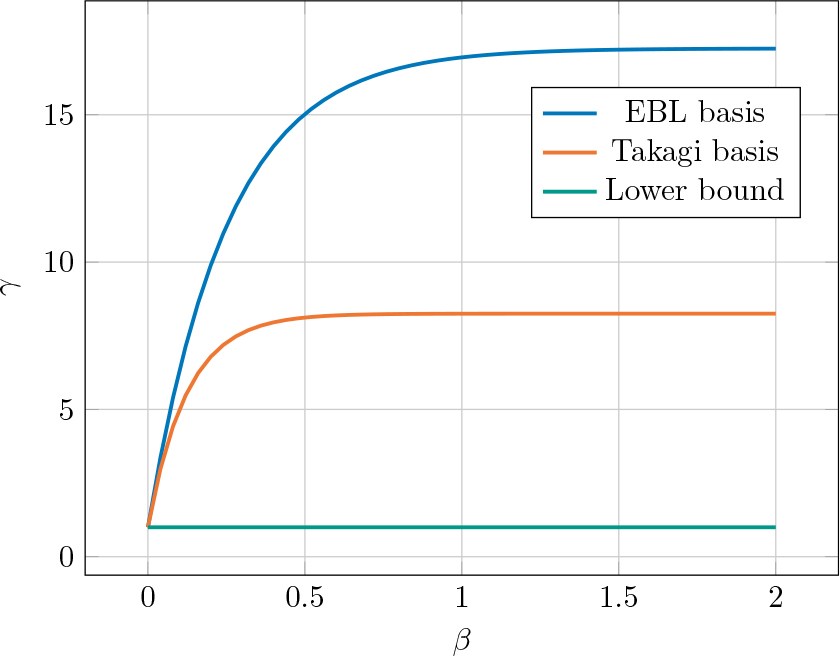
Figure 4.
Scaling of the QPD cost γ with inverse temperature β for the decomposition of e−βH using different basis sets, where H is the 2-qubit Heisenberg Hamiltonian H = –XX – γγ – ZZ + II. The Takagi basis (orange) outperforms the EBL basis (blue), illustrating the utility of including entangling gates in the QPD basis set. The lower bound, obtained using the diamond norm [62,63], is shown in teal. (See Appendix C for the analysis of optimal sampling cost and the effect of adding identity to the Hamiltonian for ITE.)
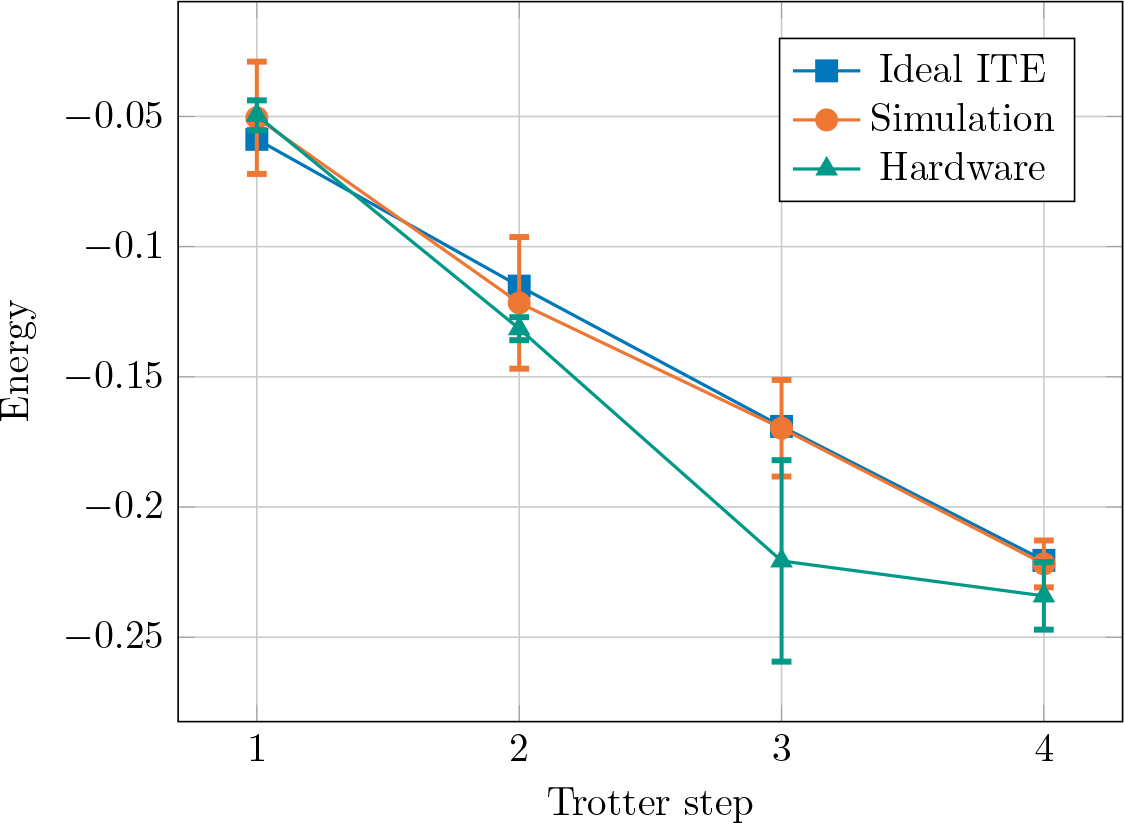
Figure 5.
Energy estimation using ITE. We estimate the energy 〈ψt|H|ψt〉/〈ψt|ψt〉, where H is the 2-qubit Heisenberg Hamiltonian and |ψt〉 = (e−0.01H)t|00〉 is the imaginary-time evolved state with t Trotter steps. The blue, orange, and teal points show the values for exact, simulated, and hardware ITE, respectively, where the simulation (resp., demonstration) implements Algorithm 2 on classical (resp., quantum) hardware.
Table A1.
EBL basis [43]. A complete basis for single-qubit linear maps that contains 10 trace-preserving elements ([1] to [RXY]) and 6 non-trace-preserving elements ([πX] to [πXY]), where we use the notation [U](·) := U(·)U†. The map [P0] refers to projection onto the state |0〉.
| [1] | ||||
| [σX] | = | [H][S]2[H] | ||
| [σY] | = | [H][S]2[H][S]2 | ||
| [σZ] | = | [S]2 | ||
| [RX] | = | = | [H][S]3[H] | |
| [RY] | = | = | [S][H][S]3[H][S]3 | |
| [RZ] | = | = | [S]3 | |
| [RYZ] | = | = | [H][S]3[H][S]2 | |
| [RZX] | = | = | [S]3[H][S]3[H][S]3 | |
| [RXY] | = | = | [H][S]2[H][S]3 | |
| [πX] | = | = | [S][H][S][H][P0][H][S]3[H][S]3 | |
| [πY] | = | = | [H][S]3[H][P0][H][S][H] | |
| [πZ] | = | = | [P0] | |
| [πYZ] | = | = | [S][H][S][H][P0][H][S][H][S]3 | |
| [πZX] | = | = | [H][S]3[H][P0][H][S][H][S]2 | |
| [πXY] | = | = | [P0][H][S]2[H] |
Table A2.
Takagi Basis [64]. A complete basis for 2-qubit CPTP maps. are the first 13 elements of the EBL basis (A1). 𝒞𝒳, 𝒞𝒮, 𝒞ℋ, 𝒞ℋ𝒳 are channel versions of CNOT, controlled-phase, controlled-Hadamard, and NOT controlled with ±1 eigenstates of the Hadamard gate, respectively. 𝒦i is the channel version of K := SH acting on qubit i. SW and iSW are channel versions of the SWAP and iSWAP gates. 𝒰 conjugated by 𝒱 denotes 𝒱† ⚬𝒰⚬𝒱 and “𝒰 + conjugation with 𝒦1/2, ” collects the nine conjugations of 𝒰 by , and .
| B1 – B169 | |
| B170–B178 | 𝒞𝒳 + conjugation with 𝒦1/2, |
| B179–B187 | 𝒳1 ⚬ 𝒞𝒳 ⚬ 𝒳1 + conjugation with 𝒦1/2, |
| B188–B196 | 𝒞𝒮 + conjugation with 𝒦1/2, |
| B197–B205 | 𝒞ℋ + conjugation with 𝒦1/2, |
| B206–B214 | 𝒞ℋ𝒳 + conjugation with 𝒦1/2, |
| B215–B223 | 𝒞ᒼ ⚬ ℋ1 + conjugation with 𝒦1/2, |
| B224–B226 | 𝒮W + conjugation with 𝒦2, |
| B227–B232 | i𝒮W + conjugation with 𝒦1/2, |
| B233–B241 | 𝒮W ⚬ ℋ1 + conjugation with 𝒦1/2, |